
Gummy Vitamins Market Report Scope & Overview:
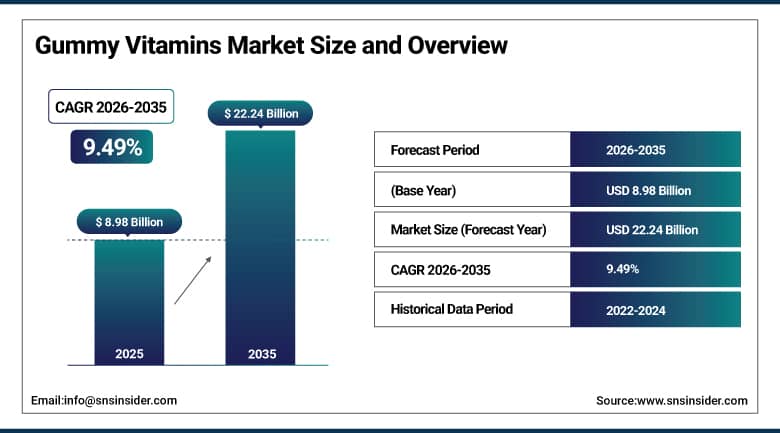
The Gummy Vitamins Market was valued at USD 8.98 Billion in 2025 and is projected at approximately USD 22.24 Billion by 2035 using an extension of SNS Insider’s published 2033 projection of USD 18.55 Billion. The 2035 figure is extrapolated, not an independently published forecast.
The gummy vitamins market covers chewable nutritional supplements sold as gelatin or plant-based gummies containing one or more vitamins, and selected adjacent formulations commonly classified with this category by industry studies. Demand spans family households, adults seeking easier routines, and consumers comparing convenient formats with tablets or capsules. Purchase decisions are shaped by taste, nutrient composition, sugar content, price, brand familiarity and confidence in labeling. The supply chain combines vitamin premixes, gelling systems, flavors, sweeteners, manufacturing capacity and retail relationships.
⮞In July 2026, Bayer announced a reformulated One A Day Women’s Multi Gummy with 1,000 mcg of biotin per serving, showing how established suppliers continue to reposition gummy products for specific consumer needs.
To Get More Information On Gummy Vitamins Market - Request Free Sample Report
Gummy Vitamins Market Trends:
-
Brands are segmenting products by age and specific nutrient needs, rather than relying solely on general multivitamin formulas.
-
Pectin-based vegetarian gummies are gaining attention as brands improve texture and heat stability.
-
Sugar content, added sweeteners and dosing accuracy are increasingly important product-development and labeling considerations.
-
Retail shelves and e-commerce subscriptions support product discovery, but clear claims and transparent ingredients influence repeat sales.
-
Product developers are exploring probiotics and other functional ingredients, which creates definitional overlap with the broader gummy-supplement market.
U.S. Gummy Vitamins Market Outlook:
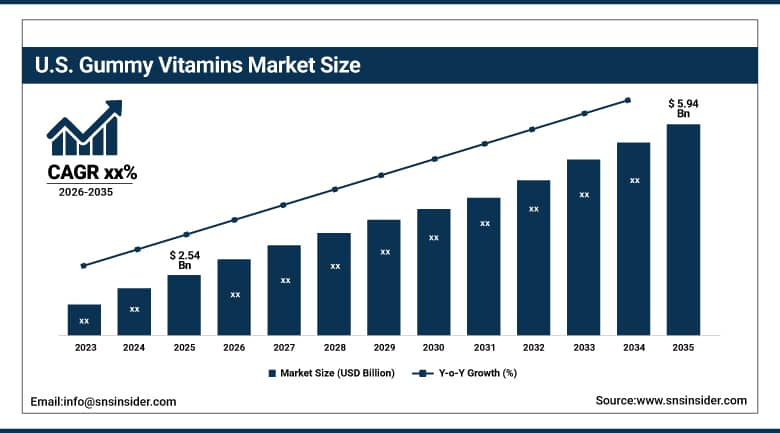
The U.S. Gummy Vitamins Market was estimated at USD 2.54 Billion in 2025 and forecast by SNS Insider to reach USD 5.01 Billion by 2033. Its equivalent 2035 endpoint is approximately USD 5.94 Billion if the implied historical-to-forecast rate continues, an extrapolation rather than a published 2035 estimate.
The United States has an established gummy vitamin retail ecosystem encompassing mass merchants, pharmacies, grocery chains and digital storefronts. Brands compete through multivitamins, specialized age groups, benefit led products, flavor preferences and recognizable packaging. Shoppers also increasingly inspect sugar, ingredient sources and recommended serving amounts, particularly when purchasing supplements for children. Product claims must comply with dietary supplement regulation rather than imply unapproved disease treatment. Retail access can drive discovery, but subscriptions and repeat purchasing depend on perceived quality and ease of use.
⮞In July 2025, Bayer introduced a One A Day Kids Multi with Iron Gummies product in the U.S., illustrating investment in formulations that address nutrient combinations and child-friendly delivery.
Gummy Vitamins Market Segment Analysis:
-
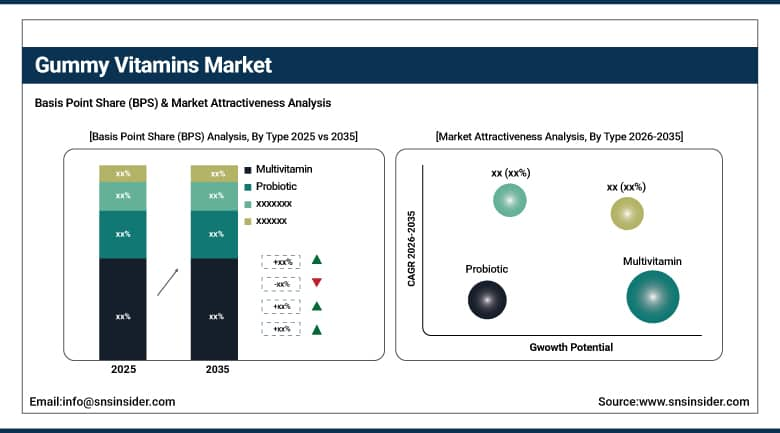
By Type, Multivitamin led the market with 45.32% share in 2025; Probiotic was identified as fastest-growing at a source-reported 12.35% CAGR for 2026–2033.
-
By Source, Animal-Based held 61.28% share in 2025; Plant-Based was identified as fastest-growing at 13.12% CAGR for 2026–2033.
-
By Age Group, Children held 52.61% share in 2025; Adults were identified as fastest-growing at 11.47% CAGR for 2026–2033.
-
By Function, Immunity led with 47.56% share in 2025; Digestive Health was identified as fastest-growing at 12.91% CAGR for 2026–2033.
By Type, Multivitamins Lead While Probiotic Gummies Expand
Multivitamins lead because a single serving format can supply several widely recognized nutrients and fits routine daily supplementation habits. Familiar formulas support broad pharmacy and supermarket distribution, while brand extensions target children, adults and specific life stages. However, one product cannot automatically meet every nutritional need, and shoppers should compare amounts against the recommended serving instructions. Manufacturers face technical challenges balancing vitamin stability, palatability and appropriate serving size. Credible product positioning depends on clear ingredient declarations, established quality controls and realistic claims.
Probiotic gummies are growing within the category because consumers associate digestive wellness with daily supplement habits. Their production is technically demanding: live cultures may respond to moisture, heat, oxygen and storage conditions differently from conventional vitamin ingredients. Manufacturers must therefore validate viable organisms at the claimed point in shelf life rather than only at blending. Some products in this segment are broader gummy supplements, and analysts should avoid treating every probiotic gummy as a vitamin product without checking the market definition. Consistent quality and clear consumer guidance support sustainable demand across diverse retail settings and many changing consumer preferences throughout.
⮞Bayer announced in July 2026 that its updated One A Day Women’s Multi Gummy contains biotin alongside vitamins A, C and E and zinc; this is an example of differentiated multivitamin positioning.
By Source, Animal-Based Formulations Lead While Plant-Based Alternatives are Fastest-Growing
Animal based gummies dominate source classification largely because gelatin remains a familiar gelling material, providing recognizable chew, elasticity and processing properties. Established manufacturing lines and ingredient sourcing make these products practical for high volume vitamin brands. Gelatin can still create dietary or cultural restrictions for some shoppers, prompting manufacturers to consider alternative formulations. The animal versus plant source split refers primarily to the gummy matrix, not necessarily the vitamin molecules themselves. This distinction matters when reviewing market shares and labeling.
Plant based gummies offer an expanding choice for buyers seeking gelatin free or vegan compatible supplements. Pectin and starch based systems can meet some of these needs, although their texture, processing temperature and moisture behavior differ from gelatin. Product developers must balance stability, taste, nutrient load and acceptable serving sizes before scale up. Plant based claims also require attention to flavor carriers, coatings and other minor ingredients, not just the main gelling agent. Demand spans established wellness brands and private label manufacturers.
⮞The FDA’s current dietary supplement guidance covers gummy products but does not preapprove most supplement claims. Manufacturers remain responsible for truthful labels and product quality.
By Age Group, Children Lead While Adult-Focused Products Expand
Children represent the largest identified age segment in the underlying study, reflecting the long-standing use of chewable products for families seeking convenient supplement routines. Parents often prioritize familiar flavors and easy administration, but attractive appearance also raises the importance of storage away from young children. Nutrient amounts must be appropriate to the intended age group and clearly displayed on labels. Product development requires attention to sweetness, texture and safe serving guidance rather than treating gummies as ordinary candy.
Adult gummies have broadened the category beyond products historically associated with children. Formulations increasingly address life stage needs and everyday nutritional routines, including options marketed toward women, men and older consumers. Adults may choose gummies because they dislike swallowing pills, but dosage capacity can constrain how many nutrients fit into a practical serving. Suppliers must balance formulation complexity against cost, taste and stability. Clear benefits, measured nutrient amounts and appropriate product claims are more sustainable differentiators than trend led language alone.
⮞Bayer launched One A Day Kids Multi with Iron Gummies in July 2025, reflecting continued development of child-oriented vitamin combinations.
By Function, Immunity Leads While Digestive Health Gains Traction
Immunity positioned gummies lead the reported function segmentation because vitamins such as C and D are familiar to shoppers and frequently associated with everyday immune support. That positioning does not establish that a particular product prevents infection, and marketing language must respect applicable rules on dietary supplement claims. Retail shelf communication often emphasizes recognizable ingredients, serving convenience and clear usage instructions. Producers can differentiate through dosage accuracy, ingredient transparency and carefully supported labeling.
Digestive health gummies are expanding as supplement brands add probiotics and related ingredients to everyday wellness ranges. The category deserves careful definition because some digestive gummies contain no vitamins and belong in broader supplement markets. Technical requirements also differ by ingredient, particularly where probiotic viability or moisture sensitive components are involved. Consumers may prefer familiar gummy formats, yet effective formulation relies on ingredient stability and accurate labeling rather than taste alone. Manufacturers should document shelf life, quality testing and intended use.
⮞The FDA distinguishes structure/function claims such as supporting normal body functions from claims to treat or prevent disease; gummy marketers must follow the applicable requirements.
Regional Analysis:
|
Region |
Major Country |
Share within Region, 2025 (%) |
|---|---|---|
|
North America |
United States |
73.53 |
|
Europe |
Germany |
Not independently verified |
|
Asia Pacific |
China |
Not independently verified |
|
Middle East and Africa |
UAE |
Not independently verified |
|
Latin America |
Brazil |
Not independently verified |
North America Gummy Vitamins Market Insights
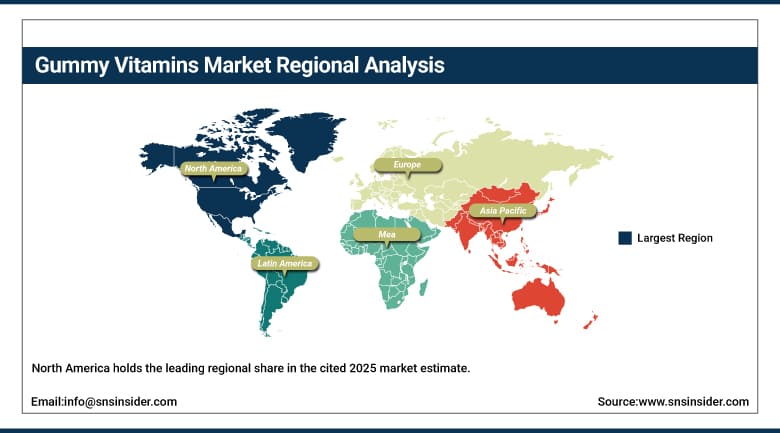
North America holds the leading regional share in the cited 2025 market estimate. The United States anchors demand through a mature dietary supplement sector, widespread pharmacy distribution, large mass retailers and extensive online shopping. Canada contributes additional retail and e commerce opportunities, though labeling and health product requirements differ from the United States. The regional market includes established brands and private label alternatives competing across price, ingredient sourcing and nutrient combinations. Consumers may be drawn by taste and convenience, but brands need transparent nutritional information and appropriate supplement claims.
North American suppliers increasingly compete on formulation credibility as well as brand recognition. Product developers must control texture, nutrient potency, heat exposure and stability across distribution conditions. E commerce makes specialized products easy to discover but exposes brands to rapid comparison of ingredients and prices. Childrens gummies require particularly careful directions and safe storage communication because their candy like appearance can encourage accidental overconsumption. Large manufacturers benefit from shelf access and purchasing scale, while smaller brands can address targeted dietary preferences.
⮞Bayer’s July 2026 One A Day Women’s Multi Gummy announcement identified Walmart retail distribution, reflecting the importance of large physical and digital channels in the U.S.
Get Customized Report as Per Your Business Requirement - Enquiry Now
Europe Gummy Vitamins Market Insights:
Europe presents an established but heterogeneous market in which national consumer preferences and regulatory requirements shape gummy vitamin adoption. Supermarkets, pharmacies and online platforms provide routes to shoppers seeking convenient supplement formats. Demand includes family multivitamins and specialized formulations, while plant-based ingredient systems can appeal to consumers avoiding gelatin. Producers selling across borders must account for differences in permitted ingredients, local language labeling and the treatment of health claims. Premium positioning can reward traceability and quality assurance, but price and formulation complexity remain commercial constraints.
European brands are exploring gelatin alternatives and cleaner ingredient declarations while balancing taste, appearance and product shelf life. Pectin based systems require manufacturing adjustments and may create costs beyond a simple raw material substitution. Country specific labeling and product notification practices complicate cross border sales, particularly for smaller businesses without specialist regulatory resources. E commerce improves consumer reach but does not remove the need for locally compliant claims and packaging. Manufacturers should evaluate product specifications against the target market before launch.
⮞The European market requires attention to local dietary supplement and nutrition-claim rules; EU-authorized health claims cannot be substituted with broad unsupported disease claims.
Asia Pacific Gummy Vitamins Market Insights
Asia Pacific offers an important growth opportunity as consumers encounter wider ranges of ready to consume supplements in pharmacies, modern retail and online marketplaces. Japan, China, India, South Korea and Australia differ substantially in purchasing power, dietary preferences and supplement regulations, making a uniform regional strategy risky. Manufacturers can adapt formats and serving sizes to local consumer expectations, while plant-based formulations may address dietary preferences in selected markets. The region also has packaging, ingredient and contract manufacturing capabilities supporting product development.
Digital commerce and expanding retail distribution support discovery of gummy supplements across Asia Pacific, particularly where modern wellness brands target younger adult shoppers. However, national rules on ingredient permissibility, labeling and nutritional claims differ, creating real barriers to a single regional launch. Buyers may compare gummies with traditional tablets, powders and local nutritional products on price and convenience. Manufacturers need technical support for shelf stability in hot or humid climates and must account for variable logistics conditions.
⮞Haleon stated in its 2025 annual results that Centrum Daily Kits expanded across Asia Pacific; this reflects broader demand for age-targeted vitamin formats, although kits are not necessarily gummies.
MEA & Latin America Gummy Vitamins Market Insights
The Middle East and Africa represent an emerging distribution opportunity for gummy vitamin brands, with demand concentrated in higher income urban markets and selected pharmacy networks. Halal considerations and gelatin origin can be especially relevant to product selection in Gulf countries, prompting interest in documented sourcing and plant-based alternatives. Regulatory requirements and importer procedures vary widely by market and should not be treated as uniform. Supply chains must also manage high ambient temperatures that may affect gummy texture and stability.
Latin America offers developing demand for gummy vitamins through pharmacies, supermarkets and expanding digital retail platforms. Brazil and Mexico provide sizeable consumer markets, while other countries differ considerably in import rules and purchasing behavior. Brands may market convenient daily nutrition, but inflation and household spending constraints can make price points critical. Importers should evaluate vitamin concentrations, permitted claims and packaging in each target country before committing to distribution. Regional temperature and humidity conditions can create additional manufacturing and transport considerations.
⮞FDA guidance and local country rules differ, making export-compliant label design and ingredient registration important considerations for suppliers seeking cross-border distribution.
Market Dynamics:
Growth Drivers: Convenient Formats and Targeted Nutrient Positioning Support Demand
A central driver of gummy vitamin demand is the desire for nutritional supplements that fit comfortably into everyday habits. Some consumers find conventional pills inconvenient, while gummies offer familiar textures and flavors without additional preparation. Manufacturers have extended the format from basic multivitamins to specific life stages and nutrient combinations, helping retailers reach multiple shopper groups. Product convenience alone does not confirm better health outcomes, and consumers still need appropriate dietary advice. Commercial strength therefore rests on well-designed formulations, clear serving instructions, ingredient integrity and accessible distribution.
Targeted formulation is another growth driver, particularly as established brands introduce products for age groups, gender specific needs and differentiated nutritional objectives. The addition of vitamins, minerals and selected functional ingredients creates more shelf variety, but it also demands stronger analytical quality controls. Gummy products have physical limits on dosage and ingredient compatibility, so manufacturers must avoid overpromising nutrient density compared with tablets. Retailers increasingly require products that combine distinctive positioning with competitive pricing and consistent supply.
⮞In July 2026, Bayer’s One A Day Women’s Multi Gummy reformulation highlighted higher biotin content and everyday hair, skin and nail nutritional support claims.
Restraints: Sugar, Stability and Dosing Requirements Raise Formulation Complexity
Gummy manufacturing creates technical restraints not found to the same degree in conventional tablet and capsule production. Moisture content, heat exposure, pH and ingredient interactions can affect texture and vitamin stability during processing and storage. High nutrient loads may alter taste or limit feasible serving sizes, requiring reformulation and additional quality testing. Sugar content and alternative sweeteners can influence consumer acceptance and product economics. Manufacturers also face competing demands for desirable chew and extended shelf life.
Consumer safety and labeling requirements create additional hurdles, especially for products marketed to families. Brightly colored gummies can resemble confectionery, so brands must communicate age-appropriate servings and safe storage rather than encouraging indiscriminate consumption. Products should not be presented as treatments for disease when marketed as dietary supplements. Formulations with multiple nutrients need careful attention to cumulative intake if consumers already use other supplements or fortified foods. Regulatory compliance, raw material verification and accurate Supplement Facts labeling require ongoing resources.
⮞FDA guidance requires a Supplement Facts panel and other mandatory information for dietary supplement products, including applicable gummy formats.
Opportunities: Pectin Innovation and Adult Nutrition Open New Product Niches
Plant based formulation technology creates an opening for manufacturers that can replace gelatin while maintaining appealing chew and predictable stability. Pectin based systems can address vegan or dietary preferences, but they require different processing conditions and careful optimization of flavor, acidity and moisture. Brands that establish reliable quality standards can serve mainstream retail alongside specialty nutrition channels. Development should consider every ingredient in the finished product before claiming plant-based suitability. Consistent quality and clear consumer guidance support sustainable demand across diverse retail settings and many changing consumer preferences throughout the global supplement market over the coming years as brands.
Adult wellness ranges offer a second opportunity as consumers look for convenient multivitamins and selected nutritional combinations. Products designed for specific life stages can improve shelf organization and marketing relevance, while direct to consumer channels enable targeted distribution. However, the market is competitive and advertising claims must remain evidence based. Producers should select meaningful nutritional differences rather than multiplying nearly identical stock keeping units. Quality testing, clear labeling and practical serving sizes can support trust. Consistent quality and clear consumer guidance support sustainable demand across diverse retail settings and many changing consumer preferences throughout the global supplement market over the.
⮞In July 2025, One A Day introduced Kids Multi with Iron Gummies, showing that formulation and nutrient-delivery innovation can support distinct consumer use cases.
Recent Developments:
-
In July 2026, Bayer updated its One A Day Women’s Multi Gummy formulation to deliver 1,000 mcg of biotin per two-gummy serving.
-
In July 2025, Bayer introduced One A Day Kids Multi with Iron Gummies for children.
Gummy Vitamins Market Key Players:
-
Bayer AG (One A Day)
-
Church & Dwight Co., Inc. (vitafusion)
-
Unilever PLC (OLLY)
-
Pharmavite LLC (Nature Made)
-
Haleon plc (Centrum)
-
SmartyPants Vitamins
-
Goli Nutrition Inc.
-
Nature’s Way Brands, LLC (Alive!)
-
Nestlé Health Science (Garden of Life)
-
MaryRuth Organics
-
Jamieson Wellness Inc.
-
Herbaland Naturals Inc.
-
NOW Foods
-
Hero Nutritionals
-
Vitabiotics Ltd. (Wellkid)
-
Swisse Wellness
-
Blackmores Limited
-
Nature's Bounty
-
Lifeable
-
Rainbow Light
Gummy Vitamins Market Report Scope:
| Report Attributes | Details |
|---|---|
| Market Size in 2025 | USD 8.98 Billion |
| Market Size by 2035 | USD 22.24 Billion |
| CAGR | At a CAGR of 9.49% by 2035 |
| Base Year | 2025 |
| Forecast Period | 2026-2035 |
| Historical Data | 2022-2024 |
| Report Scope & Coverage | Market Size, Segments Analysis, Competitive Landscape, Regional Analysis, DROC & SWOT Analysis, Forecast Outlook |
| Key Segments | By Type: Dominant – Multivitamin (45.32% share in 2025); Fastest-Growing – Probiotic (CAGR 12.35%, 2026–2033) By Source: Dominant – Animal-Based (61.28% share in 2025); Fastest-Growing – Plant-Based (CAGR 13.12%, 2026–2033) By Age Group: Dominant – Children (52.61% share in 2025); Fastest-Growing – Adults (CAGR 11.47%, 2026–2033) By Function: Dominant – Immunity (47.56% share in 2025); Fastest-Growing – Digestive Health (CAGR 12.91%, 2026–2033) |
| Regional Analysis/Coverage | North America (US, Canada), Europe (Germany, UK, France, Italy, Spain, Russia, Poland, Rest of Europe), Asia Pacific (China, India, Japan, South Korea, Australia, ASEAN Countries, Rest of Asia Pacific), Middle East & Africa (UAE, Saudi Arabia, Qatar, South Africa, Rest of Middle East & Africa), Latin America (Brazil, Argentina, Mexico, Colombia, Rest of Latin America). |
| Company Profiles | Bayer AG (One A Day), Church & Dwight Co., Inc. (vitafusion), Unilever PLC (OLLY), Pharmavite LLC (Nature Made), Haleon plc (Centrum), SmartyPants Vitamins, Goli Nutrition Inc., Nature’s Way Brands, LLC (Alive!), Nestlé Health Science (Garden of Life), MaryRuth Organics, Jamieson Wellness Inc., Herbaland Naturals Inc., NOW Foods, Hero Nutritionals, Vitabiotics Ltd. (Wellkid), Swisse Wellness, Blackmores Limited, Nature's Bounty, Lifeable, Rainbow Light. |

Frequently Asked Questions
Key players include Bayer (One A Day), Church & Dwight (vitafusion), Unilever (OLLY), Pharmavite (Nature Made), Haleon (Centrum), SmartyPants, Goli Nutrition and specialist gummy brands.
Multivitamin dominated with a 45.32% share in 2025, while Probiotic is projected to grow at the fastest CAGR of 12.35%.
Opportunities include plant-based gel systems, age-specific supplements, improved shelf-life stability, reliable quality testing and expanded pharmacy and digital retail distribution.
North America accounted for 38.47% of the 2025 market in the cited report. Asia Pacific is a prospective growth region, but its precise 2026–2035 CAGR is not independently established.
Multivitamin products led the Type segmentation with 45.32% share in 2025 according to the source. Probiotic gummies were identified as the fastest-growing type for 2026–2033.
