
Feed Flavors and Sweeteners Market Report Scope & Overview:
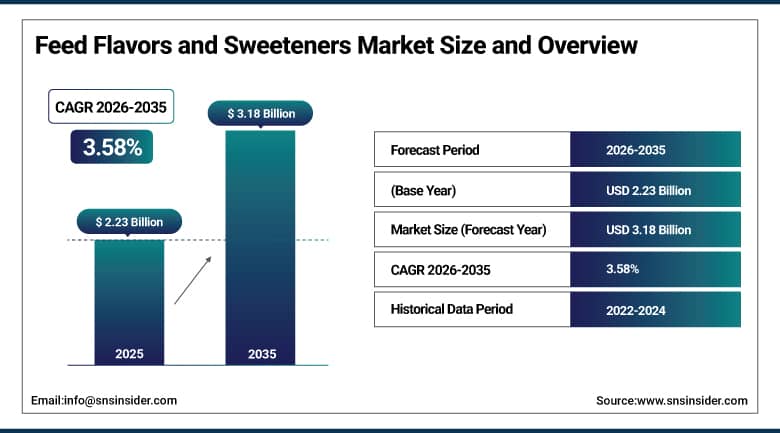
The Feed Flavors and Sweeteners Market was valued at USD 2.23 Billion in 2025 and is expected to reach USD 3.18 Billion by 2035, growing at a CAGR of 3.58% from 2026 to 2035.
Feed flavor and sweetener market is experiencing constant growth because of the evident trend toward the use of natural ingredients and technological innovations aimed at providing precise animal nutrition around the world. Flavors and sweeteners are functional feed additives that are used for improving palatability, feed intake and consistency of the diet for livestock, pets and fish farming, such as flavoring agents, sweetening agents, and systems designed for masking bitterness of minerals, amino acids, drugs, fermented products, and alternative proteins. Moreover, the development of the industry is driven by the worldwide prohibition of antibiotic growth promoters, which made palatability enhancers become performance safeguards without any residue constraints, usage of high-performance compound feeds and waste reduction during feeding programs.
More than 420 million tons of feed are produced annually across commercial mills, with 34% incorporating flavoring agents and 29% using sweetening additives, as these ingredients play a critical role improving feed intake and conversion efficiency across more than 2.3 billion farm animals worldwide.
To Get More Information On Feed Flavors and Sweeteners Market - Request Free Sample Report
Feed Flavors and Sweeteners Market Trends
- Rising adoption of natural and high-intensity sweeteners is improving feed palatability while supporting clean-label preferences.
- Growing consolidation of livestock farms is increasing demand for palatability-enhancing additives that improve feed acceptance and efficiency.
- Increasing use of alternative proteins is driving demand for taste-modulation systems that mask undesirable feed flavors.
- Expanding young-animal nutrition applications are creating premium opportunities for specialized palatability solutions.
- Strategic partnerships are supporting development of diverse, application-specific feed flavor and sweetener solutions.
The U.S. Feed Flavors and Sweeteners Market Outlook
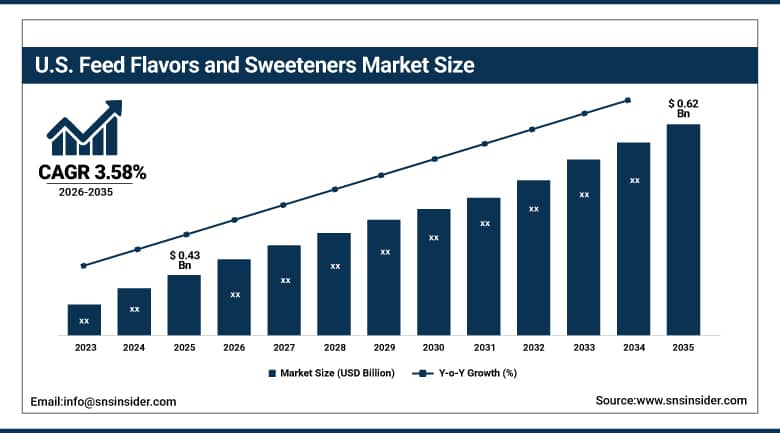
The U.S. feed flavors and sweeteners market was valued at USD 0.43 Billion in 2025 and is projected to reach USD 0.62 Billion by 2035, growing at a CAGR of 3.58% during 2026–2035.
The top compound feed producers in the country are increasing the usage of flavors and sweeteners because of the high demand for palatability enhancers which ensure constant feed intake among the country's domestic livestock. Global bans on the use of antibiotics as performance enhancers have led to the adoption of flavors and sweeteners, alongside the rising trend of precision nutrition in animals, driving the constant demand for feed flavors and sweeteners in the country.
The sucralose-based sweetener range called “Sucram” was mentioned by ADM in May 2024. Among other brands included in this category there are “Sucram Specifeek” and “Sucram M’I Sweet” designed to provide flavor modification according to specific animal species. Such modification was based on the studies of swine’s taste receptor cells to enhance food intake especially during weaning.
Feed Flavors and Sweeteners Market Segment Analysis
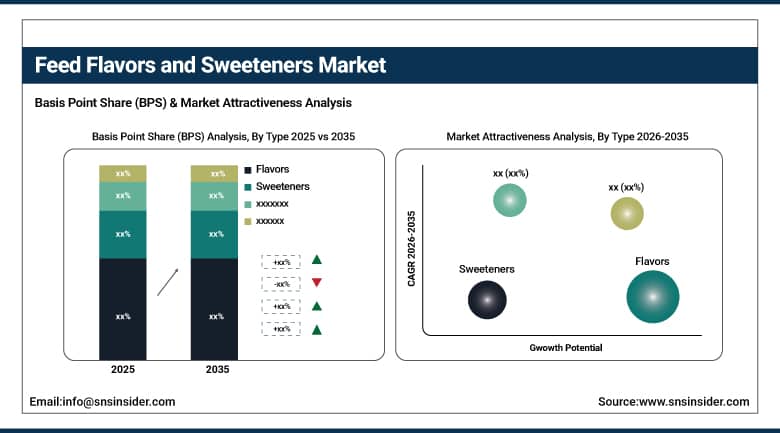
- By Type, flavors dominated the feed flavors and sweeteners market with a 50.00% share in 2025, while sweeteners is the fastest-growing type segment with a CAGR of 6.20% from 2026–2035.
- By Livestock, poultry dominated the feed flavors and sweeteners market with a 35.00% share in 2025, while swine is the fastest-growing livestock segment with a CAGR of 6.40% from 2026–2035.
- By Category, synthetic/conventional dominated the feed flavors and sweeteners market with a 58.60% share in 2025, while natural is the fastest-growing category segment with a CAGR of 7.40% from 2026–2035.
- By Form, powder dominated the feed flavors and sweeteners market with a 56.80% share in 2025, while liquid/micro-encapsulated is the fastest-growing form segment with a CAGR of 7.20% from 2026–2035.
By Type, flavors dominated the feed flavors and sweeteners market, while sweeteners is the fastest-growing segment.
Feed flavors grabbed a 50% market share, reflecting their broad use across routine livestock feed formulations. Feed flavors remain the dominant type category owing to their ability to mask off-flavors from alternative feed ingredients, including minerals, amino acids, medications, fermented ingredients, and alternative proteins, making them the foundational additive category incorporated across the majority of compound feed manufacturing worldwide.
The sweeteners segment is expected to register the fastest CAGR of 6.20% during the forecast period 2026-2035. These sweeteners enhance feed intake without contributing any extra calories, which is consistent with the clean-label approach gaining popularity in the livestock sector, and this is the factor that is fueling the growth in the use of sweeteners like saccharin and stevia extracts.
By Livestock, poultry dominated the feed flavors and sweeteners market, while swine is the fastest-growing segment.
Poultry grabbed 35% of the market, representing the largest single livestock category as producers prioritize feed efficiency across increasingly intensive, high-throughput poultry production operations. Poultry remains the dominant livestock segment owing to the scale of global poultry farming and the critical role palatability enhancers play supporting consistent growth performance across large commercial flocks worldwide.
The swine segment is expected to register the fastest CAGR of 6.40% during the forecast period 2026-2035. The demand for animal health improvement and performance through increased feed consumption is on the rise, leading to significant growth in the swine sector owing to increased investments in feed palatability to ensure constant feed consumption in swine farming systems.
By Category, synthetic/conventional dominated the feed flavors and sweeteners market, while natural is the fastest-growing segment.
The synthetic/conventional segment dominated the feed flavors and sweeteners market owing to its broader cost accessibility and established, large-scale production infrastructure, making it the more commonly used category across the majority of mainstream compound feed manufacturing applications worldwide.
The natural segment is expected to register the fastest CAGR of 7.40% during the forecast period 2026-2035. One particular trend that has been observed in the industry involves the increasing use of natural ingredients in the development of products. This is due to the increasing demand for flavors and sweeteners that are made using natural sources.
By Form, powder dominated the feed flavors and sweeteners market, while liquid/micro-encapsulated is the fastest-growing segment.
Powder forms continue to be favored because of ease of handling, being the leading form type among most compound feed production processes. Powder forms allow easy incorporation into existing feed mixing and production process systems, thereby ensuring consistency in dosage and compatibility with bulk feed production process systems.
The liquid/micro-encapsulated form type is projected to witness the highest CAGR of 7.20% during the forecast period 2026-2035. Forms such as liquid and micro-encapsulated are growing in popularity for use in certain specific applications due to the need for greater stability and compatibility among others.
Regional Analysis
|
Region |
Major Country |
Share within Region, 2025 (%) |
|---|---|---|
|
North America |
United States |
65.50% |
|
Europe |
Germany |
27.60% |
|
Asia Pacific |
China |
44.60% |
|
Middle East & Africa |
UAE |
25.60% |
|
Latin America |
Brazil |
37.70% |
North America Feed Flavors and Sweeteners Market Insights
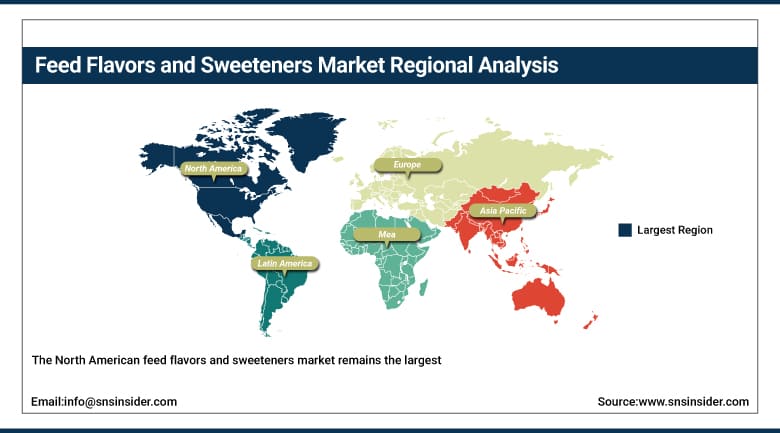
The North American feed flavors and sweeteners market remains the largest, supported by extensive compound feed production and intensive poultry, swine, and cattle farming. Rising emphasis on feed efficiency, consistent intake, and animal performance is increasing adoption of palatability-enhancing solutions. Growing use of alternative protein sources and functional feed ingredients is further creating demand for flavor-masking technologies. In addition, advanced animal nutrition practices and established ingredient supply chains continue to support regional market expansion.
The US generated a share of 65.5% of the revenues from North America feed flavoring and sweetening during 2025 owing to high presence of capacity for producing compound feeds and growing consumption of palatability enhancers. In North America, Mexico will be seen to grow at the highest rate of 4.6% CAGR until 2035, on account of growing animal husbandry and feed production investments.
Get Customized Report as Per Your Business Requirement - Enquiry Now
Europe Feed Flavors and Sweeteners Market Insights
The Europe feed flavors and sweeteners market is witnessing steady growth, supported by stringent regulations restricting antibiotic growth promoters and encouraging alternative feed additives. The region’s well-established compound feed industry and advanced livestock production systems continue to drive demand for palatability-enhancing solutions. Growing preference for natural, traceable, and clean-label animal nutrition ingredients is further encouraging manufacturers to adopt natural flavors, sweeteners, and taste-modulation technologies across poultry, swine, and ruminant feed applications.
Germany is one of the major markets in Europe owing to its strong compound feed manufacturing base and growing consumer demand for natural feed additive solutions. Other countries such as France and the Netherlands are also contributing to market growth through expanding livestock production and rising natural ingredient adoption across their domestic feed manufacturing sectors.
Asia Pacific Feed Flavors and Sweeteners Market Insights
Asia Pacific is expected to register the fastest growth in the global feed flavors and sweeteners market during the forecast period, supported by expanding livestock and poultry production, rising commercial feed adoption, and increasing investments in modern feed manufacturing. Growing focus on animal performance, feed intake, and cost-efficient nutrition is encouraging greater use of palatability enhancers across China, India, Japan, Southeast Asia, and other emerging markets.
China is one of the main growth drivers in the Asia Pacific feed flavors and sweeteners market, owing to its massive livestock farming industry and rapidly expanding domestic compound feed manufacturing capacity. India and Southeast Asian nations are also contributing to regional growth through expanding poultry and swine production and rising demand for feed efficiency solutions.
Middle East & Africa and Latin America Feed Flavors and Sweeteners Market Insights
Middle East & Africa and Latin America flavors and sweeteners feeds market is experiencing growth, backed by the growth in the livestock population, technological advancements in the feed industry, and investment made in commercial animal nutrition. The growing importance of feed palatability, intake, and productivity is contributing towards the use of flavors and sweeteners in the poultry, swine, cattle, and other livestock segments. The rising need for economically feasible and high-performing feeds is likely to boost regional market growth.
Brazil is set to be a prominent Latin American market fueled by its substantial livestock production industry and growing domestic compound feed manufacturing capacity. The Middle East & Africa region has UAE and Saudi Arabia investing in modern livestock production infrastructure that is gradually increasing demand for palatability-enhancing feed additives across their expanding agricultural sectors.
Market Dynamics
Growth Drivers: Rising precision animal nutrition and antibiotic ban compliance driving market growth
The global shift toward precision animal nutrition, higher-performance compound feed, and reduced waste in feeding programs is among the primary drivers of the feed flavors and sweeteners market. Global bans on antibiotic growth promoters continue to elevate palatability enhancers as performance safeguards that face no residue limits, driving sustained demand across livestock, companion animal, and aquaculture feed formulation applications worldwide.
The consolidation of livestock farming operations continues to increase demand for palatability-enhancing additives, as feed flavors and sweeteners play a critical role improving feed intake and conversion efficiency across increasingly intensive commercial livestock production. The rising need to maintain animal health and improve performance through enhanced feed intake, growing demand for taste-modulation systems masking off-flavors from alternative proteins, and increasing focus on young animal transition diet applications are further supporting demand across the forecast period.
Restraints: Raw material cost volatility and regulatory complexity limiting market expansion
One of the main barriers to market growth is fluctuating raw material costs affecting both natural and synthetic flavor and sweetener production, which continues to introduce pricing uncertainty for feed additive manufacturers negotiating supply arrangements with compound feed producers.
Additionally, varying regulatory requirements governing feed additive approval and labeling across different international markets continue to complicate product development and market entry for manufacturers seeking to serve multiple global livestock production regions. The technical complexity of formulating effective taste-masking solutions for increasingly diverse feed ingredient combinations, including alternative proteins and fermented inputs, further requires substantial ongoing research and development investment.
Opportunities: Expansion of natural ingredient formulations and young animal diets creating new growth avenues
Young animal transition diets create premium growth pockets, representing a significant growth opportunity as producers increasingly invest in specialized palatability solutions supporting early-life feed acceptance and consistent growth performance during critical developmental periods.
There is a considerable growth opportunity in the continued development of natural and high-intensity sweeteners aligned with growing clean-label consumer and regulatory preferences. The expansion of livestock farming consolidation and precision animal nutrition adoption in emerging markets across Asia Pacific and Latin America is likely to unlock substantial new demand throughout the forecast period.
Recent Developments:
- 2025: Symrise AG expanded its natural feed flavor production capacity, strengthening its ability to supply growing livestock producer demand for clean-label palatability enhancer solutions.
- 2025: Alltech launched an updated natural sweetener blend designed for young animal transition diets, offering producers a specialized solution supporting early-life feed acceptance and growth performance.
- 2026: Adisseo France expanded its feed palatability enhancer product portfolio, strengthening its position supplying diverse flavor and sweetener solutions to compound feed manufacturers globally.
- 2026: Kemin Industries launched a new flavor masking solution designed for alternative protein-based feed formulations, targeting manufacturers seeking to improve palatability of increasingly diverse feed ingredient combinations.
Feed Flavors and Sweeteners Market key players are:
- Symrise AG
- dsm-firmenich AG
- Alltech, Inc.
- Archer Daniels Midland Company (ADM Animal Nutrition)
- Lucta S.A.
- Solvay S.A.
- Adisseo France SAS
- Arvesta (Palital Feed Additives B.V.)
- Kemin Industries, Inc.
- Novus International, Inc.
- Pancosma SA
- Nutreco N.V.
- Cargill, Incorporated
- Kerry Group plc
- Biomin Holding GmbH
- Nuscience Group
- Anpario plc
- Delacon Biotechnik GmbH
- Vetagro S.p.A.
- Trouw Nutrition
Feed Flavors and Sweeteners Market Report Scope :
| Report Attributes | Details |
|---|---|
| Market Size in 2025 | USD 2.23 Billion |
| Market Size by 2035 | USD 3.18 Billion |
| CAGR | CAGR of 3.58% From 2026 to 2035 |
| Base Year | 2025 |
| Forecast Period | 2026-2035 |
| Historical Data | 2022-2024 |
| Report Scope & Coverage | Market Size, Segments Analysis, Competitive Landscape, Regional Analysis, DROC & SWOT Analysis, Forecast Outlook |
| Key Segments | • By Type (Flavors, Sweeteners) • By Livestock (Poultry, Swine, Ruminants, Others) • By Category (Synthetic/Conventional, Natural) • By Form (Powder, Liquid/Micro-Encapsulated) |
| Regional Analysis/Coverage | North America (US, Canada), Europe (Germany, UK, France, Italy, Spain, Russia, Poland, Rest of Europe), Asia Pacific (China, India, Japan, South Korea, Australia, ASEAN Countries, Rest of Asia Pacific), Middle East & Africa (UAE, Saudi Arabia, Qatar, South Africa, Rest of Middle East & Africa), Latin America (Brazil, Argentina, Mexico, Colombia, Rest of Latin America). |
| Company Profiles | Symrise AG, dsm-firmenich AG, Alltech, Inc., Archer Daniels Midland Company (ADM Animal Nutrition), Lucta S.A., Solvay S.A., Adisseo France SAS, Arvesta (Palital Feed Additives B.V.), Kemin Industries, Inc., Novus International, Inc., Pancosma SA, Nutreco N.V., Cargill, Incorporated, Kerry Group plc, Biomin Holding GmbH, Nuscience Group, Anpario plc, Delacon Biotechnik GmbH, Vetagro S.p.A., Trouw Nutrition. |
Frequently Asked Questions
The Feed Flavors and Sweeteners Market is expected to grow at a CAGR of 3.58% from 2026 to 2035.
The Feed Flavors and Sweeteners Market was valued at USD 2.237 Billion in 2025.
The market is driven by a notable shift towards natural ingredients and technological advancements supporting global precision animal nutrition.
The Flavors segment dominated the Feed Flavors and Sweeteners Market, accounting for approximately 50% market share.
The North America region dominated the Feed Flavors and Sweeteners Market in 2025, driven by strong demand for palatability enhancers.
