
Healthcare Bioconvergence Market Report Scope and Overview:
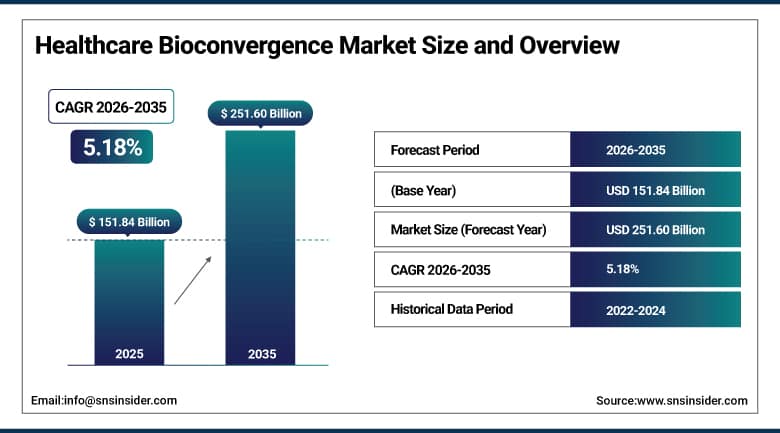
The Healthcare Bioconvergence Market was valued at USD 151.84 Billion in 2025 and is projected to reach USD 251.60 Billion by 2035, registering a CAGR of 5.18% from 2026 to 2035. The market continues expanding steadily.
The Healthcare Bioconvergence Market is steadily reshaping how new therapies, diagnostics and medical devices are discovered and built by merging biology with engineering, artificial intelligence, nanotechnology, materials science and advanced computing. The market is characterized by rapid growth in AI-driven drug discovery partnerships, expanding use of 3D bioprinting and organ-on-chip models in regenerative medicine and preclinical research, and rising investment in bioelectronic medicine, biosensors and autonomous laboratory infrastructure. Significant growth is being witnessed in nanorobotic drug delivery and precision medicine applications, considering that pharmaceutical companies, biotech firms, research institutions and governments continue investing in multidisciplinary platforms that speed discovery and improve patient outcomes.
Insilico Medicine and SK Biopharmaceuticals entered an AI-powered drug discovery collaboration in June 2026 valued at up to USD 2.5 billion to develop novel therapies for neuroimmune disorders, combining generative AI drug design with clinical development expertise and reflecting the industry's broader shift toward AI-enabled bioconvergence in drug discovery.
To Get More Information On Healthcare Bioconvergence Market - Request Free Sample Report
Healthcare Bioconvergence Market Trends:
-
Rising AI-driven drug discovery partnerships continue linking generative models with biopharma pipelines.
-
Growing use of autonomous, AI-enabled cloud labs continues automating biological experimentation at scale.
-
Expanding 3D bioprinting and organ-on-chip models continue improving preclinical testing and tissue engineering.
-
Increasing development of bioelectronic medicine continues creating device-based alternatives to drug therapies.
-
Rising integration of multi-omics and AI continues advancing precision medicine and biomarker discovery.
U.S. Healthcare Bioconvergence Market Outlook:
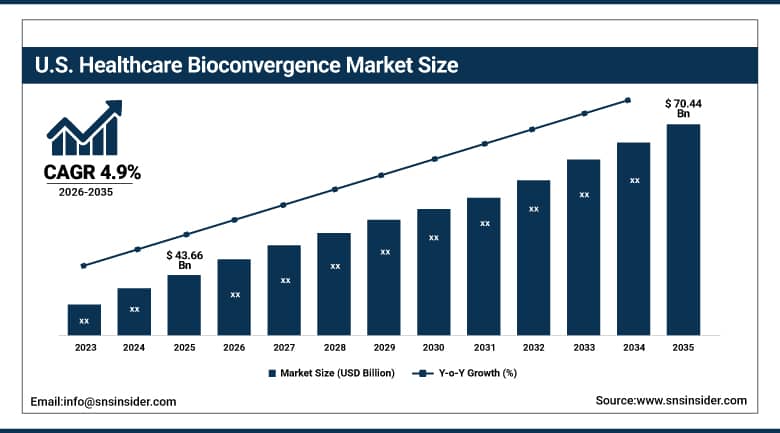
The U.S. Healthcare Bioconvergence Market was valued at approximately USD 43.66 Billion in 2025 and is projected to reach approximately USD 70.44 Billion by 2035, registering a CAGR of approximately 4.9% from 2026 to 2035.
Demand across the United States continued to be shaped by the country's world-leading biopharmaceutical R&D spending, deep venture capital ecosystem for biotech and AI start-ups, and strong federal funding for life sciences through the NIH, NSF and ARPA-H. Rising investment in AI-driven drug discovery, synthetic biology, bioelectronic devices and regenerative medicine continued reinforcing the country's position as the largest national market. Growing collaboration between technology companies, pharmaceutical firms and academic research centres added further layers of sustained domestic demand, with stakeholders increasingly prioritizing autonomous lab infrastructure and integrated data platforms.
Ginkgo Bioworks reported in August 2026 that Caltech, Northwestern and the University of Maryland had commissioned autonomous labs to be built by the company under the National Science Foundation's roughly USD 400 million investment in a national network of AI-enabled cloud labs, highlighting growing federal support for bioconvergence infrastructure in American research.
Healthcare Bioconvergence Market Segment Analysis:
-
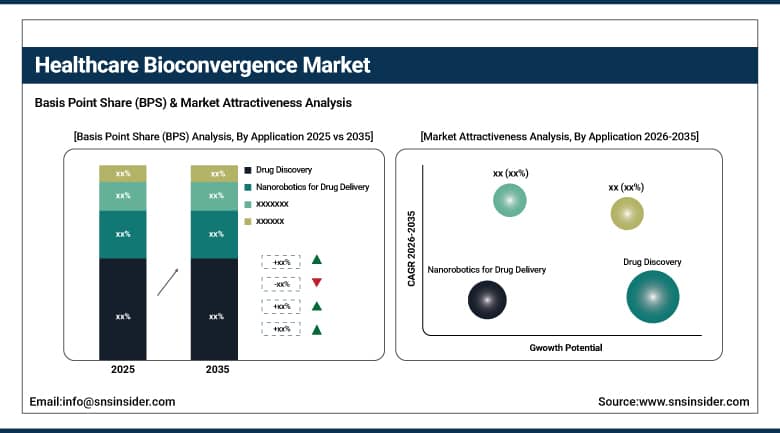
By Application, Drug Discovery segment dominated the Healthcare Bioconvergence Market in 2025 with 21% share; Nanorobotics for Drug Delivery segment is the fastest growing segment with a CAGR of approximately 8.6%.
By Application: Drug Discovery Leads, Nanorobotics for Drug Delivery Grows Fastest
The Drug Discovery segment dominated the Healthcare Bioconvergence Market in 2025, driven by heavy pharmaceutical and biotech investment in AI-enabled target identification, generative molecular design, high-throughput screening, organ-on-chip models and computational biology. Rising disease burden, including cancer, neurological and immune disorders, together with approaching patent expirations, continues pushing drug developers to adopt bioconvergence tools that shorten discovery timelines and improve success rates. Large multi-billion-dollar collaborations between AI drug discovery firms and pharmaceutical companies reinforced this segment's position as the largest contributor to total market revenue throughout the base year.
The Nanorobotics for Drug Delivery segment is the fastest growing in the Healthcare Bioconvergence Market owing to advances in nanoscale engineering, smart nanoparticles and targeted delivery systems that can release drugs precisely at disease sites. These technologies promise higher therapeutic efficacy with fewer side effects, particularly in oncology and hard-to-reach tissues. Growing integration of nanorobotics with AI, imaging and genomics is accelerating this segment's growth trajectory as research moves toward clinical translation. Rising funding for precision drug delivery platforms further supports demand.
Regenerative Medicine, Diagnostic & Biological Sensors, Bioelectronics, Engineered Living Materials, Optogenetics and Precision Medicine together form a substantial and fast-evolving share of the market. Regenerative medicine benefits from 3D bioprinting, stem cell technologies and new bioinks, while biosensors and wearable diagnostics enable continuous monitoring and early disease detection. Bioelectronic medicine, including neuromodulation devices and brain-computer interfaces, is expanding treatment options for inflammatory and neurological conditions, and precision medicine continues growing as multi-omics and AI decision support enter clinical practice.
Regional Analysis:
|
Region |
Major Country |
Share within Region, 2025 (%) |
|---|---|---|
|
North America |
United States |
88.20% |
|
Europe |
Germany |
24.10% |
|
Asia Pacific |
China |
38.90% |
|
Middle East and Africa |
Israel |
34.60% |
|
Latin America |
Brazil |
42.30% |
North America Healthcare Bioconvergence Market Insights
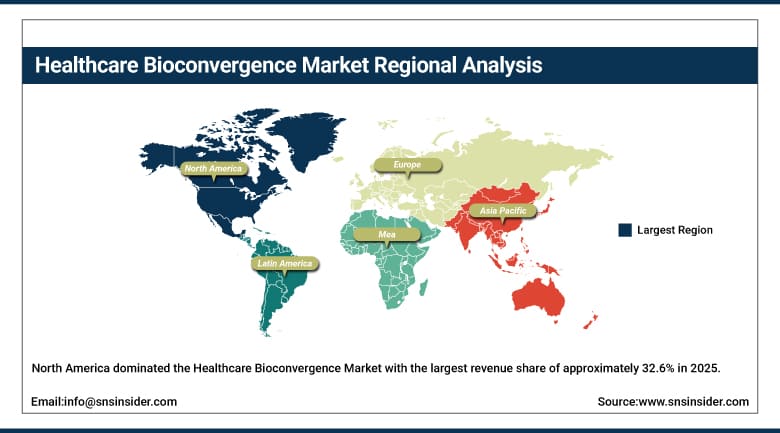
North America dominated the Healthcare Bioconvergence Market with the largest revenue share of approximately 32.6% in 2025. World-leading biopharmaceutical R&D spending, a dense ecosystem of biotech, AI and medtech companies, strong venture funding and substantial federal research programmes continued reinforcing this dominant regional position. Major innovation hubs in Boston, the San Francisco Bay Area and San Diego concentrate talent across biology, engineering and computer science. Growing investment in autonomous labs and AI drug discovery further reinforced this region's leadership position.
The United States accounted for the substantial majority of regional revenue, anchored by its large pharmaceutical industry, leading research universities and federal agencies supporting bioconvergence. Canada added further demand through its AI research institutes and growing life sciences sector, and that combined strength kept the region the largest addressable market for healthcare bioconvergence through the forecast period. Continued partnerships between technology and pharmaceutical companies reinforced sustained demand.
Get Customized Report as Per Your Business Requirement - Enquiry Now
Europe Healthcare Bioconvergence Market Insights
Europe held a meaningful share of global revenue, supported by leading research institutes, strong public research funding through Horizon Europe and national programmes, and established pharmaceutical and medtech industries. European countries are active in regenerative medicine, 3D cell culture, synthetic biology and bioelectronic medicine research. Regulatory frameworks such as the EU AI Act and Medical Device Regulation continued shaping how convergent technologies are developed and approved. Growing academic-industry collaboration further reinforced regional demand.
Germany continued to lead demand at roughly 24.10% of European revenue, supported by strong biotech innovation, advanced engineering and robust research investment. The UK, France and Switzerland contributed substantial additional demand through leading life sciences clusters and government support for innovation, and continued European investment in precision medicine should keep regional demand for bioconvergence solutions climbing through the forecast period. Additional demand from the Netherlands, Denmark and Sweden reinforced broader regional market strength.
Asia Pacific Healthcare Bioconvergence Market Insights
Asia Pacific is advancing at the fastest pace, growing at a CAGR of approximately 6.4% from 2026 to 2035. This growth is driven by rapidly rising biotech and pharmaceutical R&D in China, Japan, South Korea, Singapore and India, strong government support for AI and life sciences, and the rising prevalence of chronic diseases, with new research parks, biomanufacturing facilities and AI drug discovery companies continuing to broaden the region's addressable base well beyond its traditional smaller footprint. Growing cross-border partnerships with Western pharma further support adoption.
China held a substantial share of regional revenue, supported by large investments in AI, synthetic biology and biomanufacturing. Japan and South Korea contributed meaningful additional demand, with Japan's regenerative medicine leadership and South Korea's growing biopharma companies engaging in AI drug discovery partnerships both reinforcing the region's position as the fastest-growing market tracked in this report. Singapore, India and Australia contributed smaller but steadily growing regional demand throughout the period.
MEA and Latin America Healthcare Bioconvergence Market Insights
The Middle East and Africa and Latin America both showed steady growth, driven by rising investment in life sciences, digital health and research infrastructure across both areas. As these regions build biotech ecosystems, bioconvergence technologies offer opportunities to leapfrog into advanced diagnostics, precision medicine and AI-enabled research. International research collaborations further support adoption in leading centres.
Israel led Middle East and Africa demand, supported by its strong biotech, medtech and AI start-up ecosystem, while Saudi Arabia and the UAE invest heavily in genomics and biotechnology under national transformation programmes. In Latin America, Brazil accounted for the largest share of regional revenue, with its growing biotech sector and research institutions continuing to anchor regional demand, while Mexico and Argentina contributed additional demand through expanding life sciences research.
Market Dynamics:
Growth Drivers: Rising Biopharmaceutical R&D Investment and AI Integration
The industry is driven by increasing biopharmaceutical R&D investment, the growing integration of artificial intelligence, machine learning and computational biology into research workflows, and the rising prevalence of complex chronic diseases that require new therapeutic approaches. As pharmaceutical and biotech companies seek to improve R&D productivity and accelerate clinical development, demand for convergent platforms spanning AI drug discovery, synthetic biology, biosensors and regenerative medicine continues rising worldwide. Government funding for advanced research infrastructure further reinforces this sustained industry-wide demand driver.
Rising technical capability across bioconvergence technologies continues reinforcing this driver, as generative AI, autonomous labs, 3D bioprinting, nanotechnology and bioelectronics mature and become easier to deploy. Growing collaboration among technology, pharmaceutical and academic organizations continues accelerating translation from research to clinic, and that combination of investment and innovation keeps demand rising at a steady, sustained pace. Expanding data-sharing and cloud computing capacity are further widening the addressable user base.
Restraints: Complex Regulatory Requirements and High Development Costs
Complex and evolving regulatory and compliance requirements continue posing a restraint on faster market-wide expansion, as bioconvergence solutions often combine biologics, devices, software and AI under multiple regulatory frameworks. Requirements covering safety, efficacy, clinical validation, data privacy and cybersecurity can extend approval timelines and increase costs. Uncertainty around regulation of AI-enabled and combination products adds further complexity.
High development costs and long timelines for translating multidisciplinary research into commercial products continue posing a further restraint. A shortage of talent with combined expertise in biology, engineering and data science limits the pace of innovation. Data interoperability and intellectual property challenges continue complicating collaborations in several regions.
Opportunities: 3D Bioprinting in Tissue Engineering and Autonomous Research Infrastructure
The growing application of 3D bioprinting in tissue and organ engineering represents a significant opportunity, as advanced bioinks and printing platforms support complex tissue models for drug testing and regenerative therapies. Vendors positioned early in bioprinting, organ-on-chip and engineered living materials stand to capture meaningful share as these technologies move toward clinical use. Growing regulatory interest in non-animal testing methods continues widening this addressable opportunity.
Rising investment in autonomous, AI-enabled laboratories and integrated data platforms offers a second substantial opportunity, as governments and companies seek to run experiments continuously and feed results directly into AI models. Providers with scalable automation, software and data capabilities stand to capture meaningful share as research infrastructure modernizes. Continued growth of AI drug discovery partnerships across North America, Europe and Asia is further accelerating adoption.
Recent Developments:
-
September 2026: Ginkgo Bioworks was awarded a subcontract of up to USD 17.5 million under ARPA-H's Genetic Medicines and Individualized Manufacturing for Everyone (GIVE) program to provide automation hardware, systems integration and control software for an autonomous manufacturing system for individualized RNA medicines.
-
February 2026: CollPlant Biotechnologies launched BioFlex, a ready-to-print recombinant human collagen-based bioink kit for Digital Light Processing 3D bioprinting, designed to accelerate development of advanced tissue models, drug discovery and regenerative medicine research.
Healthcare Bioconvergence Market key players are:
-
Ginkgo Bioworks
-
BICO - The Bio Convergence Company
-
BiomX
-
Singota Solutions
-
Anima Biotech Inc.
-
SetPoint Medical
-
Galvani Bioelectronics
-
Insilico Medicine
-
Recursion Pharmaceuticals
-
Isomorphic Labs
-
CollPlant Biotechnologies
-
Emulate, Inc.
-
Twist Bioscience
-
Illumina, Inc.
-
Medtronic plc
-
Neuralink
Healthcare Bioconvergence Market Report Scope:
| Report Attributes | Details |
|---|---|
| Market Size in 2025 | USD 151.84 Billion |
| Market Size by 2035 | USD 251.60 Billion |
| CAGR | CAGR of 5.18% From 2026 to 2035 |
| Base Year | 2025 |
| Forecast Period | 2026-2035 |
| Historical Data | 2022-2024 |
| Report Scope & Coverage | Market Size, Segments Analysis, Competitive Landscape, Regional Analysis, DROC & SWOT Analysis, Forecast Outlook |
| Key Segments | • By Application (Drug Discovery, Nanorobotics for Drug Delivery, Regenerative Medicine, Diagnostic & Biological Sensors, Bioelectronics, Engineered Living Materials, Optogenetics, Precision Medicine) |
| Regional Analysis/Coverage | North America (US, Canada), Europe (Germany, UK, France, Italy, Spain, Russia, Poland, Rest of Europe), Asia Pacific (China, India, Japan, South Korea, Australia, ASEAN Countries, Rest of Asia Pacific), Middle East & Africa (UAE, Saudi Arabia, Qatar, South Africa, Rest of Middle East & Africa), Latin America (Brazil, Argentina, Mexico, Colombia, Rest of Latin America). |
| Company Profiles | Ginkgo Bioworks, BICO - The Bio Convergence Company, BiomX, Singota Solutions, Anima Biotech Inc., SetPoint Medical, Galvani Bioelectronics, Insilico Medicine, Recursion Pharmaceuticals, Isomorphic Labs, CollPlant Biotechnologies, Emulate, Inc., Twist Bioscience, Illumina, Inc., Medtronic plc, Neuralink |
Frequently Asked Questions
Key players include Ginkgo Bioworks, BICO, BiomX, Anima Biotech, SetPoint Medical, Galvani Bioelectronics, Insilico Medicine, and Recursion Pharmaceuticals.
Key opportunities include 3D bioprinting for tissue and organ engineering, autonomous AI-enabled laboratories, bioelectronic medicine, and AI-driven precision medicine.
The market is driven by rising biopharmaceutical R&D investment, AI and computational biology integration, chronic disease burden, and government funding for advanced research.
The Drug Discovery segment dominated the Healthcare Bioconvergence Market, accounting for approximately 21% market share.
The North America region dominated the Healthcare Bioconvergence Market in 2025 with approximately 32.6% share, driven by leading R&D spending, a dense biotech and AI ecosystem, and strong federal research funding.
