
Helideck monitoring systems Market Report Scope & Overview:
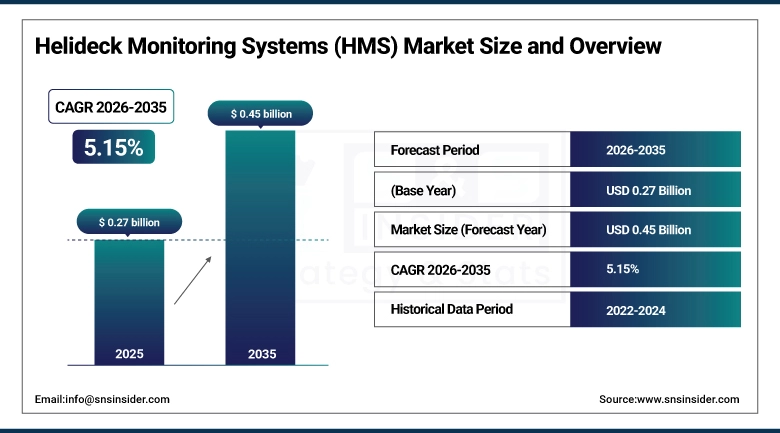
The Helideck Monitoring Systems (HMS) Market was valued at USD 0.27 Billion in 2025 and is projected to reach around USD 0.45 Billion by 2035, growing at a CAGR of 5.15 from 2026–2035.
The Helideck Monitoring Systems (HMS) Market is witnessing steady and strategic growth driven by the expansion of offshore oil & gas exploration, rising investments in offshore wind energy infrastructure, and increasing emphasis on aviation safety in marine environments. The growing need for real-time monitoring of helideck conditions such as wind speed, vessel motion, weather variability, and landing surface stability is significantly boosting the adoption of advanced HMS platforms
Recent developments highlight a strong shift toward digitalized and intelligent helideck monitoring ecosystems, with companies integrating AI-based predictive weather analytics, IoT-enabled sensor networks, and cloud-connected offshore safety platforms.
Additionally, recent industry trends include the integration of HMS with autonomous offshore vessel operations and remote helideck management systems, enabling reduced human intervention in hazardous environments. Investments in offshore wind expansion across Europe and Asia are creating new deployment opportunities beyond traditional oil & gas platforms.
To Get more information on Helideck Monitoring Systems (HMS) Market - Request Free Sample Report
Helideck monitoring systems Market Trends
-
Rising offshore oil & gas and deepwater projects are driving demand for advanced helideck monitoring systems to ensure safe helicopter operations.
-
Expanding offshore wind farms and floating energy platforms are accelerating adoption of real-time helideck safety monitoring solutions.
-
Integration of AI, IoT sensors, and cloud-based platforms is enhancing predictive monitoring and operational accuracy in offshore environments.
-
Strict aviation safety regulations (e.g., CAP 437) are mandating wider deployment of certified helideck monitoring systems globally.
-
Increasing digitalization of offshore operations is improving remote monitoring, landing safety, and decision-making efficiency.
-
Growing adoption of hybrid and portable HMS solutions is enabling flexible deployment across dynamic offshore installations.
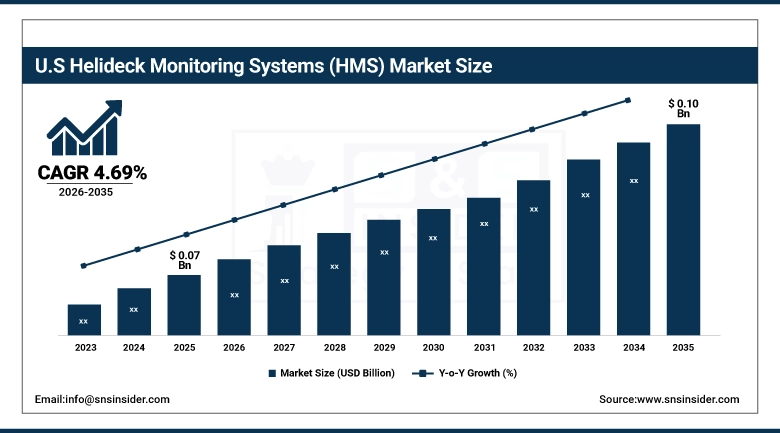
The U.S. Helideck Monitoring Systems (HMS) Market was valued at USD 0.07 Billion in 2025 and is expected to reach around USD 0.10 Billion by 2035, growing at a CAGR of 4.69% from 2026–2035.
The U.S. emerges as the largest regional market for Helideck Monitoring Systems owing to its robust offshore oil & gas operations in the Gulf of Mexico, significant involvement of defense and naval aircraft operations, and wide adoption of state-of-the-art offshore safety technologies. The market is bolstered by consistent upgrades to offshore platforms, rising use of helicopters for deep-sea explorations, and stringent aviation safety standards that require real-time monitoring systems for helidecks on offshore installations.
Recent developments include Kongsberg Maritime and Miros Group upgrading their U.S. offshore monitoring installations with AI-enabled motion prediction and real-time landing advisory systems to improve offshore helicopter safety.
Additionally, integration of advanced HMS solutions in Gulf of Mexico offshore wind pilot projects and next-generation FPSO deployments is strengthening demand for digital, cloud-connected helideck safety platforms across U.S. offshore operations.
Helideck monitoring systems Market Segment Highlights
-
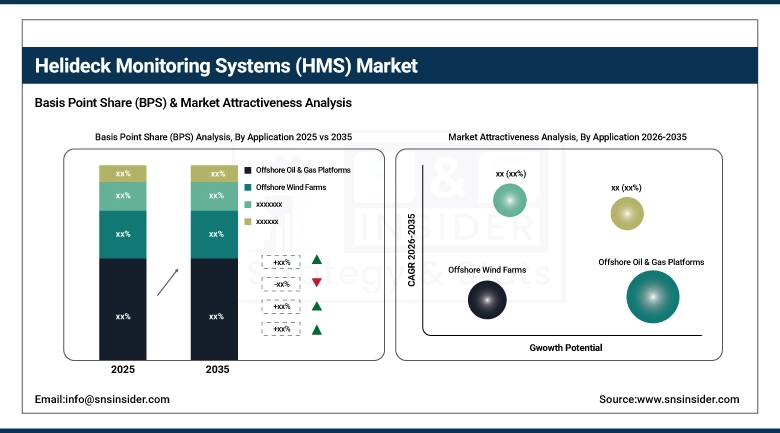
By Application, Offshore Oil & Gas Platforms dominated the Helideck Monitoring Systems (HMS) Market with 52.16% share in 2025; Offshore Wind Farms fastest growing CAGR.
-
By System Type, Fixed Helideck Monitoring Systems dominated the HMS Market with 65.15% share in 2025; Hybrid / Integrated Digital HMS fastest growing CAGR.
-
By Component, Sensors (Wind, Weather, Motion, Tilt Sensors) dominated the HMS Market with 38.27% share in 2025; Software & Analytics Platforms fastest growing CAGR.
-
By End User, Oil & Gas Operators dominated the HMS Market with 50.04% share in 2025; Offshore Wind Energy Developers fastest growing CAGR.
By Application, Offshore Oil & Gas Platforms segment dominates the Helideck Monitoring Systems (HMS) Market, Offshore Wind Farms expected to grow fastest
In 2025, the Offshore Oil & Gas Platforms segment maintained its dominant position in the Helideck Monitoring Systems (HMS) Market, accounting for 52.16% of total revenue. This leadership is primarily driven by extensive offshore drilling activities, high dependency on helicopter-based crew transport, and strict safety requirements for landing operations on rigs and FPSOs.
From 2026 to 2035, the Offshore Wind Farms segment is projected to record the highest CAGR. This rapid growth is driven by accelerating offshore renewable energy investments, expansion of large-scale wind farm installations in Europe and Asia-Pacific, and increasing requirement for safe personnel transfer operations to offshore turbines.
By System Type, Fixed Helideck Monitoring Systems segment dominates the HMS Market, Hybrid / Integrated Digital HMS expected to grow fastest
The Fixed Helideck Monitoring Systems segment held the largest share of 65.15% in 2025, due to its widespread deployment across permanent offshore oil rigs, FPSO units, and naval vessels. These systems are preferred for their high reliability, continuous monitoring capability, and compliance with international offshore aviation safety standards such as CAP 437.
The Hybrid / Integrated Digital HMS segment is expected to register the highest CAGR during the 2026–2035 forecast period. Growth is driven by increasing digitalization of offshore operations, integration of AI-based predictive analytics, and rising demand for cloud-connected, real-time monitoring platforms.
By Component, Sensors (Wind, Weather, Motion, Tilt Sensors) segment dominates the Helideck Monitoring Systems (HMS) Market, Software & Analytics Platforms segment expected to grow fastest
In 2025, the Sensors (Wind, Weather, Motion, Tilt Sensors) segment maintained its dominant position in the Helideck Monitoring Systems (HMS) Market, accounting for 38.27% of total revenue. Such dominance is based on the necessity to have immediate access to information about the environment and the conditions in offshore operations from helidecks due to the fact that the wind speed, movement of the boat, and stability of the landing surface are the key criteria determining the safety of a helicopter. HMS systems include sensors, which constitute the most basic level of HMS installation.
From 2026 to 2035, the Software & Analytics Platforms segment is projected to record the highest CAGR.
By End User, Oil & Gas Operators segment dominates the Helideck Monitoring Systems (HMS) Market, Offshore Wind Energy Developers segment expected to grow fastest
The Oil & Gas Operators segment held the largest share of 50.04% in 2025, due to high levels of offshore drilling operations, high reliance on helicopters for personnel transfers, and rigorous offshore aircraft safety criteria. Oil and gas organizations have been at the forefront of the adoption of HMS technology due to their extensive infrastructure of offshore oil installations, FPSOs, and deep-sea exploration facilities that rely on helidecks for safety purposes.
The Offshore Wind Energy Developers segment is projected to achieve the highest growth rate during 2026–2035
Helideck monitoring systems Market Regional Analysis
|
Region |
Major Country |
Share within Region (%) |
|---|---|---|
|
North America |
United States |
31.45% |
|
Europe |
Germany |
28.24% |
|
Asia Pacific |
China |
23.09% |
|
Middle East & Africa |
UAE |
3.95% |
|
Latin America |
Brazil |
13.27% |
North America Helideck Monitoring Systems (HMS) Market Insights
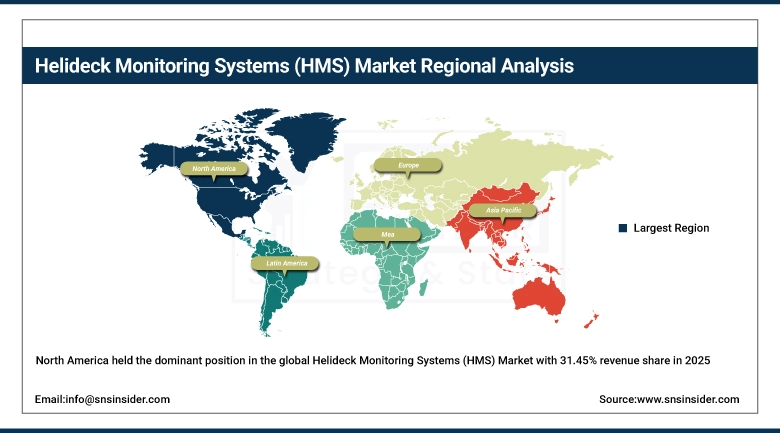
North America held the dominant position in the global Helideck Monitoring Systems (HMS) Market with 31.45% revenue share in 2025, due to extensive offshore oil and gas activities in the Gulf of Mexico, significant naval aviation operations, and early adoption of cutting-edge offshore safety surveillance technology. The area enjoys well-developed offshore facilities, extensive use of helicopters for crew transfers, and strict aviation safety regulations, which require the monitoring of helideck conditions in real time for all important offshore installations. The United States is the major contributor to the development of the market, with ongoing modernization of offshore drilling rigs and increased usage of digital safety equipment.
Additionally, integration of HMS technologies into Gulf of Mexico offshore wind pilot projects and next-generation FPSO developments is strengthening the shift toward digitally connected offshore safety ecosystems.
Furthermore, growing investments in offshore automation and remote monitoring capabilities are accelerating the deployment of cloud-based HMS platforms integrated with predictive weather analytics and centralized offshore command centers, enhancing decision-making efficiency and reducing operational risk in complex marine environments.
Get Customized Report as per Your Business Requirement - Enquiry Now
Asia Pacific Helideck Monitoring Systems (HMS) Market Insights
The Asia Pacific region is projected to register the highest CAGR of 6.06% from 2026–2035, Due to the quick development of offshore exploration of oil and natural gas resources in countries such as India, China, and South-East Asia, as well as the increased investments in wind energy in other countries, the demand for helicopter management systems has risen significantly in the region.
Supporting this growth, aviation and energy authorities such as India’s Directorate General of Civil Aviation (DGCA) and China’s offshore energy regulators are increasingly emphasizing offshore safety compliance and modernization of helideck infrastructure. This is encouraging the deployment of advanced monitoring systems integrated with real-time environmental sensing and automated landing safety verification tools.
Additionally, rapid expansion of offshore wind farms in China, South Korea, and Vietnam is creating new demand for scalable and cost-efficient HMS solutions, particularly hybrid and portable systems suited for dynamic offshore environments and large-scale renewable energy installations.
Europe Helideck Monitoring Systems (HMS) Market Insights
In 2025, Europe held a substantial market share within the global HMS industry due to its well-established offshore energy sector, abundant oil and gas production activities in the North Sea region, and the early introduction of innovative maritime safety systems. The UK, Norway, and the Netherlands are among the frontrunners in implementing complex helideck monitoring systems, especially in offshore drilling facilities and FPSO vessels.
Supporting this position, European offshore operators are increasingly integrating HMS with digital twin-based offshore asset management systems, enabling predictive safety analysis and real-time helideck performance optimization. Additionally, growing emphasis on offshore wind expansion in the North Sea is reinforcing demand for high-precision monitoring systems capable of supporting frequent personnel transfers and complex weather conditions.
Furthermore, sustainability-driven offshore modernization programs across Europe are encouraging the deployment of energy-efficient and fully automated helideck monitoring platforms, reducing operational risk while improving offshore aviation safety standards.
Latin America, Middle East & Africa (LAMEA) Helideck Monitoring Systems (HMS) Market Insights
The HMS market in LAMEA is expanding steadily due to increasing offshore oil exploration activities, rising investments in FPSO-based production systems, and gradual modernization of maritime aviation safety infrastructure. Key contributing countries include Brazil, Mexico, Saudi Arabia, UAE, and South Africa, where offshore helicopter operations are critical for energy sector logistics.
Supporting this growth, Middle Eastern aviation authorities and national oil companies are actively investing in offshore safety modernization programs, particularly across large-scale oil fields and deepwater exploration projects.
Additionally, increasing participation of global offshore service providers and defense modernization programs is accelerating the adoption of next-generation HMS technologies in emerging offshore hubs, particularly where complex offshore logistics and harsh environmental conditions demand high-reliability safety monitoring systems
Helideck monitoring systems Market Growth Drivers:
-
Rising offshore oil & gas exploration, deepwater drilling, and offshore wind expansion is driving strong demand for advanced Helideck Monitoring Systems (HMS) to ensure safe helicopter operations in harsh marine environments.
The primary driving force behind the HMS market is the growing dependence on helicopter-based offshore logistics, wherein tasks such as crew transportation, emergency evacuations, and supply delivery services are highly dependent upon real-time helideck monitoring with respect to various parameters like wind velocity, movement of the vessel, visibility, and deck stability, among others. As offshore activities venture further into the deep seas and rough terrains, the requirement for a highly reliable, advanced, and up-to-date safety monitoring system becomes increasingly essential.
Additionally, recent developments such as Kongsberg Maritime and Miros Group upgrading offshore helideck monitoring solutions with real-time motion compensation and AI-driven landing advisory systems are strengthening safety performance in extreme offshore conditions.
Similarly, increasing deployment of integrated HMS platforms in Gulf of Mexico offshore modernization projects and North Sea wind energy expansion initiatives is reinforcing the transition toward fully digital, predictive offshore aviation safety ecosystems.
Helideck monitoring systems Market Restraints:
-
Rising complexity of offshore safety regulations, harsh marine operating conditions, and high installation costs are limiting widespread adoption and increasing deployment challenges for Helideck Monitoring Systems (HMS)
The main limitation in the Helideck Monitoring Systems (HMS) Market can be seen due to the harsh operating conditions at offshore facilities that require these systems to perform effectively in harsh weather, high saline content, high winds, and continual structural movements. The installation of HMS is accompanied by stringent calibration of specialized equipment, adherence to the international standards of safety related to the aviation industry such as CAP 437, making HMS a complex and costly affair. Moreover, the requirement for specialized technical workforce for maintenance adds to the difficulty.
Helideck monitoring systems Market Opportunities:
-
Expansion of offshore renewables, autonomous maritime operations, and digital offshore infrastructure is creating strong opportunities for AI-enabled and remotely operated Helideck Monitoring Systems (HMS) globally.
One of the key advantages associated with the HMS market is the swift evolution of offshore activities towards digitally driven and remote-controlled environments, where the provision of real-time safety intelligence and predictive monitoring is essential to facilitate aviation operations. The increasing adoption of offshore wind turbines, floating production facilities, and deep-sea exploration structures has led to the emergence of high demand for state-of-the-art HMS systems that are equipped with AI-enabled weather prediction capabilities, autonomous sensors, and cloud-powered decision-making platforms. The development of such intelligent offshore facilities not only ensures safe and efficient helicopter operations but also provides ample room for expansion within the HMS market segment.
Recent Developments:
-
2026: Kongsberg Maritime enhanced its Helideck Monitoring Systems (HMS) portfolio with upgraded real-time motion reference and landing advisory capabilities, integrating AI-assisted weather and vessel motion prediction to improve offshore helicopter landing safety in extreme marine conditions.
-
2026: Miros Group advanced its offshore monitoring solutions by deploying next-generation helideck motion and environmental sensing systems with improved data fusion algorithms, enabling higher accuracy in landing decision support for offshore oil, gas, and wind installations.
-
2025: Fugro expanded its offshore asset monitoring services by integrating advanced helideck condition assessment modules into its remote operations platforms, supporting safer and more efficient helicopter logistics across deepwater offshore projects.
-
2025: Vaisala strengthened its marine weather intelligence solutions with enhanced offshore wind and helideck-specific forecasting systems, improving real-time visibility, wind shear detection, and operational decision-making for offshore aviation safety.
Helideck monitoring systems Market Key Players
Some of the Helideck monitoring systems Market Companies
-
Kongsberg Maritime
-
Miros Group
-
Fugro
-
Vaisala
-
ASB Systems
-
Observator Group
-
BMT (BMT Argoss)
-
Rutter Inc.
-
NORBIT
-
Nortek Group
-
Consilium Safety Group
-
Navtech Radar
-
HENSOLDT
-
Kelvin Hughes (HENSOLDT UK)
-
Thales Group
-
Saab AB
-
Leonardo S.p.A.
-
Honeywell Aerospace
-
Siemens AG
-
DNV (Det Norske Veritas)
Helideck monitoring systems Market Report Scope:
| Report Attributes | Details |
|---|---|
| Market Size in 2025 | USD 0.27 Billion |
| Market Size by 2035 | USD 0.45 Billion |
| CAGR | CAGR of 5.15% From 2026 to 2035 |
| Base Year | 2025 |
| Forecast Period | 2026-2035 |
| Historical Data | 2022-2024 |
| Report Scope & Coverage | Market Size, Segments Analysis, Competitive Landscape, Regional Analysis, DROC & SWOT Analysis, Forecast Outlook |
| Key Segments | • By Application (Offshore Oil & Gas Platforms, Offshore Wind Farms, Naval & Defense Vessels, FPSO & Floating Production Units, Search & Rescue / Emergency Operations) • By System Type (Fixed Helideck Monitoring Systems, Portable / Mobile Helideck Monitoring Systems, Hybrid / Integrated Digital HMS, Others) • By Component (Sensors [Wind, Weather, Motion, Tilt Sensors], Software & Analytics Platforms, Communication Systems, Radar & Surveillance Systems, Lighting & Visual Aid Systems) • By End User (Oil & Gas Operators, Offshore Wind Energy Developers, Defense & Naval Authorities, Helicopter Service Operators / Aviation Contractors) |
| Regional Analysis/Coverage | North America (US, Canada), Europe (Germany, UK, France, Italy, Spain, Russia, Poland, Rest of Europe), Asia Pacific (China, India, Japan, South Korea, Australia, ASEAN Countries, Rest of Asia Pacific), Middle East & Africa (UAE, Saudi Arabia, Qatar, South Africa, Rest of Middle East & Africa), Latin America (Brazil, Argentina, Mexico, Colombia, Rest of Latin America). |
| Company Profiles | Kongsberg Maritime, Miros Group, Fugro, Vaisala, ASB Systems, Observator Group, BMT (BMT Argoss), Rutter Inc., NORBIT, Nortek Group, Consilium Safety Group, Navtech Radar, Hensoldt, Kelvin Hughes (Hensoldt UK), Thales Group, Saab AB, Leonardo S.p.A., Honeywell Aerospace, Siemens AG, DNV |

Frequently Asked Questions
The Offshore Oil & Gas Platforms segment dominated the Helideck monitoring systems Market in 2025.
Morth America dominated the Helideck monitoring systems Market in 2025.
Rapid expansion of offshore oil & gas exploration, deepwater drilling projects, and offshore wind energy installations is the primary growth driver of the Helideck Monitoring Systems (HMS) Market.
The Helideck monitoring systems Market was valued at USD 0.27 billion in 2025.
The Helideck monitoring systems Market is expected to grow at a CAGR of 5.15% from 2026 to 2035.
