
High Voltage & Medium Voltage Motors Market Report Scope & Overview:
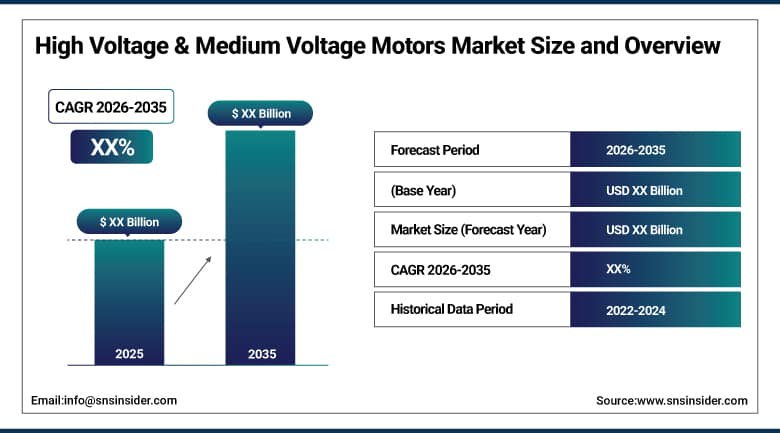
The High Voltage & Medium Voltage Motors Market was valued at USD XX Billion in 2025 and is expected to reach USD XX Billion by 2035, growing at a CAGR of XX% from 2026-2035.
The High Voltage & Medium Voltage Motors Market is experiencing growth due to rising industrial automation, expanding power generation capacity, and increasing investments in energy-efficient equipment. Industries such as oil and gas, mining, chemicals, cement, metals, and water treatment require reliable motors to operate heavy-duty machinery, pumps, compressors, and material-handling systems. Growing electricity demand and grid infrastructure modernization are further supporting motor installations across industrial facilities. Additionally, stricter energy-efficiency regulations are encouraging businesses to replace aging motors with advanced, high-efficiency models. The adoption of variable-speed drives is also increasing, enabling improved process control, reduced energy consumption, and lower operating costs.
⮞According to the International Energy Agency (IEA), global electricity demand is projected to grow by an average of 3.6% annually during 2026–2030, driven by industrial activity, electric vehicles, cooling, and data centers. This rising demand is expected to support investments in industrial electrical equipment, including high- and medium-voltage motors.
⮞Additionally, ABB reports that industrial electric motors account for approximately 45% of global electricity consumption, highlighting the importance of energy-efficient motor technologies. The adoption of efficient motors and drives can potentially reduce electricity consumption by up to 10%, encouraging industries to upgrade aging equipment and improve operational efficiency.
To Get More Information On High Voltage & Medium Voltage Motors Market - Request Free Sample Report
High Voltage & Medium Voltage Motors Market Trends:
-
Rising demand for energy-efficient motors across power generation, mining, oil and gas, and heavy manufacturing industries.
-
Growing adoption of variable frequency drives improves motor speed control, process automation, and operational efficiency.
-
Increasing infrastructure investments drive deployment of reliable high-voltage and medium-voltage motors for heavy-duty industrial applications.
-
Expanding integration of smart sensors and predictive maintenance technologies reduces downtime and extends motor service life.
-
Continuous advancements in insulation, cooling, and motor design improve reliability and energy efficiency.
U.S. High Voltage & Medium Voltage Motors Market Outlook:
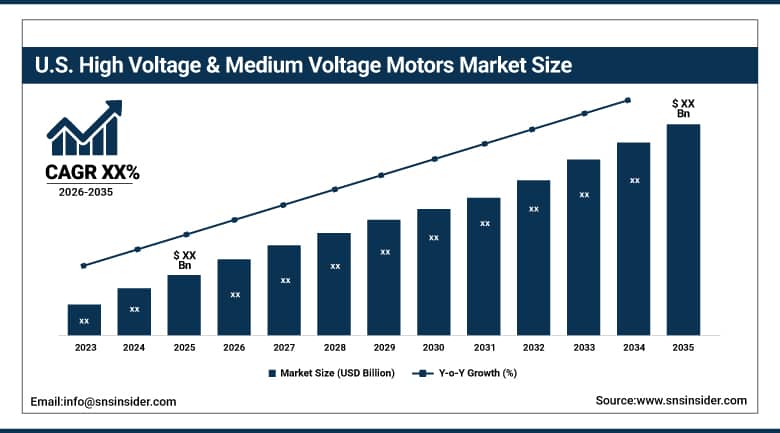
The U.S. High Voltage & Medium Voltage Motors Market was valued at USD XX Billion in 2025 and is expected to reach USD XX Billion by 2035, growing at a CAGR of XX% from 2026-2035.
The U.S. High Voltage & Medium Voltage Motors Market is growing due to increasing investments in industrial modernization, energy infrastructure, and energy-efficient manufacturing equipment. Demand from oil and gas, chemicals, mining, water treatment, and power generation industries is supporting motor installations for pumps, compressors, fans, and heavy-duty machinery. The replacement of aging industrial equipment with high-efficiency motors is further strengthening market demand. Additionally, expanding data center infrastructure is increasing requirements for reliable cooling systems and auxiliary equipment. Growing adoption of variable-speed drives, predictive maintenance technologies, and automated industrial processes is also supporting market expansion throughout the forecast period.
⮞According to the International Energy Agency (IEA), U.S. electricity demand is projected to increase by nearly 2% annually during 2026–2030, driven partly by industrial expansion and data-center development.
High Voltage & Medium Voltage Motors Market Segment Analysis:
By Motor Type
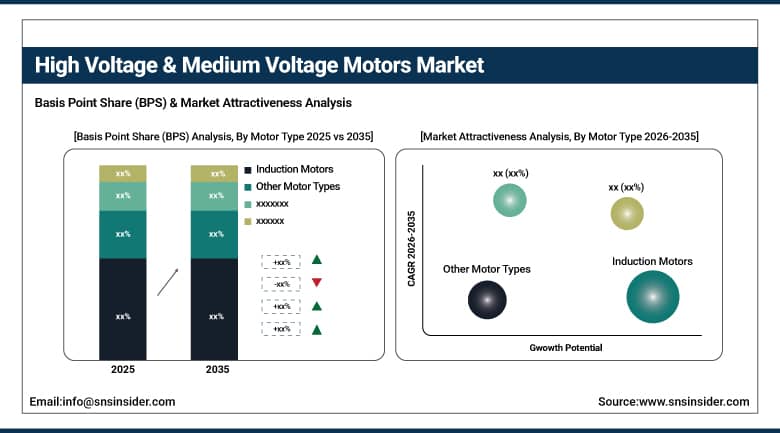
Induction motors represent a key segment of the High Voltage & Medium Voltage Motors Market because of their widespread use in industrial pumping, oil and gas transportation, mining, chemical processing, and heavy manufacturing. Their rugged construction, operational reliability, and suitability for continuous-duty applications make them an important choice for industrial facilities. In April 2025, WEG announced the supply of 20 medium-voltage induction motors rated up to 7 MW for a major oil pipeline project in the UAE, alongside 14 medium-voltage drives. This project demonstrates demand for high-power induction motors in critical pumping infrastructure.
Energy efficiency is increasingly influencing induction motor adoption as industries seek to reduce electricity consumption and operating costs. In March 2024, ABB reported that its Baldor-Reliance SP4 induction motors reduce motor losses by an average of 20% compared with standard induction motors. ABB also indicated that more than 80% of industrial electric motors operate direct-on-line. These findings highlight opportunities to improve industrial energy efficiency through advanced motor technologies and equipment upgrades, although the SP4 statistic specifically relates to low-voltage motors.
By Power Rating
The Above 1–5 MW segment plays an important role in the High Voltage & Medium Voltage Motors Market because these motors support energy-intensive applications, including pumps, compressors, fans, mining equipment, and industrial processing machinery. Industries increasingly require reliable, high-power motor systems to maintain continuous operations, improve productivity, and reduce electricity consumption. Demand is further supported by industrial modernization and the adoption of variable-speed-drive technologies for improved process control.
In June 2024, ABB introduced its MV Titanium concept, a medium-voltage, speed-controlled motor designed for the 1–5 MW power range. According to ABB, the solution could deliver energy savings of up to 40% in suitable applications, including pumps and compressors. This development highlights the growing importance of energy-efficient, high-power motor technologies
By Application
Pumps and pump systems represent a major application segment of the High Voltage & Medium Voltage Motors Market, particularly across oil and gas pipelines, water transmission, wastewater treatment, desalination, and industrial processing. These applications require reliable, high-power motors to maintain continuous fluid movement, manage high-pressure operations, and support large-scale infrastructure. Increasing investments in water security, pipeline development, and industrial capacity are strengthening demand for medium-voltage motors integrated with pumps and variable-speed drives. Motor efficiency, operational reliability, and precise flow control are important considerations for facilities seeking to reduce energy consumption and minimize unplanned downtime.
In 2026, WEG reported that it would supply 21 integrated drive packages featuring 6.6 kV medium-voltage motors rated from 6.63 MW to 11.97 MW for a seawater-treatment and transportation project. The system is designed to treat and deliver more than 110 million imperial gallons of filtered seawater daily through a 75-kilometre pipeline network, demonstrating the role of high-power motors in large-scale pumping infrastructure.
Regional Analysis:
|
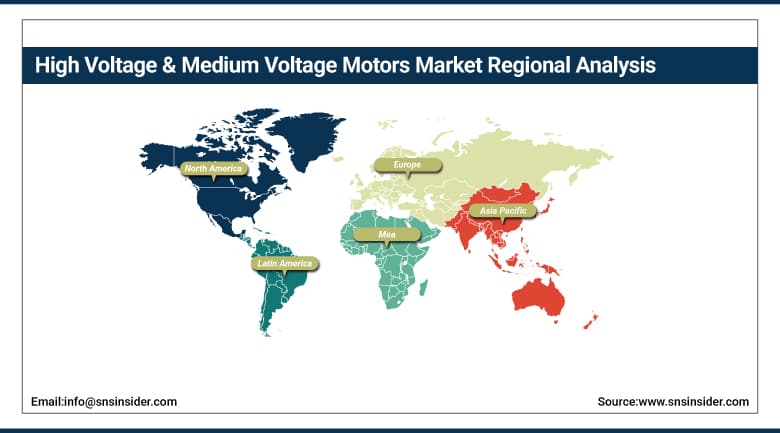
Region |
Major country |
Share within region, 2025 (%) |
|---|---|---|
|
Asia Pacific |
China |
38.21% |
|
North America |
United States |
78.99% |
|
Europe |
Russia |
12.02% |
|
Latin America |
Brazil |
42.84% |
|
Middle East & Africa |
Saudi Arabia |
20.23% |
Get Customized Report as Per Your Business Requirement - Enquiry Now
North America High Voltage & Medium Voltage Motors Market Insights
The North America High Voltage & Medium Voltage Motors Market is driven by industrial modernization, expanding manufacturing activities, and increasing demand for energy-efficient motor systems. The United States holds a significant position due to its established oil and gas, mining, chemicals, power generation, and water treatment industries. These sectors require reliable, high-power motors for operating pumps, compressors, fans, conveyors, and other heavy-duty equipment. Growing investments in industrial automation are encouraging the adoption of advanced motors and variable-speed drives to improve operational efficiency and reduce electricity consumption. Additionally, aging industrial infrastructure is creating demand for motor replacement and equipment upgrades.
⮞According to the U.S. Department of Energy, data centers consumed an estimated 192 TWh of electricity in 2024, equivalent to 4.7% of total U.S. electricity consumption. Under its reference scenario, consumption is projected to reach 649 TWh by 2030. This expansion is expected to increase demand for cooling systems, pumps, fans, and other motor-driven auxiliary equipment.
Europe High Voltage & Medium Voltage Motors Market Insights
The Europe High Voltage & Medium Voltage Motors Market is driven by industrial modernization, energy-efficiency initiatives, and increasing investments in sustainable manufacturing. Germany, Italy, France, and the United Kingdom support regional demand through established automotive, chemicals, metals, machinery, and power generation industries. European industries are increasingly adopting high-efficiency motors and variable-speed drives to reduce electricity consumption, improve operational performance, and lower maintenance costs. European Union ecodesign requirements also encourage energy-efficient motor technologies, supporting equipment upgrades across industrial facilities.
⮞In 2024, electricity accounted for 33.3% of the EU industry's total energy consumption of 8,835 petajoules, highlighting the importance of electricity efficiency in energy-intensive manufacturing. The European Commission also launched a call for evidence on 25 August 2025 to review ecodesign requirements for electric motors and variable-speed drives, considering technological developments and potential extensions to the rules. These developments reinforce the region's focus on industrial energy efficiency and motor-system optimization.
Asia Pacific High Voltage & Medium Voltage Motors Market Insights
The Asia Pacific High Voltage & Medium Voltage Motors Market is driven by rapid industrialization, expanding manufacturing capacity, and increasing infrastructure investments across China, India, Japan, and Southeast Asia. Growing demand from mining, metals, chemicals, oil and gas, power generation, and water treatment industries is supporting the adoption of high-power motors for pumps, compressors, fans, and heavy-duty machinery. China benefits from its extensive industrial manufacturing base, while India's expanding infrastructure and industrial development are creating additional demand. Increasing automation and the adoption of variable-speed drives are encouraging industries to improve operational efficiency and reduce electricity consumption. Furthermore, investments in renewable energy, industrial facilities, and energy-efficient equipment are supporting regional market development.
⮞According to the International Energy Agency, electricity demand across Asia Pacific increased by 4.1% in 2025 and is expected to grow by an average of 4.7% annually during 2026–2030, supporting requirements for power infrastructure and industrial equipment. China's electricity consumption reached approximately 10.37 trillion kWh in 2025, increasing by around 5% year over year, with the industrial sector accounting for approximately 64% of total consumption.
These trends reinforce the importance of reliable motor-driven machinery across industrial applications. The growing emphasis on equipment reliability, process optimization, and reduced operating costs is expected to sustain demand for advanced medium-voltage and high-voltage motor systems across the region.
MEA & Latin America High Voltage & Medium Voltage Motors Market Insights
The Middle East & Africa High Voltage & Medium Voltage Motors Market is supported by investments in oil and gas infrastructure, water desalination, mining, and power generation. Gulf countries are expanding industrial facilities and water transportation networks, increasing demand for reliable, high-power motors. Across Africa, mining activities, electricity infrastructure development, and industrialization are creating additional opportunities for motor manufacturers.
The Latin America High Voltage & Medium Voltage Motors Market is driven by mining, oil and gas production, agricultural processing, and industrial manufacturing. Brazil, Mexico, Chile, and Argentina contribute to regional demand through their industrial bases and natural resource industries. Motors are essential for operating pumps, compressors, conveyors, crushers, and other heavy-duty machinery.
High Voltage & Medium Voltage Motors Market Dynamics"
Growth Drivers: Rising Industrial Automation and Expansion of Energy-Intensive Manufacturing Operations
Increasing industrial automation and expanding manufacturing capacity are accelerating demand for high voltage and medium voltage motors across energy-intensive industries. Sectors such as oil and gas, mining, chemicals, cement, steel, and water treatment depend on powerful motors to operate pumps, compressors, fans, conveyors, crushers, and processing equipment. As production facilities expand, manufacturers require reliable motor systems capable of supporting continuous operations, high mechanical loads, and demanding operating conditions.
The growing adoption of automated production lines is also increasing requirements for precise motor control, operational consistency, and reduced equipment downtime. Furthermore, investments in industrial modernization are encouraging companies to replace aging motor installations with technologically advanced alternatives. High-efficiency motors and variable-speed-drive-compatible systems help improve process performance while reducing electricity consumption. These factors collectively support sustained demand for medium and high voltage motors across established industrial economies and rapidly industrializing markets worldwide.
Restraints: High Initial Investment and Installation Costs Limit Industrial Motor Replacement
High acquisition costs and installation expenses can discourage industrial operators from adopting advanced high voltage and medium voltage motors, particularly small and medium-sized enterprises with limited capital budgets. These systems often require specialized engineering, electrical infrastructure modifications, protective equipment, motor control centers, and professional commissioning. Additional expenses may arise when existing facilities need upgrades to accommodate new motor dimensions, voltage requirements, cooling systems, or variable-speed drives.
Industries operating in price-sensitive markets may continue using older equipment when immediate replacement costs outweigh perceived short-term savings. Furthermore, large industrial projects frequently involve lengthy procurement cycles, technical evaluations, and capital expenditure approvals, delaying purchasing decisions. Although energy-efficient motors can reduce electricity consumption and maintenance expenses over time, the financial benefits depend on operating hours, load conditions, energy prices, and equipment utilization. These investment considerations can postpone modernization projects and restrict the adoption of premium motor technologies across cost-conscious industrial applications.
Opportunities: Expansion of Renewable Energy Infrastructure Creates Demand for Advanced Industrial Motor Systems
Expanding renewable energy infrastructure is creating opportunities for medium and high voltage motor manufacturers across power generation and supporting industrial applications. Wind farms, solar installations, hydroelectric facilities, and associated grid infrastructure require reliable auxiliary equipment for cooling, water circulation, lubrication, ventilation, and other operational processes. As renewable capacity expands, supporting facilities increasingly need efficient motor systems capable of delivering dependable performance under demanding operating conditions.
Energy storage installations and associated thermal management infrastructure can also create additional requirements for industrial pumps, fans, and cooling equipment. Furthermore, investments in electricity transmission, grid modernization, and new power facilities are stimulating demand for motors used in substations, generating stations, and industrial support systems. Manufacturers offering robust designs, high efficiency, variable-speed compatibility, and condition-monitoring capabilities can strengthen their position in these applications. Developing markets with expanding electricity demand and renewable energy investment may provide particularly attractive opportunities for suppliers serving infrastructure developers and industrial equipment integrators.
Recent Developments:
-
2025: TMEIC announced the development and shipment of a 48.4 MW, six-pole synchronous motor with reported efficiency of 99.0%. The first unit had been shipped in July 2024 to an industrial gas manufacturer and was operating stably. Applications include compressors in steel, chemical, mining, pulp and paper, and oil and gas facilities.
-
2025: JEUMONT Electric announced the installation of three new machines at its motor-testing platform. The investment, involving a newly constructed building, strengthens testing capabilities for submarine propulsion motors and supports its naval motor business.
High Voltage & Medium Voltage Motors Market Key Players:
-
ABB
-
WEG
-
TMEIC
-
TECO Electric & Machinery
-
Nidec Industrial Solutions
-
Innomotics
-
Bharat Bijlee
-
Menzel Elektromotoren
-
Bharat Heavy Electricals Limited (BHEL)
-
HD Hyundai Electric
-
Marathon Electric Motors India
-
Cantoni Group (EMIT)
-
Toshiba
-
Hyosung Heavy Industries
-
CG Power and Industrial Solutions
-
Kirloskar Electric Company
-
Wolong Electric Group
-
VEM Group
-
Jeumont Electric
-
General Electric Vernova
High Voltage & Medium Voltage Motors Market Report Scope:
|
Report Attributes |
Details |
|---|---|
|
Market Size in 2025 |
USD XX Billion |
|
Market Size by 2035 |
USD XX Billion |
|
CAGR |
CAGR of XX% From 2026 to 2035 |
|
Base Year |
2025 |
|
Forecast Period |
2026-2035 |
|
Historical Data |
2022-2024 |
|
Report Scope & Coverage |
Market Size, Segments Analysis, Competitive Landscape, Regional Analysis, DROC & SWOT Analysis, Forecast Outlook |
|
Key Segments |
• By Motor Type (Induction Motors, Synchronous Motors, Other Motor Types) |
|
Regional Analysis/Coverage |
North America (US, Canada), Europe (Germany, UK, France, Italy, Spain, Russia, Poland, Rest of Europe), Asia Pacific (China, India, Japan, South Korea, Australia, ASEAN Countries, Rest of Asia Pacific), Middle East & Africa (UAE, Saudi Arabia, Qatar, South Africa, Rest of Middle East & Africa), Latin America (Brazil, Argentina, Mexico, Colombia, Rest of Latin America). |
|
Company Profiles |
ABB, WEG, TMEIC, TECO Electric & Machinery, Nidec Industrial Solutions, Innomotics, Bharat Bijlee, Menzel Elektromotoren, Bharat Heavy Electricals Limited (BHEL), HD Hyundai Electric, Marathon Electric Motors India, Cantoni Group (EMIT), Toshiba, Hyosung Heavy Industries, CG Power and Industrial Solutions, Kirloskar Electric Company, Wolong Electric Group, VEM Group, Jeumont Electric, General Electric Vernova |

Frequently Asked Questions
Key players include ABB, WEG, TMEIC, Innomotics, Nidec Industrial Solutions, Toshiba, TECO Electric & Machinery, BHEL, Hyosung Heavy Industries, and General Electric Vernova.
Pumps, compressors, fans, conveyors, and heavy-duty machinery drive demand across oil and gas, mining, chemicals, power generation, cement, and water treatment.
Key opportunities include renewable energy infrastructure, grid modernization, industrial electrification, desalination projects, energy-efficient motors, variable-speed drives, and predictive maintenance technologies.
Increasing industrial automation and expanding energy-intensive manufacturing operations drive demand for reliable, high-power motors across mining, chemicals, oil and gas, and manufacturing.
High initial investment and installation costs, including electrical infrastructure upgrades, specialized engineering, and commissioning, can delay motor replacement and restrict adoption.
