
Torque Motor Market Report Scope & Overview:
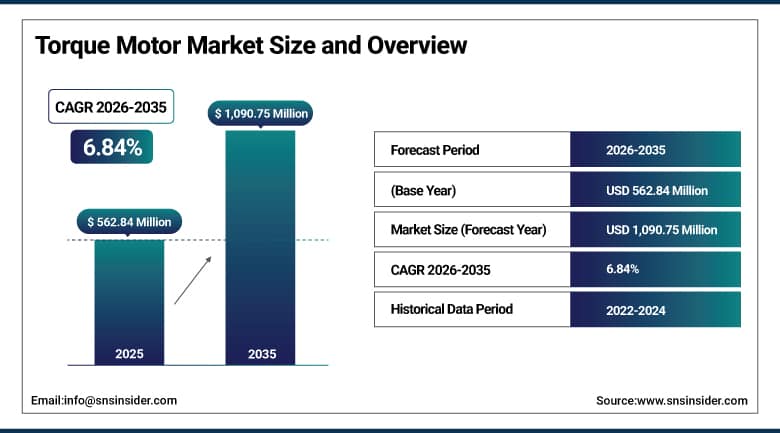
The Torque Motor Market was valued at USD 562.84 Million in 2025 and is expected to reach USD 1,090.75 Million by 2035, growing at a CAGR of 6.84% from 2026-2035.
The Torque Motor Market continues to expand as manufacturers seek direct-drive motion solutions that deliver high torque at low speeds without gearboxes, belts, or pulleys. By removing mechanical transmission elements, torque motors reduce backlash, wear, noise, and maintenance while improving positioning accuracy and dynamic response, which makes them well suited for rotary tables in machine tools, semiconductor handling equipment, robotic joints, and precision indexing systems. Growing automation across electronics, automotive, packaging, and aerospace manufacturing is increasing demand for compact, energy-efficient motion components that support higher throughput and tighter tolerances. The rapid development of collaborative and humanoid robots is creating strong new demand for lightweight frameless torque motors with high torque density for joints and actuators.
Demand from humanoid robotics gained visibility when Leadshine showcased, in January 2026, its FM series frameless motors at CES 2026 in Las Vegas, with the FM2-8513 model delivering a peak torque of 7 Nm at a weight of 326 grams, equal to a torque density of about 21.5 Nm per kilogram.
To Get More Information On Torque Motor Market - Request Free Sample Report
Torque Motor Market Trends:
-
Rising use of frameless torque motors in humanoid and collaborative robot joints.
-
Growing adoption of direct-drive rotary tables in five-axis machine tools.
-
Expanding demand for high torque density motors with low cogging for precision positioning.
-
Increasing integration of encoders, thermal sensors, and condition monitoring into motor designs.
-
Rising deployment of torque motors in semiconductor wafer handling and inspection equipment.
-
Growing development of outer-rotor and axial flux designs for compact actuators.
U.S. Torque Motor Market Outlook:
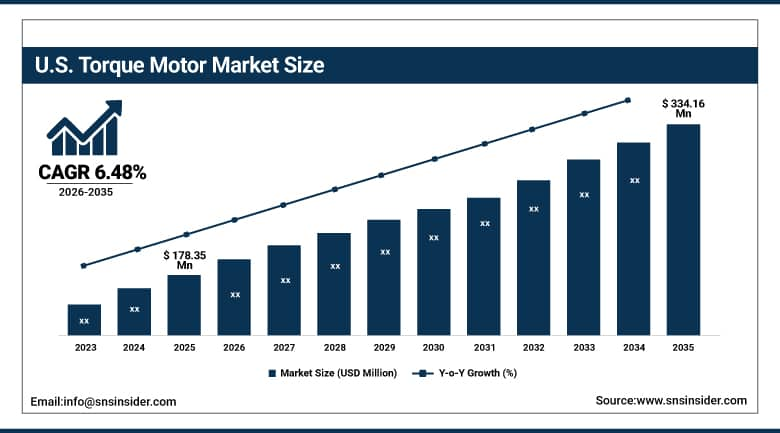
The U.S. Torque Motor Market was valued at USD 178.35 Million in 2025 and is expected to reach USD 334.16 Million by 2035, growing at a CAGR of 6.48% from 2026-2035.
The US Torque Motor Market has continued to thrive owing to advancements in manufacturing, large aerospace and defense industries, increased semiconductor fab spending, and a quickly growing robotics industry. There are many leading motion control companies in the United States such as Kollmorgen, Moog, Allient, Celera Motion, and Parker Hannifin that provide services to machine builders, robotics manufacturers, and defense companies. The construction of new semiconductor fabrication plants due to federal subsidies is leading to an increase in demand for precision direct drive motion control in wafer processing, lithography support, and inspection systems. The use of torque motors is common in aerospace and defense applications such as gimbals, radar pedestals, and weapon stabilization systems.
Motion control suppliers in the United States sharpened their robotics focus when Allient Inc. announced, in June 2026, that it would present frameless torque motors and axial flux motors for robotic and humanoid robotic platforms at Automate 2026 in Chicago, reflecting growing demand from advanced robotics developers.
Torque Motor Market Segment Analysis:
-
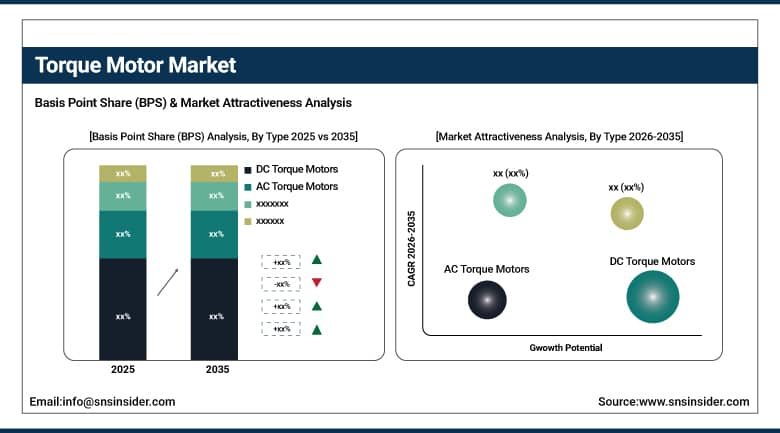
By Type, the DC Torque Motors segment dominated the Torque Motor Market with approximately 64.28% share in 2025, while the AC Torque Motors segment is the fastest growing with a CAGR of approximately 8.12%.
-
By Torque Range, the Medium Torque segment dominated the Torque Motor Market with approximately 44.62% share in 2025, while the Low Torque segment is the fastest growing with a CAGR of approximately 7.94%.
-
By Design, the Frameless segment dominated the Torque Motor Market with approximately 58.46% share in 2025 and is also the fastest growing with a CAGR of approximately 7.66%.
-
By End-Use, the Machine Tools segment dominated the Torque Motor Market with approximately 28.74% share in 2025, while the Robotics & Semiconductors segment is the fastest growing with a CAGR of approximately 9.18%.
By Type, DC Torque Motors Dominate the Torque Motor Market and AC Torque Motors Grow Fastest
DC Torque Motors dominated the market share in 2025, due to the fact that brushless DC motors and permanent magnets are extensively applied in precise positioning, robotics, aerospace gimbal drives, and medical machinery when size, torque, and ease of operation become vital factors. DC torque motors provide high torque at slow speed, have low cogging torque, and great responsiveness; thus, they can be effectively used in many direct-drive applications. The large installed base in the fields of defense stabilization, optics, and lab automation ensures consistent replacement demand as well. The flexibility and extensive supplier base of DC torque motors ensure the largest segment market share.
AC Torque Motors are the fastest-growing type as machine tool builders, semiconductor equipment makers, and heavy automation users adopt synchronous AC direct-drive motors for high-power rotary tables, indexing systems, and large robotic axes. AC designs integrate well with modern servo drives and industrial networks and can deliver high continuous torque with effective liquid cooling. Growing use of five-axis machining centers and automated production cells in Asia Pacific and Europe is increasing demand. Better electronics and efficiency standards are also contributing to the adoption of AC Torque motors, driving faster growth in their market.
By Torque Range, Medium Torque Dominates the Torque Motor Market and Low Torque Grows Fastest
The Medium Torque motors in the 100-1,000 Nm class were in demand in 2025 because it includes many major applications in industry such as rotary tables for machine tools, indexing tables in automated assembly machines, packaging machines, and printing machines. They need powerful torque and accurate positioning and rigidity. In addition, machine manufacturers consider the medium torque motors with direct drive technology as a good substitute for worm gear and belt drives. The wide variety of applications and consistent spending on machine tools and automation ensure that medium torque continues to be the biggest torque range class.
Low Torque motors up to 100 Nm represent the most rapidly growing category for collaborative robots, humanoid robots, semiconductor handling machines, medical products, and optical positioners which demand light-weight motors with high torque density. In the case of humanoid robot applications, a large number of small motors is required for arm, hand, and leg joints, giving rise to huge volume opportunities. Frameless low torque motors with low weight, low cogging, and integrated sensors are being launched by suppliers in order to cater to such requirements. The rapidly growing robotics and electronic manufacturing industries remain key drivers of the fastest growing torque range category.
By Design, Frameless Dominates and Grows Fastest in the Torque Motor Market
The frameless types have dominated in the market in 2025 as the frameless torque motor comprises of a rotor and stator which are built in the customer's machine by making use of its own bearings. These motors provide space saving and light weight along with absence of coupling as well. The engineers can use these motors to develop small, stiff, and highly responsive systems. These types of motors are extensively used in robot joints, rotary tables, gimbals, and also in medical machines. The versatility of these types has made them the biggest design type in the market.
Frameless designs are also the fastest-growing segment as humanoid and collaborative robot developers, semiconductor equipment makers, and aerospace system designers seek the highest possible torque density in the smallest package. Integrated joint actuators combining frameless motors, gearboxes, encoders, and brakes are becoming standard building blocks for robots. Suppliers are launching new frameless series with outer-rotor designs, low-voltage windings, and improved thermal performance. Growing volume production of robots, particularly in Asia Pacific and North America, continues to reinforce frameless motors as both the largest and fastest-growing design segment.
By End-Use, Machine Tools Dominate the Torque Motor Market and Robotics & Semiconductors Grow Fastest
Machine Tools was the leading end-user in 2025, because torque motors are used extensively in applications such as rotary/tilting tables, indexing heads, and turning axes in machining centers, grinding machines, and gear cutting machines. The direct drive system provides backlash and wear-free motion without any worm gear systems and thus improves accuracy, surface quality, and productivity. There is an increasing demand for high-performance five-axis machining systems used in the aerospace, automotive, and medical industries for manufacturing their components. China, Germany, Japan, Italy, and South Korea remain key producers of machine tools for torque motors.
Robotics and Semiconductors is the fastest growing end-use market since robot manufacturers and semiconductor manufacturing equipment need precise, small in size, and very dynamic motion control systems. Collaborative and humanoid robots have frameless torque motors in their joints, whereas wafer-handling robots, inspection machines, and lithography-related equipment have direct drive motors that ensure accurate and vibration-free positioning. The increasing investment in new semiconductor manufacturing facilities and the rapidly commercialization of humanoid robots is leading to the growing demand. Manufacturers are introducing specialized product offerings for these end-use applications, which keeps driving the fastest growth in end-use markets in Asia Pacific and North America.
Regional Analysis:
|
Region |
Major Country |
Share within Region, 2025 (%) |
|
North America |
United States |
88.96% |
|
Asia Pacific |
China |
36.42% |
|
Europe |
Germany |
31.26% |
|
Latin America |
Brazil |
43.84% |
|
Middle East & Africa |
Saudi Arabia |
27.36% |
North America Torque Motor Market Insights
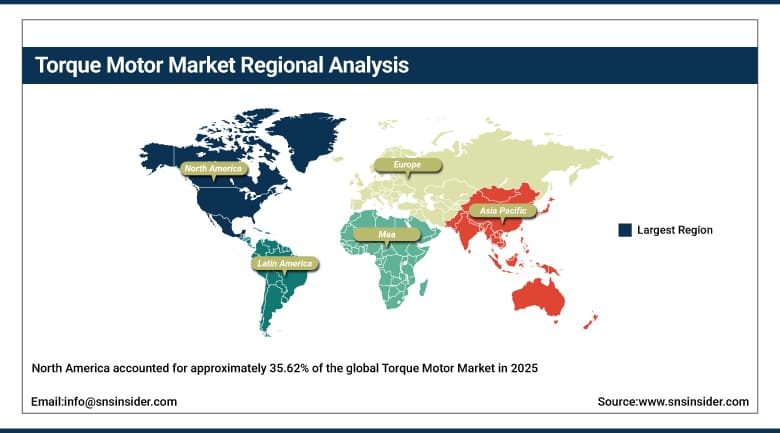
North America accounted for approximately 35.62% of the global Torque Motor Market in 2025, making it the largest regional market, supported by advanced manufacturing, strong aerospace and defense demand, semiconductor fabrication investment, and a fast-growing robotics sector. The area has some of the best motion control firms, such as Kollmorgen, Moog, Allient, Celera Motion, and Parker Hannifin. Applications in the defense industry, such as gimbals, radar pedestals, and stabilization systems, ensure a stable need for highly precise torque motors, whereas manufacturers and automation integrators keep using direct drives for efficiency.
The U.S. drives the regional demand on account of government incentives for semiconductors and resumption of manufacturing in the country as well as a significant population of developers of humanoid and collaborative robots. The manufacturers of medical devices, particularly the makers of imaging systems and robotic surgery devices, drive the value-added demand on account of accurate and silent motions. Canada provides the demand for the region on account of the presence of the aerospace and automation industries, whereas Mexico is contributing to the demand due to the automotive and electronics industries that employ automation equipment.
Get Customized Report as Per Your Business Requirement - Enquiry Now
Asia Pacific Torque Motor Market Insights
The Asia Pacific region holds the fastest-growing regional market share at a CAGR of around 8.46% in the period between 2026 and 2035. This growth will be attributed to the large scale of manufacturing, increasing rates of automation, good machine tool production, and expanding industries of semiconductors and electronics. The key players like China, Japan, South Korea, Taiwan, and India are making huge investments in robotics, automation, and precision equipment. These all involve direct drive motion components. Moreover, this region produces most of the industrial and collaborative robots in the world, and there is an increase in the developers of humanoid robots.
China emerges as a key driver of regional demand due to being the leading manufacturer of machine tools and industrial robots. China is further increasing regional demand due to suppliers like Leadshine and Inovance offering increased supply of torque motors and frameless motors for robotics and automation. On the other hand, Japan makes its contribution in the region due to its highly developed machine tool, robotics, and semiconductor equipment industries. South Korea and Taiwan provide support to demand from electronics and semiconductors industry. India is making incremental contributions due to growing manufacturing and automation investments.
Europe Torque Motor Market Insights
Europe holds a significant share of the global Torque Motor Market, supported by a strong machine tool industry, advanced automation, precision engineering, and leading motor manufacturers such as Siemens, ETEL, Franz Kessler, Fischer Elektromotoren, IDAM (Schaeffler), Tecnotion, and Phase Motion Control. European machine builders were early adopters of direct-drive rotary axes and continue to use torque motors extensively in machining centers, grinding machines, and packaging equipment. Energy efficiency regulations and Industry 4.0 initiatives are also encouraging the adoption of efficient, low-maintenance motors with integrated sensing and predictive maintenance capability.
The German demand anchor for this region lies in its world-renowned machine tools, automation, and automotive industries, alongside manufacturers like Siemens and Franz Kessler. The Swiss participation in regional demand arises from companies like ETEL and others who produce high precision equipment, catering to both semiconductor and industrial customers. The Italian contribution in terms of regional demand is provided by the country's machine tool and packaging machinery industries. In the case of the Netherlands, it is due to semiconductor equipment manufacture, and for France and the UK, it is due to their aerospace and defense programs.
MEA & Latin America Torque Motor Market Insights
The Middle East and Africa market is relatively small but is growing with the Gulf nations focusing on developing their economies and manufacturing industries, as well as producing military defense systems locally. Saudi Arabia Vision 2030 plan and UAE's industrial strategy have led to development of manufacturing plants and automated systems using motion components for precise movement. Israel, for its part, has made some contribution through the defense and electronics industry in which torque motors are used in stabilization, optical and radar systems. South Africa has some demand in automotive and mining equipment industries.
The Latin American market is increasing due to the efforts of Brazilian and Mexican manufacturers automating production processes to increase efficiency and competitiveness. The country of Brazil plays a crucial role in regional demand through industries like machinery, automotive, food processing, and packaging that utilize direct drive motion in indexing and positioning operations. The Mexican share of the market comes from their automotive and electronics industry, which employs torque motors for automated assembly and testing machines. The other small contributors come from Argentina and Colombia, which make up smaller volumes in industrial and packaging applications.
Market Dynamics:
Growth Drivers: Rising Industrial Automation and Rapid Growth of Advanced Robotics
Increasing levels of automation in industries are expected to be the key driving factor behind the growth in the Torque Motor Market due to the need for increased precision and reliability. Torque motors do not require gears or belts, and thus decrease backlash and increase machine rigidity. Torque motors are now being used more frequently by machine tool manufacturers for rotary tables and indexing heads to achieve five-axis machining. Torque motors are also being used by packaging and printing equipment manufacturers for high-speed indexing.
The rise of the highly sophisticated category of robotics is another significant factor driving the growth, since collaborative robots, humanoid robots, and dedicated service robots need compact actuators with high torque density and smooth performance. Frameless torque motors are commonly found in robot joints that are assembled with gearboxes, encoders, and brakes in order to become part of the integrated actuators. Rising commercialization of humanoid robots, especially in China and the US, will greatly boost the number of units. New frameless series that target low voltage robotic platforms continue to drive the demand for them.
Restraints: High Initial Costs and Rare-Earth Material Supply Risks
Initial high costs can be considered as an important constraint on market growth, because torque motors and their drives, encoders, and cooling units are much costlier than traditional motors and gearboxes. Frameless motor integration will need special engineering skills and will also increase the cost of product development for machinery makers. Customers who are price sensitive, especially in developing countries, will keep preferring traditional gearboxes. Specific customization needs for certain applications will also lead to increased costs and longer production times.
The supply of rare earth materials poses another constraint as the high performance torque motors make use of neodymium-iron-boron permanent magnets which are mainly sourced from China. The export restrictions, trade conflicts, and price fluctuations in rare earth elements may increase the production cost and also pose a challenge to the supply chain process for the motor manufacturers. Additionally, import tariffs also impose an element of uncertainty to the suppliers in the global market. Although there have been efforts by the manufacturers to design rare earths in smaller quantities as well as alternate magnet materials, it may affect the performance.
Opportunities: Humanoid Robot Commercialization and Semiconductor Equipment Expansion
Commercializing humanoid robots is a large opportunity due to the fact that a single humanoid robot requires many motors for its arms, legs, hands, and body. Developers need small, lightweight frameless torque motors with high torque density and low cogging along with the sensing capability required for natural motion. If and when developers start moving from development prototypes towards large-scale manufacturing, there will be huge demand for motors and actuator modules. Companies which are able to supply such frameless motors efficiently are poised to benefit from this market opportunity.
The semiconductor equipment industry presents yet another potential area where torque motor use can lead to development opportunities because the demand for precision, cleanliness, and stability of movement is increasing due to the rising investments in new wafer fabs, advanced packaging facilities, and inspection capabilities. Torque motors are applied in wafer handling robot units, rotary tables, inspection equipment, and lithography supporting equipment. There are also government grants being provided in the US, Europe, Japan, South Korea, Taiwan, and India to build new fabs.
Recent Developments:
-
2026: TQ-RoboDrive introduced its ILM Series outer-rotor frameless torque motor, delivering 48 Nm of continuous torque at a height of 50 mm for humanoid robot knee and hip joints, addressing the growing demand for compact, high-torque robotic actuators.
-
2026: Allient expanded its ElectroFlux Series of frameless torque motors with new 25 mm and 38 mm sizes, targeting space-constrained robotics, precision instruments, and motion-control applications requiring compact designs and high torque density.
-
2026: Alva Industries showcased its SlimTorq frameless torque motor portfolio at Robotics Summit & Expo 2026, including a new 25 mm diameter configuration designed to support increasingly compact robotic joints and precision direct-drive systems.
-
2024: Sierramotion, an Allient company, expanded its STS Series of frameless torque motors with 38 mm, 85 mm, and 165 mm outer-diameter options, supporting direct-drive and highly integrated precision-motion applications.
Torque Motor Market Key Players:
-
Kollmorgen (Regal Rexnord Corporation)
-
ETEL S.A. (HEIDENHAIN)
-
Siemens AG
-
Moog Inc.
-
HIWIN Corporation
-
Franz Kessler GmbH
-
Fischer Elektromotoren GmbH
-
IDAM (Schaeffler Group)
-
Tecnotion B.V.
-
Celera Motion (Novanta Inc.)
-
Allient Inc.
-
Parker Hannifin Corporation
-
Yaskawa Electric Corporation
-
Oriental Motor Co., Ltd.
-
NUM AG
-
Lafer S.p.A.
-
Phase Motion Control S.p.A.
-
Shenzhen Leadshine Technology Co., Ltd.
-
TQ-Systems GmbH (TQ-RoboDrive)
-
maxon group
Torque Motor Market Report Scope:
| Report Attributes | Details |
|---|---|
| Market Size in 2025 | USD 562.84 Million |
| Market Size by 2035 | USD 1,090.75 Million |
| CAGR | 6.84% from 2026 to 2035 |
| Base Year | 2025 |
| Forecast Period | 2026-2035 |
| Historical Data | 2022-2024 |
| Report Scope & Coverage | Market Size, Segments Analysis, Competitive Landscape, Regional Analysis, DROC & SWOT Analysis, Forecast Outlook |
| Key Segments | • By Type: Dominant – DC Torque Motors (64.28% share in 2025); Fastest-Growing – AC Torque Motors (CAGR 8.12%) • By Torque Range: Dominant – Medium Torque (44.62% share in 2025); Fastest-Growing – Low Torque (CAGR 7.94%) • By Design: Dominant – Frameless (58.46% share in 2025); Fastest-Growing – Frameless (CAGR 7.66%) • By End-Use: Dominant – Machine Tools (28.74% share in 2025); Fastest-Growing – Robotics & Semiconductors (CAGR 9.18%) |
| Regional Analysis/Coverage | North America (US, Canada), Europe (Germany, UK, France, Italy, Spain, Russia, Poland, Rest of Europe), Asia Pacific (China, India, Japan, South Korea, Australia, ASEAN Countries, Rest of Asia Pacific), Middle East & Africa (UAE, Saudi Arabia, Qatar, South Africa, Rest of Middle East & Africa), Latin America (Brazil, Argentina, Mexico, Colombia, Rest of Latin America). |
| Company Profiles | Kollmorgen (Regal Rexnord Corporation), ETEL S.A. (HEIDENHAIN), Siemens AG, Moog Inc., HIWIN Corporation, Franz Kessler GmbH, Fischer Elektromotoren GmbH, IDAM (Schaeffler Group), Tecnotion B.V., Celera Motion (Novanta Inc.), Allient Inc., Parker Hannifin Corporation, Yaskawa Electric Corporation, Oriental Motor Co., Ltd., NUM AG, Lafer S.p.A., Phase Motion Control S.p.A., Shenzhen Leadshine Technology Co., Ltd., TQ-Systems GmbH (TQ-RoboDrive), maxon group |

Frequently Asked Questions
Key players include Kollmorgen, ETEL S.A., Siemens AG, Moog Inc., HIWIN Corporation, Franz Kessler GmbH, and Fischer Elektromotoren GmbH, among other global motion control suppliers.
Humanoid robot commercialization and expanding semiconductor equipment investment represent the primary opportunities.
Growth is primarily driven by rising industrial automation combined with the rapid growth of collaborative and humanoid robotics.
By Type, DC Torque Motors dominated the market with approximately 64.28% share in 2025, reflecting their broad use in precision positioning and robotics.
North America dominated the market with approximately 35.62% share in 2025, driven by advanced manufacturing, aerospace and defense, and robotics demand.
