
Compressed Air Leak Detection Market Report Scope & Overview:
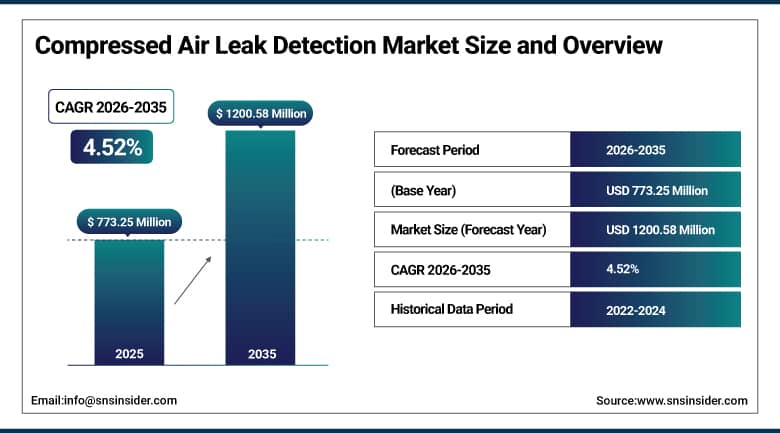
The Compressed Air Leak Detection Market was valued at USD 773.25 Million in 2025 and is expected to reach USD 1200.58 Million by 2035, growing at a CAGR of 4.52% from 2026–2035.
The compressed air leak detection market is experiencing steady growth due to increasing demand for energy efficiency, lower operating costs, and reliable compressed air system performance across industrial facilities. The expansion of manufacturing, automotive, food & beverage, pharmaceuticals, chemicals, and other process industries is driving demand for advanced leak detection solutions. Investments in ultrasonic detection, acoustic imaging, infrared/thermal detection, laser-based detection, and AI-enabled analytics are improving leak identification, monitoring accuracy, and maintenance efficiency. Companies are focusing on reducing compressed air losses, improving equipment reliability, optimizing energy consumption, and supporting predictive maintenance programs. Growing adoption of leak detection across air compressors, air distribution systems, pneumatic equipment, and production equipment is accelerating technology development. The integration of portable and fixed monitoring solutions, digital analytics, and IoT-enabled capabilities is further supporting market growth.
In March 2026, advancements in compressed air leak detection are accelerating the adoption of ultrasonic detection, acoustic imaging, and advanced diagnostic technologies across industrial facilities. Newer solutions combine acoustic and thermal imaging, automated data analysis, and digital reporting to improve leak identification, prioritization, and maintenance efficiency. These developments are helping manufacturers reduce compressed air losses, lower energy consumption, improve equipment reliability, and strengthen predictive maintenance programs across global industrial operations.
To Get More Information On Compressed Air Leak Detection Market - Request Free Sample Report
Compressed Air Leak Detection Market Trends:
-
Growing emphasis on energy efficiency and reducing compressed air losses is driving the adoption of advanced leak detection technologies to identify hidden leaks, lower compressor energy consumption, and reduce operating costs across industrial facilities.
-
Rising deployment of compressed air systems across manufacturing, automotive, food & beverage, pharmaceuticals, chemicals, and other industrial operations is increasing demand for reliable leak detection and monitoring solutions.
-
Increasing adoption of ultrasonic detection, acoustic imaging, infrared/thermal detection, and advanced sensing technologies is supporting faster, more accurate, and non-invasive identification of compressed air leaks.
-
Growing focus on predictive maintenance, energy optimization, equipment reliability, and reducing production losses is creating opportunities for compressed air leak detection technology providers.
-
Advancements in ultrasonic sensors, acoustic imaging, digital analytics, AI-enabled monitoring, and IoT-connected systems are improving leak identification, reporting, prioritization, and maintenance efficiency, supporting the adoption of compressed air leak detection solutions across industrial facilities.
U.S. Compressed Air Leak Detection Market Outlook:
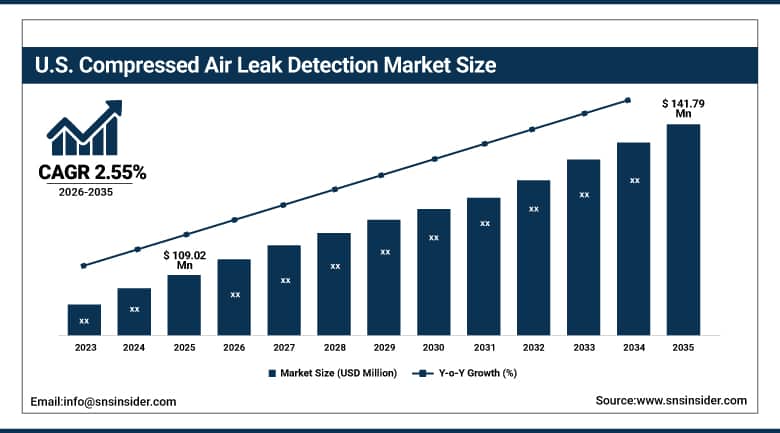
The U.S. Compressed Air Leak Detection Market was valued at USD 109.02 Million in 2025 and is expected to reach around USD 141.79 Million by 2035, growing at a CAGR of 2.55% from 2026–2035.
The U.S. compressed air leak detection market is growing steadily due to rising demand for energy-efficient compressed air systems, reduced operating costs, and improved equipment reliability across industrial facilities. The expansion of manufacturing, automotive, food & beverage, pharmaceuticals, chemicals, and other process industries is driving demand for advanced leak detection solutions. Investments in ultrasonic detection, acoustic imaging, infrared/thermal detection, and digital monitoring technologies are improving leak identification, maintenance efficiency, and system performance. Growing adoption of compressed air systems across manufacturing plants and industrial production facilities is supporting market demand. Companies are focusing on portable leak detectors, fixed monitoring systems, AI-enabled analytics, and IoT-connected solutions to improve leak detection accuracy, energy optimization, and predictive maintenance. The increasing emphasis on reducing compressed air losses, improving energy efficiency, and supporting industrial sustainability initiatives is further supporting market growth in the U.S.
In August 2026, the U.S. Department of Energy’s Better Plants program expanded its diagnostic equipment resources for manufacturers, including ultrasonic leak detectors and acoustic imagers designed to identify compressed air and gas leaks. The initiative supports industrial facilities in improving energy management and equipment performance, strengthening the adoption of advanced leak detection technologies across U.S. manufacturing operations.
Compressed Air Leak Detection Market Segment Analysis:
-
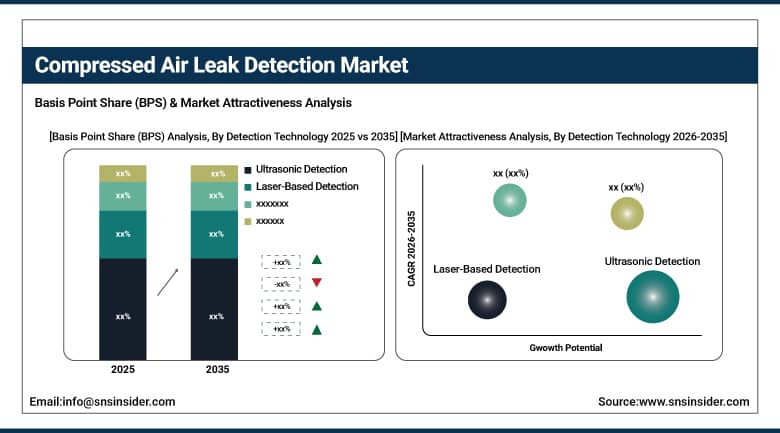
By Detection Technology, ultrasonic detection dominated the compressed air leak detection market with a 48.30% share in 2025, while laser-based detection is projected to be the fastest-growing segment, registering an 11.24% CAGR during 2026–2035.
-
By Portability, portable leak detectors dominated the compressed air leak detection market with a 63.20% share in 2025, while fixed leak detectors are projected to be the fastest-growing segment, registering a 6.07% CAGR during 2026–2035.
-
By Application, air compressors dominated the compressed air leak detection market with a 34.60% share in 2025, while pneumatic equipment is projected to be the fastest-growing segment, registering an 8.75% CAGR during 2026–2035.
-
By Sales Channel, direct instrument OEM dominated the compressed air leak detection market with a 41.70% share in 2025, while industrial distributors are projected to be the fastest-growing segment, registering a 7.09% CAGR during 2026–2035.
-
By End Use Industry, manufacturing dominated the compressed air leak detection market with a 35.80% share in 2025, while automotive is projected to be the fastest-growing segment, registering a 7.31% CAGR during 2026–2035.
By Detection Technology, ultrasonic detection dominated the compressed air leak detection market, while laser-based detection is expected to grow fastest.
Ultrasonic detection held the dominant position in the compressed air leak detection market in 2025, supported by its ability to identify high-frequency sound generated by compressed air escaping from leaks. Its non-invasive operation, portability, ease of use, and suitability for detecting leaks across compressors, distribution systems, pneumatic equipment, and production facilities are driving widespread adoption. Growing emphasis on energy efficiency, reduction of compressed air losses, preventive maintenance, and lower operating costs is further supporting demand for ultrasonic leak detection solutions.
Laser-based detection is projected to register the highest CAGR during the forecast period from 2026 to 2035. Laser-based technologies offer precise and remote leak identification and can support faster inspection across industrial environments. Increasing demand for accurate leak localization, automated inspection, and advanced monitoring is encouraging adoption of laser-based solutions. Growing industrial automation and the need to improve maintenance efficiency and minimize compressed air losses are expected to further support the expansion of laser-based detection technologies.
By Application, air compressors dominated the compressed air leak detection market, while pneumatic equipment is expected to grow fastest.
Air compressors accounted for the dominant share of the compressed air leak detection market in 2025, driven by their central role in generating compressed air for industrial operations. Leakage around compressors and associated connections can increase energy consumption, operating costs, and equipment loading, creating demand for regular leak detection and maintenance. The increasing adoption of compressed air systems across manufacturing, automotive, food & beverage, pharmaceuticals, chemicals, and other industries is supporting the deployment of leak detection solutions around compressor systems.
Pneumatic equipment is projected to exhibit the highest growth rate during 2026–2035. The increasing use of pneumatic tools, actuators, valves, cylinders, and other equipment across automated industrial processes is creating greater demand for efficient leak identification and maintenance. Growing emphasis on equipment reliability, energy optimization, predictive maintenance, and minimizing production losses is encouraging companies to monitor pneumatic systems more closely. The adoption of advanced detection technologies is expected to further strengthen demand for compressed air leak detection across pneumatic equipment.
By End Use Industry, manufacturing dominated the compressed air leak detection market, while automotive is expected to grow fastest.
Manufacturing held the dominant position in the compressed air leak detection market in 2025, supported by extensive use of compressed air systems across production, assembly, material handling, automation, and other industrial processes. Compressed air losses can increase energy consumption and operating expenses, encouraging manufacturers to conduct regular leak detection and maintenance activities. Increasing focus on energy efficiency, equipment reliability, operational cost reduction, and sustainable industrial operations is further supporting adoption across manufacturing facilities.
Automotive is projected to register the highest CAGR during the forecast period from 2026 to 2035. Automotive manufacturing relies extensively on compressed air for pneumatic tools, assembly operations, automation, painting, material handling, and production equipment. Increasing vehicle production, factory automation, and investments in energy-efficient manufacturing are creating greater demand for compressed air leak detection solutions. Growing adoption of predictive maintenance and energy optimization practices is expected to further accelerate the use of leak detection technologies across automotive production facilities.
Regional Analysis:
|
Region |
Major Country |
Share within Region, 2025(%) |
|---|---|---|
|
North America |
United States |
82.40% |
|
Europe |
Germany |
34.30% |
|
Asia Pacific |
China |
48.54% |
|
Middle East & Africa |
Saudi Arabia |
23.50% |
|
Latin America |
Brazil |
23.00% |
Asia Pacific compressed air leak detection market insights
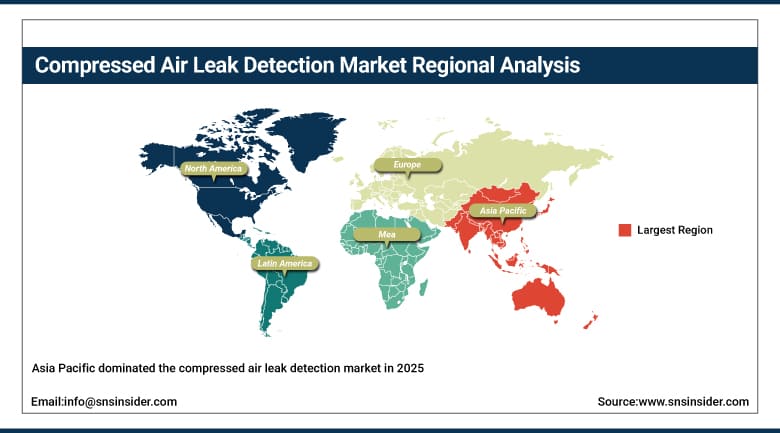
Asia Pacific dominated the compressed air leak detection market in 2025 and is expected to register the fastest growth, with a CAGR of 6.32% during 2026–2035. Rapid industrialization, expanding manufacturing activities, and increasing deployment of compressed air systems across production facilities are driving regional demand. Manufacturing, automotive, food & beverage, pharmaceuticals, chemicals, and other industrial sectors are increasingly focusing on energy efficiency and operating cost reduction.
Growing adoption of ultrasonic detection, acoustic imaging, infrared/thermal detection, and laser-based detection is supporting more accurate identification of compressed air losses. Increasing investments in industrial automation, predictive maintenance, and energy optimization are also encouraging companies to monitor compressed air systems more effectively.
Get Customized Report as Per Your Business Requirement - Enquiry Now
North America compressed air leak detection market insights
North America accounted for an 18.90% share of the compressed air leak detection market in 2025, supported by established manufacturing industries, widespread use of compressed air systems, and increasing emphasis on energy efficiency. The region is witnessing growing adoption of leak detection solutions across manufacturing, automotive, food & beverage, pharmaceuticals, chemicals, and other industrial facilities. Increasing focus on reducing compressed air losses, lowering energy consumption, improving equipment reliability, and strengthening preventive maintenance is supporting regional demand.
The United States represents the larger portion of regional demand, while Canada is also contributing through its manufacturing and industrial sectors. Adoption of ultrasonic detection, acoustic imaging, infrared/thermal detection, and other advanced technologies is expected to support continued market development.
Europe compressed air leak detection market insights
The compressed air leak detection market in Europe is expected to witness steady growth during the forecast period, supported by its established industrial base and increasing focus on energy efficiency, operational cost reduction, and equipment reliability. Manufacturing, automotive, food & beverage, pharmaceuticals, chemicals, and other industries are increasingly adopting leak detection solutions to identify compressed air losses and improve system performance.
Growing emphasis on preventive maintenance and energy optimization is encouraging the use of portable and fixed leak detection solutions across industrial facilities. Increasing adoption of advanced detection technologies is expected to further support demand as companies seek to minimize energy waste and improve compressed air system efficiency.
Middle East & Africa and Latin America compressed air leak detection market insights
The compressed air leak detection market in the Middle East & Africa and Latin America is expected to witness consistent growth from 2026 to 2035, supported by increasing industrial activity and expanding use of compressed air systems across manufacturing and other industrial operations. Growing awareness of energy losses, operating costs, equipment reliability, and preventive maintenance is encouraging industrial facilities to adopt leak detection technologies.
The expansion of manufacturing activities and increasing focus on operational efficiency are creating opportunities for portable and fixed leak detection solutions. The adoption of ultrasonic detection and other advanced technologies is expected to support market development as industrial facilities increasingly seek to identify leaks, reduce unnecessary energy consumption, and improve compressed air system performance.
Market Dynamics:
Growth Driver: Increasing emphasis on energy efficiency and reduction of compressed air losses is driving market growth
One of the key factors driving the growth of the global compressed air leak detection market is the increasing focus on energy efficiency, operating cost reduction, and effective management of compressed air systems across industrial facilities. Compressed air leaks can result in significant energy losses, increased compressor loading, higher operating expenses, and reduced system efficiency. As manufacturing, automotive, food & beverage, pharmaceuticals, chemicals, and other industries seek to optimize energy consumption, companies are increasingly adopting leak detection solutions to identify and address compressed air losses. In addition, growing adoption of ultrasonic detection, acoustic imaging, infrared/thermal detection, and laser-based detection technologies is improving the accuracy and efficiency of leak identification. Increasing investments in predictive maintenance, industrial automation, and energy optimization are further encouraging companies to conduct regular inspections and monitor compressed air systems.
Restraint: High equipment costs and technical limitations can limit market adoption
The cost of advanced compressed air leak detection equipment and the technical expertise required to operate sophisticated systems can restrict adoption, particularly among small and medium-sized industrial facilities. Advanced acoustic imaging, infrared/thermal detection, laser-based systems, and digitally connected monitoring solutions may require higher initial investments compared with conventional inspection methods. In addition, integrating leak detection technologies with existing maintenance and industrial monitoring systems can increase implementation complexity. Furthermore, effective leak detection requires trained personnel capable of identifying, measuring, and prioritizing leaks across complex compressed air networks. Environmental conditions, background industrial noise, equipment accessibility, and variations in operating pressure can also affect detection accuracy.
Opportunity: Growing adoption of predictive maintenance and advanced leak monitoring creates new market opportunities
The increasing adoption of predictive maintenance, industrial automation, and digital monitoring presents significant opportunities for compressed air leak detection solution providers. Industrial facilities are increasingly seeking technologies that can continuously identify leaks, prioritize maintenance requirements, and provide actionable information for improving compressed air system efficiency. Integration of advanced sensors, acoustic imaging, digital analytics, and connected monitoring capabilities can support more efficient maintenance and energy management. Furthermore, growing demand for portable and fixed leak detection solutions across manufacturing, automotive, food & beverage, pharmaceuticals, chemicals, and other industries is creating opportunities for technology providers.
Recent Developments:
-
2023: Fluke's ii900 and ii910 acoustic imagers supported compressed air leak detection in industrial environments. Fluke's 2023–2024 product documentation described the ii900 as a solution for detecting compressed air, steam, gas, and vacuum leaks, with Sound Map technology designed to locate leaks in noisy production facilities.
-
2024: Atlas Copco emphasized regular leak detection and compressed air quality audits to reduce energy costs. The company reported that improper installations, inefficient couplings, faulty hoses, and leaking valves can increase compressed air energy consumption and highlighted air audits as a way to identify efficiency and cost-saving opportunities.
-
2025: IFM highlighted its SDL100 handheld leak detector for rapid identification, measurement, and documentation of compressed air leaks. The device combines ultrasonic microphones, laser distance measurement, and a camera to locate leaks, calculate compressed air losses and associated costs, and support digital reporting aligned with ISO 50001.
-
2025: UE Systems continued expanding its ultrasound-based condition-monitoring solutions and industry partnerships. Its official news archive records a 2025 partnership with perma, reflecting the company's broader development of integrated reliability and maintenance technologies. Its acoustic imaging portfolio supports detection and measurement of compressed air and industrial gas leaks.
Compressed Air Leak Detection Market key players are:
-
Fluke Corporation
-
Atlas Copco AB
-
Parker Hannifin Corporation
-
UE Systems, Inc.
-
SDT International SA
-
SONOTEC GmbH
-
CS Instruments GmbH & Co. KG
-
Teledyne FLIR LLC
-
SKF AB
-
SUTO iTEC GmbH
-
INFICON Holding AG
-
Testo SE & Co. KGaA
-
Emerson Electric Co.
-
Honeywell International Inc.
-
Siemens AG
-
Schneider Electric SE
-
EXAIR Corporation
-
General Tools & Instruments LLC
-
Riken Keiki Co., Ltd.
-
Teseo Srl.
Compressed Air Leak Detection Market Report Scope:
| Report Attributes | Details |
|---|---|
| Market Size in 2025 | USD 773.25 Million |
| Market Size by 2035 | USD 1200.58 Million |
| CAGR | CAGR of 4.52% From 2026 to 2035 |
| Base Year | 2025 |
| Forecast Period | 2026-2035 |
| Historical Data | 2022-2024 |
| Report Scope & Coverage | Market Size, Segments Analysis, Competitive Landscape, Regional Analysis, DROC & SWOT Analysis, Forecast Outlook |
| Key Segments | • By Detection Technology (Ultrasonic Detection, Acoustic Imaging, Infrared/Thermal Detection, Laser-Based Detection, Others) • By Portability (Portable Leak Detectors, Fixed Leak Detectors) • By Application (Air Compressors, Air Distribution Systems, Pneumatic Equipment, Production Equipment, Others) • By Sales Channel (Direct Instrument OEM, Industrial Distributors, Reliability Service Providers, Energy Audit Firms) • By End Use Industry (Manufacturing, Automotive, Oil & Gas, Food & Beverage, Pharmaceuticals, Chemicals, Others) |
| Regional Analysis/Coverage | North America (US, Canada), Europe (Germany, UK, France, Italy, Spain, Russia, Poland, Rest of Europe), Asia Pacific (China, India, Japan, South Korea, Australia, ASEAN Countries, Rest of Asia Pacific), Middle East & Africa (UAE, Saudi Arabia, Qatar, South Africa, Rest of Middle East & Africa), Latin America (Brazil, Argentina, Mexico, Colombia, Rest of Latin America). |
| Company Profiles | Fluke Corporation, Atlas Copco AB, Parker Hannifin Corporation, UE Systems, Inc., SDT International SA, SONOTEC GmbH, CS Instruments GmbH & Co. KG, Teledyne FLIR LLC, SKF AB, SUTO iTEC GmbH, INFICON Holding AG, Testo SE & Co. KGaA, Emerson Electric Co., Honeywell International Inc., Siemens AG, Schneider Electric SE, EXAIR Corporation, General Tools & Instruments LLC, Riken Keiki Co., Ltd., Teseo Srl. |
Frequently Asked Questions
Key players include Fluke Corporation, Atlas Copco AB, Parker Hannifin Corporation, UE Systems, Inc., SDT International SA, SONOTEC GmbH, and CS Instruments GmbH & Co. KG, among others.
Key opportunities include predictive maintenance, advanced acoustic imaging, connected leak monitoring, energy optimization, and adoption of portable and fixed leak detection solutions.
The market is driven by increasing focus on energy efficiency, reduction of compressed air losses, operating cost savings, equipment reliability, and preventive maintenance.
The ultrasonic detection segment dominated the market, accounting for approximately 48.30% share in 2025, supported by its ability to identify compressed air leaks efficiently in industrial environments.
Asia Pacific dominated the market in 2025 with a 38.50% share, supported by rapid industrialization, expanding manufacturing activity, and increasing adoption of energy-efficiency and maintenance technologies.
