
Human Motion Sensor Market Report Scope & Overview:
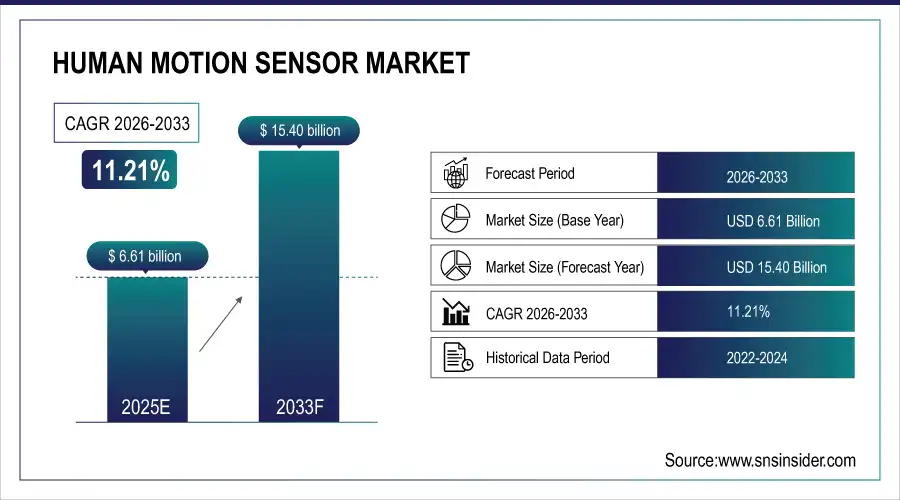
The Human Motion Sensor Market size was valued at USD 6.61 Billion in 2025E and is projected to reach USD 15.40 Billion by 2033, growing at a CAGR of 11.21% during 2026-2033.
The Human Motion Sensor Market is growing due to increasing adoption of smart homes and building automation systems, rising demand for advanced security and surveillance solutions, and expanding use of motion sensing in healthcare for patient monitoring and fall detection. Growth in automotive applications such as occupancy detection and gesture control, along with rapid advancements in IoT, AI, and low-power sensor technologies, further accelerates market expansion globally.
Market Size and Forecast:
-
Market Size in 2025E USD 6.61 Billion
-
Market Size by 2033 USD 15.40 Billion
-
CAGR of 11.21% From 2026 to 2033
-
Base Year 2025E
-
Forecast Period 2026-2033
-
Historical Data 2021-2024
To Get more information On Human Motion Sensor Market - Request Free Sample Report
Key Human Motion Sensor Market Trends
-
Rising adoption of smart home and building automation systems for energy-efficient lighting, heating, and security solutions.
-
Growing integration of motion sensors in healthcare for patient monitoring, fall detection, and elderly care applications.
-
Increasing use of motion sensors in automotive for occupancy detection, gesture recognition, and advanced driver-assistance systems (ADAS).
-
Expansion of wearable devices and IoT-enabled technologies, enabling personalized health tracking and smart consumer electronics applications.
-
Development of advanced sensing technologies including vision-based, radar, and RF-based sensors for industrial automation, smart infrastructure, and security applications.
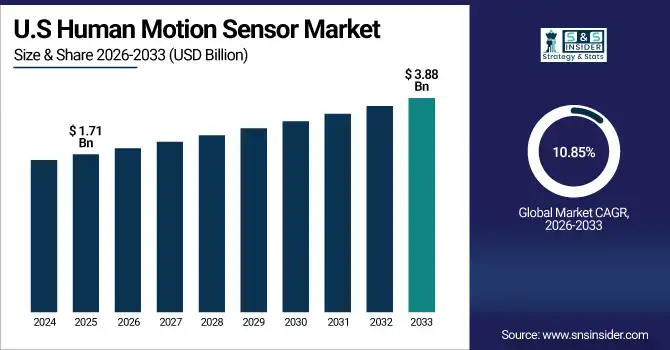
The U.S. Human Motion Sensor Market size was valued at USD 1.71 Billion in 2025E and is projected to reach USD 3.88 Billion by 2033, growing at a CAGR of 10.85% during 2026-2033. The U.S. Human Motion Sensor Market is growing due to strong adoption of smart home and building automation technologies, rising investments in security and surveillance, increased healthcare monitoring needs, and rapid integration of motion sensors in automotive safety and advanced driver-assistance systems.
Human Motion Sensor Market Growth Drivers:
-
Smart Homes Healthcare and Automotive Drive Global Human Motion Sensor Market Growth
The global Human Motion Sensor Market is primarily driven by the rapid adoption of smart home and building automation systems. Increasing consumer preference for energy-efficient, automated lighting, heating, and security solutions is boosting demand for motion detection technologies. The rising need for enhanced security and surveillance across residential, commercial, and industrial sectors is another major growth driver. Additionally, the expanding use of motion sensors in healthcare, particularly for patient monitoring, fall detection, and elderly care, is fueling market growth. Technological advancements such as miniaturized sensors, low-power consumption devices, and integration with IoT and AI platforms further enhance sensor performance, driving adoption across multiple end-use sectors. The automotive sector is also contributing significantly, with motion sensors enabling occupancy detection, gesture recognition, and advanced driver-assistance systems (ADAS), supporting safety and convenience in modern vehicles.
~50% of recent device launches in connected electronics integrated motion sensors for gesture recognition and predictive functions, showing industry emphasis on motion sensing capabilities.
Human Motion Sensor Market Restraints:
-
Technical Challenges and Data Privacy Concerns Restrain Human Motion Sensor Market Growth Globally
The global Human Motion Sensor Market faces restraints from technical challenges such as limited sensor range, susceptibility to environmental interference, and false detection issues, which can affect accuracy and reliability. Integration complexity with existing systems and compatibility issues across diverse devices also hinder seamless adoption. Additionally, concerns around data privacy and security in connected devices, along with a lack of standardized protocols for motion sensing technologies, may slow market growth.
Human Motion Sensor Market Opportunities:
-
Emerging Asia Pacific Drives Human Motion Sensor Market Growth with Wearables Smart Cities and Industrial Automation Opportunities
The market also presents significant growth opportunities in emerging regions, particularly in Asia Pacific, where increasing urbanization, smart city initiatives, and rapid industrialization are boosting demand for motion sensing technologies. The expansion of wearable devices and healthcare monitoring solutions offers untapped potential for motion sensors in personalized healthcare. Moreover, the integration of vision-based, radar, and RF-based sensing technologies into consumer electronics and industrial automation systems provides opportunities for product differentiation and innovation. Increasing government investments in smart infrastructure, security, and defense applications further strengthen long-term growth prospects for the global human motion sensor market.
Globally in 2024, over 3.4 billion motion sensors were installed across smart homes, security systems, industrial automation, and wearables, reflecting extensive integration with IoT ecosystems.
Human Motion Sensor Market Segment Analysis
-
By Sensor Type, Passive Infrared (PIR) dominated with 31.64% in 2025E, and Inertial Sensors (Accelerometer / Gyroscope / IMU) is expected to grow at the fastest CAGR of 11.90% from 2026 to 2033.
-
By Technology, Active (Radar, Ultrasonic, LiDAR) dominated with 39.65% in 2025E, and RF-based (Wi-Fi / Bluetooth CSI / mmWave) is expected to grow at the fastest CAGR of 12.97% from 2026 to 2033.
-
By Application, Smart Home & Building Automation (presence, lighting control) dominated with 32.73% in 2025E, and Healthcare & Wearables (patient monitoring, fall detection) is expected to grow at the fastest CAGR of 12.19% from 2026 to 2033.
-
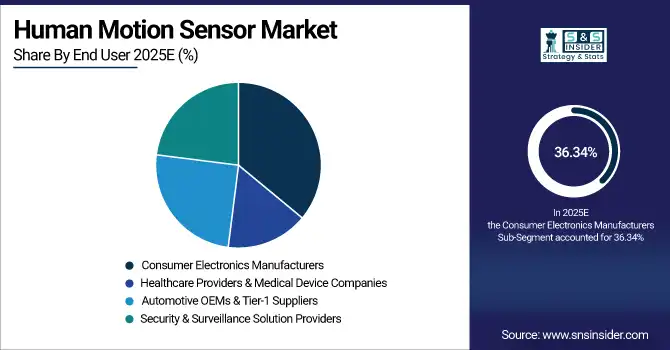
By End User, Consumer Electronics Manufacturers dominated with 36.34% in 2025E, and Healthcare Providers & Medical Device Companies is expected to grow at the fastest CAGR of 12.34% from 2026 to 2033.
By Sensor Type, Passive Infrared Sensors Dominate Human Motion Market with Inertial Sensors Driving Rapid Future Adoption Growth
In 2025, Passive Infrared (PIR) sensors dominate the human motion sensor market due to their wide adoption in smart home, security, and building automation applications, offering reliable presence detection at low cost and energy consumption. From 2026 to 2033, Inertial Sensors (Accelerometer, Gyroscope, IMU) are expected to grow the fastest, driven by increasing use in wearables, healthcare monitoring, automotive gesture control, and industrial robotics for precise motion tracking and advanced analytics.
By Technology, Active Technologies Lead Human Motion Sensor Market with RF-Based Solutions Driving Rapid Future Growth
In 2025, Active technologies such as Radar, Ultrasonic, and LiDAR dominate the human motion sensor market due to their high accuracy, long detection range, and extensive use in automotive, industrial, and security applications. From 2026 to 2033, RF-based technologies (Wi-Fi, Bluetooth CSI, mmWave) are expected to grow the fastest, driven by rising adoption in smart homes, healthcare monitoring, contactless gesture recognition, and IoT-enabled devices for precise, non-intrusive motion detection.
By Application, Smart Home Automation Leads Human Motion Sensor Market with Healthcare and Wearables Driving Future Growth
In 2025, Smart Home and Building Automation dominates the human motion sensor market due to widespread adoption in lighting control, energy management, and security systems, offering convenience and efficiency. From 2026 to 2033, Healthcare and Wearables are expected to grow the fastest, driven by increasing demand for patient monitoring, fall detection, elderly care, and fitness tracking, as well as the integration of motion sensors into wearable devices for personalized health and activity management.
By End User, Healthcare and Consumer Electronics Drive Human Motion Sensor Market Growth with Widespread Adoption and Innovation
In 2025, Consumer Electronics Manufacturers dominate the human motion sensor market due to extensive integration of sensors in smartphones, gaming devices, wearables, and smart home products, driving widespread adoption. From 2026 to 2033, Healthcare Providers and Medical Device Companies are expected to grow the fastest, fueled by increasing use of motion sensors in patient monitoring, fall detection, rehabilitation, and elderly care, enabling personalized healthcare solutions and improved clinical outcomes.
Human Motion Sensor Market Report Analysis
North America Human Motion Sensor Market Insights
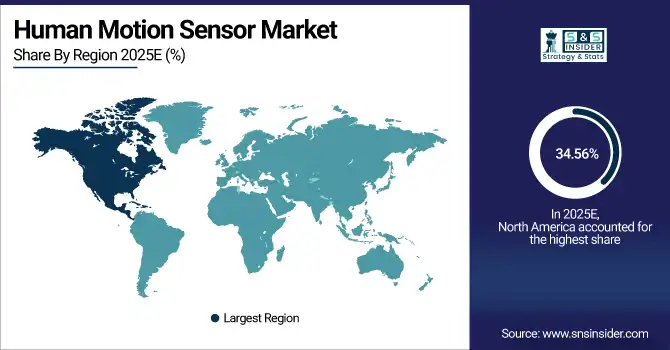
In 2025, North America dominates the human motion sensor market with a 34.56% share, driven by widespread adoption of smart home and building automation systems, advanced security and surveillance solutions, and integration of motion sensors in consumer electronics. Strong demand from healthcare monitoring, automotive occupancy detection, and industrial automation, coupled with rapid technological advancements and IoT integration, further reinforces the region’s leadership in deploying high-performance motion sensing solutions across multiple sectors.
Get Customized Report as per Your Business Requirement - Enquiry Now
U.S. Human Motion Sensor Market Insights
The United States dominates the North American human motion sensor market, driven by high adoption of smart home automation, advanced security systems, wearable healthcare devices, and automotive technologies, supported by robust IoT infrastructure and strong consumer demand for innovative motion-sensing solutions.
Europe Human Motion Sensor Market Insights
In 2025, Europe holds a 24.77% share of the human motion sensor market, supported by widespread adoption of smart building automation, energy-efficient systems, and advanced security solutions. Strong industrial automation, growing use of motion sensors in healthcare monitoring, and government initiatives promoting smart cities and IoT infrastructure further drive regional growth, while technological advancements and increasing consumer awareness of connected devices continue to enhance market penetration across European countries.
Germany Human Motion Sensor Market Insights
Germany dominates the European human motion sensor market, driven by its advanced industrial automation sector, strong adoption of smart building and energy-efficient systems, robust automotive industry integration, and government support for IoT and smart city initiatives.
Asia Pacific Human Motion Sensor Market Insights
Asia Pacific is expected to experience the fastest growth in the human motion sensor market, with a CAGR of 11.79% from 2026 to 2033, driven by rapid urbanization, expanding smart city projects, and increasing industrial automation. Strong adoption in consumer electronics, healthcare wearables, and automotive applications, along with government initiatives supporting IoT infrastructure and smart devices, further fuels demand for advanced motion sensing technologies across the region.
China Human Motion Sensor Market Insights
China dominates the Asia Pacific human motion sensor market, driven by its large consumer electronics industry, rapid urbanization, government-backed smart city initiatives, growing automotive sector, and increasing adoption of IoT and wearable healthcare devices across both urban and industrial applications.
Latin America (LATAM) and Middle East & Africa (MEA) Human Motion Sensor Market Insights
In 2025, Latin America and the Middle East & Africa (MEA) hold smaller but growing shares of the human motion sensor market. Adoption is driven by increasing investments in smart infrastructure, security, and surveillance systems, along with rising demand for automation in residential, commercial, and industrial sectors. Expanding awareness of energy-efficient smart building solutions and gradual integration of wearable and healthcare monitoring devices are expected to further support regional market growth.
Competitive Landscape for Human Motion Sensor Market:
STMicroelectronics N.V. is a global semiconductor leader specializing in MEMS and motion sensor technologies. The company develops advanced human motion sensors, IMUs, and AI-enabled solutions for smart homes, wearables, automotive, healthcare, and industrial automation, driving innovation and precision in motion detection across multiple end-use applications worldwide.
- In May 2025, ST introduced the LSM6DSV320X IMU, a compact MEMS inertial sensor with dual accelerometers and embedded AI for precise motion tracking in electronics, IoT, wearables, and smart devices.
Bosch Sensortec GmbH is a leading sensor technology company focused on MEMS and motion sensing solutions for consumer electronics, wearables, IoT, and smart applications. The company delivers compact, low‑power motion sensors and integrated systems that enable precise activity tracking, gesture recognition, and environmental awareness across smart devices and automation markets globally.
- In January 2025, Bosch Sensortec showcased AI‑enabled sensor solutions at CES 2025, integrating Edge AI with MEMS sensors to deliver smarter, real‑time motion and environmental sensing capabilities for consumer devices and smart applications.
Human Motion Sensor Market Key Players:
Some of the Human Motion Sensor Market Companies
- STMicroelectronics N.V.
- Bosch Sensortec GmbH
- Honeywell International Inc.
- Murata Manufacturing Co., Ltd.
- NXP Semiconductors N.V.
- Analog Devices, Inc.
- Texas Instruments Incorporated
- Panasonic Corporation
- Qualcomm Technologies, Inc.
- Sony Corporation
- Microchip Technology Inc.
- TE Connectivity Ltd.
- Sensirion AG
- Seiko Epson Corporation
- Infineon Technologies AG
- Kionix, Inc.
- MEMSIC, Inc.
- InvenSense, Inc.
- Omron Corporation
- AMS AG (formerly ams AG)
| Report Attributes | Details |
|---|---|
| Market Size in 2025E | USD 6.61 Billion |
| Market Size by 2033 | USD 15.40 Billion |
| CAGR | CAGR of 11.21% From 2026 to 2033 |
| Base Year | 2025E |
| Forecast Period | 2026-2033 |
| Historical Data | 2021-2024 |
| Report Scope & Coverage | Market Size, Segments Analysis, Competitive Landscape, Regional Analysis, DROC & SWOT Analysis, Forecast Outlook |
| Key Segments | • By Sensor Type (Passive Infrared (PIR), Radar (Doppler / FMCW), Ultrasonic, and Inertial Sensors (Accelerometer / Gyroscope / IMU)) • By Technology (Active (Radar, Ultrasonic, LiDAR), Passive (PIR, IMU-based), Vision-based (2D/3D depth cameras, stereo), and RF-based (Wi-Fi / Bluetooth CSI / mmWave)) • By Application (Smart Home & Building Automation (presence, lighting control), Healthcare & Wearables (patient monitoring, fall detection), Security & Surveillance (intrusion detection, perimeter monitoring), and Automotive (occupancy detection, gesture control)) • By End User (Consumer Electronics Manufacturers, Healthcare Providers & Medical Device Companies, Automotive OEMs & Tier-1 Suppliers, and Security & Surveillance Solution Providers) |
| Regional Analysis/Coverage | North America (US, Canada), Europe (Germany, UK, France, Italy, Spain, Russia, Poland, Rest of Europe), Asia Pacific (China, India, Japan, South Korea, Australia, ASEAN Countries, Rest of Asia Pacific), Middle East & Africa (UAE, Saudi Arabia, Qatar, South Africa, Rest of Middle East & Africa), Latin America (Brazil, Argentina, Mexico, Colombia, Rest of Latin America). |
| Company Profiles | STMicroelectronics, Bosch Sensortec, Honeywell International, Murata Manufacturing, NXP Semiconductors, Analog Devices, Texas Instruments, Panasonic, Qualcomm Technologies, Sony, Microchip Technology, TE Connectivity, Sensirion, Seiko Epson, Infineon Technologies, Kionix, MEMSIC, InvenSense, Omron, ams AG. |

Frequently Asked Questions
North America dominated the Human Motion Sensor Market in 2025E.
Passive Infrared (PIR) segment dominated the Human Motion Sensor Market.
The Human Motion Sensor Market is driven by rising smart home adoption, healthcare monitoring, security and surveillance demand, automotive applications, and rapid integration of IoT and AI-enabled motion sensing technologies.
The Human Motion Sensor Market size was USD 6.61 Billion in 2025E and is expected to reach USD 15.40 Billion by 2033.
The Human Motion Sensor Market is expected to grow at a CAGR of 11.21% from 2026-2033.
