
ABF Substrate Market Report Scope and Overview:
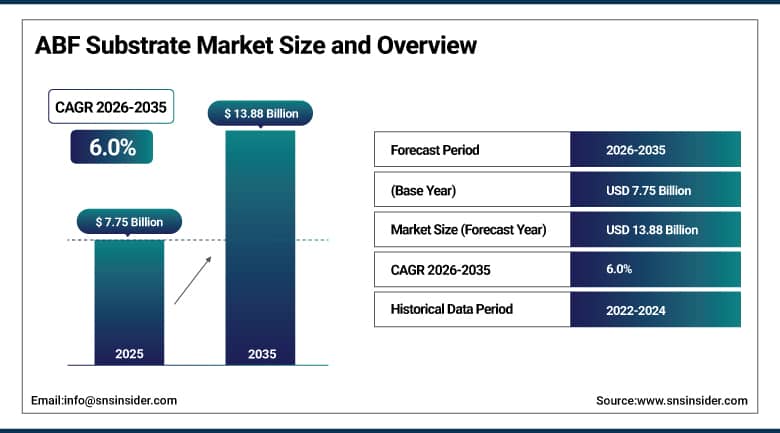
The ABF Substrate Market size was valued at USD 7.75 Billion in 2025 and is projected to reach USD 13.88 Billion by 2035, registering a CAGR of 6.0% from 2026 to 2035.
The ABF Substrate Market is enabling next-generation semiconductor packaging by providing superior electrical performance, thermal management, and miniaturization for high-density interconnections between chips and circuit boards. The market is characterized by accelerating adoption of flip-chip packaging in AI accelerators and high-performance computing processors, rising 5G network infrastructure deployment requiring high-frequency signal handling, growing automotive electrification demanding advanced power modules and battery-management substrates, and increasing industrial and healthcare applications specifying reliable thermal performance. Significant growth is being witnessed in 2.5D and 3D chiplet packaging, coreless substrate architectures, and government-backed capacity investment, considering that substrate manufacturers, foundries, and equipment manufacturers are investing heavily in build-up film technology that overcomes the density limitations of conventional organic substrates.
In 2025, TSMC and Samsung Semiconductor raised orders for ABF substrates by 23% as their customers wanted advanced packaging of new processor nodes, gaming processors, and AI accelerators needing better thermal and signal control.
To Get More Information On ABF Substrate Market - Request Free Sample Report
ABF Substrate Market Trends
-
Accelerating adoption of flip-chip packaging in AI accelerators is expanding advanced-node ABF substrate demand.
-
Growing 2.5D and 3D chiplet packaging is widening substrate density and interconnect requirements.
-
Rising automotive electrification continues expanding demand for power-module and battery-management substrates.
-
Increasing 5G infrastructure deployment is driving substrate demand for high-frequency signal handling.
-
Advancing coreless substrate architectures continue improving electrical performance for premium applications.
U.S. ABF Substrate Market Size Outlook
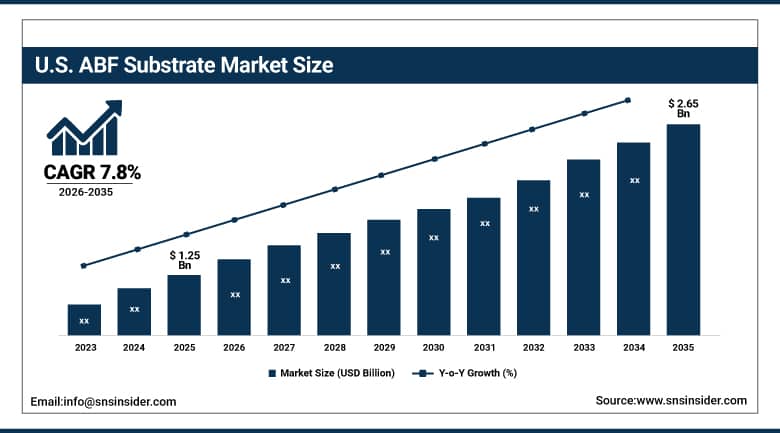
The U.S. ABF Substrate Market was valued at approximately USD 1.25 Billion in 2025 and is projected to reach approximately USD 2.65 Billion by 2035, registering a CAGR of approximately 7.8% from 2026 to 2035.
US market demand was still driven by major semiconductor design firms located domestically, creating demand for substrates from partnerships with foundries involved in manufacturing of cutting-edge processors. US defense and aerospace companies demanding substrates conforming to military specifications and used in avionics, guidance technology, and communications also drove sustained demand. OEMs of automobiles ramped up their EV manufacturing efforts, resulting in more demand for substrates from battery management systems, power inverters, and computing systems in self-driving vehicles. Reshoring efforts helped keep the US among the fastest-growing markets for ABF substrates worldwide during the forecast period.
In 2025, Unimicron Technology Corp. advanced its strategic capacity expansion in Malaysia and Singapore, aiming to balance Asian manufacturing concentration while maintaining quality standards and customer-service responsiveness for U.S. and global design customers.
ABF Substrate Market Segment Analysis
-
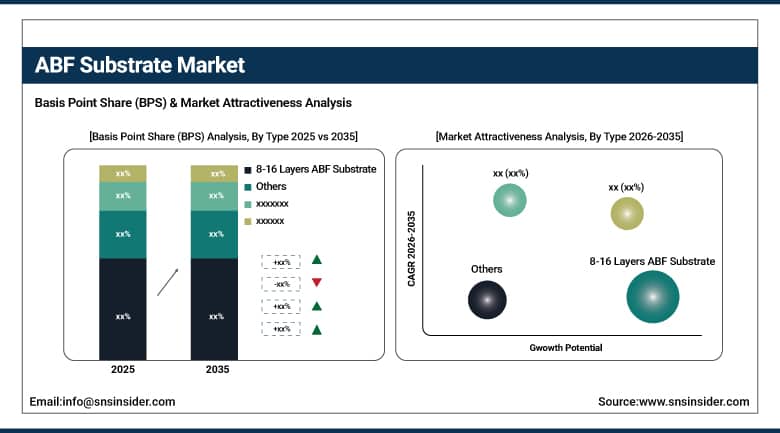
By Type, the 8-16 Layers ABF Substrate segment dominated the ABF Substrate Market with approximately 50.00% share in 2025, while the Others (Above 16 Layers) segment is the fastest growing with a CAGR of approximately 9.60%.
-
By Application, the Consumer Electronics segment dominated the ABF Substrate Market with approximately 41.50% share in 2025, while the Automotive segment is the fastest growing with a CAGR of approximately 7.30%.
-
By End-User, the OEMs segment dominated the ABF Substrate Market with approximately 51.00% share in 2025, while the EMS Providers segment is the fastest growing with a CAGR of approximately 7.00%.
By Type: 8-16 Layers ABF Substrate Leads, Others Grow Fastest
8-16 Layers ABF Substrate dominated the ABF Substrate Market in 2025, as server processors, artificial-intelligence accelerators, and high-performance-computing chips increasingly specify this layer-count range to handle complex wiring requirements and dense input-output configurations. These substrates deliver the routing density and thermal reliability required for data-center processors and AI training hardware, where signal integrity across dozens of high-speed channels is non-negotiable. Major foundries and OEMs continue standardizing on 8-16 layer architectures for flagship processor packaging, as this configuration balances manufacturing yield against the routing complexity needed for modern chiplet-based designs. Sustained data-center and AI-accelerator capital expenditure keeps this layer-count range the largest revenue-generating Type category through the forecast period.
Others, covering ABF substrates above sixteen layers and custom stack-up configurations, are registering the fastest growth in the ABF Substrate Market as advanced GPU and HPC processors push packaging technology toward extreme density and heterogeneous integration. The adoption of 2.5D and 3D IC packaging solutions, in which multiple dies and interposers coexist within a single package, has created a need for substrates that can handle much higher levels of interconnect density compared to conventional substrates. Chip makers creating next-generation AI accelerators with bandwidth needs of over two terabytes per second are among those who now need high-density layer substrates. Scaling of chiplet interconnect standards will ensure that this segment grows faster than the rest of the industry until 2035.
By Application: Consumer Electronics Leads, Automotive Grows Fastest
Consumer Electronics segment accounted for the largest share of the ABF Substrate Market in 2025 due to steady demand from smartphone, tablet, and laptop vendors who seek packaging for their premium processors, power management circuitry, and RF circuits. The production of more than 1.2 billion smartphones per year includes ABF substrates used in application processors and memory interface technology, and the largest device vendors create volume and specifications of demand for these substrates throughout their entire portfolio of products. Also, manufacturers of laptops and notebooks have the need for high-end processors and graphics processors that will provide computing performance within affordable pricing. Gaming consoles, wearables, and portable media players are an incremental demand due to increasing complexity of consumer electronics.
Automotive is the fastest-growing end-use segment in the ABF Substrate Market due to the increasing manufacturing of battery electric vehicles, proliferation of semiconductor in battery management systems, and advanced driver assistance systems. The production increase of electric vehicles has created a high demand for substrates since each battery management system needs advanced substrates for its thermal management and electrical isolation during operation. The original equipment manufacturers of automobiles have set down specifications of ABF substrates in their electric vehicles' programs for several years into the future. Conventional internal combustion engines are still using ABF substrates in their engine management and infotainment systems, while qualification against automotive standards is speeding up its growth in the segment.
By End-User: OEMs Lead, EMS Providers Grow Fastest
OEMs are the largest ABF Substrate Market end-user segment, which includes semiconductor producers that use ABF substrates within their proprietary packaging and fabrication processes. The largest foundries and IDM use ABF substrates from suppliers, forming lasting relationships and partnerships in order to develop new technologies in the field of advanced packaging. This ensures that quality products are available and helps to meet the specifications set out by the clients as well as production volumes required. Continuous investment by semiconductor leaders in next-generation processors and accelerators for AI applications has helped to keep OEMs as the largest end-users over the forecast period.
EMS Providers witness the highest growth rate as far as end users are concerned due to the growing practice among automotive equipment, industrial equipment, and telecommunication equipment companies to outsource manufacturing, assembly, and testing of their products to EMS Providers who handle supplier relations and quality control. Increasing complexity of automotive power electronics modules and telecommunication network equipment forces equipment brand owners to engage with EMS Providers who possess unique knowledge and operational capacity for ABF substrate sourcing. Outsourcing approach allows equipment manufacturers to concentrate on system design and branding while EMS providers take care of manufacturing process and complexities associated with it.
Regional Analysis
|
Region |
Major Country |
Share within Region, 2025 (%) |
|
North America |
United States |
85.00% |
|
Europe |
Germany |
35.00% |
|
Asia Pacific |
Taiwan |
40.00% |
|
Middle East and Africa |
UAE |
28.00% |
|
Latin America |
Mexico |
42.00% |
Asia Pacific ABF Substrate Market Insights
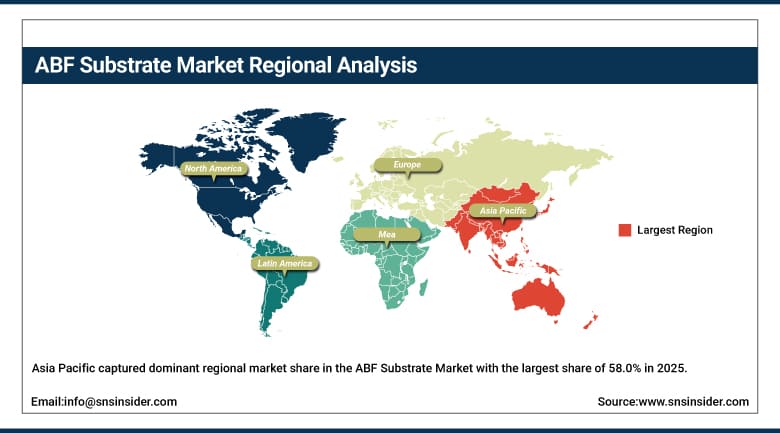
Asia Pacific captured dominant regional market share in the ABF Substrate Market with the largest share of 58.0% in 2025, driven by the concentration of semiconductor manufacturing, printed circuit board production, and consumer-electronics assembly across Taiwan, South Korea, China, and Japan. Taiwan's position as home to leading semiconductor foundries and substrate manufacturers has created an integrated ecosystem where advanced substrate development directly supports the world's largest fabless design companies. South Korea's vertically integrated semiconductor and substrate production facilities capture significant value across the supply chain, while China's rapid advancement in semiconductor self-sufficiency continues accelerating domestic ABF substrate capacity expansion.
Taiwan was responsible for about 40.00% of regional revenues, owing to the presence of an ecosystem that integrates leading foundry companies with local substrate suppliers. The demand from South Korea and Japan, owing to their vertically integrated production capabilities and higher position in high-reliability substrates for automotive and industrial applications, also contributed significantly. China's increasing substrate capacity domestically and India's growth in semiconductor assembly and test market helped Asia Pacific remain the largest ABF Substrates market.
Get Customized Report as Per Your Business Requirement - Enquiry Now
North America ABF Substrate Market Insights
North America has witnessed the fastest growth amongst all regions with a CAGR of 7.8% up to 2035, attributed to large semiconductor design companies, aerospace & defense firms, and automotive original equipment manufacturers who need advanced high-reliability substrates. The leadership position of the US in semiconductor IP and fabless semiconductor designs, along with advanced packaging technology research, kept the demand for high-quality ABF substrate solutions strong with the help of foundries in order to manufacture processors.
The United States accounted for roughly 85.00% of regional revenue, anchored by leading design companies headquartered domestically and defense and aerospace contractors requiring ABF substrates meeting stringent qualification standards. Canada and Mexico contributed further regional demand through nearshoring of semiconductor assembly and test operations, and that combined strength kept North America the fastest-growing ABF Substrate market through the forecast period.
Europe ABF Substrate Market Insights
Europe held a meaningful share of global ABF Substrate Market revenue, with growth driven by automotive manufacturing concentration in Germany, France, and Italy, coupled with telecommunications infrastructure development and industrial automation initiatives. Leading European automakers' electric-vehicle platforms require ABF substrates in battery-management systems, power inverters, and advanced driver-assistance-system controllers, while regional emphasis on supply-chain resilience and technology sovereignty continued prompting infrastructure investment supporting domestic substrate production capacity.
Germany accounted for an approximate share of 35.00% of the revenue generated in Europe, driven by the large automotive manufacturing industry as well as the presence of suppliers of power electronics in the region. France and Italy added to the demand from Europe with their automotive and industrial automation sectors respectively, while the manufacturing industry in Austria helped keep the demand on the upswing.
Latin America and Middle East & Africa ABF Substrate Market Insights
Latin America and the Middle East and Africa both showed steady growth, driven by expanding electronics-assembly nearshoring, growing automotive-component manufacturing, and increasing government-backed technology-sector investment across both regions. Mexico's semiconductor assembly and test-operations expansion, supporting nearshoring of United States consumer-electronics manufacturing, continued generating regional substrate demand growth throughout the forecast period.
The UAE held the largest share of Middle East and African revenues at approximately 28.00%, backed by increasing investments in technology infrastructure and electronics assembly projects. In Latin America, Mexico represented the highest share of regional revenues at approximately 42.00%, owing to increasing near-shoring of semiconductor assembly and automotive component assembly production within the region.
Market Dynamics
Growth Drivers: AI/HPC Packaging Demand and Automotive Electrification
The industry is driven by the semiconductor industry's relentless pursuit of smaller package footprints, higher pin counts, and improved electrical performance, as manufacturers transition from traditional organic substrates to advanced build-up film technologies. Flip-chip packaging architectures utilizing ABF substrates enable pitch reduction supporting the integration of increasingly complex system-on-chip designs, and major foundries have significantly increased ABF substrate orders as customers demand advanced packaging for next-generation processor nodes and artificial-intelligence accelerators requiring superior thermal management and signal integrity.
Automotive electrification represents a further driver, as the industry's transition toward battery electric vehicles and advanced driver-assistance platforms generates substantial ABF substrate demand for power electronics, battery-management systems, and sensor-integration modules. Government initiatives supporting semiconductor self-sufficiency, including the U.S. CHIPS Act and the European Chips Act, have catalyzed capacity investments and technological innovation, and that combination of AI infrastructure buildout and automotive electrification is exactly what keeps demand climbing at such a sustained pace.
Restraints: Limited Manufacturing Capacity and Supply-Chain Concentration
The lack of capacity for production is a significant barrier to growth since only a few companies have the technological capabilities and facilities that can enable them to provide ABF substrates in quantities that satisfy the needs of the semiconductor industry. As a result of this, the sector has experienced supply shortages due to the high level of manufacturing complexity, expensive entry barriers, and significant capital costs that have been deterring new entrants into the market.
Dependence on limited sources of suppliers in specific regions makes the industry vulnerable to supply chain disruptions because of geopolitical conflicts, trade limitations, and natural calamities. There has been continuous price inflation in the cost of raw materials used in the fabrication of photoimageable dielectric resin and copper material, thus posing a challenge to profitability in the cost-sensitive applications of the substrates. The high manufacturing complexities and increased R&D costs have made it difficult for smaller firms to keep up with technological advancements.
Opportunities: AI Accelerator Packaging and Automotive/IoT Expansion
Advanced packaging technology adoption for emerging applications, including artificial-intelligence accelerators, high-bandwidth-memory integration, and chiplet architectures, creates substantial growth opportunities for ABF substrate manufacturers supporting next-generation semiconductor packaging innovation. Next-generation process nodes reaching two nanometers and below in production volume will drive substrate consumption growth as semiconductor manufacturers deploy advanced packaging at scale supporting artificial intelligence and data-center acceleration.
Growing use of semiconductors in automotive electronics and Internet of Things devices offers a second substantial opportunity, as electric vehicles and autonomous-driving systems require high-reliability chips capable of operating in harsh environments. Manufacturers that adapt their ABF substrate offerings to meet the specific requirements of these applications, including reduced cost, greater durability, and lower power consumption, stand to capture meaningful share as demand for miniaturized, low-power packaging continues expanding through the forecast period.
Recent Developments:
-
2025: Ibiden Co., Ltd. expanded its European manufacturing capabilities through facility investment in Austria in partnership with AT&S Austria Technologie und Systemtechnik AG.
-
2025: Unimicron Technology Corp. achieved 0.25mm pitch ball grid array interconnections through proprietary photoimageable dielectric formulations and precision pattern-transfer techniques.
-
2024: Shennan Circuits Co., Ltd. and Wus Printed Circuit Co., Ltd. expanded domestic ABF substrate production capacity in China, increasing regional supply-chain self-sufficiency.
ABF Substrate Companies are:
-
Unimicron Technology Corp.
-
Ibiden Co., Ltd.
-
Shinko Electric Industries Co., Ltd.
-
Ajinomoto Fine-Techno Co., Ltd.
-
Kinsus Interconnect Technology Corp.
-
Nan Ya PCB Corporation
-
ASE Technology Holding Co., Ltd.
-
AT&S Austria Technologie & Systemtechnik AG
-
TTM Technologies, Inc.
-
Daeduck Electronics Co., Ltd.
-
Samsung Electro-Mechanics Co., Ltd.
-
Kyocera Corporation
-
Zhen Ding Technology Holding Limited
-
LG Innotek Co., Ltd.
-
Shennan Circuits Co., Ltd.
-
Simmtech Co., Ltd.
-
Korea Circuit Co., Ltd.
-
Wus Printed Circuit Co., Ltd.
-
Meiko Electronics Co., Ltd.
-
Tripod Technology Corporation
ABF Substrate Market Report Scope:
| Report Attributes | Details |
|---|---|
| Market Size in 2025 | USD 7.75 Billion |
| Market Size by 2035 | USD 13.88 Billion |
| CAGR | CAGR of 6.0% From 2026 to 2035 |
| Base Year | 2025 |
| Forecast Period | 2026-2035 |
| Historical Data | 2022-2024 |
| Report Scope & Coverage | Market Size, Segments Analysis, Competitive Landscape, Regional Analysis, DROC & SWOT Analysis, Forecast Outlook |
| Key Segments | • By Type (4-8 Layers ABF Substrate, 8-16 Layers ABF Substrate, Others) • By Application (Consumer Electronics, Automotive, Telecommunications, Industrial, Healthcare, Others) • By End-User (OEMs, ODMs, EMS Providers) |
| Regional Analysis/Coverage | North America (US, Canada), Europe (Germany, UK, France, Italy, Spain, Russia, Poland, Rest of Europe), Asia Pacific (China, India, Japan, South Korea, Australia, ASEAN Countries, Rest of Asia Pacific), Middle East & Africa (UAE, Saudi Arabia, Qatar, South Africa, Rest of Middle East & Africa), Latin America (Brazil, Argentina, Mexico, Colombia, Rest of Latin America). |
| Company Profiles | Unimicron Technology Corp., Ibiden Co., Ltd., Shinko Electric Industries Co., Ltd., Ajinomoto Fine-Techno Co., Ltd., Kinsus Interconnect Technology Corp., Nan Ya PCB Corporation, ASE Technology Holding Co., Ltd., AT&S Austria Technologie & Systemtechnik AG, TTM Technologies, Inc., Daeduck Electronics Co., Ltd., Samsung Electro-Mechanics Co., Ltd., Kyocera Corporation, Zhen Ding Technology Holding Limited, LG Innotek Co., Ltd., Shennan Circuits Co., Ltd., Simmtech Co., Ltd., Korea Circuit Co., Ltd., Wus Printed Circuit Co., Ltd., Meiko Electronics Co., Ltd., Tripod Technology Corporation. |
Frequently Asked Questions
Key players in the ABF Substrate Market include Unimicron Technology Corp., Ibiden Co., Ltd., Shinko Electric Industries Co., Ltd., Ajinomoto Fine-Techno Co., Ltd., and Kinsus Interconnect Technology Corp., among others.
Key opportunities in the ABF Substrate Market include advanced packaging adoption for AI accelerators and high-bandwidth-memory integration, and expanding use in automotive electronics and IoT devices.
The market is driven by accelerating AI and HPC packaging demand, expanding 5G infrastructure deployment, rising automotive electrification, and growing adoption of advanced flip-chip and chiplet packaging.
The 8-16 Layers ABF Substrate segment dominated the ABF Substrate Market, accounting for approximately 50.00% market share in 2025.
Asia Pacific dominated the ABF Substrate Market in 2025 with a 58.0% share, driven by the concentration of semiconductor manufacturing, printed circuit board production, and consumer-electronics assembly across Taiwan, South Korea, China, and Japan.
