
Industrial Agitators Market Report Scope & Overview:
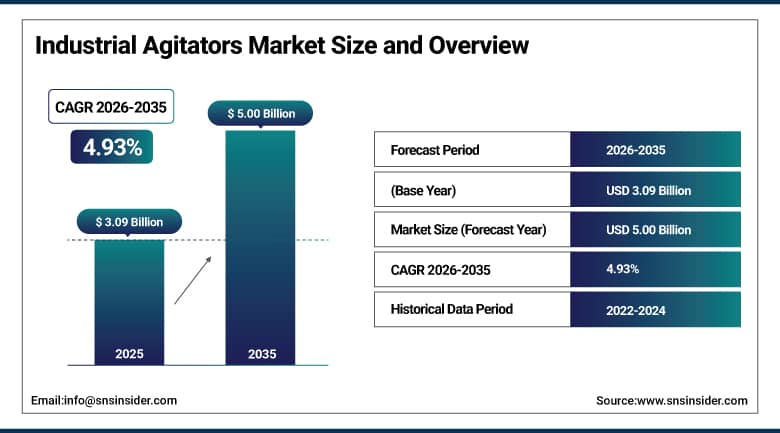
The Industrial Agitators Market was valued at USD 3.09 Billion in 2025 and is expected to reach USD 5.00 Billion by 2035, growing at a CAGR of 4.93% from 2026 to 2035.
The global industrial agitators’ market is witnessing a directional shift toward durable material choices including stainless steel and quality-specific alloys that sustain performance in high-temperature and high-pressure operating zones across process industry applications. Maintenance practices have become more systematic, with most sectors adopting preventive maintenance programmes within 6-to-12-month intervals that reduce unplanned downtime and extend equipment service life. A significant emphasis on energy efficiency is prompting widespread adoption of variable speed drives and smart monitoring technologies that optimise agitator power consumption relative to process mixing requirements. Industrial agitators are essential fluid processing equipment used across chemical, pharmaceutical, food and beverage, water treatment, and oil and gas industries to achieve mixing, blending, emulsification, heat transfer, and chemical reaction homogeneity within process vessels of widely varying scale and fluid characteristics.
In 2024, SPX FLOW expanded its Lightnin agitator portfolio with new high-efficiency impeller designs incorporating computational fluid dynamics optimised blade geometry that reduces power consumption per unit mixing intensity by approximately 15 to 20 percent relative to conventional turbine impeller configurations. This product innovation reflects the industrial agitator market's transition toward energy performance as a primary procurement specification criterion, driven by industrial operators' energy cost reduction objectives and sustainability reporting requirements that elevate operating cost efficiency above initial purchase price in the total cost of ownership evaluation for long-lived process equipment.
To Get More Information On Industrial Agitators Market - Request Free Sample Report
Industrial Agitators Market Trends
-
Growing integration of variable frequency drives (VFDs) is improving agitator energy efficiency by enabling precise speed control and optimized mixing performance across industrial processes
-
Adoption of IIoT-enabled smart agitators is increasing as manufacturers leverage real-time monitoring, predictive maintenance, and performance analytics to reduce downtime and operating costs
-
Rising implementation of hygienic design standards is driving demand for sanitary agitators in pharmaceutical, biotechnology, and food & beverage industries requiring strict cleanliness and regulatory compliance
-
Increasing use of portable agitators is supporting flexible batch processing operations by providing cost-effective and adaptable mixing solutions across multiple production environments
-
Computational fluid dynamics (CFD)-based design optimization is enhancing agitator performance through advanced simulation of fluid flow, mixing efficiency, and application-specific impeller configurations
U.S. Industrial Agitators Market Outlook
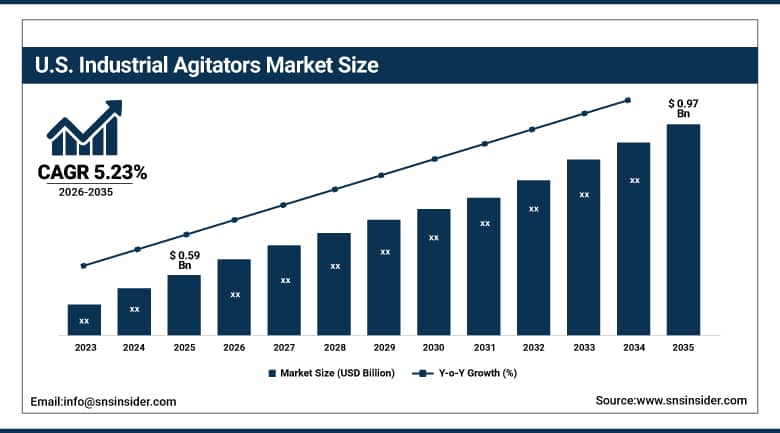
The U.S. Industrial Agitators Market was valued at approximately USD 0.59 Billion in 2025 and is expected to reach approximately USD 0.97 Billion by 2035, growing at a CAGR of approximately 5.23%.
The U.S. is the most commercially significant industrial agitators market within North America, driven by the increased demand primarily from chemical, pharmaceutical, and food and beverage industries whose combined procurement defines the domestic commercial base. SPX FLOW's Lightnin, EKATO Group, Philadelphia Mixing Solutions, Chemineer, and Haynes Wire Company collectively serve the domestic market across a wide application range. Manufacturers are increasingly adopting energy-efficient agitators installed with smart technologies including variable frequency drives and Industrial IoT capabilities to boost operational efficiency and meet stringent environmental regulations. The trend toward customised agitator solutions is also on the rise as industrial operators seek equipment precisely suited to their specific process requirements including viscosity profile, mixing objective, tank geometry, and hazardous area classification.
In 2023, Alfa Laval introduced new Hybrid Agitator configurations combining axial and radial flow impeller elements for the pharmaceutical and food processing sectors, enabling a single agitator system to deliver both bulk blending and shear-intensive emulsification mixing objectives within the same vessel without impeller exchange. The innovation addresses pharmaceutical manufacturers' requirement for process flexibility during multi-product batch manufacturing campaigns where vessel changeover time directly impacts production throughput and facility utilisation economics.
Industrial Agitators Market Segment Analysis
-
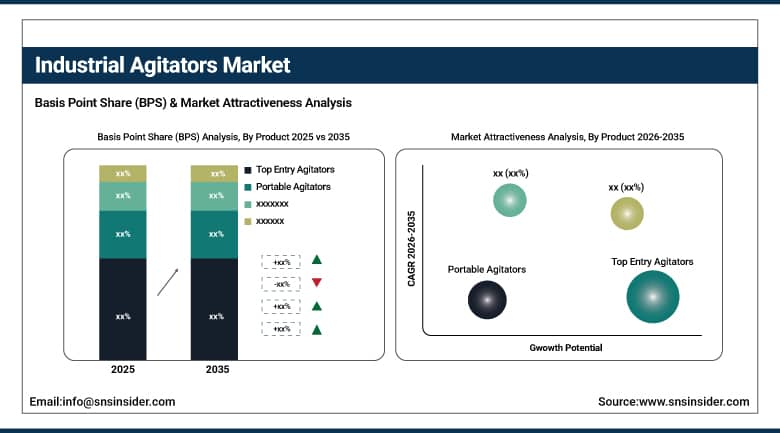
By Product, the Top Entry segment dominated the Industrial Agitators Market with approximately 42.4% share in 2025, while the Portable segment is the fastest growing.
-
By End Use, the Chemical segment dominated the Industrial Agitators Market with approximately 32% share in 2025, while the Pharmaceutical segment is the fastest growing.
By Product, top entry dominates, portable grows fastest
Top entry agitators retained the dominant product position with approximately 42.4% of the industrial agitator’s market in 2025. Their commercial primacy reflects the large-scale process industry's structural preference for top-mounted vertical shaft agitator configurations whose mechanical simplicity, broad impeller selection compatibility, and proven performance in large-diameter storage and process tanks create the most commercially versatile agitator architecture across chemical, oil and gas, and water treatment applications. Each large crude oil storage tank, each reactor vessel in a chemical plant, and each water treatment clarifier basin creates top entry agitator procurement whose per-unit commercial value substantially exceeds smaller format alternatives. The configuration's ability to accommodate multiple impeller stages on a single shaft creates mixing zone distribution in tall vessels that single impeller side and bottom entry alternatives cannot achieve equivalently.
Portable agitators are the fastest growing product because batch process flexibility, pilot plant and scale-up testing requirements, and small to medium enterprise budget constraints collectively create procurement preference for mobile mixing equipment that can serve multiple vessel locations without the civil engineering and structural installation investment that fixed top, side, or bottom entry agitators require. Each pharmaceutical compounding facility, each food and beverage batch kitchen, and each specialty chemical blending operation whose product portfolio diversity requires mixing equipment flexibility creates portable agitator procurement whose commercial aggregate across the growing batch processing sector sustains the segment's fastest-growing designation. The post-pandemic acceleration of pharmaceutical manufacturing at contract manufacturing organisations creates particular demand for portable agitation in flexible fill-finish and API synthesis environments.
By End Use, chemical dominates, pharmaceutical grows fastest
Chemical retained the dominant end-use position with approximately 32% of the industrial agitators market in 2025. The chemical industry's commercial dominance reflects the extraordinary breadth of mixing requirements that span reaction vessel agitation, solvent extraction mixing, slurry suspension, polymer blending, crystallisation control, and heat transfer enhancement across the full spectrum of inorganic, organic, fine, and specialty chemical manufacturing. Each chemical plant whose reactor vessel, storage tank, and intermediate processing vessel creates agitator procurement whose commercial aggregate across global chemical production investment sustains the segment's market leadership. The chemical sector's continuous production process preference creates high availability requirement for agitator equipment whose reliability and service life directly determine production uptime and yield consistency.
Pharmaceutical is the fastest growing end use because the biopharmaceutical manufacturing expansion, the global biosimilar market's production capacity investment, and the gene therapy and mRNA vaccine manufacturing sector's rapid scale-up create above-average agitator procurement from a sector whose GMP compliance requirements create premium specification investment above commodity mixing equipment. Each new bioreactor installation for monoclonal antibody production, each fermentation vessel for antibiotic manufacturing, and each mixing vessel for sterile pharmaceutical formulation creates agitator procurement whose sanitary design, CIP compatibility, and GMP documentation requirements create commercial relationships that sustain premium pricing relative to industrial-grade commodity alternatives. The pharmaceutical industry's global post-pandemic manufacturing capacity expansion creates particular momentum that sustains the segment's fastest-growing designation.
By Product, side entry and bottom entry in context
Side entry agitators hold an important position in the product landscape for specific applications where top entry installation is impractical due to tank operating pressure, floating roof design, or access constraint. Side entry configurations are widely used in petroleum storage tank blending applications where horizontal shaft mounting through the tank shell wall provides effective mixing without the above-grade structure that top entry installation requires. Bottom entry agitators serve applications in crystallisation vessels, bioreactors, and closed pharmaceutical processing vessels whose bottom-mounted sealed shaft eliminates the top access requirement that creates contamination risk in sterile processing environments. Static mixers serve continuous flow applications within pipelines and tubular reactors where no moving parts requirement creates maintenance-free mixing performance across fluid streams whose Reynolds number and viscosity range are within the achievable static mixing efficiency envelope.
Regional Analysis
|
Region |
Major Country |
Share within Region, 2025 (%) |
|---|---|---|
|
North America |
United States |
87.4% |
|
Europe |
Germany |
22.3% |
|
Asia Pacific |
China |
44.8% |
|
Middle East & Africa |
Saudi Arabia |
31.2% |
|
Latin America |
Brazil |
44.2% |
Asia Pacific Industrial Agitators Market Insights
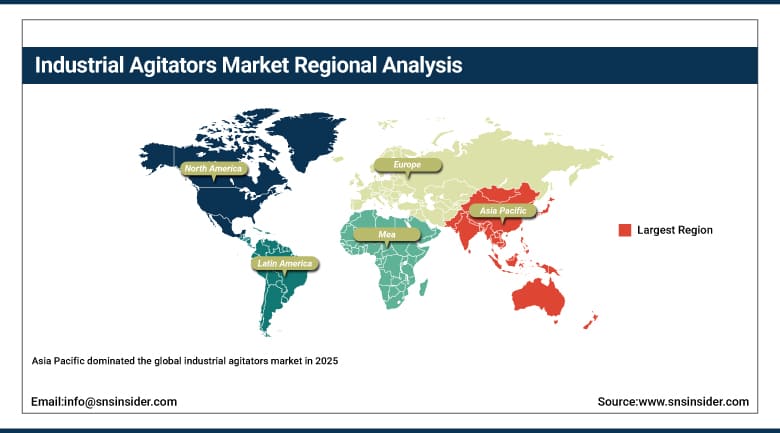
Asia Pacific dominated the global industrial agitators market in 2025, driven by rapid industrialisation in China, India, Japan, South Korea, and Southeast Asia whose chemical, water treatment, oil and gas, food processing, and pharmaceutical manufacturing sectors create the most commercially concentrated regional agitator procurement globally. China accounts for approximately 44.8% of Asia Pacific revenues through its position as the world's largest chemical producer, the expanding pharmaceutical manufacturing sector, and the water treatment infrastructure investment that creates above-average agitator procurement across multiple end-use sectors simultaneously.
India represents the most commercially dynamic emerging market within Asia Pacific where the pharmaceutical industry's API manufacturing expansion, the chemical sector's capacity growth, and the water treatment infrastructure development under the government's Jal Jeevan Mission create above-average industrial agitator procurement from both new facility construction and legacy equipment modernisation.
Get Customized Report as Per Your Business Requirement - Enquiry Now
North America Industrial Agitators Market Insights
North America is the fastest growing regional industrial agitators market within its established commercial base, driven by chemical sector reshoring investment, pharmaceutical manufacturing expansion, and the increasing adoption of energy-efficient agitator systems that sustain replacement procurement cycles above baseline equipment ageing replacement rates. The United States accounts for approximately 87.4% of North American revenues through SPX FLOW's Lightnin operations, Philadelphia Mixing Solutions, Chemineer, and Haynes Wire's commercial presence.
Canada contributes approximately 12.6% of North American revenues through its oil sands mining and upgrading sector's agitator procurement, the water treatment infrastructure investment, and the food and beverage processing industry's blending equipment demand.
Europe Industrial Agitators Market Insights
Europe is a technically sophisticated industrial agitators market where the chemical industry's Verbund site integration, EKATO Group's German headquarters leadership, and the pharmaceutical sector's strict GMP compliance requirement create above-average per-unit specification investment that sustains premium commercial relationships. Germany accounts for approximately 22.3% of European revenues through its chemical industry's BASF, Evonik, and Bayer procurement, EKATO Group's domestic operations, and the pharmaceutical manufacturing sector's sanitary agitator investment.
The United Kingdom, Netherlands, and France are significant secondary markets where the chemical industry's ICI legacy asset base, Shell and TotalEnergies' refinery agitator procurement, and the food and beverage sector's hygienic mixing investment create consistent commercial demand. Alfa Laval's Swedish operations and Sulzer's Swiss agitator practice sustain regional supply capability.
MEA & Latin America Industrial Agitators Market Insights
Saudi Arabia leads MEA revenues at approximately 31.2% through ARAMCO's refinery and petrochemical facility agitator procurement, SABIC's chemical manufacturing mixing equipment investment, and the water desalination sector's large-scale agitation requirements. The UAE's petrochemical industry adds complementary Gulf demand. Brazil leads Latin American revenues at approximately 44.2% through Petrobras' refinery processing equipment, the food and beverage industry's mixing investment, and the water treatment infrastructure expansion. Mexico's chemical manufacturing sector and Colombia's expanding food processing industry collectively sustain growing regional market development through 2035.
Market Dynamics
Growth Drivers: Process efficiency automation demand and expanding water treatment infrastructure investment
Rising demand for advanced mixing technologies across oil and gas, chemical, pharmaceutical, and water treatment industries is the industrial agitators market's most commercially consistent structural growth driver. The increasing complexity of chemical reactions requiring precise temperature uniformity, concentration homogeneity, and reaction rate control creates growing demand for engineered agitation solutions beyond commodity commodity propeller mixing. Each new specialty chemical plant, each API synthesis facility, and each bioreactor installation creates agitator procurement whose engineering requirement sustains premium specification above commodity industrial grade alternatives.
Environmental regulations enforcing stringent wastewater treatment standards and industrial effluent quality requirements are compelling industries to adopt high-performance agitators for effective clarification, biological treatment, and sludge processing. Each new wastewater treatment plant commissioned under regulatory compliance timelines and each legacy facility upgrade creates agitator procurement whose institutional procurement cycle sustains consistent commercial demand across the water treatment equipment supply chain.
Restraints: High design complexity and installation challenges for custom agitator configurations
High design complexity leading to elevated manufacturing cost is a key restraint in the industrial agitator’s market. Different process requirements across industries, encompassing fluid viscosity, mixing speed, tank geometry, and chemical compatibility characteristics, make standardised solutions unsuitable for many applications and require custom engineering that extends lead times and increases total procurement cost. Each custom agitator specification requiring application-specific impeller selection, shaft seal design, and drive configuration creates engineering investment whose cost and timeline moderates’ procurement pace in capital-constrained industrial expansion programmes.
The large physical size and mechanical complexity of top entry agitator systems in large process vessels creates installation challenges whose structural support, crane access, and vessel penetration requirements create civil and mechanical engineering scope that substantially exceeds the agitator equipment cost itself. Retrofitting older facilities with modern agitator systems creates particular complexity when existing vessel nozzle locations, headroom clearances, and structural load capacity constrain the replacement equipment specification.
Opportunities: Pharmaceutical bioreactor expansion and IoT-integrated smart agitation systems
The post-pandemic acceleration of pharmaceutical manufacturing capacity investment, particularly in bioreactor-based biopharmaceutical production, represents the most commercially premium near-term opportunity for precision agitator manufacturers whose hygienic design, GMP compliance, and controlled impeller performance capability creates specification preference in pharmaceutical procurement. Each new monoclonal antibody manufacturing facility and each contract manufacturing organisation expanding bioreactor capacity creates sanitary agitator procurement whose regulatory documentation and validation requirements create long-duration customer relationships that sustain premium commercial margins.
IoT and smart monitoring integration in industrial agitators represents the most commercially differentiated product development direction whose real-time vibration analysis, power consumption optimisation, and predictive maintenance data create operational value beyond the physical mixing function alone. Each smart agitator installation that reduces unplanned downtime, optimises energy consumption, and extends service interval through condition-based maintenance creates demonstrable return on investment that sustains premium specification above conventional non-connected alternatives.
Recent Developments:
-
2024: SPX FLOW expanded its Lightnin agitator portfolio in 2024 with new high-efficiency impeller designs incorporating CFD-optimised blade geometry that reduces power consumption per unit mixing intensity by approximately 15 to 20 percent relative to conventional turbine impeller configurations.
-
2024: EKATO Group launched its next-generation EKATO HWL laboratory reactor agitator system in 2024 with integrated IIoT connectivity for real-time torque, temperature, and mixing intensity monitoring, targeting pharmaceutical and specialty chemical development laboratories requiring precise process parameter documentation for scale-up validation.
-
2023: Alfa Laval introduced new Hybrid Agitator configurations in 2023 combining axial and radial flow impeller elements for pharmaceutical and food processing applications, enabling single agitator systems to deliver both bulk blending and emulsification objectives within the same vessel without impeller exchange.
-
2023: Philadelphia Mixing Solutions launched an enhanced PHLOX impeller series in 2023 with improved surface finish and CIP-validated sanitary design for biopharmaceutical and food-grade applications requiring FDA 21 CFR compliance and EHEDG certification for mixing contact surfaces.
-
2023: Sulzer expanded its agitator service and retrofit programme in 2023 with new predictive maintenance monitoring packages for installed base equipment, offering vibration analysis, gearbox condition monitoring, and seal performance tracking through IIoT-connected sensor kits compatible with legacy Sulzer and competitor agitator installations.
Industrial Agitators Market Key Players
-
SPX FLOW Inc. (Lightnin)
-
EKATO Group
-
Philadelphia Mixing Solutions Ltd.
-
Alfa Laval AB
-
Sulzer Ltd.
-
Chemineer Inc. (NOV)
-
Mixel SAS
-
Inoxpa SLU
-
Silverson Machines Ltd.
-
Admix Inc.
-
Haynes Wire Company
-
Agitaser SL
-
SUMA Rührtechnik GmbH
-
Metenova AB
-
Dynamix Inc.
-
Tsurumi Manufacturing Co. Ltd.
-
Fusion Fluid Equipment LLC
-
GMM Pfaudler Ltd.
-
De Dietrich Process Systems GmbHARDE Barinco Inc.
Industrial Agitators Market Report Scope:
| Report Attributes | Details |
|---|---|
| Market Size in 2025 | USD 3.09 Billion |
| Market Size by 2035 | USD 5.00 Billion |
| CAGR | CAGR of 4.93% From 2026 to 2035 |
| Base Year | 2025 |
| Forecast Period | 2026-2035 |
| Historical Data | 2022-2024 |
| Report Scope & Coverage | Market Size, Segments Analysis, Competitive Landscape, Regional Analysis, DROC & SWOT Analysis, Forecast Outlook |
| Key Segments | • by Product (Top Entry, Side Entry, Bottom Entry, Portable, Static) • by End Use (Chemical, Water and Wastewater Treatment, Oil, Gas and Petrochemical, Food and Beverages, Pharmaceutical, Others) |
| Regional Analysis/Coverage | North America (US, Canada, Mexico), Europe (Eastern Europe [Poland, Romania, Hungary, Turkey, Rest of Eastern Europe] Western Europe] Germany, France, UK, Italy, Spain, Netherlands, Switzerland, Austria, Rest of Western Europe]), Asia Pacific (China, India, Japan, South Korea, Vietnam, Singapore, Australia, Rest of Asia Pacific), Middle East & Africa (Middle East [UAE, Egypt, Saudi Arabia, Qatar, Rest of Middle East], Africa [Nigeria, South Africa, Rest of Africa], Latin America (Brazil, Argentina, Colombia, Rest of Latin America) |
| Company Profiles | SPX FLOW Inc. (Lightnin), EKATO Group, Philadelphia Mixing Solutions Ltd., Alfa Laval AB, Sulzer Ltd., Chemineer Inc. (NOV), Mixel SAS, Inoxpa SLU, Silverson Machines Ltd., Admix Inc., Haynes Wire Company, Agitaser SL, SUMA Rührtechnik GmbH, Metenova AB, Dynamix Inc., Tsurumi Manufacturing Co. Ltd., Fusion Fluid Equipment LLC, GMM Pfaudler Ltd., De Dietrich Process Systems GmbH, ARDE Barinco Inc. |
Frequently Asked Questions
Top Entry agitators dominated the Industrial Agitators Market with approximately 42.4% share in 2025, while Portable agitators is the fastest growing segment.
Rising demand for advanced mixing technologies in complex chemical and pharmaceutical processes, expanding water and wastewater treatment infrastructure investment driven by environmental regulation compliance, and energy efficiency mandates creating replacement procurement cycles as operators upgrade legacy agitator equipment with variable speed drive integrated modern alternatives.
The Industrial Agitators Market is expected to grow at a CAGR of 4.93% from 2026 to 2035.
