
Liquid Flavor Market Report Scope & Overview:
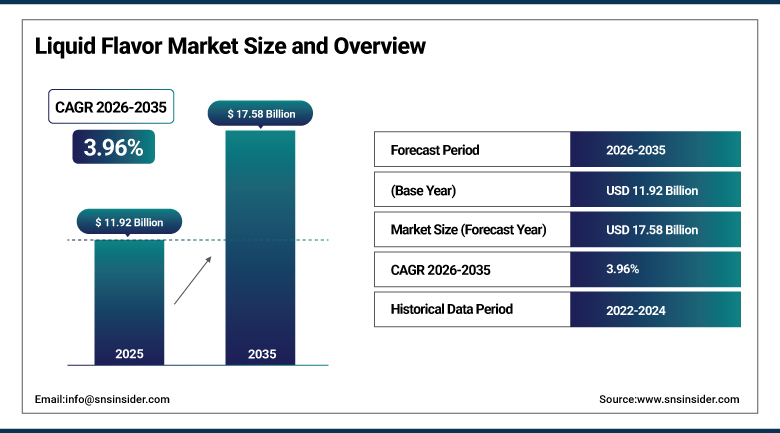
The Liquid Flavor Market was valued at USD 11.92 Billion in 2025 and is expected to reach USD 17.58 Billion by 2035, growing at a CAGR of 3.96% from 2026 to 2035.
The market for Liquid Flavors is exhibiting consistent growth driven by the need of the food & beverages industry for products that cater to the changing tastes of consumers in terms of clean label, natural and plant-based flavors. The ever-growing consumer preference for taste authenticity is creating innovations in flavors such as exotic, ethnic and functional ones used in beverages, confections, dairy and bakery goods. Technical developments in flavor encapsulation and solubility have increased the range of applications possible and the inclusion of nutraceutical, e-liquid and dairy alternatives is helping the market grow further. Apart from that, increased sustainability pressures and use of artificial intelligence to customize flavors are contributing to the trend.
In 2026, Givaudan inaugurated a new, state-of-the-art production facility in Cikarang, Indonesia, expanding its manufacturing capacity to serve growing regional demand for flavor solutions across Southeast Asia’s food and beverage industries.
Market Size and Forecast
- Market Size in 2026E: USD 12.39 Billion
- Market Size by 2035: USD 17.58 Billion
- CAGR: 3.96% from 2026 to 2035
- Fastest Growing Region: Asia Pacific
- Largest Region: North America
To Get more information Liquid Flavor Market - Request Free Sample Report
Liquid Flavor Market Trends
- Growing demand for herbal and functional flavor profiles is expanding rapidly as consumers seek wellness-oriented beverage and food formulations.
- Rising expansion into nutraceutical, e-liquid, and dairy alternative markets continues broadening liquid flavor’s addressable application base beyond traditional food and beverage categories.
- Expanding use of flavor encapsulation technology is improving solubility, stability, and shelf-life performance across diverse product formats.
- Increasing integration of AI-powered tools for personalized flavor recommendations is reshaping product development timelines for beverage and food manufacturers.
- Growing manufacturer investment in sustainable and green sourcing practices is reshaping ingredient procurement strategies across the flavor industry.
U.S. Liquid Flavor Market Outlook
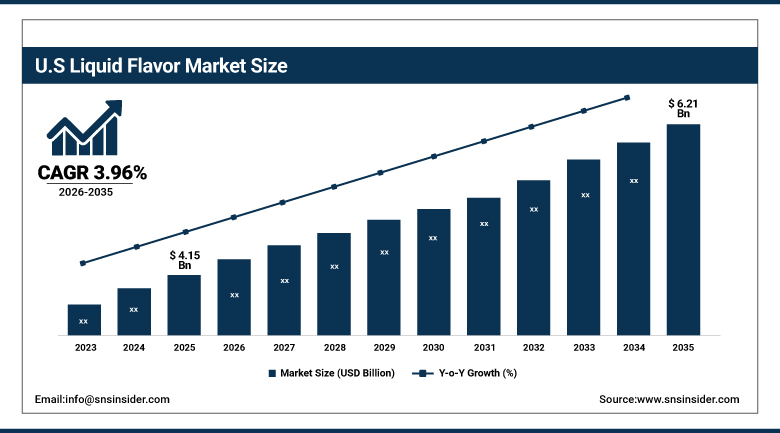
The U.S. Liquid Flavor Market was valued at USD 4.15 Billion in 2025 and is projected to reach USD 6.21 Billion by 2035, growing at a CAGR of 3.96% during 2026-2035.
The U.S. Liquid Flavor Market is growing steadily, due to high demand across packaged food, functional beverages, dairy items, and bakery formulations from the country’s mature food and beverage manufacturing base. Manufacturers are focusing on natural taste enhancement and clean-label positioning to meet shifting consumer preferences for recognizable ingredients with reduced artificial additives. Organic liquid flavors are gaining increasing usage due to the rising selection of organic-certified beverages, confectionery, and ready-to-drink applications. Innovations such as flavor encapsulation and improved solubility technologies are driving customer choice options as the market shows characteristics of a maturing stage. Robust distribution networks through direct industrial supply agreements and specialty ingredient distributors are increasing product availability. Furthermore, increasing investments by flavor producers and shifting demand toward natural and organic profiles are opening up new growth avenues, even as penetration in core segments such as carbonated beverages and confectionery approaches saturation.
In 2026, Monin launched its TruFlavour range in the U.S., featuring 15 unsweetened, clean-label liquid flavors such as hibiscus, pickle, and mushroom, targeting beverage and culinary applications.
Liquid Flavor Market Segment Analysis
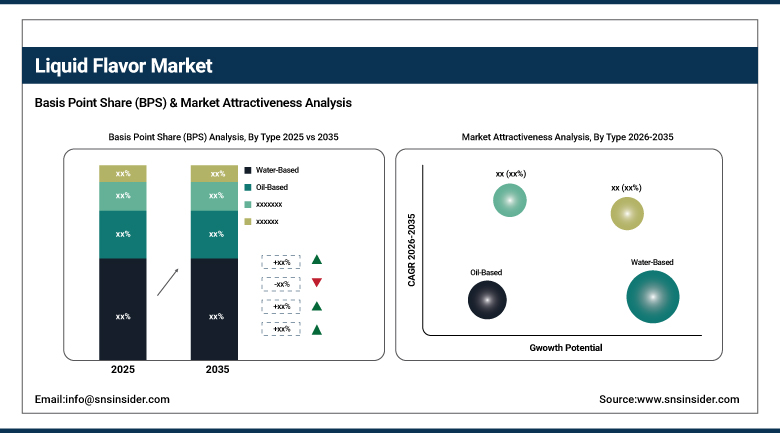
- By Type, water-based segment dominated the liquid flavor market in 2025 with around 52% share; oil-based segment is the fastest-growing segment.
- By Flavor Profile, sweet segment dominated the market in 2025 with around 44% share; herbal & functional segment is the fastest-growing segment.
- By Application, beverages segment dominated the market in 2025 with around 46.35% share; dairy segment is the fastest-growing segment.
- By Sourcing, synthetic/artificial segment dominated the market in 2025; natural segment is the fastest-growing segment.
By Type, Water-Based Dominates the Liquid Flavor Market While Oil-Based Registers the Fastest Growth
Water-Based dominates the Liquid Flavor Market owing to its solubility properties that make it ideal for beverages, jams, and frostings requiring a clear, transparent solution. This compatibility with the largest application category, beverages, ensures sustained demand from manufacturers producing carbonated drinks, flavored waters, and functional beverages. The wide availability, established manufacturing infrastructure, and broad compatibility across liquid formulations are reinforcing this segment’s continued market leadership.
Oil-Based is experiencing rapid growth driven by increasing demand from confectionery, bakery, and dairy applications where oil-soluble flavor compounds provide superior flavor release and stability in fat-based product matrices. Rising popularity of premium chocolate, artisanal bakery, and specialty dairy products is compelling manufacturers to expand oil-based flavor formulations. Advances in encapsulation technology that improve oil-based flavor stability during processing and storage are opening up several opportunities for commercial utilization in this segment.
By Flavor Profile, Sweet Dominates the Liquid Flavor Market While Herbal & Functional Emerges as the Fastest-Growing Profile
Sweet holds the largest share in the Liquid Flavor Market due to the dominance of sweet flavor profiles in various beverages, confectionery, dairy, and bakery segments, which are attributed to the well-established taste preferences among consumers globally. Sweet liquid flavors can leverage their rich formulation knowledge base and wide regulatory acceptance in many food segments, making them popular with manufacturers. The applicability of sweet flavors across almost all major food and beverage segments makes this segment the dominant market leader in terms of market share.
Herbal & Functional liquid flavors will witness fast-paced growth on account of consumer inclination toward wellness beverages and foods that offer both taste as well as health benefits. Rising consumer preference for wellness beverages that use botanical and adaptogenic flavors is driving manufacturers to focus on herbal flavor development.
By Application, Beverages Dominates the Liquid Flavor Market While Dairy Experiences the Fastest Growth
Beverages dominates the Liquid Flavor Market, accounting for 46.35% of revenue in 2025, due to the widespread use of liquid flavor concentrates across carbonated drinks, flavored waters, ready-to-drink teas and coffees, and functional beverages. Rising global beverage consumption and continuous new product launches across both alcoholic and non-alcoholic categories are driving sustained demand for liquid flavor solutions. The broad applicability of liquid flavors across virtually every beverage subcategory is reinforcing this segment’s continued market leadership.
Dairy is growing rapidly on account of increasing incorporation of liquid flavors into yogurts, ice creams, and flavored milk products seeking clean-label, botanical flavor infusions. Rising consumer demand for dairy alternative products requiring liquid flavor solutions to replicate familiar taste profiles is compelling manufacturers to expand dairy-focused flavor development. Advances in flavor masking technology for plant-based dairy alternatives are opening up several opportunities for commercial utilization in this segment.
By Sourcing, Synthetic/Artificial Dominates the Liquid Flavor Market While Natural Registers the Fastest Growth
The dominance of Synthetic/Artificial flavors in the Liquid Flavor Market can be attributed to the high level of cost effectiveness, consistency of taste profile, and well-established manufacturing base for large-scale production. Artificial flavor substances have gained from many years of experience in formulation and wide regulatory acceptance, making it possible for the producers to formulate specific and reproducible tastes at reasonable costs. The well-established manufacturing base and cost effectiveness of artificial flavors are driving their dominance in the market.
Natural is experiencing rapid growth driven by increasing consumer preference for clean-label products with recognizable, minimally processed ingredients over synthetic alternatives. Rising health consciousness and growing scrutiny of artificial additives are compelling manufacturers across North America and Europe to expand natural flavor development. Advances in natural flavor extraction technology that improve cost competitiveness relative to synthetic alternatives are opening up substantial opportunities for commercial utilization in this segment.
Regional Analysis
|
Region |
Country |
Share (2025) |
|
North America |
United States |
84.20% |
|
Asia Pacific |
China |
35.40% |
|
Europe |
Germany |
22.60% |
|
Middle East & Africa |
UAE |
17.20% |
|
Latin America |
Brazil |
23.70% |
North America Liquid Flavor Market Insights
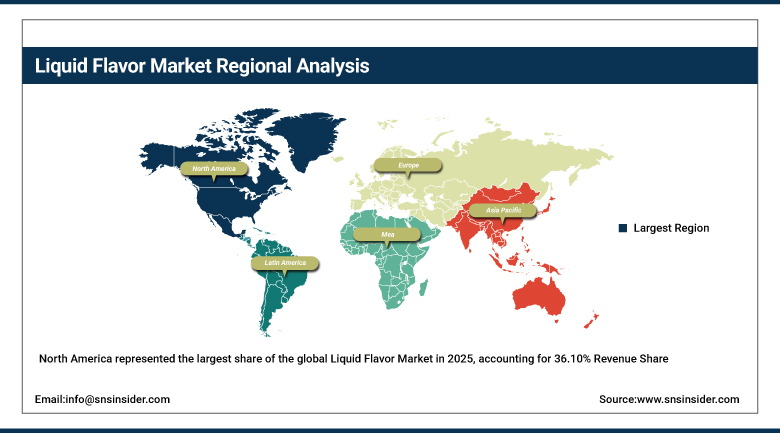
North America represented the largest share of the global Liquid Flavor Market in 2025, accounting for approximately 36.10% of global revenue, supported by high demand across the region’s mature food and beverage manufacturing industries and the presence of leading global flavor houses with established regional distribution. Increasing consumer preference for natural and clean-label flavor ingredients is reinforcing demand for reformulated products across the region. Growing interest in functional beverages and nutraceutical applications is encouraging manufacturers to expand liquid flavor product lines. Well-established food and beverage manufacturing infrastructure across the United States and Canada is also improving product accessibility and sustaining regional market development.
The United States accounted for approximately 84.20% of the North American market in 2025, reflecting its large food and beverage manufacturing base and extensive liquid flavor distribution infrastructure. Canada is contributing to regional growth through steady demand for flavored beverage and confectionery applications.
Get Customized Report as per Your Business Requirement - Enquiry Now
Europe Liquid Flavor Market Insights
Europe held a significant share of the Liquid Flavor Market in 2025, supported by strong consumer demand for exotic and specialty flavors within craft beverage and artisanal food product categories. Rising demand for natural and organic liquid flavors across Germany, the United Kingdom, and France is supporting product innovation. Increasing regulatory clarity around natural flavor labeling and growing emphasis on sustainable sourcing are further reinforcing Europe’s market position.
Germany led the European market with a 22.60% regional share in 2025, supported by its strong food and beverage manufacturing base and growing emphasis on clean-label formulations. The United Kingdom and France are also contributing meaningfully to regional growth, supported by leading flavor houses headquartered across the region.
Asia Pacific Liquid Flavor Market Insights
Asia Pacific is expected to register the fastest CAGR in the Liquid Flavor Market during 2026–2035, growing at approximately 4.00%, driven by rising consumer demand for flavored products, expanding food processing capacity, and growing culinary exploration across the region’s large population base. China and India are witnessing particularly strong growth as expanding middle-class populations increasingly adopt packaged and ready-to-eat food products requiring flavor solutions. Rising product innovation and growing consumer awareness regarding functional and wellness-oriented beverages are further supporting market expansion. Rising demand for natural liquid flavors, driven by rapid urbanization and changing lifestyles, is also reinforcing Asia Pacific’s above-average growth trajectory compared with more mature markets.
China accounted for approximately 35.40% of the Asia Pacific market in 2025, supported by its expanding food and beverage manufacturing base and rising domestic demand for flavored packaged products. Japan, India, and South Korea are also contributing meaningfully to regional growth, with India benefiting from a rapidly expanding food processing industry and rising popularity of ready-to-eat products.
Middle East & Africa and Latin America Liquid Flavor Market Insights
The Middle East and Africa are witnessing consistent growth due to expansion in food and beverage processing facilities in the Gulf countries, which is further aided by the rising investments in modern retailing. Latin America is witnessing consistent growth in its beverages and confectionery markets due to growing food processing facilities and increasing consumer interest in flavored beverages and confections.
In the Middle East & Africa market, the United Arab Emirates was the market leader in 2025, capturing 17.20% of regional shares, backed by growing food and beverage processing facilities and expansion in modern retailing. In the Latin America market, Brazil accounted for 23.70% of the regional market in 2025, owing to the growing consumption of beverages and confections.
Market Dynamics
Growth Drivers: Clean-Label Demand and Functional Beverage Expansion Driving Market Growth
The main factors influencing the growth of the Liquid Flavor Market include increasing food and beverage industry demand for clean-label, natural, and plant-based flavoring solutions, alongside rising consumer desire for authentic and exotic taste experiences. As liquid flavors are increasingly recognized as essential formulation tools for differentiating products across saturated food and beverage categories, manufacturers are realizing growth opportunities across beverages, confectionery, dairy, and bakery applications, contributing to growth in the global market for this ingredient category.
Growing expansion into nutraceutical, e-liquid, and dairy alternative markets continues to broaden liquid flavor’s addressable application base beyond traditional food and beverage use cases. Increasing innovation in flavor encapsulation and solubility technology is influencing new product formulation trends across the overall liquid flavor market.
Restraints: Market Saturation and Regulatory Complexity Limiting Market Expansion
Though there are good demand prospects, there will be challenges in terms of market saturation in already matured categories such as carbonated drinks, confectionery, and dairy because of their higher penetration rates and low volume growth potential. Differences in regulations in different regions with respect to labeling of flavors, natural flavor definitions, and acceptable additives will continue to determine the time required for market entry, and manufacturers have to make investments for regional compliance. Increasing costs of natural flavor production compared to synthetically produced flavors may affect pricing strategy for some applications.
High costs of developing flavors, sensory testing, and getting regulatory approval result in higher production costs and make it hard to launch products quickly in the market for smaller manufacturers. Moreover, growing competitive rivalry between the existing flavor houses and new regional players puts pressures on prices and reduces profit margins. The maturity of the category forces manufacturers to combine affordability, naturality, and compliance with regulations to preserve consumer confidence and expand their presence.
Opportunities: Nutraceutical Expansion and AI-Powered Customization Creating New Growth Avenues
Opportunities lie in the expansion of nutraceuticals and functional beverages, the use of AI for flavors customization, and the expansion of dairy alternatives. Flavor profiles developed from herbs and functional flavors would provide an opening for products which target consumers' rising interest in foods and beverages with health properties alongside good taste. The expansion of AI-based tools for the development of more accurate and rapid creation of personalized flavor formulas is another opportunity that manufacturers can leverage. Entering new markets with customized flavors is yet another area for the expansion of product relevance and reach.
The innovation in the area of sustainable sourcing and its implementation into product development may help to differentiate the product and attract brands concerned about sustainability. Innovation in the area of flavor encapsulation technology provides the opportunity to manufacturers to create more stable products with expanded application occasions. Expansion of applications of e-liquids and dairy alternatives is another way of differentiating one's products.
Recent Developments:
- 2026: International Flavors & Fragrances Inc. entered into a purchase agreement to sell its Food Ingredients business to funds advised by CVC Capital Partners.
- 2025: Givaudan completed the acquisition of a majority stake in Vollmens Fragrances, a Brazilian fragrance and flavor house operating across Latin America.
Liquid Flavor Market key players are:
- Givaudan SA
- dsm-firmenich (Firmenich)
- Symrise AG
- International Flavors & Fragrances Inc.
- Sensient Technologies Corporation
- Mane SA
- Takasago International Corporation
- T. Hasegawa Co., Ltd.
- McCormick & Company, Inc.
- Gold Coast Ingredients, Inc.
- Nature’s Flavors, Inc.
- Kerry Group plc
- Robertet SA
- Huabao International Holdings Limited
- Frutarom Industries Ltd.
- Döhler Group SE
- Blue Pacific Flavors, Inc.
- Flavor Producers, LLC
- Wild Flavors, Inc. (Archer Daniels Midland Company)
- Archer Daniels Midland Company
Liquid Flavor Market Report Scope:
| Report Attributes | Details |
|---|---|
| Market Size in 2025 | USD 11.92 Billion |
| Market Size by 2035 | USD 17.58 Billion |
| CAGR | CAGR of 3.96% From 2026 to 2035 |
| Base Year | 2025 |
| Forecast Period | 2026-2035 |
| Historical Data | 2022-2024 |
| Report Scope & Coverage | Market Size, Segments Analysis, Competitive Landscape, Regional Analysis, DROC & SWOT Analysis, Forecast Outlook |
| Key Segments | • By Type (Water-Based, and Oil-Based) • By Flavor Profile (Sweet, Herbal & Functional, Savory, and Others) • By Application (Beverages, Confectionery, Dairy, Bakery, and Others) • By Sourcing (Synthetic/Artificial, and Natural) |
| Regional Analysis/Coverage | North America (US, Canada), Europe (Germany, UK, France, Italy, Spain, Russia, Poland, Rest of Europe), Asia Pacific (China, India, Japan, South Korea, Australia, ASEAN Countries, Rest of Asia Pacific), Middle East & Africa (UAE, Saudi Arabia, Qatar, South Africa, Rest of Middle East & Africa), Latin America (Brazil, Argentina, Mexico, Colombia, Rest of Latin America). |
| Company Profiles | Givaudan SA; dsm-firmenich (Firmenich); Symrise AG; International Flavors & Fragrances Inc.; Sensient Technologies Corporation; Mane SA; Takasago International Corporation; T. Hasegawa Co., Ltd.; McCormick & Company, Inc.; Gold Coast Ingredients, Inc.; Nature’s Flavors, Inc.; Kerry Group plc; Robertet SA; Huabao International Holdings Limited; Frutarom Industries Ltd.; Döhler Group SE; Blue Pacific Flavors, Inc.; Flavor Producers, LLC; Wild Flavors, Inc. (Archer Daniels Midland Company); Archer Daniels Midland Company |
Frequently Asked Questions
Key players include Givaudan SA, dsm-firmenich (Firmenich), Symrise AG, International Flavors & Fragrances Inc., and Sensient Technologies Corporation, among others.
Key opportunities include nutraceutical and functional beverage expansion, AI-powered flavor customization tools, dairy alternative market growth, sustainable and green sourcing practices, and expanding e-liquid application development.
The market is driven by increasing food and beverage industry demand for clean-label, natural, and plant-based flavoring solutions, alongside rising consumer desire for authentic taste experiences.
The Beverages segment dominated the Liquid Flavor Market in 2025, accounting for 46.35% of revenue share.
The North America region dominated the Liquid Flavor Market in 2025, accounting for approximately 36.10% of global market share, driven by high demand across the region’s mature food and beverage manufacturing industries.
