
Magnetic Plastics Market Report Scope & Overview:
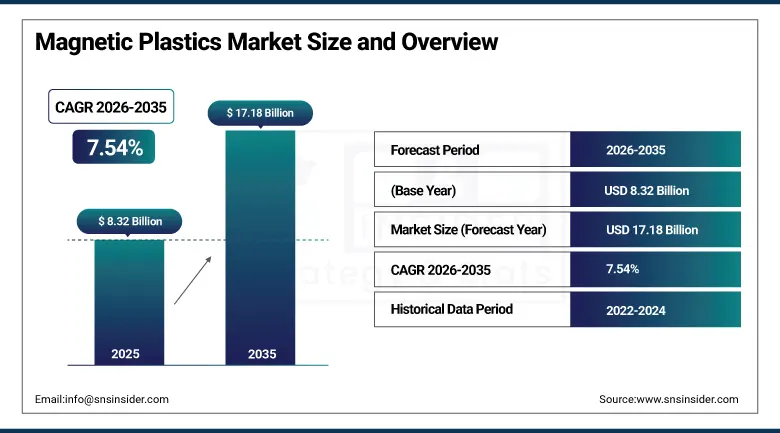
The Magnetic Plastics Market was valued at USD 8.32 billion in 2025 and is expected to reach USD 17.18 billion by 2035, growing at a CAGR of 7.54% from 2026–2035.
The magnetic plastics market is witnessing steady growth in the global market owing to increasing demand for lightweight magnetic materials. Rising adoption in automotive electrification and compact electronic devices is supporting market expansion. Manufacturers are focusing on replacing conventional metal magnets with flexible magnetic plastics. Growing use in sensors, actuators, and industrial equipment is creating new opportunities. Advancements in magnetic composite technologies and polymer engineering are improving product performance. Increasing investments in energy-efficient components and smart manufacturing are further accelerating adoption of magnetic plastics.
According to the International Energy Agency & Global EV Outlook 2025 and the International Organization of Motor Vehicle Manufacturers, there were more than 17 million units of electric cars sold globally in 2024, comprising 20% of all the new vehicles sold. In addition, there were around 92.5 million motor vehicles produced globally in 2025. The growing sales and production of such vehicles are expected to increase the demand for lightweight magnetic parts for use in actuators and other devices, thus boosting the magnetic plastic market.
To Get more information On Magnetic Plastics Market - Request Free Sample Report
Magnetic Plastics Market Trends
-
Emerging use of magnetic polymers in automobiles because of its lightweight structure and higher energy efficiency performance.
-
Evolving use of magnetic polymers in consumer electronics because of its ability to enable device miniaturization in terms of high performance.
-
Increasing usage of magnetic polymer composites owing to regulations regarding environmental friendliness and recyclability of magnetic polymers.
-
Increased use of magnetic plastics in industrial automation systems such as robots, sensors, and engineering machinery across the world.
-
Progress in polymer engineering making next generation plastics more heat-resistant, magnetically efficient, and mechanically durable.
-
Growth in investment in smart manufacturing processes driving the adoption of advanced magnetic polymer products in various industries.
U.S. Magnetic Plastics Market Outlook.
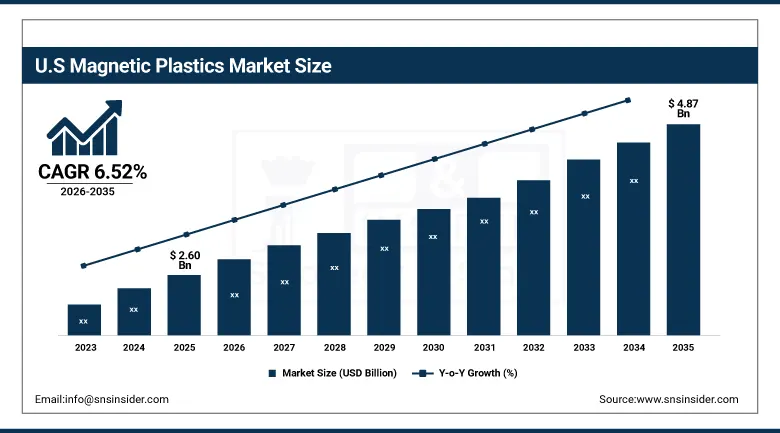
The U.S. Magnetic Plastics Market was valued at USD 2.60 billion in 2025 and is expected to reach around USD 4.87 billion by 2035, growing at a CAGR of 6.52% from 2026–2035.
The U.S. magnetic plastics market is growing consistently owing to rising demand for lightweight magnetic materials in advanced manufacturing. Strong adoption in automotive electrification and electronic devices is supporting steady growth across industries. The use of magnetic plastics in sensors, actuators, and consumer electronics has contributed to market expansion. Increasing focus on energy efficient materials and polymer based magnetic systems has generated higher demand. Development of advanced composite technologies, miniaturized electronic components, and high-performance industrial applications is further driving market expansion.
According to the U.S. Geological Survey Mineral Commodity 2025 and the U.S. Department of Energy critical materials program, magnetic materials used in advanced polymer and composite systems are increasingly tied to domestic rare earth supply chains, with the United States importing more than 80% of rare earth compounds for downstream manufacturing inputs.
Magnetic Plastics Market Segment Analysis
-
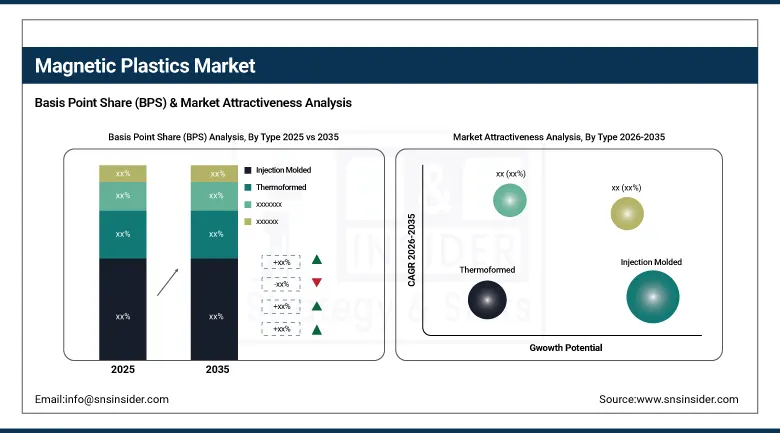
By Type, injection molded dominated the market with 42.80% share in 2025; while extrusion molded are the fastest growing segment with CAGR of 9.15% during 2026 to 2035.
-
By Application, automotive dominated the market with 36.80% share in 2025; while electronics are the fastest growing segment with CAGR of 9.67% during 2026 to 2035.
-
By Material, ferrite dominated the market with 51.40% share in 2025; while neodymium is the fastest growing segment with CAGR of 10.37% during 2026 to 2035.
-
By Form, sheets dominated the market with 47.20% share in 2025; while rolls are the fastest growing segment with CAGR of 9.75% during 2026 to 2035.
By Type, injection molded dominated the magnetic plastics market, while extrusion molded are the fastest growing segment.
Injection molded segment emerged as the market leader in terms of magnetic plastics market revenue share in 2025. This was mainly because of its high efficiency, dimensional accuracy, and capacity to produce complicated geometrical shapes in large quantities. This type is extensively employed for the manufacturing of automotive and electronics parts. High consistency in materials and low cost facilitate the use in mass production. High industrial demand helps maintain market leadership.
Extrusion molded segment is anticipated to register the fastest CAGR during 2026-2035. Increasing demand for extrusion molded products such as sheets, strips, and flexible magnetic plastics drives the segment growth. Extrusion molding results in reduced waste generation and higher processing efficiency. Higher demand for lighter electronics and packaging applications will further help drive the growth. The growing use of flexible magnetic plastic products will boost segment growth.
By Application, automotive dominated the magnetic plastics market, while electronics are the fastest growing segment.
Automotive application accounted for the dominated revenue share in the magnetic plastics market during 2025 owing to increasing use of lightweight magnetic parts in electric vehicles. The growing demand for high energy-efficient and low-emission transportation systems will also propel the adoption. Magnetic plastics find widespread applications in motors, sensors, actuators, and interior components. Increasing production in the automotive industry along with rapid advancement in technology is also propelling adoption rates. Adoption rates are bolstered by the increasing trend towards developing EV platform systems.
Electronics application segment is likely to witness the fastest CAGR from 2026-2035. Rising demand for miniaturized, high-performance electronics is driving the growth. Growing adoption rates of smartphones, wearables, and smart sensors will bolster the application trends. The use of magnetic plastics makes the electronic components small and efficient. Increasing demand for IoT and consumer electronics will further drive growth trends. The rapid growth in semiconductor integration and flexible electronics system is boosting growth.
By Material, ferrite dominated the magnetic plastics market, while neodymium is the fastest growing segment.
The ferrite segment held the dominated market share by generating the maximum revenue in 2025. The high popularity of the segment is attributed to the fact that ferrites have low prices, are highly available, and have excellent magnetic stability. Ferrite magnets find their uses in a variety of automotive, electronics, and electrical appliances because of their properties such as corrosion resistance and high thermal stability. Additionally, ease of manufacturing and compatibility with plastics have contributed to their widespread use.
The neodymium segment is estimated to register the fastest CAGR during the forecast period owing to its magnetic strength and energy density compared to other materials. Growing adoption owing to the growing need for miniaturization and performance improvement of electronic devices has boosted the segment growth. Usage in electric vehicles, sensors, and robotics have also supported the rising usage. Ongoing innovations related to processing of rare earth material will drive global market expansion.
By Form, sheets dominated the magnetic plastics market, while rolls are the fastest growing segment.
Sheets segment held a major share in the magnetic plastics market owing to the high revenue generated by the segment in 2025. The dominance is credited to its extensive industrial utility and easy processability. sheets offer uniform distribution of magnets and are highly durable. They are widely applied in automotive interior design and electronic shields. Increasing application in consumer electronics and industrial machinery further propels the sheets segment. Cost-effectiveness and suitability for manufacturing systems are key factors contributing to sheets segment dominance.
Rolls segment is predicted to witness the fastest CAGR during the forecast period of 2026 to 2035 owing to growing requirements of flexible magnetic plastics. rolls segment is more adaptable to complex shapes and is easily processable via automated production line systems. Increasing usage in electronic devices and smart parts is propelling the rolls segment. Increasing applications in packaging, sensors, and small appliances are further aiding the growth of rolls segment.
Regional Analysis
|
Region |
Major Country |
Share within Region, 2025(%) |
|---|---|---|
|
North America |
United States |
84.65% |
|
Europe |
Germany |
28.10% |
|
Asia Pacific |
China |
43.20% |
|
Middle East & Africa |
UAE |
19.40% |
|
Latin America |
Brazil |
48.60% |
North America Magnetic Plastics Market Insights.
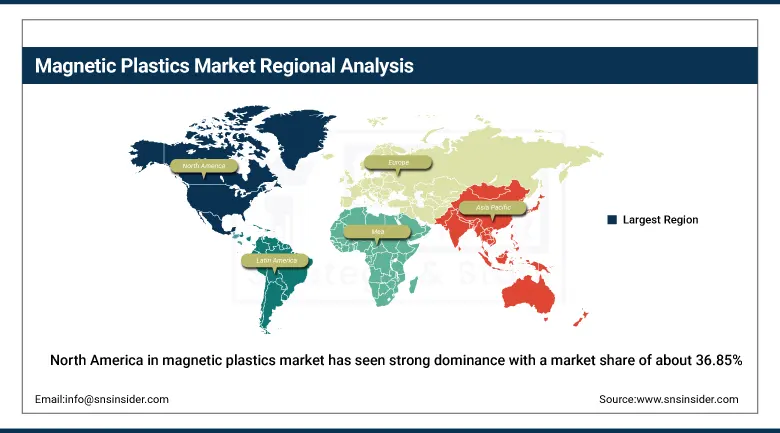
North America in magnetic plastics market has seen strong dominance with a market share of about 36.85% in 2025 due to advanced manufacturing infrastructure and high adoption of engineered materials. The region benefits from strong demand in automotive electrification, electronics, and industrial components. Increasing use of lightweight magnetic materials in sensors and actuators is driving expansion across the United States and Canada. Rising adoption of polymer based magnetic composites and advanced production systems is further supporting market leadership. Strong R&D investments are strengthening innovation capabilities in magnetic plastic technologies.
As per the USGS production, rare earth magnets have high dependence on imports for their raw materials, where almost more than 70% of their supply is dependent on imports. Also, according to the data related to clean energy transition by the Department of Energy, wind energy makes up to more than 10% of all the U.S. power generation.
Get Customized Report as per Your Business Requirement - Enquiry Now
Europe Magnetic Plastics Market Insights.
Europe magnetic plastics market is characterized by steady growth in 2025 owing to strict sustainability regulations and rising demand for energy efficient materials. The major countries contributing towards the demand include Germany, France, United Kingdom, and Italy. Rising demand for electric vehicles and precision engineering components is fueling market growth. Increased use of magnetic polymers in automotive interiors and industrial automation is propelling usage rate.
According to the European Environment Agency, the EU plastics recycling rates had attained about 35% of total plastics waste recycled, while EU Green Deal policy regulations on recycled plastics stipulate an increase in use of recycled plastics in industrial uses. EU industrial sector decarbonization targets set a target of a 55% reduction in greenhouse gases by 2030.
Asia Pacific Magnetic Plastics Market Insights.
Asia Pacific is positioned to register the fastest CAGR growth in the magnetic plastics market during the forecast period with a market share of about 8.61% in 2025. Rapid industrial expansion and increasing electronics manufacturing are driving strong demand across China, Japan, India, South Korea, and Southeast Asia. Expanding automotive production and rising consumer electronics demand are significantly boosting adoption. Growing demand for cost effective magnetic materials is further accelerating market growth. Large scale investments in industrial automation and smart manufacturing support strong regional outlook.
According to the United Nations Industrial Development Organization and regional manufacturing cited in Asia-Pacific industrial production frameworks, the Asia Pacific region accounts for over 50% of global manufacturing output, with China alone contributing nearly 30% of global industrial value added in recent years.
As per OECD industrial materials transition indicators and UN Comtrade classifications, magnetic plastics demand is strongly concentrated in electronics and automotive supply chains, which together represent more than 45% of advanced polymer component consumption in Asia Pacific.
Middle East & Africa and Latin America Magnetic Plastics Market Insights.
The Middle East & Africa along with Latin American regions are experiencing steady growth due to expanding industrialization and increasing infrastructure development. Key contributing countries include Brazil, Mexico, UAE, Saudi Arabia, and South Africa. Investments in automotive assembly plants and industrial equipment manufacturing are supporting market growth. Rising demand for durable and lightweight magnetic materials in energy and transport sectors is driving adoption.
According to the United Nations Industrial Development Organization 2025 industrial development indicators and World Bank manufacturing value-added statistics, Latin America accounts for about 5% of global manufacturing output, while the Middle East and Africa collectively contribute under 4%, reflecting lower advanced materials penetration compared to OECD regions.
Market Dynamics
Growth Drivers: Expansion of industrial automation and smart manufacturing increasing adoption of advanced polymer magnetic components globally.
Automation in different industries is also becoming common, thereby making the need for high-performing magnetic components rise. These components have been widely adopted as they offer reliable and versatile solutions when it comes to their application in robotics, automation machinery, and engineering applications. The adoption of intelligent manufacturing processes has led to the higher integration of the components in industrial settings. These components are vital in enhancing efficiency and reducing maintenance costs in the industry.
According to the OECD Industrial Digital Transformation 2025 and UNIDO industrial development evaluations, more than 50% of the countries that form part of the Organization for Economic Cooperation and Development have adopted their Industry 4.0 or smart manufacturing policies, which include automated processes. According to the OECD manufacturing digitalization indicators, more than 40% of manufacturers in advanced economies use cyber-physical or automated manufacturing systems.
Restraints: High material processing complexity and performance limitations restricting widespread adoption in advanced industrial applications.
The manufacturing process along with some other difficulties have hindered the widespread use of magnetized plastics for high-end purposes. Uniform magnetic properties as well as distribution have proven difficult to attain. Magnetized plastics have been shown to be deficient in terms of operating at extremely high temperatures and loads. For industries that require precise and robust construction, metallic magnets continue to be more suitable. In addition, lack of sufficient mechanical strength for certain formulations has also curtailed their use.
Opportunities: Advancements in polymer engineering and sustainable materials enabling development of high performance magnetic composite solutions.
Innovations in the field of polymer chemistry can enable researchers to develop magnetic composites. Significant improvements in heat stability, magnetic efficiency, and physical resistance of the composite have been achieved. Moreover, the development of environmentally-friendly production technologies also plays an important role in this process. With improving production technologies, there can emerge many more applications and improvements in efficiency of these materials.
According to UN Environmental Program & Global Plastics Outlook and OECD Global Plastics Outlook 2025, annual production of plastic was more than 400 million tons globally, out of which less than 9% of plastic waste could be recycled. According to the OECD Materials Circularities, more than 60% of plastics’ demand falls under durable use wherein there is an increasing use of engineering polymers.
Additionally, the International Energy Agency reports that electrification trends in transport and electronics have increased demand for high-performance polymer components, with over 30% growth in advanced materials usage in electrified systems, supporting development of magnetic composite plastics.
Recent Developments
-
2026: Zhejiang DMEGC Magnetics Co., Ltd. upgrades intelligent manufacturing systems improving permanent magnet production efficiency and global supply reliability.
-
2025: TDK Corporation invests in sensor and magnetics R&D for next generation electric mobility and industrial applications.
-
2025: BASF SE expands specialty polymer and functional materials capacity in Europe focusing on electrification and automotive applications.
-
2024: VACUUMSCHMELZE GmbH & Co. KG collaborates with European partners on sustainable magnet recycling and material efficiency programs.
Magnetic Plastics Market Key Players are:
-
BASF SE
-
Proterial, Ltd.
-
TDK Corporation
-
Shin-Etsu Chemical Co., Ltd.
-
Neo Performance Materials Inc.
-
Arnold Magnetic Technologies Corporation
-
Daido Steel Co., Ltd.
-
VACUUMSCHMELZE GmbH & Co. KG
-
Ningbo Yunsheng Co., Ltd.
-
Beijing Zhong Ke San Huan High-Tech Co., Ltd.
-
Zhejiang DMEGC Magnetics Co., Ltd.
-
Dexter Magnetic Technologies, Inc.
-
Bunting Magnetics Co.
-
Goudsmit Magnetics Group
-
Eclipse Magnetics Ltd.
-
Magnetfabrik Bonn GmbH
-
Electron Energy Corporation
-
RTP Company
-
Permanent Magnets Limited
-
Mate Co., Ltd.
Magnetic Plastics Market Report Scope:
| Report Attributes | Details |
|---|---|
| Market Size in 2025 | USD 8.32 Billion |
| Market Size by 2035 | USD 17.18 Billion |
| CAGR | CAGR of 7.52% From 2026 to 2035 |
| Base Year | 2025 |
| Forecast Period | 2026-2035 |
| Historical Data | 2022-2024 |
| Report Scope & Coverage | Market Size, Segments Analysis, Competitive Landscape, Regional Analysis, DROC & SWOT Analysis, Forecast Outlook |
| Key Segments | • By Type (Injection Molded, Extrusion Molded, Thermoformed, Others) • By Application (Electronics, Automotive, Consumer Goods, Aerospace, Healthcare, Others) • By Material (Ferrite, Neodymium, Samarium-Cobalt, Alnico, Others) • By Form (Sheets, Rolls, Strips, Others) |
| Regional Analysis/Coverage | North America (US, Canada), Europe (Germany, UK, France, Italy, Spain, Russia, Poland, Rest of Europe), Asia Pacific (China, India, Japan, South Korea, Australia, ASEAN Countries, Rest of Asia Pacific), Middle East & Africa (UAE, Saudi Arabia, Qatar, South Africa, Rest of Middle East & Africa), Latin America (Brazil, Argentina, Mexico, Colombia, Rest of Latin America). |
| Company Profiles | BASF SE, Proterial, Ltd., TDK Corporation, Shin-Etsu Chemical Co., Ltd., Neo Performance Materials Inc., Arnold Magnetic Technologies Corporation, Daido Steel Co., Ltd., VACUUMSCHMELZE GmbH & Co. KG, Ningbo Yunsheng Co., Ltd., Beijing Zhong Ke San Huan High-Tech Co., Ltd., Zhejiang DMEGC Magnetics Co., Ltd., Dexter Magnetic Technologies, Inc., Bunting Magnetics Co., Goudsmit Magnetics Group, Eclipse Magnetics Ltd., Magnetfabrik Bonn GmbH, Electron Energy Corporation, RTP Company, Permanent Magnets Limited, Mate Co., Ltd. |
Frequently Asked Questions
The magnetic plastics market is expected to grow at a CAGR of 7.54% from 2026 to 2035.
The magnetic plastics market was valued at USD 8.32 billion in 2025.
: Rising demand for lightweight magnetic materials, EV adoption, electronics growth, industrial automation, and polymer advancements driving efficiency and miniaturization globally.
The automotive segment dominated the market in 2025 due to increasing use of lightweight magnetic components in EVs, sensors, actuators.
North America dominated the magnetic plastics market in 2025 due to advanced manufacturing, EV adoption, and strong electronics demand globally.
