
Manufacturing Analytics Market Report Scope & Overview:
The Manufacturing Analytics Market size was valued at USD 13.59 billion in 2025 and is expected to reach USD 78.37 billion by 2035, growing at a CAGR of 19.23% from 2026-2035.
The Manufacturing Analytics Market is growing due to rising adoption of Industry 4.0, smart factories, and IoT-enabled systems. Demand for real-time insights, predictive maintenance, and supply chain optimization drives analytics solution adoption. Cloud-based platforms, AI integration, and digital transformation across industries like electronics, automotive, and pharmaceuticals enhance efficiency and decision-making, fueling strong market growth.

To Get more information on Manufacturing Analytics Market - Request Free Sample Report
Manufacturing Analytics Market Trends
-
Increasing demand for data-driven decision-making and operational efficiency is driving the manufacturing analytics market.
-
Growing adoption of Industry 4.0, IoT, and smart factory initiatives is boosting market growth.
-
Rising focus on predictive maintenance, quality analytics, and production optimization is accelerating adoption.
-
Integration of AI, machine learning, and advanced visualization tools is enhancing real-time insights.
-
Expansion across discrete and process manufacturing industries is supporting wider market penetration.
-
Emphasis on cost reduction, energy efficiency, and supply chain optimization is shaping market trends.
-
Strategic partnerships between analytics providers, industrial automation vendors, and manufacturers are accelerating innovation and deployment.
U.S. Manufacturing Analytics Market Size Outlook
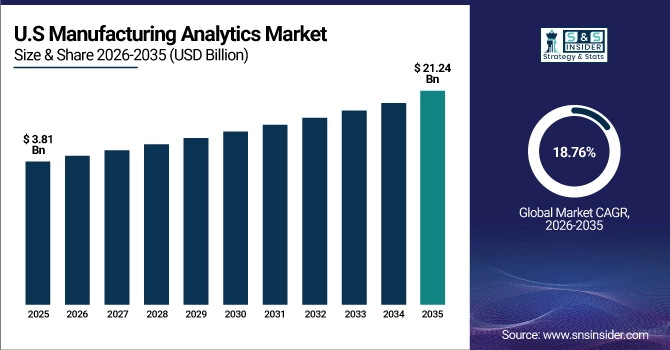
The U.S. Manufacturing Analytics Market was valued at USD 3.81 billion in 2025 and is expected to reach USD 21.24 billion by 2035, growing at a CAGR of 18.76% from 2026-2035.
The U.S. Manufacturing Analytics Market is growing due to increased adoption of smart factories, IoT integration, and AI-driven analytics, enabling real-time operational insights, predictive maintenance, and supply chain optimization, which enhance efficiency and productivity across manufacturing sectors.
Manufacturing Analytics Market Growth Drivers:
-
Rising demand for real-time operational visibility and data-driven decision-making across complex manufacturing environments
Increasing production complexity, cost pressures, and demand variability push manufacturers to rely on real-time operational data for faster, more accurate decisions. Manufacturing analytics enables visibility across machines, processes, and workflows, helping reduce downtime, improve throughput, and optimize resource utilization. Integration of IoT sensors, connected equipment, and MES systems generates large volumes of data that require advanced analytics to extract actionable insights. Companies increasingly focus on predictive maintenance, quality optimization, and yield improvement to remain competitive. Analytics platforms support continuous monitoring, root-cause analysis, and performance benchmarking, enabling proactive interventions rather than reactive fixes. This strong need for efficiency, agility, and measurable performance improvement accelerates adoption across discrete and process manufacturing sectors.
Manufacturing Analytics Market Restraints:
-
High initial implementation costs and complexity of integrating analytics with legacy manufacturing systems
Significant upfront investments in software licenses, infrastructure, system integration, and skilled personnel limit adoption, particularly among small and mid-sized manufacturers. Many factories still operate legacy equipment and siloed data systems that are not analytics-ready, increasing integration complexity and deployment timelines. Customization requirements, data cleansing efforts, and interoperability challenges further elevate project costs. Organizations often struggle to justify return on investment in the short term, especially when production margins are tight. Additionally, ongoing expenses related to maintenance, upgrades, and analytics model tuning add financial pressure. These cost and integration barriers slow large-scale implementation and delay decision-making around analytics adoption.
Manufacturing Analytics Market Opportunities:
-
Expanding use of artificial intelligence and machine learning to enable predictive, prescriptive, and autonomous manufacturing analytics
Rapid advancements in AI and machine learning create strong opportunities to enhance manufacturing analytics capabilities beyond descriptive insights. Advanced models enable predictive maintenance, defect detection, demand forecasting, and process optimization with higher accuracy. Prescriptive analytics supports automated decision-making by recommending optimal actions in real time. As AI models mature, manufacturers can move toward self-optimizing production systems that continuously learn from operational data. Integration of computer vision, natural language processing, and reinforcement learning further broadens use cases. Vendors offering AI-driven, easy-to-deploy analytics solutions can unlock new revenue streams and accelerate adoption across diverse manufacturing environments.
Manufacturing Analytics Market Segment Highlights
-
By End-user Industry, Electronics dominated with ~29% share in 2025; Automotive fastest growing (CAGR).
-
By Application, Inventory Management dominated with ~32% share in 2025; Supply Chain Optimization fastest growing (CAGR).
-
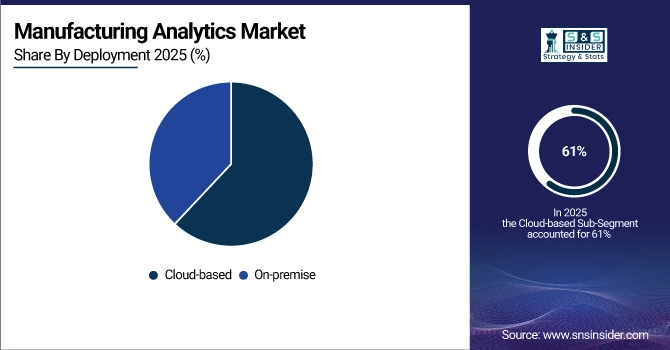
By Deployment, Cloud-based dominated with ~61% share in 2025; Cloud-based fastest growing (CAGR).
By Deployment, Cloud-based segment dominates the Market and is expected to grow fastest
Cloud-based segment dominated the Manufacturing Analytics Market in 2025 and is expected to grow at the fastest CAGR from 2026-2035 due to its scalability, flexibility, and lower implementation costs. Manufacturers prefer cloud solutions for real-time data access, centralized monitoring, and seamless integration with IoT devices and AI tools. Cloud platforms enable faster deployment, remote management, and collaboration across multiple facilities, making them ideal for digital transformation initiatives. These advantages drive widespread adoption and rapid market growth during the forecast period.
By End-user Industry, Electronics segment dominates the Market, Automotive segment is expected to grow fastest
Electronics segment dominated the Manufacturing Analytics Market in 2025 due to high adoption of smart manufacturing technologies, IoT integration, and data-driven production optimization. The need for real-time monitoring, predictive maintenance, and quality control in electronics manufacturing drove significant investments in analytics solutions, resulting in the highest revenue share.
Automotive segment is expected to grow at the fastest CAGR from 2026-2035 owing to increasing use of connected vehicles, automation, and AI-driven analytics in production. Rising demand for electric vehicles and smart manufacturing processes requires advanced analytics for supply chain efficiency, predictive maintenance, and process optimization, fueling rapid market growth.
By Application, Inventory Management segment dominates the Market, Supply Chain Optimization segment is expected to grow fastest
Inventory Management segment dominated the Manufacturing Analytics Market in 2025 because manufacturers focused on improving resource utilization, reducing stock-outs, and minimizing excess inventory. Analytics solutions enable accurate demand forecasting, real-time tracking, and optimized warehouse operations, resulting in higher operational efficiency and significant revenue generation for this segment.
Supply Chain Optimization segment is expected to grow at the fastest CAGR from 2026-2035 as manufacturers adopt analytics to enhance visibility, reduce delays, and optimize supplier networks. Increasing complexity in global supply chains and demand for just-in-time production drives adoption of predictive and prescriptive analytics, accelerating growth in this segment.
Manufacturing Analytics Market Regional Analysis
North America Manufacturing Analytics Market Insights
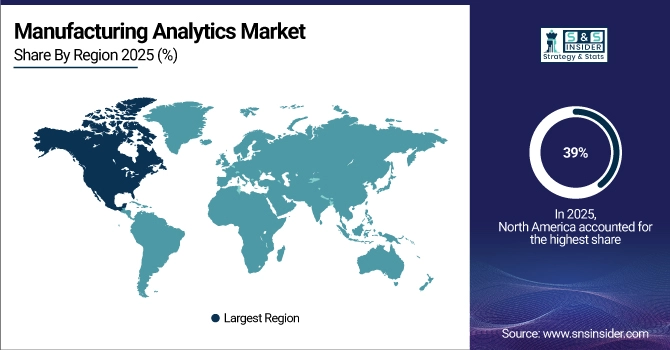
North America dominated the Manufacturing Analytics Market with the highest revenue share of about 39% in 2025 due to early adoption of advanced manufacturing technologies, strong presence of key analytics solution providers, and high investment in Industry 4.0 initiatives. The region’s manufacturers focus on automation, predictive maintenance, and real-time operational insights, supported by robust IT infrastructure and skilled workforce, which drives extensive implementation of analytics solutions, resulting in the largest market share during the year.
Get Customized Report as per Your Business Requirement - Enquiry Now
Asia Pacific Manufacturing Analytics Market Insights
Asia Pacific segment is expected to grow at the fastest CAGR of about 20.72% from 2026-2035 due to rapid industrialization, increasing adoption of smart factories, and growing investment in digital manufacturing technologies. Expanding electronics, automotive, and consumer goods industries in countries like China, India, and Japan are driving demand for analytics solutions to optimize production, enhance supply chain efficiency, and improve operational performance, fueling accelerated market growth in the region.
Europe Manufacturing Analytics Market Insights
Europe held a significant share in the Manufacturing Analytics Market due to widespread adoption of Industry 4.0, advanced manufacturing technologies, and strong industrial infrastructure. Manufacturers across Germany, France, and the UK focus on process optimization, predictive maintenance, and quality improvement using analytics solutions. Supportive government initiatives, investments in smart factories, and growing digital transformation across manufacturing sectors drive steady market growth and technology adoption in the region.
Middle East & Africa and Latin America Manufacturing Analytics Market Insights
Middle East & Africa and Latin America hold growing shares in the Manufacturing Analytics Market due to increasing industrialization, adoption of digital technologies, and government initiatives supporting smart manufacturing. Key industries, including oil & gas, automotive, and electronics, are investing in analytics for operational efficiency and predictive maintenance. Rising awareness of Industry 4.0 benefits and gradual digital transformation drive steady market growth in these regions.
Manufacturing Analytics Market Competitive Landscape:
SAP SE
SAP SE is a global enterprise software leader providing solutions for ERP, supply chain, and intelligent manufacturing. Its AI-driven manufacturing analytics enable real-time visibility, predictive insights, and operational optimization. SAP embeds AI across production processes, quality monitoring, and supply chain management, helping manufacturers detect anomalies, improve efficiency, and strengthen resilience. Its adaptive analytics and digital twin capabilities support data-driven decision-making, reduce downtime, and enhance operational transparency in complex manufacturing environments.
-
2023: SAP announced AI-embedded manufacturing analytics at Hannover Messe 2023 for real-time insights, visual inspection, quality improvement, and supply chain resilience.
-
2024: SAP released AI-powered supply chain analytics to optimize decisions, improve cycle efficiency, and detect equipment anomalies in real time.
Oracle Corporation
Oracle provides enterprise software, cloud solutions, and AI-driven analytics for manufacturing and supply chain management. Its Fusion SCM platform integrates production KPIs, quality monitoring, and anomaly detection to support operational decisions. Oracle’s AI enhancements in Fusion Data Intelligence deliver actionable insights across manufacturing processes, improving efficiency, production visibility, and predictive planning. The company emphasizes analytics-enabled industrial operations, enabling manufacturers to leverage AI for data-driven decision-making and enhanced supply chain performance.
-
2023: Oracle introduced Manufacturing Analytics in Fusion SCM, offering dashboards, work order insights, quality detection, and integrated production analytics.
-
2024: Oracle announced AI-powered analytics features for Fusion Data Intelligence to extract actionable manufacturing insights across supply chain and production.
-
2025: Oracle Fusion Analytics newsletter highlighted analytics updates relevant to manufacturing and industrial workloads across Fusion products.
IBM Corporation
IBM integrates AI, hybrid cloud, and enterprise analytics to enhance manufacturing and industrial operations. Its solutions support product lifecycle management, predictive maintenance, and quality control. IBM collaborates with partners to deliver AI-enabled digital threads across engineering and production, improving traceability, efficiency, and decision-making. The company also offers planning and analytics tools for scenario modeling, forecasting, and industrial data insights, enabling manufacturers to optimize operations and accelerate digital transformation.
-
2023: IBM and Siemens integrated Maximo with Xcelerator PLM, improving traceability, quality, and operational innovation in manufacturing.
-
2024: IBM highlighted enterprise AI adoption, showing growth in time-series, quality, and real-time analytics across manufacturing operations.
Microsoft Corporation
Microsoft provides AI, cloud, and industrial analytics solutions to optimize manufacturing productivity, operations, and sustainability. Its Industrial Copilot integrates generative AI with PLM systems for real-time shop-floor insights, simulation, and automation. Microsoft highlights AI-enabled operational efficiency, predictive maintenance, and quality improvements, partnering with industry leaders to accelerate digital transformation. Awards and recognition reinforce its role in advancing intelligent manufacturing with real-time analytics, human-machine insights, and sustainable industrial operations.
-
2023: Microsoft and Siemens introduced AI-powered Industrial Copilot for shop-floor analytics, simulation, and operational optimization.
Siemens AG
Siemens is a global industrial technology leader offering digital manufacturing, AI analytics, and PLM solutions. Its Xcelerator platform provides predictive analytics, industrial IoT integration, and lifecycle insights. Siemens leverages AI for real-time operations monitoring, quality inspection, and production optimization. Collaborations with cloud providers and AI tools enhance manufacturers’ data-driven decision-making, accelerating operational efficiency and resilience. Siemens focuses on human-machine collaboration, adaptive analytics, and smart factory integration to support next-generation industrial operations worldwide.
-
2023: Siemens and Microsoft integrated generative AI into Teamcenter PLM and industrial systems for visual inspection and quality analytics.
-
2024: Siemens expanded AI PLM and analytics collaboration with Microsoft Azure to accelerate product lifecycle decisions and contextual insights.
-
2025: Siemens unveiled industrial AI innovations at CES 2025, including Industrial Copilot for predictive operations and human-machine production insights.
Manufacturing Analytics Companies are:
-
SAP SE
-
IBM Corporation
-
Microsoft Corporation
-
Siemens AG
-
General Electric (GE Digital)
-
SAS Institute Inc.
-
Tableau Software (Salesforce)
-
TIBCO Software Inc.
-
Rockwell Automation Inc.
-
Honeywell International Inc.
-
Cisco Systems Inc.
-
FICO
-
Domo Inc.
-
Bridgei2i Analytics Solutions
-
Sight Machine Inc.
-
Sisense Inc.
-
Aegis Software
-
MachineMetrics Inc.
-
Neubrain Solutions
| Report Attributes | Details |
|---|---|
| Market Size in 2025 | USD 13.59 Billion |
| Market Size by 2035 | USD 78.37 Billion |
| CAGR | CAGR of 19.23% From 2026 to 2035 |
| Base Year | 2025 |
| Forecast Period | 2026-2035 |
| Historical Data | 2022-2024 |
| Report Scope & Coverage | Market Size, Segments Analysis, Competitive Landscape, Regional Analysis, DROC & SWOT Analysis, Forecast Outlook |
| Key Segments | • By Deployment(Cloud-based, On-premise) • By Application(Inventory Management, Supply Chain Optimization, Predictive Maintenance, Other Applications) • By End-user Industry(Electronics, Oil & Gas, Automotive, Pharmaceutical, Food & Beverage, Other End-user Industries) |
| Regional Analysis/Coverage | North America (US, Canada), Europe (Germany, UK, France, Italy, Spain, Russia, Poland, Rest of Europe), Asia Pacific (China, India, Japan, South Korea, Australia, ASEAN Countries, Rest of Asia Pacific), Middle East & Africa (UAE, Saudi Arabia, Qatar, South Africa, Rest of Middle East & Africa), Latin America (Brazil, Argentina, Mexico, Colombia, Rest of Latin America). |
| Company Profiles | SAP SE, Oracle Corporation, IBM Corporation, Microsoft Corporation, Siemens AG, General Electric (GE Digital), SAS Institute Inc., Tableau Software (Salesforce), TIBCO Software Inc., Rockwell Automation Inc., Honeywell International Inc., Cisco Systems Inc., FICO, Domo Inc., Bridgei2i Analytics Solutions, Sight Machine Inc., Sisense Inc., Aegis Software, MachineMetrics Inc., Neubrain Solutions |
Frequently Asked Questions
North America dominated the Manufacturing Analytics Market in 2025.
The Inventory Management segment dominated the Manufacturing Analytics Market in 2025.
Rising demand for real-time operational visibility and data-driven decision-making across complex manufacturing environments.
The Manufacturing Analytics Market was valued at USD 13.59 billion in 2025.
The Manufacturing Analytics Market is expected to grow at a CAGR of 19.23% from 2026 to 2035.
