
Matcha Tea Market Report Scope & Overview:
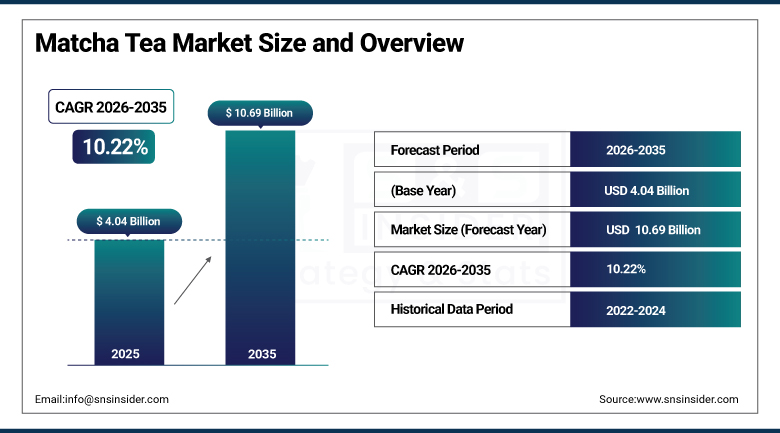
The Matcha Tea Market was valued at USD 4.04 Billion in 2025 and is expected to reach USD 10.69 Billion by 2035, growing at a CAGR of 10.22% from 2026–2035.
The global matcha tea market is experiencing robust and commercially broad-based growth as matcha transitions from a niche Japanese cultural product into a mainstream global functional beverage and food ingredient whose antioxidant, cognitive, and metabolic health credentials resonate across the full spectrum of wellness-oriented consumer demographics. Matcha tea consumption reached 35,000 metric tons in 2025, driven by expanding application across beverages, bakery, confectionery, supplements, and cosmetics that collectively extend the market’s commercial opportunity far beyond the traditional ceremonial tea segment that defined the category’s historical boundaries.
ITO EN launched Matcha LOVE Cold Brew teas with Matcha + Lemon Verbena & Peppermint and Matcha + Apple Ginger varieties in September 2025, expanding its ready-to-drink matcha portfolio in the U.S. market. The launches target the growing consumer segment seeking premium functional RTD beverages that combine matcha’s L-theanine and catechin credentials with flavour profile innovation that appeals beyond the core matcha enthusiast into mainstream health-conscious beverage purchasers.
Market Size and Forecast
-
Market Size in 2026E: USD 4.45 Billion
-
Market Size by 2035: USD 10.69 Billion
-
CAGR: 10.22% from 2026 to 2035
-
Fastest Growing Region: North America
-
Largest Region: Asia Pacific
To Get more information On Matcha Tea Market - Request Free Sample Report
Matcha Tea Market Trends
-
Rising integration of matcha into premium café menus globally, including matcha lattes, iced matcha, and matcha-based espresso alternatives, is creating a new daily consumption occasion that sustains repeat purchase frequency beyond dedicated tea culture consumers.
-
Growing adoption of matcha as a clean-label functional ingredient in packaged food and beverage product development is expanding the market’s B2B commercial demand across bakery, confectionery, ice cream, and protein supplement formulations.
-
Increasing consumer willingness to pay premium pricing for ceremonial and organic grade matcha is elevating average revenue per unit across both direct-to-consumer and retail channels as quality differentiation becomes a primary purchase driver.
-
Expanding e-commerce and DTC brand commercial infrastructure for specialty matcha is enabling Japanese and international producers to reach global consumer audiences without traditional retail distribution intermediary dependency.
-
Rising cosmetics and personal care industry adoption of matcha extract as an antioxidant active ingredient is creating a commercially significant non-food application demand stream that diversifies the market’s revenue base beyond beverage and culinary categories.
U.S. Matcha Tea Market Outlook
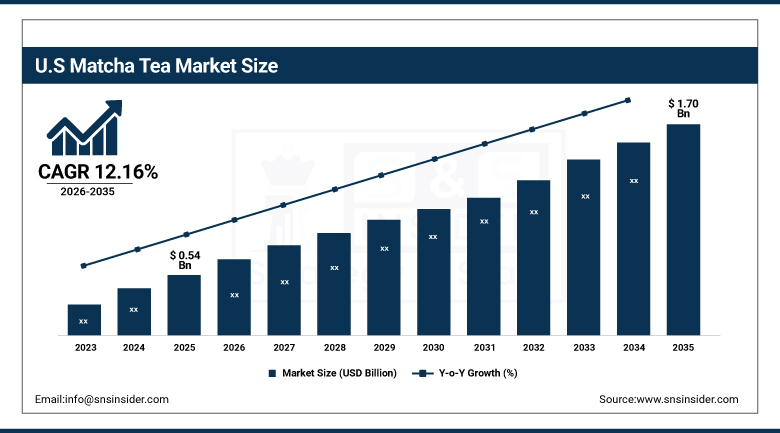
The U.S. Matcha Tea Market was valued at approximately USD 0.54 Billion in 2025 and is expected to reach approximately USD 1.70 Billion by 2035, growing at a CAGR of approximately 12.16%.
The United States is the most commercially dynamic national matcha market outside Japan and the primary driver of North America’s fastest-growing regional status globally. Consumer adoption has expanded progressively from the specialty tea and Japanese food culture community into the mainstream wellness, fitness, and café consumer segments. Starbucks’ inclusion of matcha latte and cold matcha beverages on its national menu created mass-market category awareness that independent café culture has reinforced and deepened.
Starbucks reported in 2024 that matcha beverages were among its fastest-growing menu categories in the United States, with matcha latte orders increasing by over 40% year-over-year. This mainstream café channel validation has directly accelerated retail and online purchase of at-home matcha preparation products among consumers who discover the ingredient through café experiences before investing in home preparation formats.
Matcha Tea Market Segment Analysis
-
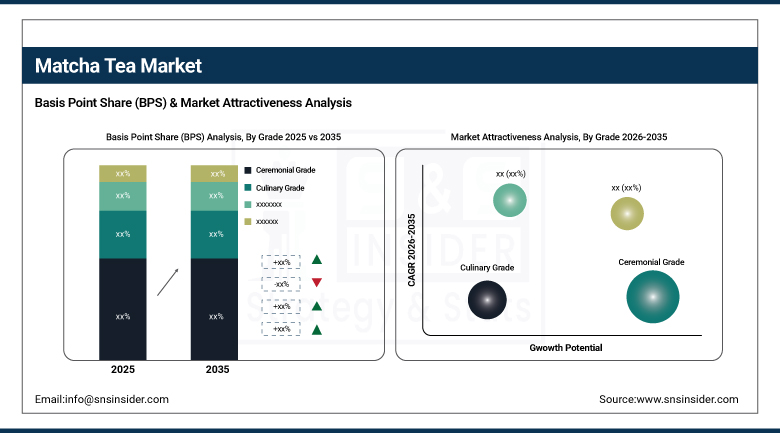
By Grade, the Ceremonial Grade segment dominated the Matcha Tea Market with 38.47% share in 2025, while the Organic segment is the fastest growing at a CAGR of 12.68% during 2026–2035.
-
By Form, the Powder segment dominated the Matcha Tea Market with 54.29% share in 2025, while the Capsules segment is the fastest growing at a CAGR of 13.14% during 2026–2035.
-
By Application, the Beverages segment dominated the Matcha Tea Market with 46.72% share in 2025, while the Dietary Supplements segment is the fastest growing during 2026–2035.
-
By Distribution Channel, the Supermarkets & Hypermarkets segment dominated the Matcha Tea Market with 34.51% share in 2025, while the Online Retail segment is the fastest growing during 2026–2035.
By Grade, ceremonial dominates, organic grows fastest
Ceremonial grade retained the dominant grade position with 38.47% of the matcha tea market in 2025. Its commercial leadership reflects the grade’s positioning at the quality apex of the matcha category, where the combination of the youngest tea leaves, the most intensive shading protocol, and the most careful stone-grinding production process delivers the vivid green colour, smooth umami flavour profile, and high L-theanine concentration that premium consumers and café operators specify for matcha latte and ceremonial tea preparation. Ceremonial grade commands the highest per-unit retail pricing in the matcha category. This pricing premium sustains revenue leadership even at lower volume than culinary grade alternatives. The café and premium beverage channel’s expansion is simultaneously creating new B2B demand at ceremonial grade specification levels that previously would have been served by culinary grade in foodservice contexts.
Organic is the fastest-growing grade segment at a CAGR of 12.68% through 2033. The commercial driver is the clean-label movement’s progressive influence on specialty food and beverage purchasing. Consumers who invest in matcha as a health and wellness product hold above-average expectations for ingredient purity, agricultural practice transparency, and certification credibility. Organic certification satisfies these expectations directly and creates a premium positioning rationale that commands 20 to 40% price premiums over conventional equivalents in retail and DTC channels. Japanese and Chinese organic matcha producers who have invested in USDA and JAS organic certification are accessing this premium consumer segment with growing commercial success. The segment’s growth also reflects growing retailer allocation of premium shelf space to certified organic food and beverage products across health-oriented retail channels.
By Form, powder dominates, capsules grow fastest
Powder retained the dominant form position with 54.29% of the matcha tea market in 2025. The format’s dominance reflects its foundational role as the original and most versatile matcha consumption format across all applications simultaneously. Powder dissolves into beverages, incorporates into baked goods, blends into smoothies, and mixes into supplement formulations with equal facility. No other matcha form achieves this cross-application versatility. For café operators and food manufacturers, powder is the operational default because it integrates into existing equipment and processes without modification. For home consumers, powder enables the full range of matcha preparation rituals from traditional whisked tea preparation to modern matcha latte creation. The format’s broad commercial utility sustains its dominant share regardless of the growth rates of alternative forms.
Capsules are the fastest-growing form at a CAGR of 13.14% through 2033. The commercial logic is the supplement channel’s progressive adoption of matcha as a functional ingredient whose antioxidant, metabolism, and cognitive benefit claims translate naturally into encapsulated nutritional product formats. Consumers who want the health benefits of matcha without the preparation time or flavour intensity of powder beverages find capsule delivery commercially compelling. The format’s compatibility with existing supplement purchasing behaviour, subscription models, and pharmacy and health store distribution channels creates accessible market entry for matcha in consumer segments who would not otherwise engage with the matcha tea category. Premium supplement brands including Thorne, Vital Proteins, and specialty matcha health brands are driving the capsule format’s commercial development.
Regional Analysis
|
Region |
Major Country |
Share within Region, 2025 (%) |
|---|---|---|
|
North America |
United States |
87.4% |
|
Europe |
Germany |
22.3% |
|
Asia Pacific |
Japan |
54.6% |
|
Middle East & Africa |
UAE |
38.4% |
|
Latin America |
Brazil |
44.2% |
Asia Pacific Matcha Tea Market Insights
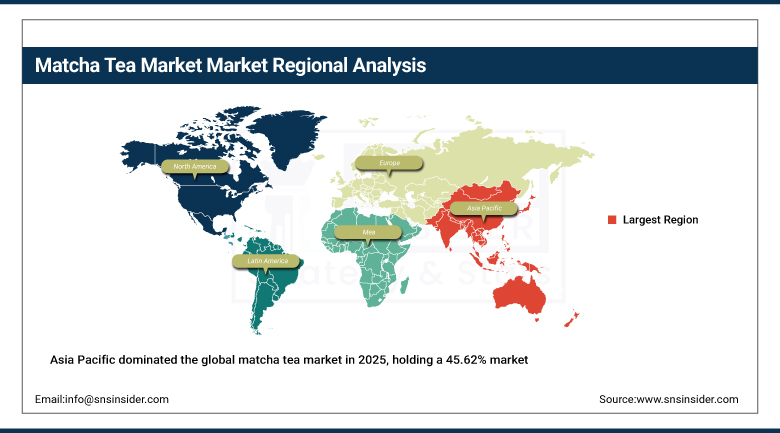
Asia Pacific dominated the global matcha tea market in 2025, holding a 45.62% market share, anchored by Japan’s position as both the world’s primary matcha producing nation and its most sophisticated domestic matcha consumption market. Japan accounts for approximately 54.6% of Asia Pacific revenues through the combination of deep-rooted ceremonial tea culture, the highest per-capita matcha consumption of any national market, and the origin location of the world’s most commercially prestigious matcha brands and production regions including Uji, Nishio, and Kagoshima. The Japanese domestic market’s commercial sophistication sustains the grade, origin, and producer provenance differentiation that premium matcha pricing depends on globally.
China, South Korea, and India are the most commercially significant secondary Asia Pacific markets where matcha adoption is growing fastest. China’s tea culture integration with matcha, South Korea’s café culture’s enthusiastic adoption of matcha beverages, and India’s growing premium wellness beverage consumer segment are each independently creating above-average matcha demand growth. Chinese matcha production has expanded substantially, with Chinese ceremonial and culinary grade products increasingly supplying both domestic and international markets at competitive price points relative to Japanese equivalents.
Get Customized Report as per Your Business Requirement - Enquiry Now
North America Matcha Tea Market Insights
North America is the fastest-growing regional matcha tea market at a CAGR of 12.52% through 2033, driven by the United States’ extraordinary matcha adoption trajectory across café culture, functional beverage development, and online specialty retail. The U.S. accounts for approximately 87.4% of North American revenues through its combination of a large and health-conscious consumer base, the world’s most developed premium beverage café ecosystem anchored by Starbucks, and the DTC e-commerce infrastructure that enables Japanese matcha producers to reach American consumers directly at premium price points. Consumer education about matcha’s L-theanine and EGCG catechin health credentials has been commercially amplified by wellness media, social platforms, and the café menu format’s normalisation of matcha as an everyday beverage alternative to coffee.
Canada contributes approximately 12.6% of North American revenues through a health-conscious consumer population whose specialty beverage culture and organic product preference create natural receptivity to premium matcha across both café and retail channels. Canadian independent cafés have adopted matcha menus at rates consistent with U.S. trends, creating consistent retail pull-through demand that national grocery retailers including Loblaws and Sobeys are satisfying through expanded organic and specialty matcha product ranging.
Europe Matcha Tea Market Insights
Europe is a commercially growing matcha tea market where the combination of rising health consciousness across consumer food and beverage purchasing, the café culture’s progressive adoption of matcha as a premium menu item, and the clean-label movement’s commercial influence on specialty food retail are creating durable demand growth across the United Kingdom, Germany, France, and the Netherlands. Germany accounts for approximately 22.3% of European revenues as the region’s largest national market, driven by its sophisticated health-oriented consumer base, the strong commercial presence of organic food retail through Alnatura, dm, and Rossmann, and above-average consumer investment in premium functional food and beverage products.
The United Kingdom is Europe’s most commercially dynamic matcha market, where independent café culture’s enthusiastic adoption of matcha latte, iced matcha, and matcha smoothie menus has created the consumer education and trial infrastructure for retail and DTC matcha product market development. UK regulatory clarity on matcha health claims and the established organic certification recognition across retail channels provide a commercially accessible route to market for premium Japanese and certified organic matcha brands targeting the UK’s well-developed health food retail ecosystem.
MEA & Latin America Matcha Tea Market Insights
The Middle East and Africa and Latin America are emerging matcha tea markets where growing urban health consciousness, expanding premium café culture, and increasing e-commerce accessibility for specialty food products are creating early-stage but commercially promising matcha consumer demand. UAE leads MEA revenues at approximately 38.4% of the regional total through Dubai and Abu Dhabi’s cosmopolitan consumer base, the well-developed premium café and hospitality sector whose menu innovation cycles actively incorporate global wellness beverage trends, and high consumer willingness to pay premium pricing for certified Japanese matcha products whose health and provenance credentials align with the wellness lifestyle positioning that premium Gulf consumer segments aspire to.
Brazil leads Latin American revenues at approximately 44.2% of the regional total through a growing urban health and wellness consumer culture, a well-developed natural and organic food retail sector, and a café culture that is progressively adopting international specialty beverage trends at above-average adoption rates relative to other Latin American markets. The broader Latin American market’s matcha adoption is in early stages but commercially promising, as rising disposable incomes and expanding e-commerce infrastructure are making premium imported specialty beverages accessible to a growing proportion of the region’s urban professional consumer segment.
Market Dynamics
Growth Drivers: Rising global health consciousness elevating functional beverage investment, café culture mainstreaming matcha consumption,
The structural alignment between matcha’s established health credential portfolio and the wellness consumer movement’s commercial priorities is the market’s most durable growth driver. Matcha’s EGCG catechin content, L-theanine calm-focus effect, and natural caffeine profile collectively address multiple consumer wellness objectives simultaneously. No single alternative ingredient delivers this combination. This multi-benefit positioning creates genuine differentiation in functional beverage formulation that commands premium consumer attention and retail pricing.
Café culture’s global adoption of matcha as a permanent menu category represents a commercial infrastructure investment whose ongoing revenue generation is independent of matcha’s health trend cycle. Once matcha latte equipment, staff training, and menu positioning are established in a café network, the ongoing operational commitment sustains consistent matcha ingredient procurement demand regardless of weekly trend fluctuations. Starbucks, independent specialty cafés, and hotel hospitality operations collectively represent a B2B procurement base whose scale provides demand stability that complements consumer retail’s higher-volatility growth profile.
Restraints: Premium pricing limiting mass-market adoption in price-sensitive consumer segments, Japanese matcha supply constraints in peak harvest seasons
Premium pricing is the matcha market’s most consistent adoption barrier in price-sensitive consumer segments and developing markets. Ceremonial and organic grade matcha carries per-unit retail pricing that positions it as a luxury wellness purchase rather than an everyday beverage staple for the majority of global consumer demographics. This pricing concentration in premium tiers limits the volume base that the market can access through mainstream retail channels whose consumer price sensitivity creates a ceiling on affordable matcha product penetration.
Japanese matcha supply is constrained by the tea cultivation cycle’s seasonal dependencies and the labour-intensive shading, harvesting, and stone-grinding production processes that characterise authentic tencha-based matcha production. Peak demand periods create supply tightness that limits the market’s ability to respond to rapid demand growth without multi-year agricultural and production capacity investment. This supply constraint creates price volatility risk that creates commercial uncertainty for food and beverage manufacturers whose formulation costs depend on stable matcha ingredient procurement economics.
Opportunities: Supplement and nutraceutical channel capsule format growth, cosmetics industry antioxidant ingredient adoption
The nutraceutical and dietary supplement channel represents a significant commercial expansion opportunity for the matcha market because it reaches consumer health investment budgets that are structurally larger than beverage and food budgets. Consumers who spend USD 50 to USD 150 monthly on supplements are commercially accessible at price points that premium matcha capsule and extract products can target without the volume sensitivity that mass-market beverage pricing creates. Supplement channel distribution through Amazon, iHerb, and health retailer networks provides global reach without the infrastructure investment that international specialty food distribution requires.
The cosmetics and personal care industry’s growing adoption of matcha extract as an antioxidant active ingredient creates a high-margin B2B market whose specification requirements for extract standardisation and certification align with the quality infrastructure that premium matcha producers have already developed for food-grade applications. Each new cosmetics brand formulating with matcha extract creates incremental ingredient demand that is independent of beverage trend cycles and structurally more margin-accretive than commodity culinary grade supply relationships.
Recent Developments:
-
2025: ITO EN launched Matcha LOVE Cold Brew teas with Matcha + Lemon Verbena & Peppermint and Matcha + Apple Ginger varieties in September 2025, targeting health-conscious U.S. consumers with flavour-innovation RTD matcha formats that extend the brand’s premium matcha positioning into the fast-growing cold brew and functional convenience beverage channels.
-
2025: Aiya Co., Ltd. expanded its organic matcha product line for the North American specialty food and supplement market in 2025, introducing new USDA-certified organic ceremonial and culinary grade matcha offerings that address the growing U.S. consumer demand for transparently sourced, certification-backed premium Japanese matcha across retail and DTC channels.
-
2024: Starbucks expanded its matcha beverage menu across North American and European markets in 2024, adding new matcha-based cold brew and seasonal matcha drink variants that built on the documented 40% year-over-year growth in matcha beverage orders, creating incremental café channel demand that directly supported wholesale matcha ingredient procurement growth for Starbucks’ Japanese and certified supplier partners.
Matcha Tea Market Key Players
-
Aiya Co., Ltd.
-
ITO EN, Ltd.
-
The AOI Tea Company
-
Marukyu Koyamaen Co., Ltd.
-
IPPODO TEA Co., Ltd.
-
DōMatcha (Canadian Matcha)
-
Encha Organic Matcha
-
Mizuba Tea Co.
-
Matcha Bar
-
Pique Tea
-
Jade Leaf Matcha
-
Kissa Tanto
-
Kyoto Obubu Tea Farms
-
Oi Ocha (ITO EN)
-
Kettl
-
Matchaful
-
Thrive Market (Private Label Matcha)
-
Stash Tea Company
-
Twinings of London
-
Numi Organic Tea
Matcha Tea Market Report Scope:
| Report Attributes | Details |
|---|---|
| Market Size in 2025 | USD 4.04 Billion |
| Market Size by 2035 | USD 10.69 Billion |
| CAGR | CAGR of 10.22% From 2026 to 2035 |
| Base Year | 2025 |
| Forecast Period | 2026-2035 |
| Historical Data | 2022-2024 |
| Report Scope & Coverage | Market Size, Segments Analysis, Competitive Landscape, Regional Analysis, DROC & SWOT Analysis, Forecast Outlook |
| Key Segments | • By Grade (Ceremonial Grade, Culinary Grade, Organic) • By Form (Powder, Liquid/RTD, Capsules, Others) • By Application (Beverages, Food & Culinary, Dietary Supplements, Cosmetics & Personal Care, Others) • By Distribution Channel (Supermarkets & Hypermarkets, Online Retail, Specialty Stores, Convenience Stores, Others) |
| Regional Analysis/Coverage | North America (US, Canada, Mexico), Europe (Eastern Europe [Poland, Romania, Hungary, Turkey, Rest of Eastern Europe] Western Europe] Germany, France, UK, Italy, Spain, Netherlands, Switzerland, Austria, Rest of Western Europe]), Asia Pacific (China, India, Japan, South Korea, Vietnam, Singapore, Australia, Rest of Asia Pacific), Middle East & Africa (Middle East [UAE, Egypt, Saudi Arabia, Qatar, Rest of Middle East], Africa [Nigeria, South Africa, Rest of Africa], Latin America (Brazil, Argentina, Colombia, Rest of Latin America) |
| Company Profiles | Aiya Co., Ltd., ITO EN, Ltd., The AOI Tea Company, Marukyu Koyamaen Co., Ltd., IPPODO TEA Co., Ltd., DōMatcha (Canadian Matcha), Encha Organic Matcha, Mizuba Tea Co., Matcha Bar, Pique Tea, Jade Leaf Matcha, Kissa Tanto, Kyoto Obubu Tea Farms, Oi Ocha (ITO EN), Kettl, Matchaful, Thrive Market (Private Label Matcha), Stash Tea Company, Twinings of London, Numi Organic Tea |

Frequently Asked Questions
Asia-Pacific dominated the market with a 45.62% share in 2025, while North America is the fastest-growing region with a CAGR of 12.52% during 2026–2033.
Ceremonial Grade dominated with a 38.47% share in 2025, while Organic is projected to grow at the fastest CAGR of 12.68% during 2026–2033.
Growth is driven by rising health awareness, demand for functional antioxidant beverages, and expanding use in drinks, supplements, bakery, and wellness products.
The market is valued at USD 4.04 Billion in 2025.
The Matcha Tea Market is expected to grow at a CAGR of 10.22% during the forecast period 2026–2033.
