
Meal Kit Delivery Services Market Report Scope & Overview:
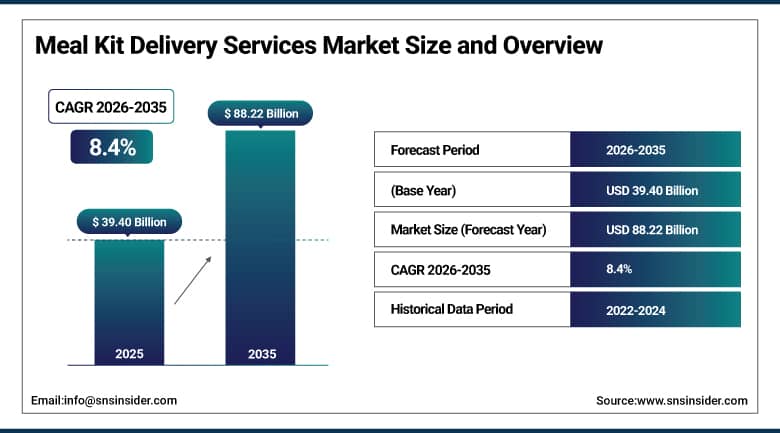
The Meal Kit Delivery Services Market was valued at USD 39.40 Billion in 2025 and is expected to reach USD 88.22 Billion by 2035, growing at a CAGR of 8.4% from 2026 to 2035.
The global Meal Kit Delivery Services Market is witnessing strong growth, primarily due to increasing consumer preference for meal solutions that offer convenience and save time. Increased urbanization and growing working hours along with changing lifestyles of households are compelling consumers to choose other alternatives to conventional methods of grocery shopping and meal preparation. Consumer interest in preparing meals at home using pre-measured ingredients is adding to the adoption of meal kit delivery service owing to its benefits in terms of preparation time and reduced food wastage. The adoption of subscription-based services, improved access through online platforms, and increased consumer preference for healthy and vegetarian meals is further aiding the adoption of the service.
FreshRealm, the fresh food production company behind Blue Apron meal kits, filed for Chapter 11 bankruptcy protection in April 2026 following a 2025 Listeria outbreak that triggered recalls and an ingredient supply disruption, with the bankruptcy affecting more than 865 jobs across New Jersey and California facilities, illustrating how food safety risks and operational disruptions continue to expose the fragility underpinning parts of the broader meal kit supply chain.
To Get More Information On Meal Kit Delivery Services Market - Request Free Sample Report
Meal Kit Delivery Services Market Trends
-
Growing category consolidation continues as legacy standalone subscription operators face acquisition, delisting, or closure amid intensifying competitive pressure.
-
Rising AI-driven meal planning applications are emerging as disruptive alternatives, addressing the flexibility gap that locked-menu weekly subscriptions could not solve.
-
Expanding corporate and institutional meal plan adoption for employee wellness programs continues to diversify demand beyond traditional household consumers.
-
Increasing partnerships with local farms for fresh ingredient sourcing continue to differentiate premium meal kit offerings from mass-market grocery alternatives.
-
Growing integration into grocery retailer ecosystems, exemplified by Home Chef's continued operation inside Kroger, is reshaping standalone subscription positioning.
U.S. Meal Kit Delivery Services Market Outlook
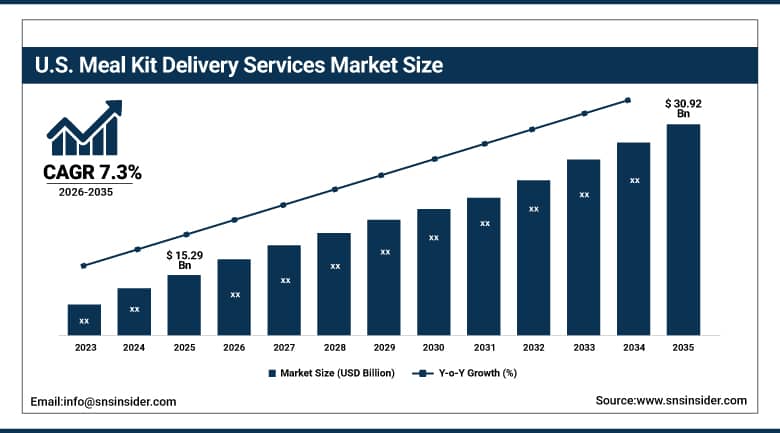
The U.S. Meal Kit Delivery Services Market was valued at USD 15.29 Billion in 2025 and is projected to reach USD 30.92 Billion by 2035, growing at a CAGR of 7.3% during 2026-2035.
Market growth continues to be propelled by a confluence of lifestyle and technology trends expanding the consumer base, even as the category undergoes significant post-pandemic normalization. HelloFresh, the last major standalone player, has watched its U.S. search volume drop roughly 80% from its 2022 peak, with the company closing its Newnan, Georgia distribution center in 2024, resulting in 727 layoffs as part of broader operational consolidation efforts reflecting the wider shift across the domestic meal-kit industry.
HelloFresh announced layoffs affecting over 270 employees in March 2025, including the closure of its Grand Prairie facility, as the company continues optimizing operations and consolidating facilities to reduce costs, reflecting the broader post-pandemic recalibration occurring across the American meal kit industry as consumer behavior data indicates overall demand remains above pre-pandemic levels even as growth rates moderate substantially.
Meal Kit Delivery Services Market Segment Analysis
-
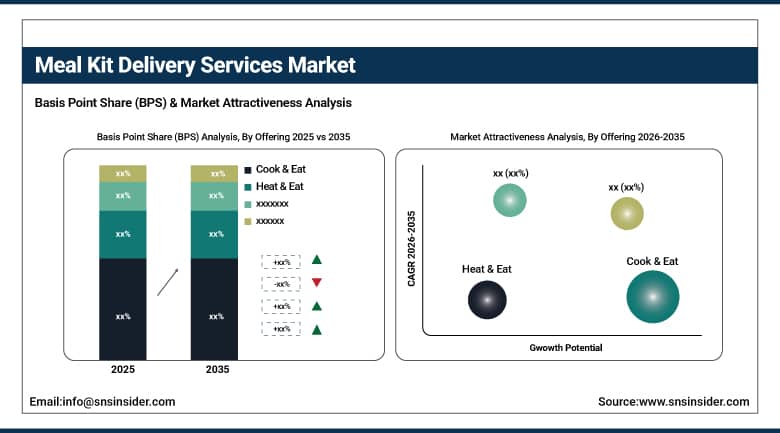
By Offering, Cook & Eat led the Meal Kit Delivery Services Market with a 60.10% share in 2025, while Heat & Eat is the fastest-growing offering segment with a CAGR of 10.60% from 2026-2035.
-
By Meal Type, Non-Vegetarian led the Meal Kit Delivery Services Market with a 63.10% share in 2025, while Vegan is the fastest-growing meal type segment with a CAGR of 11.40% from 2026-2035.
-
By Service Model, Subscription-Based led the Meal Kit Delivery Services Market with a 71.00% share in 2025, while Corporate/Institutional is the fastest-growing service model segment with a CAGR of 12.20% from 2026-2035.
By Offering, Cook & Eat Dominated the Market While Heat & Eat Is the Fastest-Growing Segment
The Cook & Eat segment led the Meal Kit Delivery Services Market with a revenue share of 60.10% in 2025, driven by demand for fresh ingredients, interactive cooking experiences, and meal customization. These kits provide pre-portioned, fresh ingredients with detailed recipes, allowing customers to prepare restaurant-quality meals at home without meal planning or grocery shopping, sustaining this offering's dominant position across the broader meal kit delivery services market worldwide.
The Heat & Eat segment is projected to register the fastest CAGR of 10.60% during the forecast period 2026-2035, driven by the increasing consumer desire for convenience without cooking involvement amid time-constrained daily schedules. Growing preference for minimal preparation effort while still accessing fresh, balanced meals continues to reinforce this segment's above-average growth trajectory relative to the more established cook and eat category.
By Meal Type, Non-Vegetarian Dominated the Market While Vegan Is the Fastest-Growing Segment
The Non-Vegetarian segment led the Meal Kit Delivery Services Market with a revenue share of 63.10% in 2025, driven by sustained consumer demand for protein-rich meal options across mainstream household consumption. Non-vegetarian meal kits continue to represent the largest and most established meal type category given broad dietary preference alignment, sustaining this segment's dominant position across the broader meal kit delivery services market worldwide.
The Vegan segment is projected to register the fastest CAGR of 11.40% during the forecast period 2026-2035, driven by the growing vegan population and health-aware consumers demanding plant-based options with higher nutritional value. Rising consumer interest in sustainable, plant-forward dietary choices continues to reinforce this segment's above-average growth trajectory relative to the more established non-vegetarian and vegetarian categories.
By Service Model, Subscription-Based Dominated the Market While Corporate/Institutional Is the Fastest-Growing Segment
The Subscription-Based segment led the Meal Kit Delivery Services Market with a revenue share of 71.00% in 2025, driven by increasing demand for home-cooked meals delivered through predictable, recurring service arrangements. Subscription-based models continue to offer companies direct customer data ownership and predictable demand forecasting, sustaining this service model's dominant position across the broader meal kit delivery services market despite recent category-wide subscription fatigue concerns.
The Corporate/Institutional segment is projected to register the fastest CAGR of 12.20% during the forecast period 2026-2035, driven by enhanced employee health initiatives via convenient and healthy food options offered through workplace wellness programs. Growing corporate expansion into meal plans for employee wellness continues to reinforce this segment's above-average growth trajectory relative to the more established consumer subscription model.
Regional Insights
|
Region |
Country |
Share (2025) |
|---|---|---|
|
North America |
United States |
86.70% |
|
Europe |
United Kingdom |
22.80% |
|
Asia Pacific |
China |
34.60% |
|
Middle East & Africa |
UAE |
20.60% |
|
Latin America |
Brazil |
24.60% |
North America Meal Kit Delivery Services Market Insights
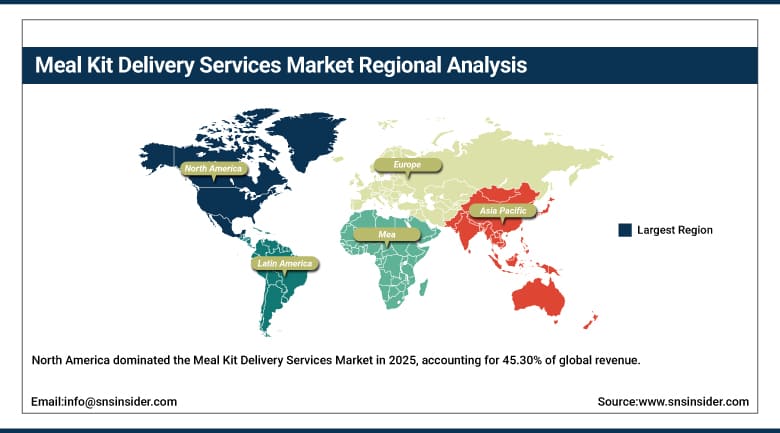
North America dominated the Meal Kit Delivery Services Market in 2025, accounting for 45.30% of global revenue. The region’s leadership is supported by high level of consumer awareness, buying power, and established meal kit suppliers. The adoption of subscription-based services has been increasing which aids in market penetration and the factor driving growth is the need for convenience as people lead busy lives. In spite of post-COVID pandemic normalization, there have been efforts to innovate the service and provide personalized meals through flexible subscriptions.
The United States accounted for approximately 86.70% of the North American market in 2025, reflecting a mature meal kit ecosystem, a high concentration of health-conscious consumers, and extensive digital and subscription-based distribution infrastructure. Canada is contributing to regional growth through steady meal kit adoption and growing consumer interest in convenient, portion-controlled meal solutions.
Get Customized Report as Per Your Business Requirement - Enquiry Now
Europe Meal Kit Delivery Services Market Insights
Europe represented a significant share of the global Meal Kit Delivery Services Market in 2025, owing to health-conscious consumers' increasing demand for meals kits along with well-established presence of players in this field. Preference of consumers for convenient, fresh, and portion-controlled meals is still fueling adoption among consumers. Moreover, changing dynamics of the regional market are being shaped through market consolidation and reorganization, even among public companies.
The United Kingdom led the European market with a 22.80% regional share in 2025, supported by leading meal kit companies including Gousto headquartered in the region. Germany, France, and the Netherlands are also contributing meaningfully to regional growth, supported by established subscription-based meal kit distribution infrastructure.
Asia Pacific Meal Kit Delivery Services Market Insights
Asia Pacific is the fastest-growing region in the Meal Kit Delivery Services Market, due to factors such as rapid urbanization, higher disposable income, and increasing demand for healthy food delivered right at their doors. The people in countries such as China, Japan, and Southeast Asia are opting more and more for meal kits as life gets busy and more hectic. In addition to that, increasing awareness regarding health issues and personalization of meal kits are boosting the adoption rate in the region.
China accounted for approximately 34.60% of the Asia Pacific market in 2025, supported by its rapidly expanding urban middle-class consumer base and growing digital food delivery adoption. Japan, India, and South Korea are also contributing meaningfully to regional growth, with rising interest in convenient, health-conscious meal solutions across the region's expanding urban centers.
Middle East & Africa and Latin America Meal Kit Delivery Services Market Insights
The Middle East & Africa region is exhibiting steady growth as urban lifestyle adoption and modern retail infrastructure investment continue expanding across the Gulf states. Latin America is similarly benefiting from expanding digital food delivery infrastructure and growing consumer interest in convenient, home-cooked meal alternatives across major regional urban centers.
The UAE led the Middle East & Africa market with a 20.60% regional share in 2025, supported by growing urban lifestyle adoption and expanding modern retail penetration. Brazil represented 24.60% of the Latin American market in 2025, driven by expanding digital food delivery infrastructure, with Mexico also contributing to regional growth through rising interest in convenient meal solutions.
Growth Drivers: Convenience Demand and Corporate Wellness Program Adoption Driving Market Growth
The key drivers influencing the development of the Meal Kit Delivery Services Market are growing consumer inclination towards convenience and healthiness of meal solutions, increasing awareness about the healthy consumption of food products, and growing disposable incomes resulting in experimentation with diverse cuisines and diets. The Meal Kits provide consumers with the possibility of getting healthy and portion-controlled food for home cooking, especially suitable for households that have limited time and pay attention to their diet due to dual-income household structure.
Growth through consolidation remains a trend in the category, where legacy standalone meal kit services become acquired, delisted, or shut down due to increased competitive pressure. Growth of AI-powered meal planning apps becomes the disruptor, solving the problem of flexibility that locked-menu weekly subscriptions failed to tackle. Institutional and corporate adoption of meal plans for wellness programs of employees becomes increasingly common in the category.
Restraints: Subscription Fatigue and Competitive Disruption from AI Meal Planning Limiting Market Expansion
Although revenues have continued to grow in the category, there are significant barriers in terms of fatigue of subscriptions, narrowing pricing differential versus grocery delivery services, and widening flexibility differential versus AI-driven meals. The locked-menu and weekly decision-making subscription service which has been used since the time novelty was the main value of the category has not withstood the test once other more flexible and cheaper alternatives were widely available to consumers.
Some category pioneers such as Plated and Chef'd have even ceased operations while Marley Spoon delisted from the Australian Securities Exchange after a strategic review in 2024. The issue of food safety is another ongoing problem for the category, as seen from the Listeria contamination incident in 2025 involving a large supplier of fresh produce.
Opportunities: Corporate Wellness Expansion and AI-Driven Personalization Creating New Growth Avenues
Substantial opportunity exists in continued expansion into corporate meal plans for employee wellness programs, providing a diversified revenue channel distinct from the challenged direct-to-consumer household subscription model. Companies that successfully pivot toward institutional and workplace wellness partnerships stand to capture significant share of category growth as traditional subscription demand continues moderating.
Growing development of AI-driven personalized meal planning applications presents a further significant growth avenue, as companies that successfully integrate flexible, algorithm-driven meal customization stand to differentiate from the rigid, locked-menu subscription model that has struggled competitively. Expanding partnerships with local farms for fresh ingredient sourcing also represent meaningful untapped opportunity for premium-positioned meal kit providers.
Recent Developments:
-
2024: Marley Spoon delisted from the Australian Securities Exchange following a 2024 strategic review, reflecting continued industry consolidation pressure.
-
2023: Wonder Group acquired Blue Apron at a 137% share price premium, subsequently dropping Blue Apron's subscription model in favor of integrated food hall operations.
-
2024: HelloFresh announced the closure of its distribution center in Newnan, Georgia, resulting in 727 layoffs as part of ongoing operational consolidation.
-
2025-2026: AI-driven meal planning applications continued emerging as disruptive alternatives to traditional locked-menu meal kit subscriptions, intensifying competitive pressure on established players.
Meal Kit Delivery Services Companies are:
-
HelloFresh SE
-
Blue Apron Holdings, Inc.
-
Marley Spoon AG
-
Gousto Group Ltd.
-
The Kroger Co. / Home Chef
-
Albertsons Companies, Inc.
-
Hungryroot, Inc.
-
Purple Carrot
-
Sunbasket, Inc.
-
Oisix ra daichi Inc.
-
EveryPlate
-
Dinnerly
-
Gobble Inc.
-
Freshly, Inc.
-
Riverford Organic Farmers Ltd.
-
SimplyCook Ltd.
-
Woop Ltd.
-
Daily Harvest, Inc.
Meal Kit Delivery Services Market Report Scope:
| Report Attributes | Details |
|---|---|
| Market Size in 2025 | USD 39.40 Billion |
| Market Size by 2035 | USD 88.22 Billion |
| CAGR | CAGR of 8.4% From 2026 to 2035 |
| Base Year | 2025 |
| Forecast Period | 2026-2035 |
| Historical Data | 2022-2024 |
| Report Scope & Coverage | Market Size, Segments Analysis, Competitive Landscape, Regional Analysis, DROC & SWOT Analysis, Forecast Outlook |
| Key Segments | • By Offering (Cook & Eat, Heat & Eat) • By Meal Type (Non-Vegetarian, Vegetarian, Vegan) • By Service Model (Subscription-Based, Single/One-Time Purchase, Corporate/Institutional) • By Distribution Channel (Direct-to-Consumer, Retail) |
| Regional Analysis/Coverage | North America (US, Canada), Europe (Germany, UK, France, Italy, Spain, Russia, Poland, Rest of Europe), Asia Pacific (China, India, Japan, South Korea, Australia, ASEAN Countries, Rest of Asia Pacific), Middle East & Africa (UAE, Saudi Arabia, Qatar, South Africa, Rest of Middle East & Africa), Latin America (Brazil, Argentina, Mexico, Colombia, Rest of Latin America). |
| Company Profiles | HelloFresh SE, Blue Apron Holdings, Inc., Marley Spoon AG, Gousto Group Ltd., The Kroger Co. / Home Chef, Albertsons Companies, Inc., CookUnity Inc., Hungryroot, Inc., Purple Carrot, Sunbasket, Inc., Oisix ra daichi Inc., EveryPlate, Dinnerly, Gobble Inc., Freshly, Inc., Relish Labs LLC, Riverford Organic Farmers Ltd., SimplyCook Ltd., Woop Ltd., Daily Harvest, Inc. |
Frequently Asked Questions
The Meal Kit Delivery Services Market is expected to grow at a CAGR of 8.4% from 2026 to 2035.
The Meal Kit Delivery Services Market was valued at USD 39.40 Billion in 2025.
The market is driven by increasing consumer preference for convenient yet healthy meal options among busy households and rising disposable incomes encouraging diverse dietary exploration.
The Cook & Eat segment dominated the Meal Kit Delivery Services Market in 2025, accounting for approximately 60.10% market share.
The North America region dominated the Meal Kit Delivery Services Market in 2025, accounting for approximately 45.30% market share.
