
Military Satellite Communications (MILSATCOM) Market Report Scope & Overview:
The Military Satellite Communications (MILSATCOM) market is witnessing continuous growth owing to the increase in defense spending, the rise in the need for secure and timely battlefield communications, and the modernization of military infrastructures around the globe. Moreover, the growth can be attributed to the increase in satellite constellations coupled with the inclusion of new technologies such as artificial intelligence and encryption. The military satellite communication systems are space-based platforms used by defense forces to establish secure voice, data, and video links across airborne, ground, and marine domains. The communication is relayed through satellites to ensure jam-resistant and encrypted connectivity without the use of vulnerable terrestrial networks that can hinder the process.
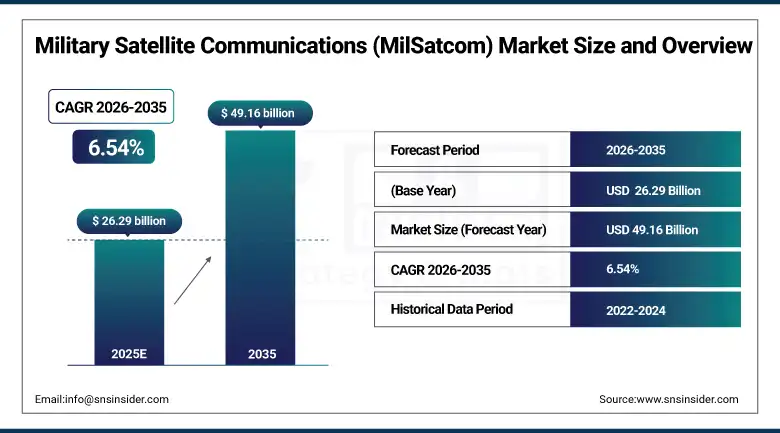
The Military Satellite Communications (MILSATCOM) Market was valued at USD 26.29 Billion in 2025 and is expected to reach USD 49.16 Billion by 2035, growing at a CAGR of 6.54% from 2026 to 2035.
To Get more information On Military Satellite Communications (MILSATCOM) Market - Request Free Sample Report
Military Satellite Communications (MILSATCOM) Market Trends
-
Rising demand for secure, reliable, and real-time communication in defense operations is driving the military satellite communication market.
-
Growing adoption for intelligence, surveillance, reconnaissance (ISR), and battlefield connectivity is boosting market growth.
-
Expansion of advanced satellite constellations and high-throughput satellites is fueling deployment.
-
Increasing focus on encrypted communication, anti-jamming capabilities, and network resilience is shaping adoption trends.
-
Advancements in AI, software-defined satellites, and next-generation ground systems are enhancing performance.
-
Rising defense budgets and modernization programs are supporting market expansion.
-
Collaborations between defense agencies, satellite operators, and technology providers are accelerating innovation and global adoption.
Key Market Highlights
|
Market Parameter |
Market Highlight / Data |
Key Growth Driver |
|---|---|---|
|
Largest End User |
Defense – 74.00% share in 2025 |
High government investments for secure, reliable, and encrypted communication solutions. |
|
Fastest-Growing End User |
Homeland Security – Fastest CAGR |
Rising concerns regarding terrorism, cyberattacks, and natural disasters. |
|
Largest Platform |
Ground – 37.00% share in 2025 |
Fixed ground stations providing high-bandwidth connectivity, encryption, and data routing. |
|
Fastest-Growing Platform |
Airborne – Fastest CAGR |
Increasing use of UAVs, fighter jets, and reconnaissance planes in modern defense strategy. |
|
Largest Component |
Transponders – 27.00% share in 2025 |
Primary hardware for transmitting, receiving, and relaying communication signals. |
|
Fastest-Growing Component |
Modems – Fastest CAGR |
Rising need for high-speed data transmission, encryption, and network management. |
|
Largest Frequency Band |
SHF – 31.00% share in 2025 |
Bandwidth capacity, reliability, and secure data exchange without interference. |
|
Fastest-Growing Frequency Band |
Ka-Band – Fastest CAGR |
High bandwidth capacity and suitability for high-data-rate communication. |
|
Largest Application |
Communication – 35.00% share in 2025 |
Constant requirement for global voice and data communication across air, land, and sea platforms. |
|
Fastest-Growing Application |
Surveillance & Reconnaissance – Fastest CAGR |
Increasing adoption of satellite-based ISR systems for intelligence gathering and threat detection. |
|
Largest Region |
North America – 42.00% share in 2025 |
Substantial military spending, advanced satellite infrastructure, and presence of key players. |
|
Fastest-Growing Region |
Asia Pacific – 8.03% CAGR |
Increase in defense spending, modernization of military communication systems, and geopolitical tensions. |
U.S. Military Satellite Communications Market Size Outlook:
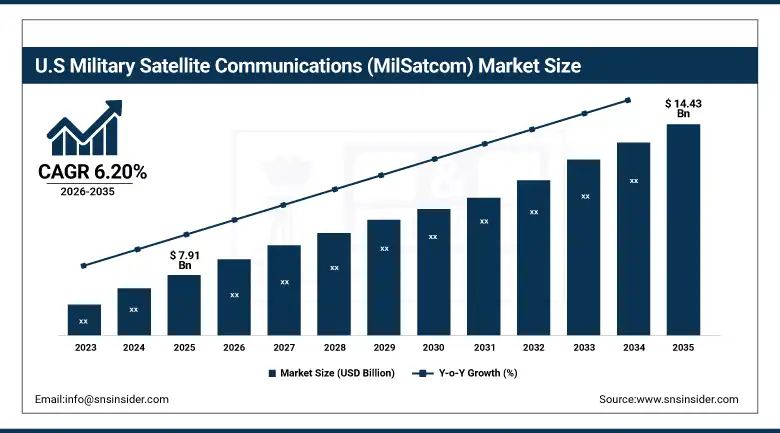
The U.S. Military Satellite Communications Market was valued at USD 7.91 billion in 2025 and is expected to reach USD 14.43 billion by 2035, growing at a CAGR of 6.20% from 2026-2035. The U.S. MILSATCOM Market is expanding owing to factors such as an increase in military spending, modernization of military networks, and the development of advanced satellite technology, as well as the demand for real-time communication in various military domains such as air, land, sea, and space.
Military Satellite Communications (MILSATCOM) Market Growth Drivers:
-
Rising demand for secure, resilient, and real-time battlefield communication systems across modern defense operations globally driving MilSatcom adoption
The increased dependency on real-time data exchange in modern warfare environments is promoting the development of military satellite communication systems. The military needs highly secure, jam-free, and encrypted communication systems for seamless coordination in warfare environments. The increased complexity of military operations, including joint and coalition operations, is also promoting the development of military satellite communication systems. Moreover, the shift towards network-centric warfare and integrated command systems is promoting investments in highly developed military satellite communication systems. These systems help in improving situational awareness and enable quick decision-making, which is significantly contributing to the development of the Military Satellite Communications (MILSATCOM) Market.
Military Satellite Communications (MILSATCOM) Market Restraints:
-
Vulnerability to cyber threats, signal jamming, and space-based attacks posing significant risks to military satellite communication networks worldwide
The increasing level of sophistication in cyber attacks and electronic warfare techniques has emerged as a significant limitation in military satellite communication systems. There are constant developments in the capabilities of adversaries to attack satellite signals, which can be detrimental to critical operations. In addition, the development of anti-satellite warfare capabilities poses a significant risk of physical damage to satellite systems. These factors necessitate continued investment in advanced encryption techniques, anti-jamming systems, and cybersecurity solutions. This, in turn, adds to the level of system complexity. These security concerns and risks can be considered significant restraints in the Military Satellite Communications (MILSATCOM) Market.
Military Satellite Communications (MILSATCOM) Market Opportunities:
-
Integration of artificial intelligence, advanced encryption, and next-generation communication technologies enhancing efficiency and security of military satellite networks significantly
The rapid development of technology in the areas of AI and cybersecurity has opened up new opportunities in the MilSatcom industry. AI network management systems can optimize network bandwidth, recognize unusual patterns, and increase network efficiency. In addition, advanced encryption techniques can increase network security, protecting military information from cyber attacks. Software-defined satellite technology can increase satellite flexibility and system performance. These advancements can provide efficient and secure communication systems to meet the dynamic requirements of military operations. In summary, the integration of technology has provided significant opportunities in the Military Satellite Communications (MILSATCOM) Market.
Military Satellite Communications (MILSATCOM) Market Segment Highlights
-
By End-User, Defense dominated the Military Satellite Communications (MILSATCOM) Market with ~74% share in 2025; Homeland Security fastest growing (CAGR).
-
By Platform, Ground dominated the Military Satellite Communications (MILSATCOM) Market with ~37% share in 2025; Airborne fastest growing (CAGR).
-
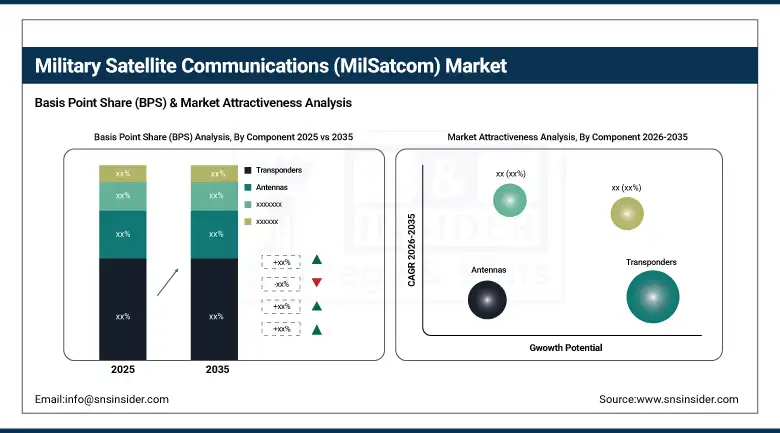
By Component, Transponders dominated the Military Satellite Communications (MILSATCOM) Market with ~27% share in 2025; Modems fastest growing (CAGR).
-
By Frequency Band, SHF dominated the Military Satellite Communications (MILSATCOM) Market with ~31% share in 2025; Ka-Band fastest growing (CAGR).
-
By Application, Communication dominated the Military Satellite Communications (MILSATCOM) Market with ~35% share in 2025; Surveillance & Reconnaissance fastest growing (CAGR).
By End-User, Defense segment dominates the Market, Homeland Security segment expected to grow fastest
The Defense segment held the largest share in the Military Satellite Communications (MILSATCOM) Market in 2025 due to high investments by governments worldwide for secure, reliable, and encrypted communication solutions. Armies worldwide require satellite-based communication for real-time coordination and integration of land, air, and sea-based operations. Hence, the high demand for mission-critical communication ensures the Defense segment holds the largest share for revenue generation.
The Homeland Security segment is expected to grow at the fastest CAGR during the forecast period of 2026-2035 due to high demand for secure and reliable communication solutions for various homeland security-related applications. Governments worldwide are investing significantly in homeland security solutions due to increasing concerns regarding terrorism, cyberattacks, and natural disasters.
By Platform, Ground segment dominates the Market, Airborne segment expected to grow fastest
Ground segment had the largest share in the Military Satellite Communications (MILSATCOM) Market in 2025. This is because the segment includes fixed ground stations. These fixed ground stations provide high-bandwidth connectivity and are usually employed for encrypting data and routing. These are the reasons why the ground segment is the backbone of military communications.
The Airborne Segment is expected to grow at the fastest CAGR during the forecast period of 2026-2035 due to the increasing use of UAVs, fighter jets, and reconnaissance planes in modern defense strategy. Satellite-based airborne communication enhances real-time situational awareness and mission efficiency for all branches of the military, resulting in an increased demand for airborne MilSatcom solutions for tactical and strategic military missions.
By Component, Transponders segment dominates the Market, Modems segment expected to grow fastest
The transponders segment accounted for the highest share of the Military Satellite Communications (MILSATCOM) Market in 2025. This is because transponders are used as primary hardware in transmitting, receiving, and relaying communication signals from satellites and ground stations. The high reliability factor coupled with the extensive coverage of transponders in military communication networks has made it a major contributor to revenue generation in the MilSatcom industry.
The modems segment is expected to witness the highest CAGR from 2026-2035. This is due to the rising need for high-speed data transmission, encryption, and network management. The modern military demands versatile modems that support various platforms and frequency bands for seamless connectivity and real-time communication, thereby accelerating the growth of the MilSatcom market.
By Frequency Band, SHF segment dominates the Market, Ka-Band segment expected to grow fastest
SHF segment accounted for the largest share of the Military Satellite Communications (MILSATCOM) Market in 2025 due to the bandwidth capacity and penetration of the SHF frequency band. The SHF frequency band is suitable for military communication due to the reliability of the frequency band. It ensures the secure exchange of data without interference. It is suitable for both mobile and fixed applications.
The Ka-Band segment is expected to grow at the fastest CAGR during the forecast period 2026-2035 due to the high capacity for bandwidth and suitability for high-data-rate communication. This frequency band has gained popularity for real-time intelligence and ISR applications, which are expected to increase the demand for Ka-Band frequencies for efficient and effective military satellite communication.
By Application, Communication segment dominates the Market, Surveillance & Reconnaissance segment expected to grow fastest
The communication segment was the largest in the Military Satellite Communications (MILSATCOM) Market in 2025. This is because communication constitutes the very essence of military satellite systems. There is a constant requirement for the use of satellite systems for voice and data communication in a global, timely manner in air, land, and sea platforms.
The Surveillance & Reconnaissance segment of the Military Satellite Communications (MILSATCOM) Market is expected to grow at the highest CAGR from 2026 to 2035, driven by the increasing adoption of satellite-based ISR systems for intelligence gathering, surveillance, and detection of potential threats. ISR systems use advanced surveillance and sensing capabilities in network-centric warfare systems.
Military Satellite Communications (MILSATCOM) Market Regional Analysis
North America Military Satellite Communications (MILSATCOM) Market Insights
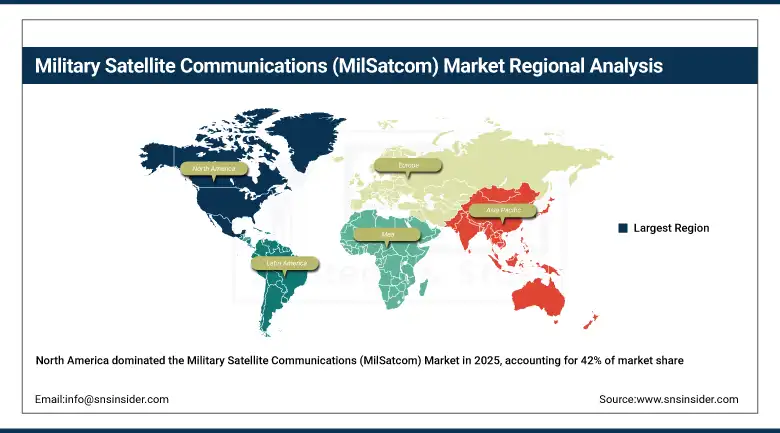
North America accounted for the highest share of the Military Satellite Communications (MILSATCOM) Market in 2025. The region is characterized by substantial military spending, advanced satellite communications infrastructure, and the presence of key players in the Military Satellite Communications (MILSATCOM) Market. The region is characterized by substantial investments by the government in secure, dependable, and high-bandwidth military communications systems. In addition, the presence of advanced ground and space-based infrastructure makes the region the leader in the Military Satellite Communications (MILSATCOM) Market. The region accounted for a revenue share of approximately 42%.
Get Customized Report as per Your Business Requirement - Enquiry Now
Asia Pacific Military Satellite Communications (MILSATCOM) Market Insights
Asia Pacific market is expected to register the fastest CAGR of 8.03% from 2026-2035, owing to factors such as an increase in defense spending, modernization of military communication systems, and geopolitical tensions. The emerging markets in this region are investing significantly in satellite-based communication systems for real-time and robust communication. Increased defense alliances, procurements of latest terminals, and adoption of latest MilSatCom technologies in airborne, naval, and land systems will propel high growth in the Military Satellite Communications Market.
Europe Military Satellite Communications (MILSATCOM) Market Insights
Europe is a notable player in the Military Satellite Communications (MILSATCOM) Market in 2025. The region has strong defense modernization programs and investments in secure satellite communications. Countries in Europe are modernizing their ground, airborne, and naval communications to increase interoperability and efficiency. The increasing use of advanced encryption and network-centric technologies, and partnerships with private satellite operators, are supporting the market in the region.
Middle East & Africa and Latin America Military Satellite Communications (MILSATCOM) Market Insights
Middle East & Africa and Latin America continued to hold their growing stature in the Military Satellite Communications (MILSATCOM) Market in 2025, considering the rising defense modernization activities, security concerns, and investments in satellite communications infrastructure. These countries are increasingly modernizing their ground, airborne, and naval communications infrastructure for secure and timely communications and are partnering with international defense and space organizations, thereby fostering the use of advanced MilSatcom technologies.
Military Satellite Communications (MILSATCOM) Market Competitive Landscape:
Lockheed Martin Corporation
Lockheed Martin Corporation, based in Bethesda, Maryland, is a leading global aerospace, defense, and security company. It focuses on advanced technology systems such as aircraft, missiles, space systems, and cybersecurity solutions for military and government institutions. Lockheed Martin Corporation promotes innovations in space, defense communications, and surveillance, as well as supporting military network security. Its products include satellite communications, missile defense systems, and AI systems, among others. It is a critical player in the development of advanced technology systems globally.
-
2026: U.S. military upgrade program Golden Dome includes Lockheed Martin as a prime for space-based communications and sensors, enhancing MilSatCom networking and tracking capabilities for defense missions.
-
2025: Lockheed Martin and Boeing advanced designs for new Mobile User Objective System (MUOS) narrowband military satellites under U.S. Space Force contract to modernize secure MilSatCom connectivity.
-
2024: Lockheed Martin received U.S. Space Force contracts to design next-generation narrowband communications satellites (MUOS Service Life Extension) to expand secure military communications.
Northrop Grumman Corporation
Northrop Grumman Corporation is a large aerospace and defense technology company based in Falls Church, Virginia. It provides high-tech solutions for aerospace, defense, and cybersecurity. Northrop Grumman Corporation focuses on satellites, missile defense systems, and autonomous systems. Northrop Grumhan is a major partner in military space communications and surveillance missions. It offers secure and robust satellite systems and is at the forefront of creating advanced and innovative technologies for space situational awareness and secure battlefield communications for allies and governments around the globe.
-
2026: Northrop Grumman remains a key partner in the U.S. Golden Dome space defense project, contributing MilSatCom space network elements for advanced tracking and communications.
-
2024: Northrop Grumman demonstrated a hybrid SATCOM connectivity milestone, integrating secure communications across multiple satellite systems for enhanced battlefield connectivity.
-
2023: Pentagon awarded Northrop Grumman a major contract to deliver and operate T2TL-Alpha satellites under SDA’s global military communications architecture.
Military Satellite Communications (MILSATCOM) Market Companies:
-
Northrop Grumman Corporation
-
RTX Corporation
-
The Boeing Company
-
Airbus Defence and Space
-
Thales Group
-
General Dynamics Corporation
-
Cobham Limited
-
Honeywell Aerospace
-
Kratos Defense & Security Solutions
-
SES S.A.
-
Eutelsat Communications
-
Inmarsat Global Limited
-
Telesat
-
SpaceX
-
Viasat Inc.
-
Israel Aerospace Industries
-
Leonardo S.p.A.
-
BAE Systems plc
| Report Attributes | Details |
|---|---|
| Market Size in 2025 | USD 26.29 Billion |
| Market Size by 2035 | USD 49.16 Billion |
| CAGR | CAGR of 6.54% From 2026 to 2035 |
| Base Year | 2025 |
| Forecast Period | 2026-2035 |
| Historical Data | 2022-2024 |
| Report Scope & Coverage | Market Size, Segments Analysis, Competitive Landscape, Regional Analysis, DROC & SWOT Analysis, Forecast Outlook |
| Key Segments | • By Component (Transponders, Antennas, Modems, Receivers, Transmitters, Others) • By Frequency Band (UHF, SHF, EHF, X-Band, Ka-Band, Others) • By Application (Navigation, Intelligence, Surveillance and Reconnaissance, Communication, Others) • By Platform (Airborne, Ground, Naval, Space) • By End-User (Defense, Homeland Security, Others) |
| Regional Analysis/Coverage | North America (US, Canada), Europe (Germany, UK, France, Italy, Spain, Russia, Poland, Rest of Europe), Asia Pacific (China, India, Japan, South Korea, Australia, ASEAN Countries, Rest of Asia Pacific), Middle East & Africa (UAE, Saudi Arabia, Qatar, South Africa, Rest of Middle East & Africa), Latin America (Brazil, Argentina, Mexico, Colombia, Rest of Latin America). |
| Company Profiles | Lockheed Martin Corporation, Northrop Grumman Corporation, RTX Corporation, The Boeing Company, Airbus Defence and Space, Thales Group, L3Harris Technologies, General Dynamics Corporation, Cobham Limited, Honeywell Aerospace, Kratos Defense & Security Solutions, SES S.A., Eutelsat Communications, Inmarsat Global Limited, Telesat, SpaceX, Viasat Inc., Israel Aerospace Industries, Leonardo S.p.A., BAE Systems plc. |
Frequently Asked Questions
North America dominated the Military Satellite Communications (MILSATCOM) Market in 2025.
The Communication segment dominated the Military Satellite Communications (MILSATCOM) Market in 2025.
Rising demand for secure, resilient, and real-time battlefield communication systems across modern defense operations globally driving MilSatcom adoption.
The Military Satellite Communications (MILSATCOM) Market was valued at USD 26.29 billion in 2025.
The Military Satellite Communications (MILSATCOM) Market is expected to grow at a CAGR of 6.54% from 2026 to 2035.
