
MS Polymer Adhesives Market Report Scope & Overview:
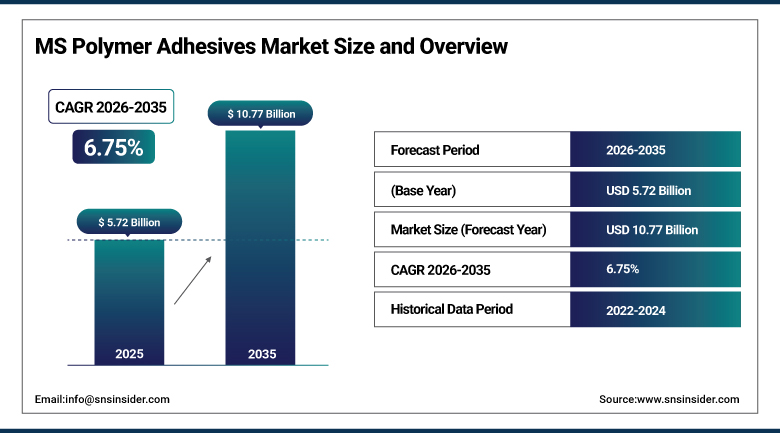
The MS Polymer Adhesives Market was valued at USD 5.72 Billion in 2025 and is expected to reach USD 10.77 Billion by 2035, growing at a CAGR of 6.75% from 2026 to 2035.
The market for modified silicone polymer adhesive has been growing at an accelerated pace on account of changing industrial demands and increasing standards. The modified silane polymer adhesive has a combination of weatherability and strength features found in silicones and polyurethanes, respectively, cures without the need for any special conditions, is weather resistant, and adheres to a variety of substrates, thus being highly versatile. The driving factors in this market are the increased usage in prefabricated modular construction, demands of electric vehicle assembly industry, and gradual replacement of old adhesives because of low VOC and isocyanate-free formulations.
For 2024, Sika AG broadened its line of SikaBond MS polymer adhesives to include fast curing products that have been developed especially for use in electric vehicle battery pack bonding, taking into account the unique structural adhesive demands of battery enclosure assembly that determine the safety performance of the automobile.
To Get more information MS Polymer Adhesives Market - Request Free Sample Report
MS Polymer Adhesives Market Trends:
-
Hybrid MS polymer adhesive formulations are enhancing bonding performance, durability, and flexibility across automotive, construction, and industrial applications.
-
Low-VOC and isocyanate-free adhesives are witnessing increased adoption as sustainability regulations and green building standards become more stringent.
-
Compatibility with automated dispensing and robotic assembly systems is driving innovation in adhesive formulations for advanced manufacturing environments.
-
Electric vehicle production is boosting demand for MS polymer adhesives in battery enclosure sealing, lightweight component bonding, and structural assembly.
-
Renewable energy projects are expanding the use of MS polymer adhesives for solar panel assembly, edge sealing, and other high-performance outdoor applications.
U.S. MS Polymer Adhesives Market Outlook:
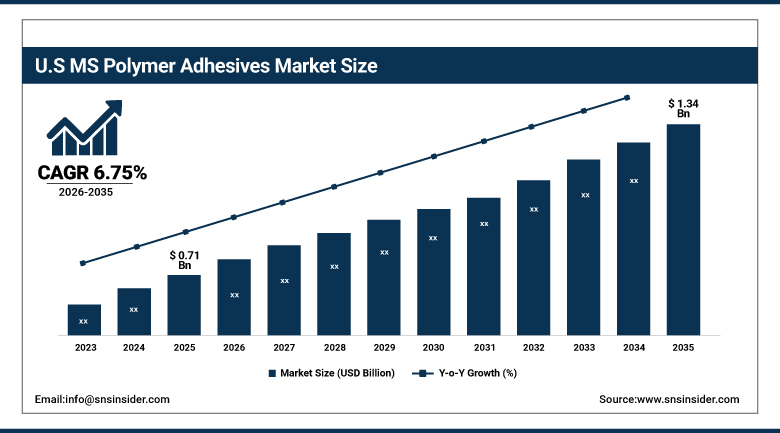
The U.S. MS Polymer Adhesives Market was valued at approximately USD 0.71 Billion in 2025 and is expected to reach approximately USD 1.34 Billion by 2035, growing at a CAGR of approximately 6.75%.
The United States' market for MS polymer adhesives is showing consistent growth due to the rising demand for sustainable and high-quality adhesive solutions in the building, automotive, and manufacturing sectors. Reasons such as increased infrastructure renovation projects backed by federal policies such as the Infrastructure Investment and Jobs Act are causing an increase in demand for durable, low VOC adhesives. American firms such as ChemLink and Pecora Corporation are playing the role of pioneers in this sector with their moisture cure adhesives and weather-resistant formulations. The drive from the authorities such as the United States Environmental Protection Agency towards sustainable and toxic-free products is driving the transition from conventional adhesives to MS polymer adhesives in key sectors.
The company ChemLink introduced new formulations in the existing range of M-1 sealants and adhesives for use in the commercial roofing sector as well as for building envelopes in 2023, to meet the needs of the green building renovation market that has been created due to federal programs of infrastructure investment. This innovation is a response to the increasing demand for single component MS polymer sealants and adhesives which meet the performance as well as low VOC air quality criteria.
MS Polymer Adhesives Market Segment Analysis:
-
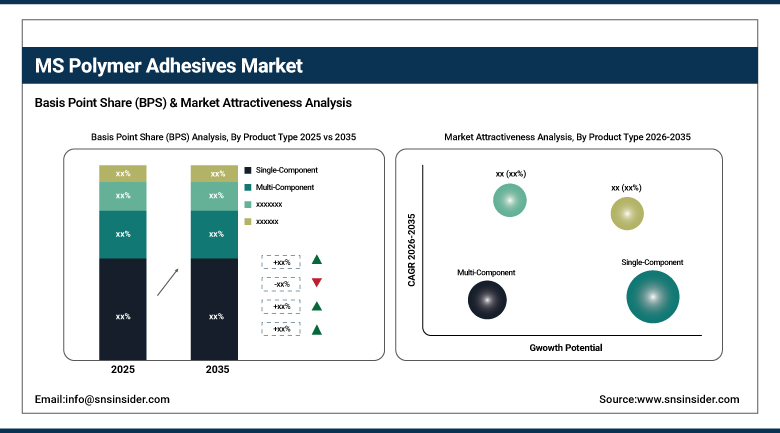
By Product Type, the single-component segment dominated the MS polymer adhesives market with approximately 68.4% share in 2025, while the multi-component segment is the fastest growing.
-
By Application, the bonding and assembly segment dominated the MS polymer adhesives market with approximately 38.9% share in 2025, while the sealing segment is the fastest growing.
-
By Substrate, the metal segment dominated the MS polymer adhesives market with approximately 32.6% share in 2025, while the plastic and composites segment is the fastest growing.
-
By End-use Industry, the building and construction segment dominated the MS polymer adhesives market with approximately 46.7% share in 2025, while the automotive and transportation segment is the fastest growing.
By Product Type, single-component dominates, multi-component grows fastest
Single-component MS polymer adhesives retained the dominant product type position in the MS polymer adhesives market in 2025. The move towards use of low VOC products within LEED certified buildings by the U.S. Green Building Council has seen more preference for one-component MS polymer adhesives because of their absence of isocyanate and environmental compliance. This ensures compliance with stringent indoor air quality standards of today’s green building certification systems. Increasing demand for one-component products in automotive service centers and OEMs comes because of their reliability, less labor requirements, and less equipment needs as compared to multi-component products.
Multi-component MS polymer adhesives are the fastest growing product type because specialized industrial assembly applications, where precise control over cure rate, working time, and final bond strength create technical requirements that single-component moisture curing chemistry cannot always satisfy, drive structured demand growth. Each industrial assembly application requiring accelerated cure profiles for high-throughput manufacturing environments, and each structural bonding scenario where mix ratio precision determines final mechanical performance, creates multi-component adhesive procurement whose technical specification requirements sustain premium commercial relationships above single-component commodity alternatives.
By End-use Industry, building and construction dominates, automotive grows fastest
Building and construction retained the dominant end-use position with approximately 46.7% of the MS polymer adhesives market in 2025. This is due to an increase in the amount of investments being made towards the development of infrastructure for both emerging and developed countries, whereby the MS polymers have found a wide variety of uses such as in floors, walls, roofs, waterproofing, tiling, parqueting, and insulation of panels. The use of MS polymer adhesives in various processes such as bonding, renovations, and maintenance works for houses and buildings as well as civil engineering constructions helps them to gain relevance in the construction industry. Modular and prefabrication construction techniques have become a major growth factor since they require bonding agents that cure fast, strong, and durable.
Automotive and transportation is the fastest growing end-use industry because automotive manufacturing hubs utilize MS polymer adhesives for weather-stripping, panel bonding, and structural sealing applications that conventional adhesive technologies cannot match in flexibility and weather resistance performance. Automotive service centers and original equipment manufacturers increasingly prefer MS polymer formulations for their consistent performance characteristics, while the growing electric vehicle production wave creates additional structured demand for battery enclosure bonding, lightweight panel assembly, and structural adhesive applications that support vehicle weight reduction objectives across the global automotive manufacturing base.
Regional Analysis:
|
Region |
Major Country |
Share within Region, 2025 (%) |
|---|---|---|
|
North America |
United States |
87.4% |
|
Europe |
Germany |
22.3% |
|
Asia Pacific |
China |
44.8% |
|
Middle East & Africa |
Saudi Arabia |
31.2% |
|
Latin America |
Brazil |
44.2% |
North America MS Polymer Adhesives Market Insights
North America emerged as the fastest-growing region in the MS Polymer Adhesives Market, registering a CAGR of approximately 7.8% during 2026–2035. This growth is driven by rising acceptance in applications such as construction, electric cars, and industrial assembly processes. Financial support from governments on sustainability-related infrastructures, like that in the form of 1.2 trillion dollars of the Bipartisan Infrastructure Law from the United States towards building and repairing roads, bridges, and housing facilities, supports the use of low VOC products like MS polymer adhesives for both structural and sealing purposes. North America generates around 87.4% of its revenue from the United States alone.
Canada contributes complementary North American revenue through its construction renovation sector and growing automotive parts manufacturing industry, whose cross-border integration with U.S. automotive assembly operations sustains consistent regional adhesive procurement.
Europe MS Polymer Adhesives Market Insights
Europe is a mature and technically sophisticated MS polymer adhesives market driven by stringent regulations, high adoption of sustainable adhesives, and advanced construction practices. As the home of strong automotive manufacturing industry in Europe, Germany is responsible for about 22.3% of European revenues. This is because 19.2 million vehicles, which include cars, vans, trucks, and buses, are produced as per European Automobile Manufacturers Association.
The United Kingdom and France are significant secondary markets where construction renovation activity and automotive component manufacturing create consistent procurement. Henkel, Sika, and Wacker Chemie's domestic and regional commercial operations sustain European market supply from established manufacturing presences across the continent.
Asia Pacific MS Polymer Adhesives Market Insights
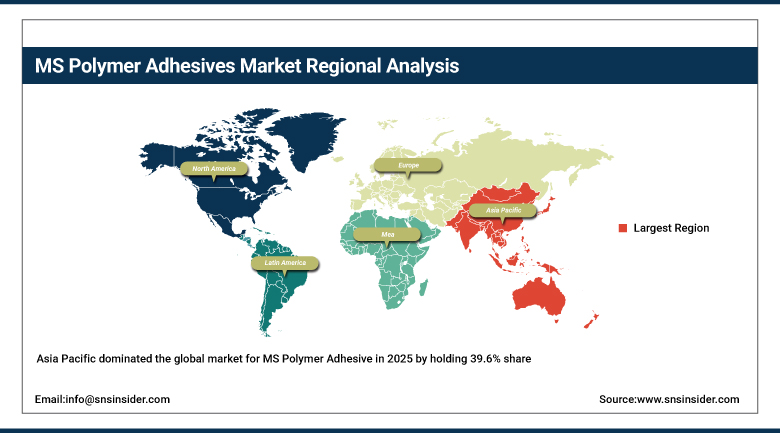
Asia Pacific dominated the global market for MS Polymer Adhesive in 2025 by holding 39.6% share on account of strong construction practices, automobile manufacturing, and manufacturing processes. Strong infrastructural development is taking place in the region such as in China, India, and Southeast Asia apart from government initiatives that promote eco-friendly building materials. This is because the country contributes about 44.8% revenue of Asia Pacific on account of the Green Building Action Programmes initiated by the government in order to promote sustainable constructions.
The Smart Cities Mission of India has created investment opportunities in infrastructure where good bonding and sealant options are required, particularly in zones that are characterized by high temperatures and humidity. The other important nation is Japan, whose sophisticated construction sector and earthquake-proof buildings require adhesives that can flexibly bond such as MS polymer adhesive.
Get Customized Report as per Your Business Requirement - Enquiry Now
MEA & Latin America MS Polymer Adhesives Market Insights
Latin America and the Middle East and Africa are emerging as attractive markets, particularly for construction and industrial applications, increasingly investing in infrastructure development and renewable energy projects that require high performance adhesive solutions. Saudi Arabia leads MEA revenues through Vision 2030 construction sector growth and expanding industrial manufacturing investment across the Kingdom.
Brazil leads Latin American revenues through its construction renovation activity and growing automotive component manufacturing sector. Mexico's automotive assembly operations and Colombia's infrastructure development collectively sustain regional market growth through 2035.
Market Dynamics:
Growth Drivers: Prefabricated modular construction adoption and technological upgradation in dispensing equipment
The rising use of prefabricated and modular construction is one of the significant growth drivers for the MS polymer adhesive industry. The process of prefabricated construction requires bonding materials, which provide quick curing time, high-strength, and durability against various environmental conditions. One of the main advantages of using MS polymer adhesives is that they have excellent flexibility, weatherability, and shrinkage resistance, which makes them more desirable to use in modular constructions for panel bonding, joint sealing, and fastening of building structures. With the increasing trend of getting certifications like LEED and WELL from modular construction projects, MS polymer adhesives become more desirable to use.
The increasing availability and adoption of automated dispensing systems across manufacturing facilities are creating new opportunities for MS polymer adhesive formulations. Modern production lines in industries like automotive assembly, electronics, and furniture manufacturing demand adhesives that can be efficiently applied using robotic or semi-automated systems.
Restraints: Limited substrate compatibility in specialized industrial applications
Although MS polymer adhesives exhibit high adhesion properties in most substrates, there are instances whereby its ability is hindered when bonding specific specialized substrates. Substrates such as polyethylene, polypropylene, and some fluoropolymer substrates need special treatment on the surface in order to allow the adhesion of the adhesive. High-performance environments where there is a high requirement for exact bonding with high temperature or chemical resistance cannot be achieved using MS polymer adhesives since there are various sectors that still use epoxy, silicone, or polyurethane-based adhesives with high substrate compatibility due to their working environment.
The need for pre-treatment or additional surface activation steps increases application time and cost, making MS polymer adhesives less attractive for highly regulated and sensitive use cases. Industrial users may also require certification or third-party validation of bond strength across non-porous and specialty materials, a challenge in certain technical settings that creates barriers for market expansion into the most demanding industrial application categories.
Opportunities: Electric vehicle assembly applications and renewable energy infrastructure expansion
Electric vehicle assembly applications represent the most commercially significant near-term growth opportunity for MS polymer adhesive manufacturers. Battery enclosure bonding, lightweight panel assembly, and structural adhesive applications that support vehicle weight reduction objectives create demand categories that conventional internal combustion engine vehicle architecture did not require at equivalent scale. Each new electric vehicle platform launched creates incremental adhesive procurement whose technical specification requirements for vibration resistance and thermal stability sustain premium commercial relationships.
Renewable energy infrastructure applications are growing as solar module assembly plants increasingly evaluate MS polymer adhesives for edge sealing and lamination applications, with more than 850 solar module assembly plants having evaluated MS adhesives for these applications. This expansion beyond traditional construction and automotive end-use categories creates new commercial channels for manufacturers capable of meeting the technical performance requirements that renewable energy infrastructure applications demand.
Recent Developments:
-
2026: Sika AG expanded its sustainable MS polymer adhesive portfolio with low-VOC, isocyanate-free solutions designed for construction, automotive, and industrial assembly applications.
-
2026: Henkel AG & Co. KGaA introduced next-generation MS polymer adhesives with enhanced bonding strength and faster curing for automated manufacturing and lightweight vehicle assembly.
-
2026: Arkema S.A. (Bostik) launched advanced hybrid polymer adhesive solutions optimized for electric vehicle assembly, renewable energy installations, and green building applications.
-
2026: H.B. Fuller Company expanded its high-performance MS polymer adhesive range with improved weather resistance and durable bonding solutions for infrastructure and industrial construction projects.
MS Polymer Adhesives Market key players are:
-
Henkel AG & Co. KGaA
-
Sika AG
-
3M Company
-
Wacker Chemie AG
-
Arkema S.A. (Bostik)
-
H.B. Fuller Company
-
Soudal Group
-
Tremco Illbruck GmbH & Co. KG
-
Hermann Otto GmbH
-
Mapei S.p.A.
-
ChemLink
-
Pecora Corporation
-
Dow Inc.
-
Kaneka Corporation
-
Illinois Tool Works Inc.
-
Den Braven Sealants International B.V.
-
RPM International Inc.
-
Shin-Etsu Chemical Co., Ltd.
-
BASF SE
-
Novachem Corporation
MS Polymer Adhesives Market Report Scope:
| Report Attributes | Details |
|---|---|
| Market Size in 2025 | USD 5.72 Billion |
| Market Size by 2035 | USD 10.77 Billion |
| CAGR | CAGR of 6.75% From 2026 to 2035 |
| Base Year | 2025 |
| Forecast Period | 2026-2035 |
| Historical Data | 2022-2024 |
| Report Scope & Coverage | Market Size, Segments Analysis, Competitive Landscape, Regional Analysis, DROC & SWOT Analysis, Forecast Outlook |
| Key Segments | • By Product Type (Single-Component, Multi-Component) • By Application (Bonding and Assembly, Sealing, Flooring and Roofing, Glazing, Others) • By Substrate (Metal, Plastic and Composites, Glass, Wood, Concrete and Masonry, Others) • By End-use Industry (Automotive and Transportation, Building and Construction, Industrial Assembly, Others) |
| Regional Analysis/Coverage | North America (US, Canada), Europe (Germany, UK, France, Italy, Spain, Russia, Poland, Rest of Europe), Asia Pacific (China, India, Japan, South Korea, Australia, ASEAN Countries, Rest of Asia Pacific), Middle East & Africa (UAE, Saudi Arabia, Qatar, South Africa, Rest of Middle East & Africa), Latin America (Brazil, Argentina, Mexico, Colombia, Rest of Latin America). |
| Company Profiles | Henkel AG & Co. KGaA, Sika AG, 3M Company, Wacker Chemie AG, Arkema S.A. (Bostik), H.B. Fuller Company, Soudal Group, Tremco Illbruck GmbH & Co. KG, Hermann Otto GmbH, Mapei S.p.A., ChemLink, Pecora Corporation, Dow Inc., Kaneka Corporation, Illinois Tool Works Inc., Den Braven Sealants International B.V., RPM International Inc., Shin-Etsu Chemical Co., Ltd., BASF SE, Novachem Corporation |

Frequently Asked Questions
The MS Polymer Adhesives Market is expected to grow at a CAGR of 6.75% from 2026 to 2035.
The MS Polymer Adhesives Market was valued at USD 5.72 Billion in 2025.
Rising adoption in prefabricated modular construction requiring quick curing, high strength, and weather-resistant bonding agents.
Building and Construction dominated the MS Polymer Adhesives Market with approximately 46.7% share in 2025.
Asia Pacific dominated the MS Polymer Adhesives Market with an estimated 39.6% share in 2025.
