
Poly Alpha Olefin Market Report Scope & Overview:
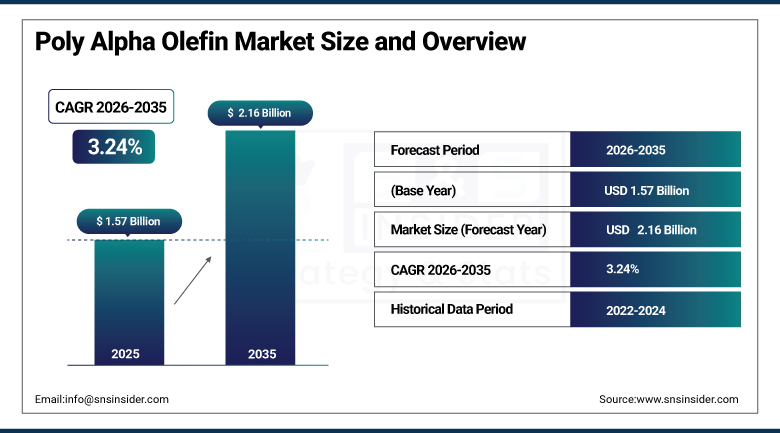
The Poly Alpha Olefin Market was valued at USD 1.57 Billion in 2025 and is projected to reach USD 2.16 Billion by 2035, growing at a CAGR of 3.24% during 2026–2035.
The Poly Alpha Olefin Market is growing at a steady pace as formulators of lubricants turn towards synthetic base oils, which provide lower volatility, higher viscosity index, and reliable cold flow properties. PAO’s are derived through oligomerization of linear alpha olefins, primarily 1-decene, followed by hydrogenation and fractionation into various viscosity grades. Production is limited to ExxonMobil, INEOS, and Chevron Phillips Chemical Company, thereby providing these companies a significant edge when it comes to pricing. The demand is being generated from traditional engine oils to wind turbine gear oils, EV driveline oils, immersion cooling systems in data centers, and continued competition by Group III+ base oils in cost sensitive automotive segments.
In August 2025, Chevron Phillips Chemical completed the expansion of its low-viscosity PAO unit in Beringen, Belgium, doubling capacity to 120,000 metric tons per year. The expansion strengthens European supply for automotive and industrial lubricants, while supporting emerging applications in electric vehicles, wind turbines, and immersion cooling.
To Get more information On Poly Alpha Olefin Market - Request Free Sample Report
Poly Alpha Olefin Market Trends
-
Metallocene PAO adoption is rising in wind turbine gear oils.
-
Low-viscosity PAO capacity is expanding across Europe and Texas.
-
PAO dielectric fluids are gaining traction in data center cooling.
-
Chinese producers are licensing technology for domestic PAO capacity.
-
Research is exploring PAO production from waste plastics.
-
Group III+ base oils are pressuring PAO in engine oils.
U.S. Poly Alpha Olefin Market Outlook
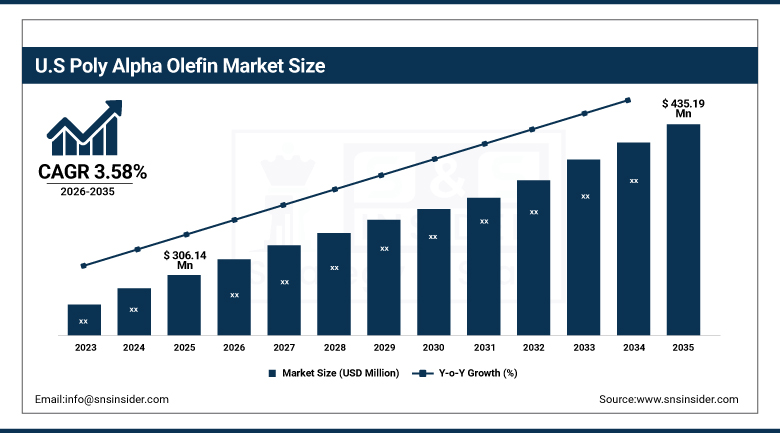
The U.S. Poly Alpha Olefin Market was valued at USD 306.14 Million in 2025 and is projected to reach USD 435.19 Million by 2035, growing at a CAGR of 3.58% during 2026–2035.
The U.S. Poly Alpha Olefin Market is anchored by the Texas Gulf Coast, where ExxonMobil, INEOS, and Chevron Phillips Chemical operate integrated alpha olefin and PAO units at Baytown, Beaumont, Chocolate Bayou, LaPorte, and Cedar Bayou. This integration secures 1-decene feedstock and supports exports to Europe, Latin America, and Asia. Domestic demand comes from premium passenger car motor oils, heavy-duty fleets, military and aerospace lubricants, and wind turbine gear oils. Growing data center construction is also opening demand for PAO-based single-phase immersion cooling fluids, while drilling operators are adopting PAO-containing lubricants in extended-reach wells. Strong OEM and military qualification requirements also keep switching costs high for established suppliers.
INEOS Oligomers is expanding its high-viscosity metallocene PAO unit in LaPorte, Texas, by 50%, raising capacity from 25,000 to nearly 40,000 metric tons per year, with completion targeted for mid-2025. The expansion supports growing demand for wind turbine gearbox lubricants and heavy industrial applications while strengthening PAO supply from the U.S. Gulf Coast.
Poly Alpha Olefin Market Segment Analysis
-
By Viscosity Type, the Low Viscosity PAO segment dominated the Poly Alpha Olefin Market with 63.48% share in 2025, while the Metallocene PAO segment is the fastest growing with a CAGR of 5.12%.
-
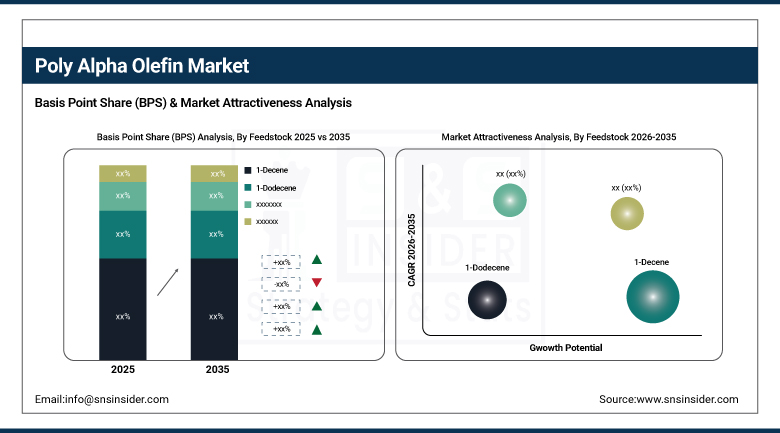
By Feedstock, the 1-Decene segment dominated the Poly Alpha Olefin Market with 71.36% share in 2025, while the 1-Dodecene segment is the fastest growing with a CAGR of 4.07%.
-
By Application, the Engine Oils segment dominated the Poly Alpha Olefin Market with 38.72% share in 2025, while the Dielectric & Heat Transfer Fluids segment is the fastest growing with a CAGR of 6.84%.
-
By End-Use Industry, the Automotive segment dominated the Poly Alpha Olefin Market with 52.93% share in 2025, while the Energy & Power segment is the fastest growing with a CAGR of 5.37%.
By Viscosity Type, Low Viscosity PAO Leads as Metallocene Grades Gain Momentum
Low Viscosity PAO, typically in the 2 to 10 cSt range, dominated the Poly Alpha Olefin Market in 2025, since it is used as the base stock for 100% fully synthetic lubricating oils like engine oil, transmission fluid, and low temperature hydraulic fluids. Its low Noack volatility along with good cold cranking properties makes it an ideal product for meeting ILSAC GF-6 and ACEA specifications. Recent capacity additions at Beringen and Chocolate Bayou are focused on these grades. Blenders also use PAO 4 and PAO 6 to upgrade Group III formulations, which keeps low-viscosity demand steady across passenger car, motorcycle, and light commercial vehicle lubricants. Industrial hydraulic fluids add further volume.
Metallocene PAO is the fastest-growing viscosity type, supported by its narrow molecular weight distribution, which delivers higher viscosity index, better shear stability, and lower pour points than conventional high-viscosity grades. Wind turbine gearbox oils, industrial gear lubricants, and greases increasingly specify mPAO to extend drain intervals and protect components under heavy loads. ExxonMobil’s SpectraSyn Elite, INEOS’s Durasyn metallocene series, and Synfluid mPAO from Chevron Phillips Chemical are key commercial products. Small doses of mPAO in low-viscosity engine oils also improve film thickness, reducing reliance on conventional viscosity modifiers and widening the addressable formulation base. This versatility supports premium pricing and repeat demand.
By Feedstock, 1-Decene Remains the Benchmark While 1-Dodecene Expands Steadily
1-Decene dominated the Poly Alpha Olefin Market in 2025, as Decenes trimers and tetramers offer the perfect blend of volatility, viscosity, and fluidity at low temperature that is the hallmark of typical PAO 4, PAO 6, and PAO 8 grades. Most manufacturers link their decene supplies with ethylene-derived linear alpha olefins plants, thus ensuring adequate feedstock and reducing costs. Decene PAO has been used in lubricants for several decades, and there is extensive data available on its performance, and it remains the first choice for engine oil and industrial approvals. But decene feedstock becomes scarce during times of increased use of alpha olefins as polyethylene comonomers.
1-Dodecene is the fastest-growing feedstock segment, as dodecene-based PAOs offer lower volatility and a higher flash point at equivalent viscosity, which suits high-temperature engine oils and fluids with tight evaporation limits. Chevron Phillips Chemical pioneered commercial dodecene-based PAO in 1995 and continues to expand its use. Blending decene and dodecene also lets producers diversify feedstock and reduce dependence on a single alpha olefin cut. Further development of PAO based on vinyl waste and bio-olefin could lead to more possible raw materials for PAO production during the forecast period, but the amount of commercial use is still very small. In addition, dodecene-based products attract attention in aviation and high-temperature fluids.
By Application, Engine Oils Hold the Lead as Dielectric Fluids Accelerate
Engine Oils dominated the Poly Alpha Olefin Market in 2025, reflecting the high number of passenger cars and heavy-duty vehicles running on fully synthetic and synthetic blends of motor oil across the globe. PAO offers benefits of oxidation resistance, deposit inhibition, and cold-starting properties to help the oils satisfy extended drain requirements set by Original Equipment Manufacturers like Mercedes-Benz, BMW, and Volkswagen. North American, European, and Chinese high-end manufacturers have continued to promote PAO base oils in their marketing. Formulations such as 0W-16 and 0W-8 have seen a rise in the demand for low volatility base oils despite the rivalry from Group III Plus base oils in medium-grade products.
Dielectric & Heat Transfer Fluids form the fastest-growing application, Backed up by electric vehicle batteries and motor cooling, transformer oils, and single phase immersion cooling in high density data centers. PAO oils have good electrical conductivity properties along with thermal stability and compatibility with seals and electronics, making them a good choice. PAO oils are currently being used in military aircraft and radar systems, showing their performance records. Gear Oils, Hydraulic Oils, Compressor Oils and Greases provide regular industrial applications especially where the life span is high and also when there is wide range of temperature requirements.
By End-Use Industry, Automotive Sustains Volume as Energy & Power Drives Growth
Automotive dominated the Poly Alpha Olefin Market in 2025, covering engine oils, transmission fluids, axle lubricants, and greases for passenger and commercial vehicles. An increase in the number of vehicles in China, India, and Southeast Asia, along with the OEM factory-fill demands of synthetic oils, ensures sustained demand. Electric cars and hybrids have changed the nature of the demand but not reduced the demand, with specialized low-viscosity fluids needed for use in electric axles, reduction gearboxes, and heat dissipation systems. The drive towards extended drain and reduced friction by automobile manufacturers is also in favor of PAO over traditional mineral base oil in premium and mainstream automobiles.
Motorcycle oils in India and Southeast Asia also contribute to the PAO demand.
Energy & Power is the fastest-growing end-use industry, backed by wind turbine gearbox lubricants, transformer fluids, and data center immersion cooling fluids. Large turbines at sea level face heavy loads and large variations in temperatures and operators favor mPAO-based gear oils due to the extended drain intervals and reduced costs of maintenance in difficult-to-access regions. Hyperscale data centers are testing PAO-based immersion cooling fluids in order to tackle the growing density of power per rack. Industrial Manufacturing and Aerospace & Defense are significant end-users of Polyalphaolefins as their products need OEM specifications and militaries’ approval. Utility-scale battery storage installations are also beginning to evaluate PAO-based thermal fluids, creating an additional long-term demand channel for producers.
Regional Analysis
|
Region |
Major Country |
Share within Region, 2025 (%) |
|---|---|---|
|
North America |
United States |
81.24% |
|
Europe |
Germany |
26.37% |
|
Asia Pacific |
China |
47.58% |
|
Middle East & Africa |
Saudi Arabia |
38.42% |
|
Latin America |
Brazil |
51.63% |
North America Poly Alpha Olefin Market Insights
North America is the fastest-growing region in the Poly Alpha Olefin Market, expanding at a CAGR of 3.71% during 2026–2035. The United States hosts the world’s largest concentration of PAO capacity along the Texas Gulf Coast, supported by integrated alpha olefin production from ExxonMobil, INEOS, and Chevron Phillips Chemical. Regional demand is driven by premium synthetic motor oils, heavy-duty fleets, aerospace and defense lubricants, and rapid data center construction. Canada adds demand from oil sands equipment and cold-climate lubricants, while Mexico’s automotive assembly plants support factory-fill and service-fill synthetic oil consumption. Wind farms in Texas and the Midwest also increase demand for mPAO-based gear oils.
Europe Poly Alpha Olefin Market Insights
Europe is a mature, specification-driven Poly Alpha Olefin Market, shaped by ACEA oil sequences, strict emissions standards, and strong demand for long-drain lubricants. Germany leads regional consumption through its premium automotive OEMs and industrial gear manufacturers, followed by France, the U.K., and Italy. Chevron Phillips Chemical’s expanded Beringen unit and INEOS’s Feluy site in Belgium strengthen local supply. Offshore wind installations in the North Sea and Baltic are increasing demand for mPAO gear oils, while REACH and EU Ecolabel requirements encourage low-volatility, high-performance synthetic base stocks. Industrial machinery exports from Germany and Italy also support steady consumption of PAO-based gear and compressor oils across the region.
Asia Pacific Poly Alpha Olefin Market Insights
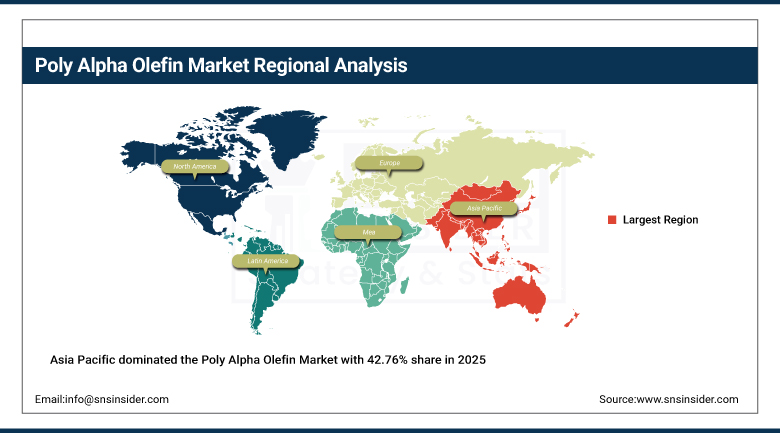
Asia Pacific dominated the Poly Alpha Olefin Market with 42.76% share in 2025, supported by the world’s largest vehicle production base and rapid industrialization across China, India, Japan, and South Korea. China leads regional demand and is building domestic supply through Shanxi Lu’an, PetroChina’s Lanzhou unit, Sinopec’s Maoming facility, and the planned CNOOC–Shell Huizhou plant. Japan and South Korea consume high-grade PAO for automotive and electronics applications. India’s growing synthetic motor oil market and expanding wind capacity further support demand, although most regional volume is still imported from the U.S. and Europe. Rising domestic capacity is expected to gradually reduce this import gap.
Get Customized Report as per Your Business Requirement - Enquiry Now
Middle East & Africa and Latin America Poly Alpha Olefin Market Insights
The Middle East & Africa Poly Alpha Olefin Market is supported by high ambient temperatures, heavy-duty fleets, and large oil and gas operations that require thermally stable lubricants. Saudi Arabia leads regional demand, with the UAE serving as a blending and distribution hub for Africa and South Asia. Latin America’s demand is anchored by Brazil, where automotive production and agribusiness equipment support synthetic lubricant use, followed by Mexico and Argentina. Both regions depend largely on imported PAO, leaving blenders exposed to freight costs, currency movements, and supply allocation from Gulf Coast and European producers. Fleet modernization is expected to lift synthetic penetration.
Market Dynamics
Growth Drivers: Stricter efficiency standards and electrification sustaining synthetic demand
Increasing regulations in terms of fuel economy and emission regulations are boosting the Poly Alpha Olefin Market as they are prompting car manufacturers to utilize engine oils with low viscosity and volatility that necessitate high quality of base stocks made synthetically to perform consistently. Longer drain interval will lead to reduced lubricant use but higher demands for performance, which suits PAO base stock formulation better.
Beyond automotive applications, rising wind turbine installations and data center expansion are broadening demand for PAO-based lubricants and thermal management fluids. Growing consumer awareness of synthetic oil benefits is further supporting premiumization across aftermarket retail and quick-lube channels, particularly in China, India, and Southeast Asia.
Restraints: High production costs and Group III+ substitution limiting penetration
The cost of PAO is still substantially higher compared to mineral and hydrocracked base oils, due to the complex process of making which includes purification of linear alpha olefin, oligomerization, hydrogenation, and exact distillation. Another factor that affects costs is the availability and cost of ethylene and decene. Group III+ base oils and gas-to-liquids base oils have become capable of meeting requirements for passenger cars at lower costs.
Supply concentration among a limited number of producers increases vulnerability to production outages, while geopolitical disruptions can further affect regional availability. Limited awareness of PAO performance benefits in price-sensitive emerging markets also restricts adoption among smaller fleet operators and independent workshops.
Opportunities: Thermal management fluids and circular feedstocks opening new value pools
Thermal management is an area which holds huge promise for the Poly Alpha Olefin Market, owing to the need for non-conductive, stable, and high-life span liquids for single phase immersion cooling of AI data centers, battery cooling of electric vehicles, and transformer fluids for grid infrastructure. PAO also has been proven to have a history in military electronics cooling.
Circular and biobased feedstocks present other possibilities, where investigation into waste PVC-based PAO and renewables-based alpha olefins can provide companies with the possibility of lowering their carbon footprint and developing distinctive products for eco-oriented lubricant brands. Technology licensing, such as NEXPAO technology from Neste in China, can also allow regional players to join the market with minimized risks.
Recent Developments:
-
In August 2026, a Nature study reported a mild AlCl3 process converting PVC waste into vinyl-derived PAO lubricants.
-
In August 2026, drones again struck Tatneft’s Taneco PAO complex in Nizhnekamsk.
-
In November 2025, Chevron Phillips Chemical’s Drilling Specialties launched NanoSlide, combining micronized graphene with Synfluid PAO.
-
In October 2025, CNOOC and Shell Petrochemicals licensed Neste’s NEXPAO technology for a 50,000-tonne PAO plant in Huizhou.
-
In September 2025, NanoXplore signed a multi-year deal to supply Tribograf graphene to Chevron Phillips Chemical.
-
In June 2024, Satellite Chemical approved a ¥25.7 billion project including a 15,000-tonne PAO plant.
Poly Alpha Olefin Companies are:
-
Exxon Mobil Corporation
-
INEOS Group
-
Chevron Phillips Chemical Company LLC
-
LANXESS AG
-
Shell plc
-
Neste Oyj
-
Idemitsu Kosan Co., Ltd.
-
Mitsui Chemicals, Inc.
-
PetroChina Company Limited
-
Sinopec Corp.
-
Shanxi Lu’an Chemical Group
-
Dowpol Corporation
-
Apalene Technology Co., Ltd.
-
Satellite Chemical Co., Ltd.
-
Tatneft PJSC
-
Sasol Limited
-
Lubrizol Corporation
-
Croda International plc
-
FUCHS SE
-
Lukoil PJSC
Poly Alpha Olefin Market Report Scope:
| Report Attributes | Details |
|---|---|
| Market Size in 2025 | USD1.57 Billion |
| Market Size by 2035 | USD 2.16 Billion |
| CAGR | CAGR of 3.24% From 2026 to 2035 |
| Base Year | 2025 |
| Forecast Period | 2026-2035 |
| Historical Data | 2022-2024 |
| Report Scope & Coverage | Market Size, Segments Analysis, Competitive Landscape, Regional Analysis, DROC & SWOT Analysis, Forecast Outlook |
| Key Segments | • By Viscosity Type (Low Viscosity PAO, High Viscosity PAO & Metallocene PAO) • By Feedstock (1-Decene, 1-Dodecene & Others) • By Application (Engine Oils, Gear Oils, Hydraulic Fluids, Compressor Oils, Greases, Dielectric & Heat Transfer Fluids & Others) • By End-Use Industry (Automotive, Industrial Manufacturing, Aerospace & Defense, Energy & Power & Others) |
| Regional Analysis/Coverage | North America (US, Canada), Europe (Germany, UK, France, Italy, Spain, Russia, Poland, Rest of Europe), Asia Pacific (China, India, Japan, South Korea, Australia, ASEAN Countries, Rest of Asia Pacific), Middle East & Africa (UAE, Saudi Arabia, Qatar, South Africa, Rest of Middle East & Africa), Latin America (Brazil, Argentina, Mexico, Colombia, Rest of Latin America). |
| Company Profiles | Exxon Mobil Corporation, INEOS Group, Chevron Phillips Chemical Company LLC, LANXESS AG, Shell plc, Neste Oyj, Idemitsu Kosan Co., Ltd., Mitsui Chemicals, Inc., PetroChina Company Limited, Sinopec Corp., Shanxi Lu’an Chemical Group, Dowpol Corporation, Apalene Technology Co., Ltd., Satellite Chemical Co., Ltd., Tatneft PJSC, Sasol Limited, Lubrizol Corporation, Croda International plc, FUCHS SE, Lukoil PJSC |
Frequently Asked Questions
Key players include Exxon Mobil Corporation, INEOS Group, Chevron Phillips Chemical Company LLC, LANXESS AG, and Shell plc, among others.
Key opportunities include immersion cooling and EV thermal management fluids, metallocene PAO for wind turbines, circular and bio-based feedstocks, and technology licensing in Asia.
Stricter fuel economy and emissions standards that require low-viscosity, low-volatility synthetic lubricants, combined with growing demand from wind energy and electrification.
Engine Oils dominated with 38.72% share in 2025, while Dielectric & Heat Transfer Fluids is the fastest growing segment with a CAGR of 6.84%.
