
Non-lethal Weapons Market Report Scope & Overview:
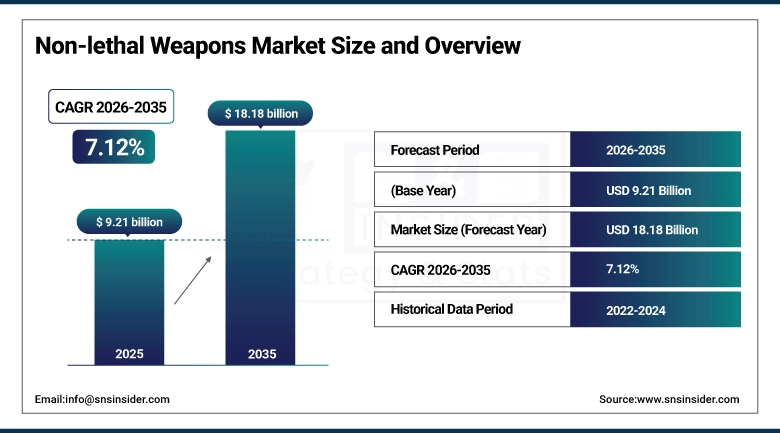
The Non-lethal Weapons Market size is valued at USD 9.21 Billion in 2025 and is projected to reach USD 18.18 Billion by 2035, growing at a CAGR of 7.12% during the forecast period 2026–2035.
The Non-lethal Weapons Market research report offers an in-depth analysis of the market trends, advancements, and defense uses. The growth in market size is largely influenced by the increase in demand for crowd control, increased adoption of conducted energy devices, such as tasers, by law enforcement officials, investments made by militaries in directed energy weapons (DEWs), and growth in public safety.
In 2025, more than 58% of law enforcement agencies increased procurement of conducted energy devices and other non-lethal tools to strengthen crowd control and reduce reliance on lethal force.
Market Size and Forecast:
-
Market Size in 2025: USD 9.21 Billion
-
Market Size by 2035: USD 18.18 Billion
-
CAGR: 7.21% from 2026 to 2035
-
Base Year: 2025
-
Forecast Period: 2026–2035
-
Historical Data: 2022–2024
To Get more information on Non-lethal Weapons Market - Request Free Sample Report
Non-lethal Weapons Market Trends:
-
Surge in use of conducted energy weapons (tasers/stun guns) by law enforcement agencies around the world.
-
Burgeoning investments in directed energy weapons (DEWs) to boost the modernization of militaries.
-
Movement toward multi-purpose non-lethal technologies that incorporate the capabilities of chemicals, kinetics, and energy.
-
Huge buying power of government organizations and military organizations, providing a boost to growth.
-
Increasing importance of border protection and peacekeeping operations in Middle East and Africa regions.
-
Self-defense market in civilians increasing for use of sprays and tasers despite being restricted due to regulatory limitations.
-
Discussions regarding ethical issues and human rights playing a role in shaping regulations.
-
Improvements in less-lethal rounds (beanbags and rubber bullets).
-
Smart targeting and integration of AI technologies in the non-lethal weapons.
-
Cooperation between defense industry companies and law enforcement products manufacturers.
U.S. Non-lethal Weapons Market Insights:
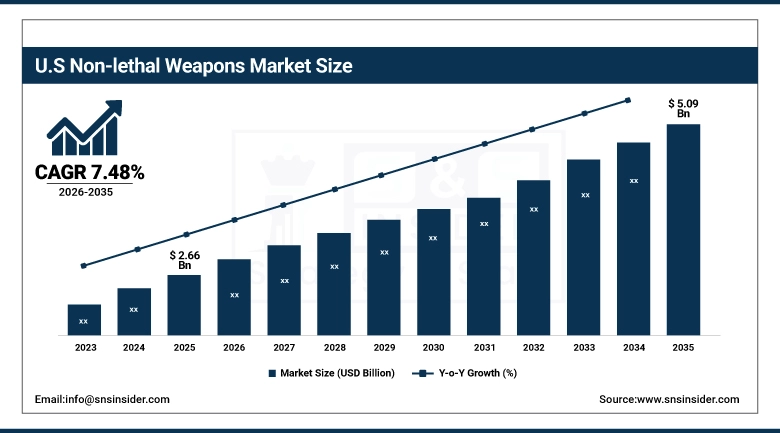
The U.S. Non-Lethal Weapons Market is forecasted to increase from USD 2.66 billion in 2025 to USD 5.09 billion during 2035, registering a CAGR of 7.48%. Factors driving this growth include increasing defense budget spending, increased adoption of cutting-edge crowd control technology, growing use of acoustic and electromagnetic devices, and the adoption of smart target selection capabilities.
Non-lethal Weapons Market Growth Drivers:
-
Rising urban unrest and civil demonstrations are driving demand for advanced crowd-control solutions.
With the increase in demonstrations, riots, and massive assemblies in the society, there is high demand for non-lethal weapons, which would be helpful in dispersing the crowds without causing many fatalities. Police and governmental organizations are using tear gas, rubber bullets, and other sound-based weapons to control crowds in the society. There is also continuous development in safety features and efficiency to promote more use and growth of the industry.
In 2025, over 62% of US police and federal agencies used advanced non-lethal weapons to handle the situation of civil unrest.
Non-lethal Weapons Market Restraints:
-
Risk of unintended harm and operational misuse is restraining adoption.
Even though these tools are regarded as “non-lethal,” taser weapons, acoustic weapons, and chemicals are capable of inflicting injuries or even causing fatalities if used improperly or excessively. The fear of accidents has made their adoption a slow process by both police departments and defense organizations, but it has also led to lawsuits against manufacturers and increased insurance premiums. The lack of proper training, the misuse of these technologies in civilian settings, and varying safety guidelines have only added to this reluctance.
Over 28% of all cases of injury involving non-lethal weapons reported in the U.S. in 2025 involved unintentional injuries.
Non-lethal Weapons Market Opportunities:
-
Rising integration of smart technologies and AI-enabled targeting systems is creating new opportunities for advanced non-lethal weapons.
Intelligent platforms with increased accuracy, misuse reduction, and enhanced accountability via monitoring using data are gaining popularity in the U.S. market. The defense and law enforcement companies are developing hybrid technologies using kinetic, chemical, and energy weapons that offer flexibility in different environmental conditions. The growth in civilian self-defense systems due to innovation initiatives by the government is contributing significantly toward driving the use of such systems.
By 2025, more than 48% of non-lethal weapon contracts signed in the U.S. included elements of smart or hybrid technologies.
Non-lethal Weapons Market Segmentation Analysis:
-
By Product Type, Direct Contact Weapons (batons, rubber bullets) held the largest market share of 31.52% in 2025, while Conducted Energy Devices (tasers) are expected to grow at the fastest CAGR of 8.98% during 2026–2035.
-
By Technology, Mechanical & Kinetic (batons, rubber bullets) dominated with 25.63% market share in 2025, whereas Conducted Energy (tasers, stun guns) are projected to record the fastest CAGR of 8.42% through 2026–2035.
-
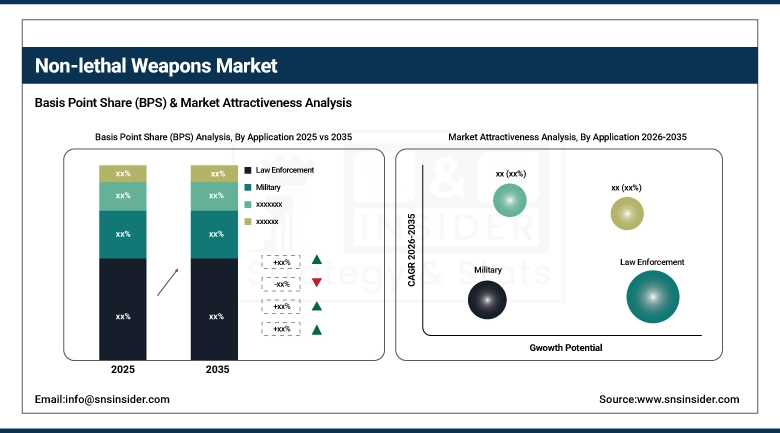
By Application, Law Enforcement accounted for the highest market share of 42.89% in 2025, while they are also expected to grow at the fastest CAGR of 7.93% during the forecast period.
-
By By End User, Government Agencies held the largest share of 43.61% in 2025, while Police Forces are expected to grow at the fastest CAGR of 8.51% during the forecast period.
By Application, Law Enforcement Leads and Expands Rapidly:
The Law Enforcement section holds the dominant market share within the category of the U.S. market for non-lethal weapons due to the wide use of tasers, batons, and chemical substances in the United States Police Department. These weapons have been found effective in the management of crowds and controlling riots.
At the same time, law enforcement remains the fastest-growing application segment in 2025, fueled by modernization programs, enhanced officer training, and rising demand for advanced technologies that improve safety, accountability, and operational efficiency.
By Product Type, Direct Contact Weapons Dominate While Conducted Energy Devices Grow Rapidly:
Weapons with Direct Contact such as batons and rubber bullets constituted the dominant portion of the U.S. market as of 2025 owing to their extensive applications in crowd control and policing due to reliability and economy of operation. Their utilization continues to be high among police units and security agencies for crowd dispersion.
Conducted Energy Weapons, which include tasers and stun guns, are the most fastest growing part of the market due to increasing interest in firearms substitutes. Increased precision, safety enhancements, and higher rates of police usage contribute to their rapid expansion.
By Technology, Mechanical & Kinetic Dominate While Conducted Energy Expands Rapidly:
Mechanical & Kinetic devices, which encompass batons and rubber bullets, continued to dominate the market in 2025 due to their established effectiveness, affordability, and simple usability during riots. They have been part of the law-enforcement force for a long time, and hence their use cannot be overlooked.
Conducted Energy devices, which include tasers and stun guns, are proving to be the fast-growing category, owing to an increasing need for non-lethal solutions in place of firearms. Precision and improved safety features are driving their growth within U.S. police departments.
By End User, Government Agencies Dominate While Police Forces Expand Rapidly:
The government agencies occupied the dominant share in the non-lethal weapons industry of the U.S. due to their critical involvement in homeland security, border patrol, and peacekeeping efforts. Their inclination toward using tried and tested means like batons, pepper sprays, and sound cannons is reflective of their operational preparedness.
Police Forces, however, represent the fastest-growing segment, driven by rising adoption of tasers, stun guns, and advanced crowd-control systems. Modernization initiatives, enhanced officer training, and growing emphasis on safer alternatives to firearms are fueling their rapid expansion nationwide.
Non-lethal Weapons Market Regional Analysis:
North America Non-lethal Weapons Market Insights:
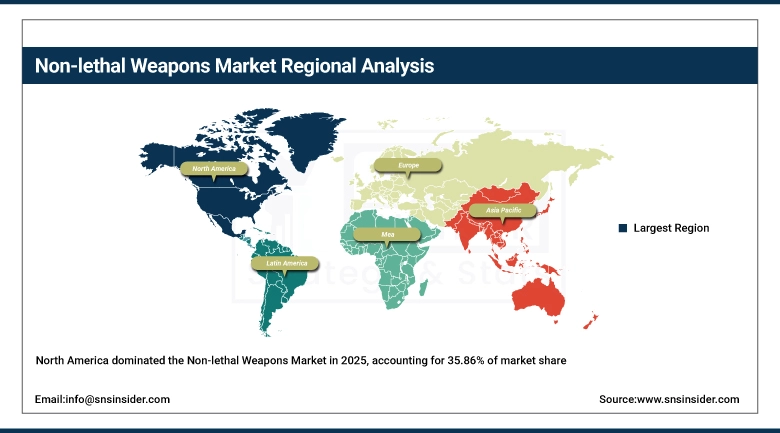
North America was the dominant player in the market in 2025, capturing a market share of 35.86%. This has been achieved due to large defense budgets, a sophisticated law enforcement system, and the extensive use of tasers, batons, and riot-control equipment. The consistent developments in directed energy weapons and acoustic weapons further boost the position of North America. The U.S. is the leading country, whereas Canada is demonstrating its potential in border security and peacekeeping missions.
Get Customized Report as per Your Business Requirement - Enquiry Now
U.S. Non-lethal Weapons Market Insights:
There is heavy policing modernization, increasing use of conducted energy weapons, and increased military spending on directed energy weapons within the market in the United States. Procurement measures at both federal and state levels, along with enhanced training and smart technology integration, reinforce the United States' status as the top-performing market within North America. Increasing demand from the civilian sector for self-defense systems also augments development efforts. Increasing demand from the civilian sector for self-defense systems also augments development efforts.
Asia-Pacific Non-lethal Weapons Market Insights:
Asia-Pacific represents the most rapidly growing region with CAGR of 8.67% owing to defense upgrades in India and China, escalating social unrest in the region, and law enforcement use of tasers and riot control equipment. The deployment of advanced technologies such as acoustic and electromagnetic deterrents is being driven by governments in their efforts toward enhancing public safety. There is also increased procurement for border security and peacekeeping missions which bolsters growth prospects. Furthermore, cooperation and innovation centers within the region are boosting innovation.
China Non-lethal Weapons Market Insights:
The development of China’s market is driven by large defense investments in modernization, the requirement for crowd control in urban areas, and increased interest in energy and acoustic weapon technologies. Robust purchasing policies and high levels of incorporation of new technologies in the military and police are ensuring China’s role in the development of the region. Increased cooperation with local industry and research in domestic non-lethal technologies further strengthens its position in the region.
Europe Non-lethal Weapons Market Insights:
Europe represents a sizable market due to its extensive use of crowd control technologies and emphasis on public safety measures. Chemical weapons, batons, and acoustic weapons have been deployed in various nations for crowd control purposes. Innovations and regulations contribute to the consistent growth of the market. Coordination and training programs among law enforcement organizations in Europe have resulted in improved effectiveness of operations in this market.
Germany Non-lethal Weapons Market Insights:
In Europe, Germany is the leading country, with extensive use of devices which includes tasers, rubber bullets, and riot control mechanisms. The country has invested heavily in technologies and incorporated these into the overall police modernization efforts, thus positioning itself as an important market in Europe. Increased focus on training officers, compliance with safety standards, and partnership with defense contractors from the region help to consolidate this position.
Latin America Non-lethal Weapons Market Insights:
The development in Latin America will be characterized by urban police tactics, counter-narcotics efforts, and growing need for crowd control. The authorities are turning to use tasers, pepper sprays, and rubber bullets to promote safety, and militaries are integrating non-lethal systems in peacekeeping activities. More cooperation with international partners will help improve the effectiveness of these operations through the efficient utilization of these technological tools.
Middle East & Africa Non-lethal Weapons Market Insights:
The Middle East & Africa region is propelled by requirements for border security, peacekeeping, and increased use of acoustic and chemical weapons. Increased investments in military modernization and law enforcement facilities have been driving the continuous growth in this market. There are various defense procurement projects and security threats in the region that are expected to propel demand in the coming years.
Non-lethal Weapons Market Competitive Landscape:
Axon Enterprise (formerly Taser International)
Axon Enterprise, Inc., based out of Scottsdale, Arizona, is one of the most prominent companies in the United States specializing in the development of technologies for public safety. This company is well recognized in the field for its production of TASER conducted energy weapons. Axon makes an enormous contribution to the development of non-lethal weapon systems as it provides alternative ways of using firearms in the law enforcement process. Axon’s integration of body-worn cameras and digital evidence platforms enhances transparency and accountability in policing.
-
In February 2025, Axon reported revenues of USD2.78 billion, driven by strong global demand for TASER devices and digital evidence solutions.
Raytheon Technologies (RTX Corporation)
Raytheon Technologies Corporation, now known as RTX Corporation, is a prominent American aerospace and defense firm whose headquarters are located in Arlington, Virginia. Raytheon boasts more than 100 years of history and is a leading provider of modern defense technology such as guided missiles, electronic warfare, and surveillance technology. In the realm of less-than-lethal technology, Raytheon has been developing directed energy and acoustic deterrence systems designed to maintain order among crowds and secure borders.
-
In September 2025, RTX reported revenues of USD88.6 billion, supported by strong demand for advanced defense and deterrence systems.
Lockheed Martin Corporation
Lockheed Martin is one of the major defense and aerospace companies located in Bethesda, Maryland. Though famous for its aviation products and missiles, Lockheed Martin is also active in the area of non-lethal weapons by conducting research on directed energy and advanced deterrence systems. The company’s strategy for innovation, affordability, and effectiveness guarantees the successful use of its products by the United States Defense Forces and their allies.
-
In May 2025, Lockheed Martin reported revenues of USD75.05 billion, with growing emphasis on directed energy and deterrence capabilities to meet evolving security needs.
Non-lethal Weapons Market Key Players:
Some of the Non-lethal Weapons Market Companies are:
-
Axon Enterprise (Taser International)
-
Raytheon Technologies
-
Lockheed Martin
-
BAE Systems
-
Northrop Grumman
-
General Dynamics
-
Rheinmetall AG
-
Thales Group
-
Leonardo S.p.A.
-
Safariland Group
-
Combined Systems Inc. (CSI)
-
FN Herstal
-
Heckler & Koch
-
Z-Medica
-
Condor Non-Lethal Technologies
-
Lamperd Less Lethal
-
Taser International (subsidiary of Axon)
-
Verney-Carron
-
Kratos Defense & Security Solutions
-
AMTEC Less-Lethal Systems
| Report Attributes | Details |
|---|---|
| Market Size in 2025 | USD 9.21 Billion |
| Market Size by 2035 | USD 18.18 Billion |
| CAGR | CAGR of 7.12% From 2026 to 2035 |
| Base Year | 2025 |
| Forecast Period | 2026-2035 |
| Historical Data | 2022-2024 |
| Report Scope & Coverage | Market Size, Segments Analysis, Competitive Landscape, Regional Analysis, DROC & SWOT Analysis, Forecast Outlook |
| Key Segments | • By Product Type (Direct Contact Weapons, Directed Energy Weapons, Conducted Energy Devices, Chemical Agents, Others), • By Technology (Mechanical & Kinetic, Electromagnetic, Chemical, Conducted Energy, Acoustic/Sonic, Others), • By Application (Law Enforcement, Military, Riot Control, Self-Defense, Others), • By End-User (Government Agencies, Defense Forces, Police Forces, Civilian Market, Others) |
| Regional Analysis/Coverage | North America (US, Canada), Europe (Germany, UK, France, Italy, Spain, Russia, Poland, Rest of Europe), Asia Pacific (China, India, Japan, South Korea, Australia, ASEAN Countries, Rest of Asia Pacific), Middle East & Africa (UAE, Saudi Arabia, Qatar, South Africa, Rest of Middle East & Africa), Latin America (Brazil, Argentina, Mexico, Colombia, Rest of Latin America). |
| Company Profiles | Axon Enterprise, Raytheon Technologies, Lockheed Martin, BAE Systems, Northrop Grumman, General Dynamics, Rheinmetall AG, Thales Group, Leonardo S.p.A., Safariland Group, Combined Systems Inc. (CSI), FN Herstal, Heckler & Koch, Z-Medica, Condor Non-Lethal Technologies, Lamperd Less Lethal, Taser International (subsidiary of Axon), Verney-Carron, Kratos Defense & Security Solutions, AMTEC Less-Lethal Systems. |
Frequently Asked Questions
Law Enforcement leads the market with 42.89% share and grows fastest with CAGR of 7.93%, reflecting extensive adoption of non-lethal weapons for riot control, public safety, and modernization programs across police forces.
Conducted Energy technologies are expanding fastest with CAGR of 8.42%, fueled by innovations in precision, safety mechanisms, and growing integration into police modernization initiatives.
Mechanical & Kinetic technologies dominate with market share of 25.63%, supported by their long-standing adoption in crowd-control scenarios and ease of deployment across law enforcement agencies.
Conducted Energy Devices, including tasers and stun guns, are the fastest-growing segment with CAGR of 8.98%, driven by rising demand for safer alternatives to firearms and enhanced officer training programs.
Direct Contact Weapons, such as batons and rubber bullets, dominate with market share of 31.52%, due to their proven reliability, cost-effectiveness, and widespread use in riot control and law enforcement operations.
