
Order Consolidation Robots Market Report Scope & Overview:
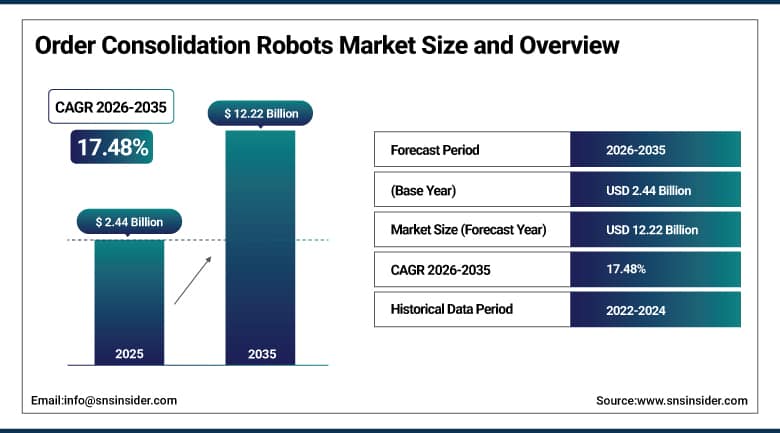
The Order Consolidation Robots Market was valued at USD 2.44 Billion in 2025 and is expected to reach USD 12.22 Billion by 2035, growing at a CAGR of 17.48% from 2026 to 2035.
Warehouses have quietly become one of the more intense proving grounds for robotics, and order consolidation is right at the center of that shift. As e-commerce keeps piling pressure on fulfillment centers to ship faster, more accurately, and at higher volume than ever before, autonomous mobile robots have moved from experimental pilots into genuinely essential infrastructure for sorting, consolidating, and moving orders through the warehouse floor. These systems tackle a problem that's only gotten harder over the past decade: persistent labor shortages that make manual order picking both labor-intensive and error-prone, especially as fulfillment windows keep shrinking. Real-time inventory management, dynamic rack placement, and goods-to-person picking are all improving accuracy and cutting fulfillment times, and modular, scalable robot systems are giving businesses the flexibility to handle fluctuating order volumes without over-investing in fixed infrastructure that sits idle during slower periods.
In August 2025, Swisslog launched its IntraMove series of autonomous mobile robots for pallet transport, capable of carrying up to 3,000 kg and featuring AI-powered fleet management alongside SLAM navigation and flexible deployment, underscoring how quickly heavy-payload automation is advancing across warehouse and distribution center operations as global e-commerce volumes keep climbing year over year.
To Get More Information On Order Consolidation Robots Market - Request Free Sample Report
Order Consolidation Robots Market Trends
-
Rising labor shortages keep pushing warehouses toward automated consolidation robots capable of handling sorting and delivery tasks with minimal human oversight.
-
Advanced automation solutions are increasingly capable of handling labor-intensive picking tasks that once relied entirely on manual effort, improving accuracy while easing workforce strain.
-
Real-time inventory management, dynamic rack placement, and goods-to-person picking continue improving order accuracy and cutting fulfillment times industry-wide.
-
Modular and scalable robot systems are letting businesses adapt to fluctuating order volumes without overcommitting to fixed, hard-to-reconfigure infrastructure.
-
High upfront costs and integration complexity remain real barriers to adoption, particularly for small and medium-sized warehouse operators.
The U.S. Order Consolidation Robots Market Outlook
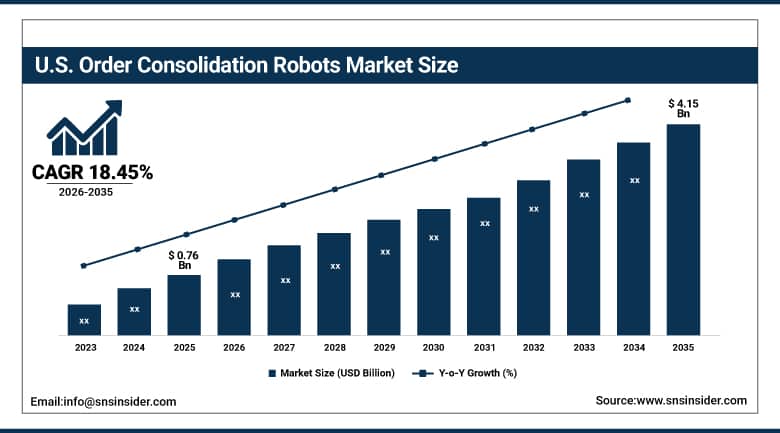
The U.S. Order Consolidation Robots Market is estimated to be USD 0.76 Billion in 2025 and is projected to reach USD 4.15 Billion by 2035, growing at a CAGR of 18.45% during 2026–2035.
Growth in the U.S. market is being driven by rapid e-commerce expansion, increasing warehouse automation, and rising adoption of advanced robotics that boost productivity while cutting labor costs and improving order accuracy across logistics and retail operations alike. American fulfillment operators have been particularly aggressive about deploying automation specifically to counter persistent warehouse labor shortages, and that urgency, combined with the sheer scale of U.S. e-commerce volume, has made the country one of the fastest-growing markets for order consolidation robotics globally, even as North America overall trails Asia Pacific in total market size.
GreyOrange, in collaboration with Google Cloud, launched GreyMatter DeepNav in August 2025, an AI-powered orchestration platform designed to dynamically manage and optimize large autonomous robot fleets, giving U.S. warehouse operators considerably more sophisticated fleet-level control over increasingly complex robotic consolidation operations.
Order Consolidation Robots Market Segment Analysis
-
By Product Type, Autonomous Mobile Robots led the market with a 46.75% share in 2025, while Collaborative Robots is the fastest-growing product-type segment at a CAGR of 19.93%.
-
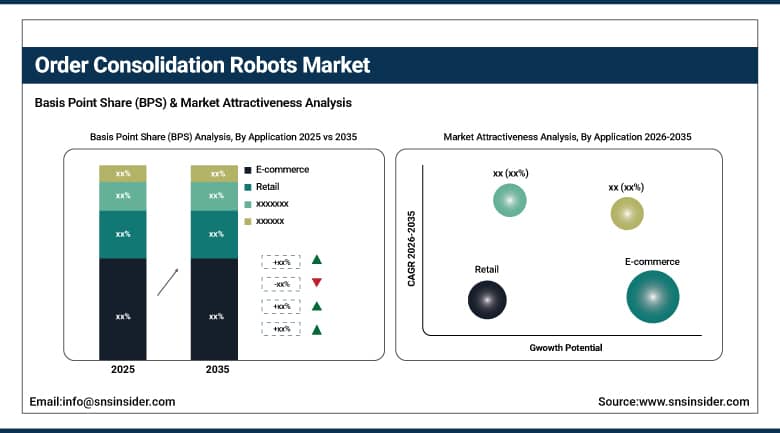
By Application, E-commerce led with a 38.88% share in 2025 and is also the fastest-growing application segment, at a CAGR of 19.34%.
-
By Payload Capacity, Medium-Capacity solutions dominated with a 37.88% share in 2025, reflecting their versatility across a wide range of warehouse operations.
By Application, E-commerce leads and grows fastest
E-commerce continues to lead the application segment and is also growing fastest, an unusual combination that makes complete sense given how central order consolidation has become to online retail fulfillment. E-commerce's widespread adoption and critical role in driving demand for efficient, reliable logistics solutions have kept this application segment firmly ahead of manufacturing, retail, and third-party logistics alike, and that lead shows no sign of narrowing.
What's kept e-commerce ahead on both dominance and growth is the relentless pace at which online order volumes keep climbing, alongside customer expectations around delivery speed that have only gotten more demanding over time. Fulfillment centers serving e-commerce customers face uniquely intense pressure to process orders quickly and accurately at scale, and that pressure is exactly what's kept order consolidation robotics investment concentrated so heavily in this single application category.
By Product Type, Autonomous Mobile Robots lead, Collaborative Robots grow fastest
Autonomous Mobile Robots remain at the head of the product-type segment, and this has a lot to do with the versatility, dependability, and ability of these robots to deal with a wide range of warehouse-related operations without requiring any human interaction. These robots are capable of moving in dynamically changing conditions, avoiding any obstacles, and even rerouting if necessary. All of this makes Autonomous Mobile Robots a natural choice for those who want to implement automation in their warehouse without having to reconfigure the whole warehouse layout according to the path of the robot.
Collaborative Robots have emerged as the fastest-growing product type due to growing interest in flexible, AI-powered robots working together with humans to increase efficiency and safety and to be more responsive to changing conditions. Instead of automating warehouses completely, these robots allow for combining human expertise with automated capabilities to perform physically repetitive tasks and leaving judgments to the human staff.
By Payload Capacity, Medium-Capacity dominates
Medium-Capacity solutions dominated the payload-capacity segment in 2025, holding a 37.88% share, largely due to their versatility and suitability for a wide range of warehouse operations that don't require either the smallest, most nimble robots or the heaviest-duty pallet-transport systems. Most consolidation tasks in a typical e-commerce or retail fulfillment center fall comfortably within medium-capacity range, and that broad applicability has kept this tier the default choice for operators outfitting a general-purpose warehouse fleet.
Low-capacity and high-capacity solutions each serve more specialized niches, low-capacity systems for lightweight, high-frequency item picking and high-capacity systems for bulk pallet movement, but neither has matched medium-capacity's broad applicability across the diverse mix of order sizes a typical fulfillment center handles day to day. As warehouse operations diversify further into handling everything from small parcels to bulky commercial goods, medium-capacity systems remain the workhorse tier most operators reach for first.
Regional Analysis
|
Region |
Major Country |
Share within Region, 2025 (%) |
|---|---|---|
|
Asia Pacific |
China |
38.60% |
|
North America |
United States |
80.40% |
|
Europe |
Germany |
24.20% |
|
Middle East & Africa |
UAE |
26.75% |
|
Latin America |
Brazil |
35.90% |
Asia Pacific Order Consolidation Robots Market Insights
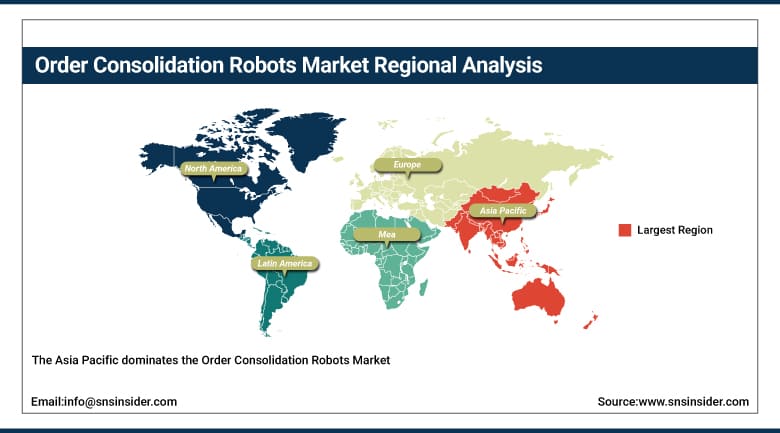
The Asia Pacific dominates the Order Consolidation Robots Market due to high growth in e-commerce, increased warehouse automation, and well-developed logistic infrastructure in major economies of the region. Increased use of advanced technology in nations such as China, Japan, and South Korea continues to help improve efficiencies and reduce labor costs, ensuring the dominance of the region in the global market environment each year.
China is leading the regional market with a share of around 38.60% of the Asia Pacific revenue due to growing e-commerce, automation of warehouses, and active governmental support that improves efficiency, reduces costs, and increases adoption. Nations such as Japan and South Korea provide significant additional demand from their developed automation environment, and the growing base of demand driven by e-commerce ensures the leadership of the region as the biggest market for order consolidation robots globally.
Get Customized Report as Per Your Business Requirement - Enquiry Now
North America Order Consolidation Robots Market Insights
North America is the fastest-growing region in the Order Consolidation Robots market, at a CAGR of approximately 19.61%, driven by increasing e-commerce demand, technological advancements in robotics, and rising investment in smart warehouses across the region. That growth rate outpaces every other region tracked in this report, even though North America trails Asia Pacific in total current market size.
The United States accounts for roughly 80.40% of regional revenue, propelled by rapid e-commerce growth, increasing warehouse automation, and the adoption of advanced robotics that are driving efficiency, reducing labor costs, and improving order accuracy across logistics and retail sectors nationwide. Canada adds further regional demand through its own growing e-commerce and logistics automation investment, and that combination should keep North America's growth rate the fastest in the market through the forecast period.
Europe Order Consolidation Robots Market Insights
The European region has a significant share of the global order consolidation robots market owing to developed manufacturing and logistics industry and strict workplace regulations that ensure efficiency and safety, thus encouraging the use of robots in different areas of operation. The key countries in Europe in terms of robotics usage include Germany, the UK, and France due to government programs that encourage smart manufacturing.
Germany accounts for a large share of regional demand, around 24.20%, driven by its advanced industrial landscape and constant efforts aimed at implementing warehouse automation solutions in its extensive network of manufacturing and logistics facilities. Besides, considerable demand for robots comes from the UK and France and future investments in digitization and modernization of supply chains will ensure that the European demand will continue to grow throughout the forecast period.
MEA & Latin America Order Consolidation Robots Market Insights
The Middle East & Africa and Latin America are gradually catching up to more mature markets, driven by the modernization of supply chain operations and increasing focus on automation across both regions. The Middle East & Africa in particular maintains a relatively stable, if modest, share of global revenue, growing at a CAGR of approximately 15.64% as regional logistics infrastructure continues to develop.
The UAE leads Middle East & Africa demand at roughly 26.75% of regional revenue, supported by the country's push toward becoming a regional logistics and e-commerce hub. Saudi Arabia and South Africa contribute further regional demand through their own infrastructure modernization efforts. In Latin America, Brazil accounts for approximately 35.90% of regional revenue, with the country's expanding e-commerce sector continuing to anchor regional demand for order consolidation robotics.
Market Dynamics
Growth Drivers: Rising labor shortages and e-commerce fulfillment pressure
Increased labor shortages are contributing to greater demand for order consolidation robots around the world, as companies adopt automation technologies due to the increasing shortage of skilled workforce in their warehouses. Manual order picking can be laborious and error-prone as companies strive to meet their orders more quickly and accurately, and automated robots with advanced multi-axis grippers and cognitive navigation technologies are increasingly taking up the order consolidation of goods onto pallets or carriers without making any mistakes and reducing the physical burden on the existing workforce in warehouses.
In addition, companies can benefit from increased efficiency, faster processing times, and lower reliance on manual labor through such automation technologies, making order consolidation robots a crucial component in the present-day warehouse automation. Another factor driving the growth of the market is the rapid growth of the e-commerce industry since the requirements for timely and accurate fulfillment keep pushing companies towards increased order consolidation, thus creating a reinforcing cycle of increasing market demand.
Restraints: High costs and integration complexity
High costs and integration complexity remain key barriers to adoption, especially for small and medium-sized enterprises that lack the capital or technical resources of larger logistics operators. Deploying a fleet of order consolidation robots requires meaningful upfront investment in hardware, software, and facility redesign, and that cost profile has kept adoption concentrated disproportionately among larger, better-capitalized warehouse operators.
Integration with existing warehouse management systems and legacy infrastructure adds a further layer of complexity, since robots need to communicate seamlessly with inventory tracking, order management, and fulfillment software to actually deliver the efficiency gains they promise. Smaller operators without dedicated IT resources often find this integration challenge genuinely daunting, which helps explain why adoption, while accelerating quickly overall, remains uneven across different tiers of the warehouse and logistics industry.
Opportunities: Fleet orchestration platforms and collaborative robot adoption
The emergence of sophisticated AI-powered fleet orchestration platforms represents a genuinely significant opportunity for order consolidation robot vendors, as these systems make it considerably easier for operators to manage large, complex robot fleets across sprawling warehouse facilities. Platforms capable of dynamically optimizing robot routing and task allocation in real time are helping operators extract meaningfully more value from their existing robot fleets without necessarily adding more hardware.
Growing adoption of collaborative robots offers a second substantial opportunity, particularly for operators hesitant to commit to a full, all-at-once automation overhaul. Vendors offering flexible, human-robot integrated solutions that let warehouses automate incrementally, starting with the most repetitive tasks and expanding from there, stand to capture meaningful share among the broad swath of small and mid-sized operators who've been slower to adopt fully autonomous systems.
Recent Developments:
-
2024: U.S. grocery retailer Kroger ordered new automated warehouse technologies from Ocado, including robotic picking and fulfillment systems, accelerating investments in robotic order consolidation solutions.
-
2024: Macy's opened a USD 640 million automated fulfillment center in North Carolina, deploying advanced warehouse robots to speed deliveries and consolidate orders more efficiently.
Order Consolidation Robots Market key players are:
-
Amazon Robotics, LLC
-
GreyOrange, Inc.
-
Swisslog Holding AG
-
Dematic Corp.
-
Honeywell Intelligrated
-
Vanderlande Industries B.V.
-
KNAPP AG
-
TGW Logistics Group GmbH
-
SSI SCHAEFER Group
-
Locus Robotics Corp.
-
6 River Systems, Inc.
-
inVia Robotics, Inc.
-
Geek+ Inc.
-
Hai Robotics Co., Ltd.
-
AutoStore AS
-
Exotec S.A.S.
-
Berkshire Grey, Inc.
-
Zebra Technologies Corporation
-
Fetch Robotics, Inc.
-
Kiva Systems (Amazon Robotics)
Order Consolidation Robots Market Report Scope:
| Report Attributes | Details |
|---|---|
| Market Size in 2025 | USD 2.44 Billion |
| Market Size by 2035 | USD 12.22 Billion |
| CAGR | CAGR of 17.48% From 2026 to 2035 |
| Base Year | 2025 |
| Forecast Period | 2026-2035 |
| Historical Data | 2022-2024 |
| Report Scope & Coverage | Market Size, Segments Analysis, Competitive Landscape, Regional Analysis, DROC & SWOT Analysis, Forecast Outlook |
| Key Segments | • by Product Type (Autonomous Mobile Robots, Collaborative Robots, Automated Guided Vehicles, Others) • by Application (E-commerce, Retail, Manufacturing, Third-Party Logistics, Others) • by Payload Capacity (Low-Capacity, Medium-Capacity, High-Capacity) |
| Regional Analysis/Coverage | North America (US, Canada, Mexico), Europe (Eastern Europe [Poland, Romania, Hungary, Turkey, Rest of Eastern Europe] Western Europe] Germany, France, UK, Italy, Spain, Netherlands, Switzerland, Austria, Rest of Western Europe]), Asia Pacific (China, India, Japan, South Korea, Vietnam, Singapore, Australia, Rest of Asia Pacific), Middle East & Africa (Middle East [UAE, Egypt, Saudi Arabia, Qatar, Rest of Middle East], Africa [Nigeria, South Africa, Rest of Africa], Latin America (Brazil, Argentina, Colombia, Rest of Latin America) |
| Company Profiles | Amazon Robotics, LLC, GreyOrange, Inc., Swisslog Holding AG, Dematic Corp., Honeywell Intelligrated, Vanderlande Industries B.V., KNAPP AG, TGW Logistics Group GmbH, SSI SCHAEFER Group, Locus Robotics Corp., 6 River Systems, Inc., inVia Robotics, Inc., Geek+ Inc., Hai Robotics Co., Ltd., AutoStore AS, Exotec S.A.S., Berkshire Grey, Inc., Zebra Technologies Corporation, Fetch Robotics, Inc., Kiva Systems (Amazon Robotics) |

Frequently Asked Questions
The Order Consolidation Robots Market is expected to grow at a CAGR of 17.48% from 2026 to 2035.
The Order Consolidation Robots Market was valued at USD 2.44 Billion in 2025.
The major growth factor is rising labor shortages and the need for faster, more accurate warehouse operations driving adoption of order consolidation robots.
The Autonomous Mobile Robots segment dominated the Order Consolidation Robots Market with a 46.75% share by product type in 2025.
Asia Pacific dominated the Order Consolidation Robots Market in 2025, driven by rapid e-commerce growth and advanced logistics infrastructure.
