
Oregano Seasoning Market Report Scope & Overview:
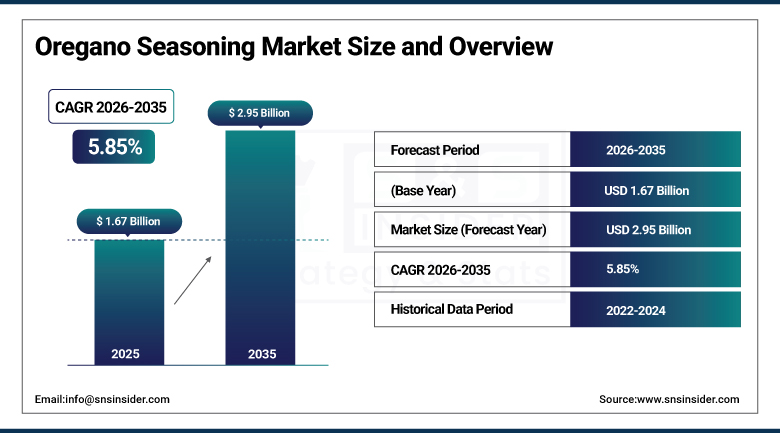
The Oregano Seasoning Market was valued at USD 1.67 Billion in 2025 and is expected to reach USD 2.95 Billion by 2035, growing at a CAGR of 5.85% from 2026-2035.
The Oregano Seasoning Market covers dried, powdered and liquid oregano preparations sold for culinary, pharmaceutical and personal care use across retail, foodservice and industrial buyers worldwide. Conventional product still accounts for most volume, yet manufacturers are widening organic and cold-processed lines as home cooks and foodservice buyers alike chase cleaner ingredient labels without giving up the herb's familiar pungency. Pharmaceutical and nutraceutical buyers are drawing on oregano's carvacrol content for formulated extracts, pulling a share of supply away from pure culinary channels. Mediterranean-cuisine popularity and a broader pivot toward herb-forward flavoring over salt and sugar continue to widen the product's everyday kitchen footprint across both developed and fast-growing retail markets.
⮞The Food and Agriculture Organization forecast in a November 17, 2025 report that the world's import bill for coffee, tea, cocoa and spices would climb 34.5 percent to USD 65.2 billion in 2025, the largest annual increase in over a decade. This sharp rise in the broader spice import category points to a firmer pricing and demand environment for oregano seasoning suppliers across nearly every major import market.
To Get more information On Oregano Seasoning Market - Request Free Sample Report
Oregano Seasoning Market Trends
-
Retailers are expanding organic and single-origin oregano lines on shelf as home cooks trade up from generic blended jars toward traceable, higher-margin single-herb offerings.
-
Foodservice chains are standardizing oregano-forward seasoning blends across menus to deliver consistent Mediterranean and Italian flavor profiles at scale across thousands of locations.
-
Nutraceutical and pharmaceutical buyers are scaling up purchases of high-carvacrol oregano extract as formulated supplements move beyond narrow health-food distribution into mainstream retail.
-
Suppliers are investing in steam-sterilization and irradiation-free pathogen-reduction methods to address recurring salmonella concerns tied to dried herb and spice supply chains.
-
E-commerce-first spice brands are gaining share from traditional packaged-goods players by offering smaller-batch, recipe-paired oregano formats targeted at younger home cooks.
U.S. Oregano Seasoning Market Outlook
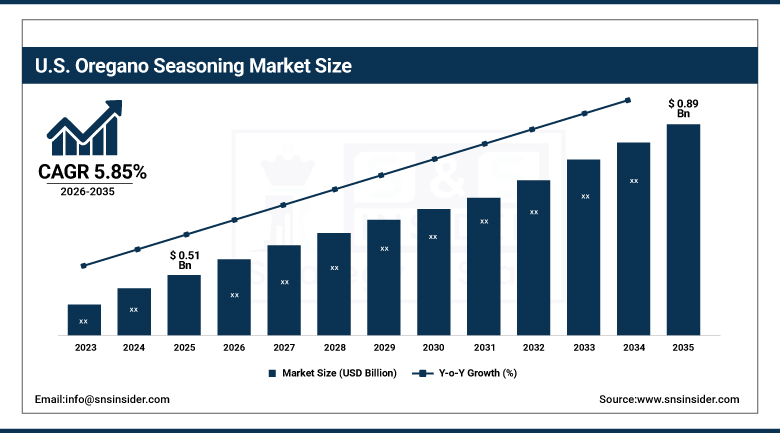
The U.S. Oregano Seasoning Market was valued at USD 0.51 Billion in 2025 and is expected to reach USD 0.89 Billion by 2035, growing at a CAGR of 5.85% from 2026-2035.
The U.S. Oregano Seasoning Market is the largest within North America. A dense restaurant and foodservice base, spanning pizza chains and Italian-American concepts, keeps bulk and foodservice-pack oregano demand steady across most major metropolitan markets. Retail buyers increasingly favor organic and non-irradiated jars positioned alongside conventional blends, giving packaged-goods suppliers room to run both tiers side by side on the same shelf set. Import reliance on a handful of producing countries continues to shape pricing and availability for U.S. buyers, since very little oregano is grown commercially within the country. Growing home-cooking interest in Mediterranean recipes keeps retail volume climbing even as foodservice remains the larger buying channel nationwide.
⮞The National Restaurant Association forecast on February 12, 2026 that U.S. restaurant and foodservice sales would reach USD 1.55 trillion in 2026, even amid a challenging business environment for operators. Strong foodservice spending supports the bulk oregano and seasoning-blend purchasing that pizza, Italian-American and Mediterranean concepts depend on to keep menu flavor consistent across thousands of locations nationwide.
Oregano Seasoning Market Segment Analysis
-
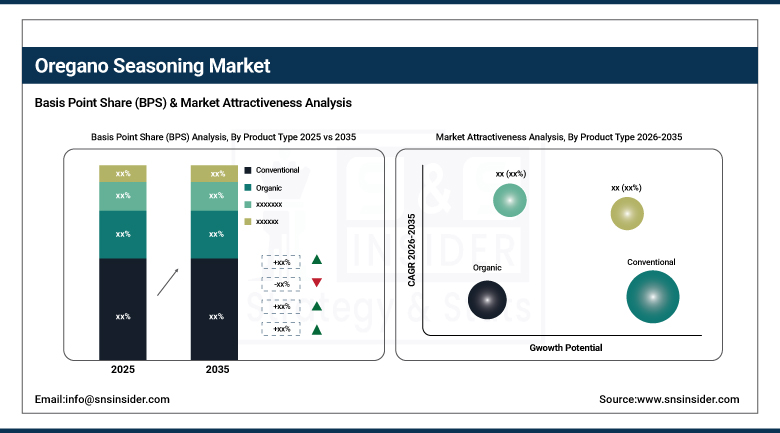
By Product Type, the Conventional segment dominated the Oregano Seasoning Market with approximately 59.70% share in 2025, while the Organic segment is the fastest growing with a CAGR of approximately 8.95%.
-
By Application, the Food and Beverages segment dominated the Oregano Seasoning Market with approximately 73.40% share in 2025, while the Pharmaceuticals segment is the fastest growing with a CAGR of approximately 7.65%.
-
By Distribution Channel, the Supermarkets and Hypermarkets segment dominated the Oregano Seasoning Market with approximately 39.80% share in 2025, while the Online Stores segment is the fastest growing with a CAGR of approximately 10.35%.
-
By Form, the Powder segment dominated the Oregano Seasoning Market with approximately 42.90% share in 2025, while the Liquid segment is the fastest growing with a CAGR of approximately 9.15%.
By Product Type, Conventional Dominates the Oregano Seasoning Market and Organic Grows Fastest
Conventional oregano holds the largest product-type share because it remains the lowest-cost option for bulk foodservice buyers and private-label packagers who prioritize consistent pricing over premium positioning on a jar of dried herb. Established growing regions have decades of conventional cultivation infrastructure already in place, keeping conventional supply chains more predictable than the smaller, newer organic acreage still being certified across several producing countries. Large packaged-goods brands continue to anchor their flagship seasoning lines on conventional product, reinforcing its volume lead even as premium retail shelf space increasingly favors the organic tier alongside it across most major grocery banners and foodservice distributors serving both channels at once.
Organic oregano is growing fastest as retail buyers and younger home cooks increasingly treat a clean ingredient label as a baseline expectation rather than a premium add-on for everyday pantry staples. Certification costs and smaller per-acre yields keep organic oregano priced well above conventional product, but shoppers willing to pay that premium are expanding faster than the conventional buyer base is growing in most developed retail markets. Specialty and natural-food retailers are also dedicating more shelf space to organic single-herb jars, giving the category a distribution advantage that pure price competition with conventional product cannot offset across most developed retail markets tracking this shift closely.
⮞The Organic Trade Association reported that U.S. organic product sales reached USD 76.6 billion in 2025, according to figures released in March 2026, with fresh and shelf-stable grocery categories posting some of the strongest gains. Sustained growth across the broader organic grocery trade supports the organic oregano tier, which benefits from the same shelf momentum.
By Application, Food and Beverages Dominates the Oregano Seasoning Market and Pharmaceuticals Grows Fastest
Food and beverage use accounts for the overwhelming majority of application share because oregano remains primarily a culinary herb, consumed in pizza, pasta sauce, marinades and Mediterranean-style dishes across both retail and foodservice channels worldwide. Packaged-goods and foodservice buyers purchase the overwhelming bulk of global oregano volume, reinforcing food and beverage's position as the category's primary demand engine year after year. Rising global interest in Mediterranean and herb-forward cuisine continues to widen this application's lead further, as more cuisines outside the herb's traditional home markets adopt it as an everyday flavoring ingredient rather than an occasional specialty purchase reserved for special meals or holiday cooking occasions.
Pharmaceuticals is growing fastest as formulators scale up extraction of carvacrol and other oregano-derived compounds for respiratory, digestive and antimicrobial supplement products entering mainstream retail rather than staying confined to specialty health-food distribution. Clinical interest in carvacrol's documented antimicrobial properties is pulling a growing share of premium-grade oregano toward extraction rather than whole-herb culinary use, a shift that pure culinary demand growth alone would not produce. Supplement brands expanding retail distribution beyond health-food channels are the primary buyers driving this faster-growing application category today across both established and newly entered consumer markets worldwide, adding momentum that pure culinary oregano sales alone do not generate.
⮞The World Health Organization's Global Traditional Medicine Centre reported in its 2025 annual report that traditional medicine, including herbal preparations, is used by billions of people worldwide, following the May 2025 adoption of its Global Traditional Medicine Strategy 2025 to 2034. Rising institutional attention to herbal and botanical medicine is reinforcing pharmaceutical-grade extraction demand, which is now outpacing ordinary culinary oregano growth.
By Distribution Channel, Supermarkets and Hypermarkets Dominates the Oregano Seasoning Market and Online Stores Grows Fastest
Supermarkets and hypermarkets lead distribution because oregano is overwhelmingly a routine grocery top-up purchase that shoppers add to a broader basket rather than seek out through a dedicated specialty trip. Large retail chains stock both conventional and organic tiers side by side, letting a single store visit cover the full range of price points a household might want without requiring a separate specialty-store stop. Private-label supermarket seasoning lines have also grown more sophisticated in recent years, narrowing the quality gap with name-brand products and reinforcing the supermarket channel's lead on pure convenience and selection breadth across nearly every major retail format worldwide.
Online stores are growing fastest as direct-to-consumer spice brands build subscription and recipe-paired formats that a traditional supermarket aisle does not replicate easily. Shoppers researching specific Mediterranean or Italian recipes increasingly discover and purchase oregano through the same online search and marketplace listings that surface the recipe itself, collapsing discovery and purchase into a single online step. Several e-commerce-first brands have built their entire positioning around smaller-batch, higher-turnover jars that online retail's lower shelf-space constraints support more easily than a physical supermarket planogram allows across most major online grocery and marketplace platforms serving home cooks and smaller households at scale today.
⮞FMI, The Food Industry Association, reported on July 15, 2025 that food retail profit margins settled at 1.7 percent, with roughly 80 percent of retailers and suppliers expecting tariffs and trade policy to keep affecting pricing through the year. Thin margins in physical grocery retail are encouraging more oregano and seasoning buyers to consider online channels, which carry lower overhead for suppliers and shoppers alike.
By Form, Powder Dominates the Oregano Seasoning Market and Liquid Grows Fastest
Powdered oregano holds the largest form share because its fine, uniform particle size blends evenly into sauces, marinades and dry seasoning mixes without the visible leaf fragments that whole-leaf product tends to leave behind in a finished dish. Foodservice and packaged-goods manufacturers favor powder specifically for its consistent dosing through automated blending and filling equipment, a practical advantage whole-leaf product cannot match at industrial production scale. Decades of established powder-grinding infrastructure across major producing regions also keep powder the lowest-cost form to manufacture and ship, reinforcing its volume lead across both retail and foodservice buying channels worldwide and across most private-label supply programs.
Liquid oregano extract is growing fastest as beverage formulators and supplement brands seek a form that disperses instantly into drinks and capsule-fill lines without the sediment that powdered or whole-leaf product would leave behind. Functional beverage and wellness-shot brands are the primary buyers adopting liquid oregano extract, valuing its carvacrol concentration and clean dispersion over the lower per-unit cost that powder still offers at bulk culinary scale. That beverage and supplement-driven adoption is pulling liquid extract's growth rate well ahead of the far larger but more slowly growing powder and whole-leaf culinary base across nearly every market tracking this functional-beverage trend closely.
The Codex Alimentarius Commission adopted new global quality standards for large cardamom, coriander and vanilla at its 49th Session in Geneva, Switzerland, reported on July 18, 2026, with the Codex Committee on Spices and Culinary Herbs continuing its broader standard-setting work across the spice category. Standard-setting across adjacent spice categories reflects the regulatory environment that liquid extract producers must navigate as they scale new oregano-derived products.
Regional Analysis
|
Region |
Major Country |
Share within Region, 2025 (%) |
|---|---|---|
|
North America |
United States |
82.40 |
|
Europe |
Italy |
24.70 |
|
Asia Pacific |
India |
29.80 |
|
Middle East and Africa |
Saudi Arabia |
33.50 |
|
Latin America |
Brazil |
38.90 |
North America Oregano Seasoning Market Insights
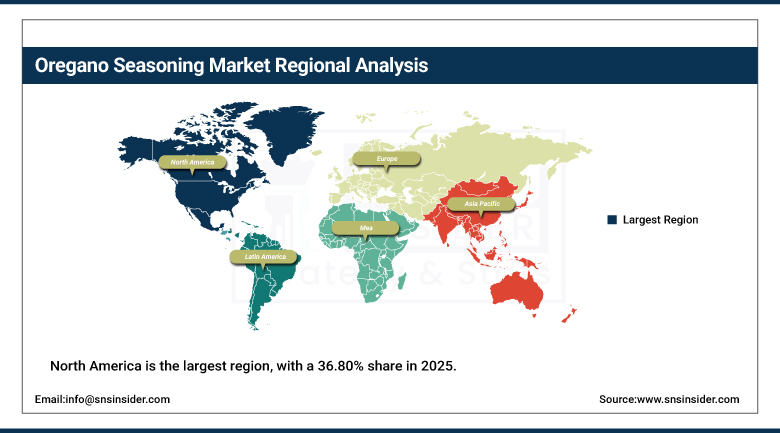
North America is the largest region, with a 36.80% share in 2025. The United States anchors regional demand through its dense pizza, Italian-American and Mediterranean foodservice base, alongside a mature packaged-goods retail trade stocking both conventional and organic tiers. Canada contributes a smaller but steadily growing base of retail and foodservice buyers, drawn largely toward the same national brands that dominate the U.S. market through cross-border supply chains. Very little oregano is grown commercially within North America itself, leaving the region's suppliers and foodservice buyers dependent on established import relationships with producing countries across the Mediterranean and beyond for nearly all of their raw supply.
North American packaged-goods brands compete on blend consistency, organic certification and private-label price positioning rather than on growing their own raw material, since nearly all regional supply originates overseas. Trade policy affecting spice and herb imports has become a more visible cost factor for regional buyers in recent budget cycles, pushing some larger buyers toward longer-term supply contracts to smooth pricing volatility. Rising home-cooking interest in Mediterranean and herb-forward recipes continues to support steady retail volume growth even as foodservice remains the region's larger overall buying channel by total volume purchased across both countries in nearly every recent budget cycle.
⮞The American Spice Trade Association stated on February 12, 2026 that the U.S. spice industry relies significantly on imports from India for products such as black pepper, cumin and turmeric that cannot be grown commercially within the United States. The same import dependence applies to oregano, which North American buyers likewise source almost entirely from overseas growing regions.
Get Customized Report as per Your Business Requirement - Enquiry Now
Europe Oregano Seasoning Market Insights
Europe is a smaller but culturally central region for oregano demand, with activity concentrated in Italy, Greece and Spain where the herb is a defining ingredient in national cuisine rather than an imported specialty item. Italy anchors regional demand through both local consumption and its role as a processing and re-export hub for oregano moving to other European markets. Germany and France add a further base of retail and foodservice buyers drawn to premium, origin-labeled Mediterranean herb products sold through specialty grocers and mainstream supermarket chains. Europe's deep culinary association with the herb keeps demand steadier through the year than in markets where oregano leans on seasonal cooking.
European spice and seasoning producers are investing in expanded blending and packaging capacity to serve both home-market demand and export volume moving to markets without equivalent local processing infrastructure. Regional buyers increasingly favor origin-verified Mediterranean oregano over blended or re-packaged imports from outside the region, supporting a premium price tier that producers closer to the herb's traditional growing areas are well placed to serve. Currency and energy-cost pressures across the bloc have pushed some producers to add capacity in lower-cost member states rather than expand existing facilities in their home markets, a pattern now spreading across several adjacent herb and spice categories too.
⮞Fuchs Group completed a twelve-month expansion of its Curtea de Argeș factory in Romania, reported on September 12, 2024, doubling production and storage capacity to 18,000 square meters and adding a dedicated spice-mixing unit. This expansion by one of Europe's larger seasoning producers is an example of regional capacity building that supports oregano and broader herb-blend output across the bloc.
Asia Pacific Oregano Seasoning Market Insights
Asia Pacific is a smaller region today but the fastest-growing, expanding at a projected CAGR of approximately 8.45% from 2026 to 2035. India anchors regional supply as one of the world's largest spice and herb exporting countries, with a large local processing and packaging base serving both home-market and export demand. China and Japan add a growing base of retail buyers drawn to Western and Mediterranean-style cooking trends gaining popularity in urban centers, while Australia contributes a smaller but steady foodservice and retail buyer base. Rising disposable income across several Asia Pacific markets continues to widen the herb's everyday culinary footprint well beyond its traditional regional usage.
Regional exporters are navigating a softer export environment after a stronger prior year, with buyers in developed import markets adjusting order volumes amid broader currency and trade-policy shifts. Local retail demand across several Asia Pacific markets is growing faster than export volume, as rising middle-class household spending supports packaged seasoning purchases that previously relied on loose, unbranded herb sold through traditional wet markets. That shift toward packaged, branded retail product is creating a faster-growing local revenue base than export volume alone would generate for regional suppliers navigating this softer overseas demand environment across most major Asia Pacific export destinations this cycle.
⮞The Spices Board India reported that the country's spice exports fell 6.37 percent to USD 4.43 billion in the fiscal year ending March 2026, with shipment volumes down 4.37 percent, according to figures published June 3, 2026. This decline following a record prior year points to a softer near-term export environment for regional oregano and herb suppliers.
MEA & Latin America Oregano Seasoning Market Insights
The Middle East and Africa is a smaller but steadily growing region, with demand concentrated in Saudi Arabia, the United Arab Emirates and South Africa. Saudi Arabia leads regional demand through a large foodservice and catering sector serving both local consumers and a steady flow of international visitors drawn to global cuisine options. The United Arab Emirates adds further demand through its role as a regional trade and re-export hub, moving oregano and other seasonings onward to buyers across the wider Gulf and East African markets. South Africa contributes a smaller, longer-established retail base relying mainly on imported product given limited local oregano cultivation.
Latin America adds smaller but steady demand, led by Brazil's large foodservice and retail sector serving both home-market consumers and a growing Italian and Mediterranean dining segment across its major cities. Mexico and Argentina contribute additional retail and foodservice demand tied to their own growing casual-dining sectors, relying mainly on imported product given limited local cultivation of their own. Currency volatility across several countries continues to make landed pricing for imported oregano less predictable than retailers and foodservice buyers in the region would prefer, even as underlying consumption keeps expanding steadily across most of the region's larger urban markets and major dining centers alike.
⮞The Dubai Multi Commodities Centre reported on April 15, 2026 that its membership surpassed 26,000 companies after adding more than 2,300 new firms in 2025, with the Dubai Gold and Commodities Exchange recording more than 2 million contracts traded, a 30 percent annual increase. The growth of this trade hub's commodities base reflects regional trading infrastructure that also supports oregano and broader spice flows moving through the Gulf toward African and South Asian buyers.
Market Dynamics
Growth Drivers: Home cooking and clean-label demand are widening everyday oregano consumption
The strongest driver is the continuing shift toward home cooking of Mediterranean and herb-forward dishes, which is pulling oregano out of its traditional pizza-and-pasta corner and into a far wider range of everyday recipes across retail markets that previously used the herb only occasionally. Packaged-goods brands are responding with recipe-paired marketing and blended seasoning kits that make oregano-forward cooking approachable for buyers unfamiliar with the herb's traditional culinary role. That recipe-led marketing approach is proving more effective at expanding the buyer base than simple price promotion, since it addresses the knowledge gap rather than the cost barrier that was holding back adoption in several newer retail markets.
A second driver is the parallel shift toward cleaner ingredient labels across packaged food, which is pulling buyers toward recognizable single-herb products like oregano and away from artificial flavor blends that dominated prior decades of seasoning innovation. Organic certification and non-irradiated processing have become meaningful purchase factors for a growing share of retail buyers rather than a narrow premium tier, widening the addressable market for suppliers who invest in those credentials. Suppliers able to document clean sourcing and processing are increasingly winning shelf space over competitors still relying on conventional blended products alone across most major grocery and specialty retail banners today.
⮞Cargill, Incorporated reported on April 9, 2026 a 12 percent year-over-year increase in seasoning sales, with easy-cook seasoning kits its fastest-growing portfolio category, alongside a USD 150 million commitment to research and development for clean-label seasonings. Sales growth and R&D investment at one of the world's largest food ingredient suppliers indicate the strength of clean-label and flavor-forward demand, which is lifting oregano and broader seasoning consumption.
Restraints: Pathogen contamination and recall risk continue to pressure supplier margins
A persistent restraint is the recurring risk of salmonella and other pathogen contamination in dried herbs and spices, which periodically forces costly recalls and tightens buyer qualification requirements across the supply chain. Retailers and foodservice buyers have grown more cautious about supplier vetting following a string of recent recalls across the broader seasoning category, adding compliance and testing costs that smaller producers absorb less easily than larger, better-capitalized suppliers. That heightened scrutiny is slowing the pace at which new or smaller oregano suppliers can win shelf space with major retail and foodservice accounts across most developed grocery markets watching this closely today.
A second restraint is the fragmented and geographically concentrated nature of global oregano cultivation, which leaves buyers exposed to weather, currency and trade-policy disruption in a relatively small number of producing countries. A poor harvest or an export-policy shift in any single major producing region can tighten global supply and lift prices across the entire category within a single buying season, since alternative growing regions cannot scale production quickly enough to offset a shortfall. That concentration risk keeps larger buyers negotiating multi-year supply contracts rather than relying on spot-market purchasing alone to cover their ongoing seasoning production needs each season.
Opportunities: Botanical and wellness positioning are opening new revenue paths beyond the spice aisle
A major opportunity lies in positioning oregano and its carvacrol-rich extracts within the broader wellness and botanical supplement category, which commands meaningfully higher margins than ordinary culinary seasoning sold by the jar. Suppliers that invest in extraction capability and ingredient documentation suited to supplement and nutraceutical buyers can access a customer base willing to pay well above culinary pricing for a standardized, higher-potency product sold through pharmacy and wellness retail rather than the ordinary spice aisle. That wellness-positioned revenue stream is largely incremental to existing culinary sales rather than cannibalizing it, since the two buyer bases rarely overlap in practice.
A second opportunity lies in expanding dedicated herb and botanical manufacturing capacity in established consuming markets, reducing the import lead times and supply-chain risk that buyers in those markets currently absorb when sourcing almost entirely from overseas growing regions. Companies building new local processing and packaging capacity close to their largest consuming markets stand to win share from competitors still shipping finished product across longer supply chains. That localization strategy is becoming more attractive as buyers increasingly weight supply-chain resilience alongside price when selecting a seasoning supplier for long-term contracts across both retail and foodservice accounts going forward into the next several planning cycles.
⮞Traditional Medicinals announced a USD 47 million, 125,000-square-foot manufacturing facility in Franklin County, Virginia on July 29, 2025 as part of its fiftieth-anniversary expansion, set to begin operations in summer 2026 alongside its existing Sebastopol, California site. This investment in new local botanical manufacturing capacity is an example of the localization opportunity that oregano and broader herb suppliers are positioning to capture.
Recent Developments:
-
In March 2026, McCormick & Company and Unilever announced an agreement to combine McCormick with Unilever Foods in a USD 44.8 Billion transaction, creating a flavor company with roughly USD 20 Billion in annual revenue.
-
In January 2026, McCormick & Company completed the acquisition of an additional 25% ownership interest in McCormick de Mexico for USD 750 Million, raising its stake to 75%.
-
In January 2026, McCormick & Company completed a redesign of its Gourmet Collection, introducing 54 certified organic varieties, including oregano, with a full retail rollout.
-
In November 2025, Midas Foods International acquired Georgia Spice and The Doug Jeffords Company, combining both under a new Creative Spiceworks brand to expand blending and packaging capacity for protein, meat processing and snack food customers.
Oregano Seasoning Market Key Players
-
McCormick & Company, Inc.
-
Fuchs Gruppe GmbH & Co. KG
-
Midas Foods International
-
B&G Foods, Inc.
-
Badia Spices, Inc.
-
Frontier Co-op
-
Kancor Ingredients Limited
-
Everest Food Products Pvt. Ltd.
-
Olde Thompson, LLC
-
Spice Islands
-
RAPS GmbH & Co. KG
-
DS Group (Catch Foods)
| Report Attributes | Details |
|---|---|
| Market Size in 2025 | USD 1.67 Billion |
| Market Size by 2035 | USD 2.95 Billion |
| CAGR | CAGR of 5.85% From 2026 to 2035 |
| Base Year | 2025 |
| Forecast Period | 2026-2035 |
| Historical Data | 2022-2024 |
| Report Scope & Coverage | Market Size, Segments Analysis, Competitive Landscape, Regional Analysis, DROC & SWOT Analysis, Forecast Outlook |
| Key Segments | • By Product Type (Conventional & Organic) • By Application (Food and Beverages, Pharmaceuticals, Cosmetics & Others) • By Distribution Channel (Supermarkets and Hypermarkets, Specialty Stores, Online Stores & Others) • By Form (Powder, Whole, Liquid & Others) |
| Regional Analysis/Coverage | North America (US, Canada), Europe (Germany, UK, France, Italy, Spain, Russia, Poland, Rest of Europe), Asia Pacific (China, India, Japan, South Korea, Australia, ASEAN Countries, Rest of Asia Pacific), Middle East & Africa (UAE, Saudi Arabia, Qatar, South Africa, Rest of Middle East & Africa), Latin America (Brazil, Argentina, Mexico, Colombia, Rest of Latin America). |
| Company Profiles | McCormick & Company, Inc., Fuchs Gruppe GmbH & Co. KG, Midas Foods International, B&G Foods, Inc., Badia Spices, Inc., Frontier Co-op, Kancor Ingredients Limited, Everest Food Products Pvt. Ltd., Olde Thompson, LLC, Spice Islands, RAPS GmbH & Co. KG, DS Group (Catch Foods) |

Frequently Asked Questions
The market includes McCormick & Company, Fuchs Gruppe GmbH & Co. KG, B&G Foods, Inc., Frontier Co-op, Midas Foods International, B&G Foods, Badia Spices, Kancor Ingredients Limited and Everest Food Products, among others.
The main opportunities lie in positioning oregano and its carvacrol-rich extracts within the botanical supplement category, and in expanding dedicated herb processing capacity closer to major consuming markets to reduce import lead times.
The key growth factor is the continuing shift toward home cooking of Mediterranean and herb-forward dishes alongside rising demand for clean-label, recognizable single-herb seasoning products.
By application, the Food and Beverages segment dominated the market with approximately 73.40% share in 2025, since oregano remains primarily a culinary herb used across retail and foodservice channels.
North America dominated the market with approximately 36.80% share in 2025, led by the United States. Asia Pacific is the fastest-growing region with a projected CAGR of approximately 8.45% from 2026 to 2035.
