
Prebiotic Soda Market Report Scope & Overview:
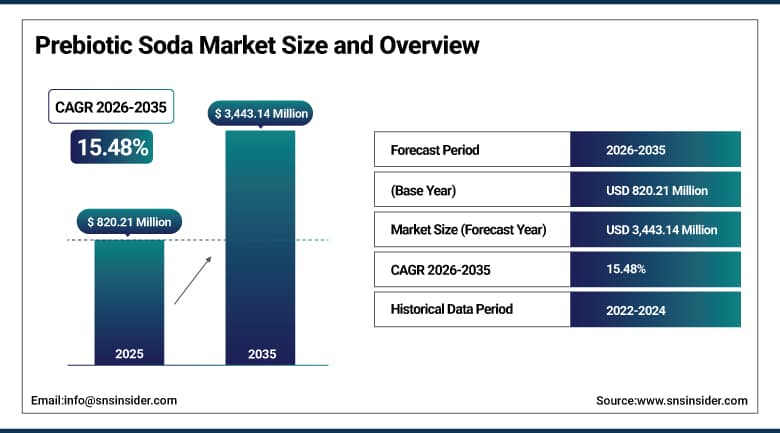
The Prebiotic Soda Market was valued at USD 820.21 Million in 2025 and is expected to reach USD 3,443.14 Million by 2035, growing at a CAGR of 15.48% from 2026–2035.
Prebiotic Soda Market entails carbonated beverages that use prebiotic fibers and other components designed to enhance digestive health while still enjoying the same taste and refreshing experience associated with conventional soft drinks. Common ingredients used in these beverages include chicory root fibers, inulin, apple cider vinegar, fruit extracts, and botanical ingredients. There is increased momentum in this market due to increased demand for an alternative to regular sodas that contain less sugar and also provide added benefits. Younger consumers, well-being households and those who are cutting down on regular sodas are key target customers. Flavoring, old-fashioned soda tastes, clean labels, and sugar-free drinks are making more customers embrace them. The focus now for manufacturers in the sector is on ingredient labeling, taste improvement, and convenient packaging to create brand loyalty among customers. Supermarket, convenience stores, online shops and food service establishments are becoming sources of such products. Competition is also increasing from the entry of established beverage companies into the market space. Premiumization, functional beverages, and increased demand for gut health are likely to drive market growth through 2035.
⮞In 2023, UK-based FHIRST introduced three functional soda flavors containing 5 grams of prebiotic fiber, 2 billion live probiotic cultures and zinc, targeting consumers seeking digestive, immune and overall wellness benefits.
To Get More Information On Prebiotic Soda Market - Request Free Sample Report
Prebiotic Soda Market Trends:
-
Increasing consumer awareness of digestive health is encouraging the adoption of beverages containing prebiotic fibers, inulin and other functional ingredients.
-
Manufacturers are recreating familiar cola, root beer, cream soda, ginger ale and fruit soda flavors with reduced sugar and functional ingredients.
-
Sugar reduction is becoming an important product development priority. Manufacturers are experimenting with stevia, monk fruit and other sweetening systems to improve nutritional positioning while maintaining taste.
-
Fruit extracts, herbal infusions and plant-based ingredients are becoming important product differentiators.
-
Recyclable PET bottles and other lightweight packaging formats are also gaining attention as manufacturers seek convenient packaging solutions and improved material efficiency.
-
Expansion of Digital and Direct-to-Consumer Sales: Online retail, subscription services and brand-owned websites are increasing consumer access to specialized prebiotic soda products.
U.S. Prebiotic Soda Market Outlook:
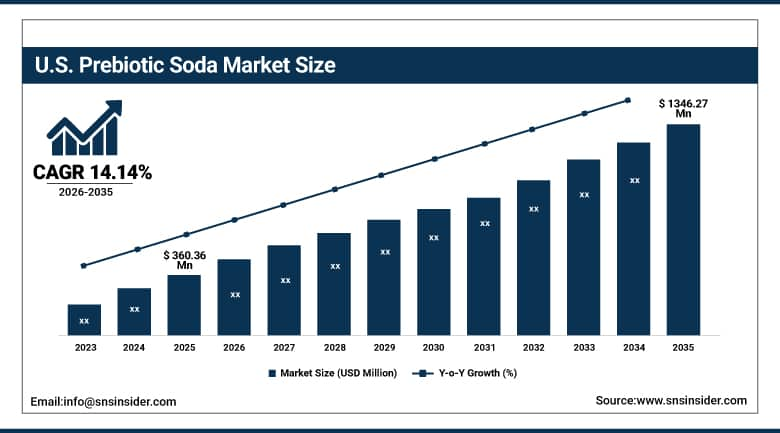
The U.S. Prebiotic Soda Market was valued at USD 360.36 Million in 2025 and is expected to reach USD 1346.27 Million by 2035, growing at a CAGR of 14.14% from 2026–2035.
U.S. Prebiotic Soda Market constitutes about 87.00% of the North American market, owing to the presence of high consumer awareness regarding gut health, well-established functional beverages supply chain, and increased consumer preference for sugar-free soda drinks. Consumers are increasingly becoming interested in the consumption of functional beverages, which contain prebiotic fibers, fruit extracts, and herbs. Beverage brands like Poppi and OLIPOP are contributing towards building awareness among consumers for functional soda drinks, and the traditional beverage brands are also launching functional soda beverages which are flavored as traditional soda beverages. Supermarkets, specialty stores, convenience stores, and e-commerce portals are some of the key distribution channels. Younger generation consumers and health-conscious families are driving the market, especially fruit-flavored and nostalgic soda drinks.
PepsiCo introduced Pepsi Prebiotic Cola in July 2025, with 3 grams of prebiotic fiber, 5 grams of sugar and 30 calories per serving. Following a limited online release in November 2025, the product became available nationwide in February 2026 in Original Cola and Cherry Vanilla flavors.
Prebiotic Soda Market Segment Analysis:
-
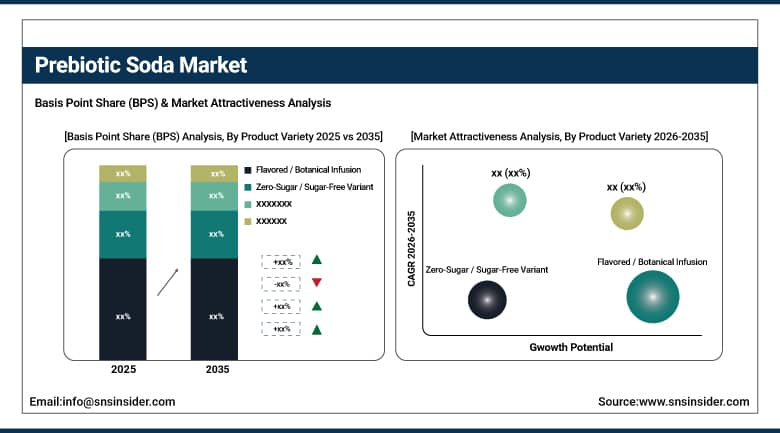
By Product Variety, the Flavored / Botanical Infusion segment dominated the Prebiotic Soda Market with approximately 47.00% share in 2025, while the Zero-Sugar / Sugar-Free Variant segment is the fastest growing with a CAGR of approximately 16.71%.
-
By Packaging Format, the Slim Aluminum Cans segment dominated the Prebiotic Soda Market with approximately 39.00% share in 2025, while the Recyclable PET Bottles segment is the fastest growing with a CAGR of approximately 18.65%.
-
By Distribution Channel, the Supermarkets & Hypermarkets segment dominated the Prebiotic Soda Market with approximately 44.00% share in 2025, while the Food Service & Cafes segment is the fastest growing with a CAGR of approximately 18.10%.
By Product Variety, Flavored / Botanical Infusion Dominates the Prebiotic Soda Market and Zero-Sugar / Sugar-Free Variants Grow Fastest
Flavored / Botanical Infusion dominated the Prebiotic Soda Market with approximately 47.00% share in 2025 because consumers are attracted to beverages that combine digestive-health positioning with distinctive fruit, herbal and botanical flavor profiles. There are alternatives to traditional cola and artificially flavoured carbonated drinks in the form of combinations based on raspberry, strawberry, citrus, ginger, hibiscus and other fruits. These products also allow manufacturers to differentiate their offerings with natural flavours, recognisable ingredients and unique formulations. Younger consumers’ preference for fruit-forward beverages bodes well for this segment. To encourage trials and improve retention, brands are more and more introducing variety packs and limited-edition flavours. Botanicals also assist brands with premium positioning in the functional beverage space. The demand for the segment is also supported by the availability of flavoured products across supermarkets, online platforms and speciality retailers.
The Zero-Sugar/Sugar-Free Variant category is witnessing the fastest growth rate among product varieties with a CAGR of approximately 16.71% for the period between 2026 and 2035. Rising awareness about the detrimental effects of excess sugar consumption, calorific value and metabolism is driving consumers towards beverages with low or no sugar at all. Manufacturers are designing formulations utilizing sweeteners from alternatives, fruits, prebiotic fiber and so on to retain the same flavor but reduce the sugar content. Such beverages are highly appealing to consumers who are controlling their daily sugar consumption and who are switching from traditional beverages. Innovations related to sweeteners are enabling manufacturers to cater to the issue of aftertaste and quality of products. Availability of functional beverages with zero sugar in mainstream retail stores can further drive adoption of such beverages.
⮞In 2025, Bloom Nutrition announced Bloom Pop, a shelf-stable prebiotic soda planned in five flavors. The product features PreticX prebiotic ingredients and distribution support from Keurig Dr Pepper.
By Packaging Format, Slim Aluminum Cans Dominate the Prebiotic Soda Market and Recyclable PET Bottles Grow Fastest
The Prebiotic Soda Market shares held by Slim Aluminum Cans were estimated to reach 39.00% in 2025 owing to their convenience, lightweight, portability, and eye-catching appearance. Slim cans have been proven to be a reliable form of packaging for premium and functional beverages. With their distinct graphics and colors and compact design, brands can easily distinguish their products using slim cans. Slim cans' compatibility with the existing carbonated beverages filling, storing and distributing systems makes them widely used packaging material. Being made of aluminum, slim cans provide protection from oxygen and light when correctly produced and closed. With their single serving size, they are especially useful in supermarkets, convenience stores, retail stores focused on fitness, and on the go situations. Brands usually use slim cans to inform about ingredients and functional positioning of the beverages.
Recyclable PET Bottles are the fastest growing packaging format, with a CAGR of approximately 18.65% during the period 2026-2035. Growth is driven by demand for lightweight, portable and resealable packaging for a variety of consumption occasions. PET bottles are more convenient for consumers who want to drink several servings of beverages, rather than consuming the contents of a single can. They also allow manufacturers the flexibility to produce both single and family size products in a range of capacities. Progress in recycled PET materials and in packaging designs are prompting beverage makers to look at more sustainable bottle solutions. Distribution is growing from convenience retailers, food-service locations and online grocery platforms, which is providing additional support to demand. More manufacturers are using recyclable materials and lighter packaging to reduce the use of materials and make transportation more efficient.” Its uptake will depend on the price of the packaging, its acceptability to consumers and the recycling infrastructure.
By Distribution Channel, Supermarkets & Hypermarkets Dominate the Prebiotic Soda Market and Food Service & Cafes Grow Fastest
Supermarkets & Hypermarkets dominated the Prebiotic Soda Market in 2025, with a share of approximately 44.00%. This is attributed to their capacity to offer vast product visibility, wide consumer reach, and easy availability of various functional beverage brands. These retail outlets allow consumers to compare flavours, nutritional information, fibre content and sugar levels before buying. Dedicated shelves for drinks and functional food sections are helping mainstream shoppers become aware of prebiotic soda products. Promotional discounts, multipacks, product sampling and introductory offers all encourage the consumer to try new brands. Existing retail distribution channels also provide manufacturers the opportunity to move out of niche wellness stores and into the mainstream soda consumer market. Large retailers can assist wider brand portfolios by fitting multiple product varieties and packaging formats. Increasing availability through supermarket chains is expected to support the segment through the forecast period.
The Food Service & Cafes segment is the fastest growing channel of distribution with a CAGR of ~18.10% during the forecast period 2026-2035. The rise of healthy eating, specialised drink menus and higher-end non-alcoholic drinks are creating new opportunities for prebiotic soda makers. Functional beverages are being adopted by cafes, restaurants, wellness venues and quick-service outlets as an alternative to traditional carbonated soft drinks. Prebiotic sodas can be enjoyed on their own or used in mocktails and speciality beverage combinations. Also, food service operators can differentiate their beverage menus with their unique taste profiles and health-oriented positioning. The increasing interest of young consumers and urban population towards functional drinks is likely to drive adoption. Restaurant and cafe partnerships with beverage brands can also help increase product awareness and encourage trial from consumers who may not have previously purchased prebiotic sodas.
Regional Analysis:
|
Region |
Major Country |
Share / Growth Indicator |
|---|---|---|
|
North America |
United States |
86.36% |
|
Asia Pacific |
China |
41.27% |
|
Europe |
United Kingdom |
18.64% |
|
Latin America |
Brazil |
43.28% |
|
Middle East & Africa |
Saudi Arabia |
19.36% |
North America Prebiotic Soda Market Insights
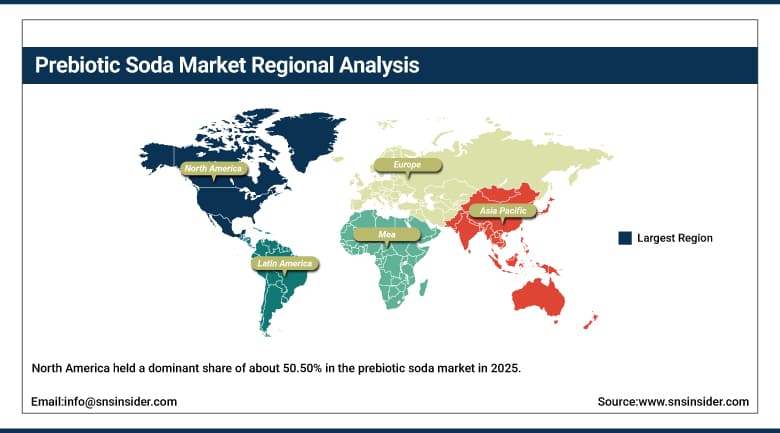
North America held a dominant share of about 50.50% in the prebiotic soda market in 2025, driven by rising consumer awareness about digestive health, established functional beverage markets, and strong retail distribution networks. The largest country market is the United States and it holds 87.00% of regional demand. Consumers are looking for drinks that contain prebiotic fibres, less sugar and recognisable ingredients. Established brands like Poppi and OLIPOP have helped to create category awareness and big beverage manufacturers are rolling out competing products. From supermarkets and convenience stores to speciality retailers and online, there is a wide selection of products. New products, influencer marketing and promotional campaigns are getting consumers to sample new flavours and formulations. The region has a strong infrastructure for beverage manufacturing and packaging which allows for product development and distribution.
The United States is the largest regional consumer due to its large consumer base, a well-established carbonated beverage industry and a growing demand for functional alternatives. Canada is the fastest growing market with a CAGR of some 16.04%. This growth is supported by the rising interest in digestive wellness, reduced-sugar beverages and premium functional drinks. Retail expansion and greater consumer familiarity with prebiotic ingredients are driving more opportunities. Market penetration is expected to rise with the availability of products in supermarkets, speciality food retailers and online platforms. Mexico also has opportunities in the growth of urban retail networks and growing interest in alternative beverage formulations. Manufacturers are likely to focus on localised flavours, affordable pack sizes and wider distribution to tap into additional consumers across the region.
Get Customized Report as Per Your Business Requirement - Enquiry Now
Asia Pacific Prebiotic Soda Market Insights
Asia Pacific is the fastest-growing region in the Prebiotic Soda Market, registering a CAGR of approximately 18.66% during 2026–2035. Growth is supported by rising disposable incomes, urbanization, increasing health awareness and expanding demand for functional beverages across China, India, Japan, South Korea and Southeast Asia. Consumers are showing greater interest in beverages that offer reduced sugar content, plant-based ingredients and digestive-health positioning. Traditional consumption preferences and growing exposure to international wellness trends are creating opportunities for fruit-based and botanical prebiotic soda formulations. The expansion of modern supermarkets, convenience retail and online grocery platforms is improving product accessibility. Domestic beverage manufacturers are also exploring functional formulations to respond to changing consumer preferences. Younger urban consumers represent an important customer base for innovative carbonated beverages.
China is a significant growth market with its large beverage consumer base, growing e-commerce infrastructure and established functional food and beverage industry. India presents a big opportunity as urban consumers are looking for beverages with lower sugar, natural ingredients and those related to digestive wellness. The growing organised retail sector and digital commerce ecosystem of the country provide additional distribution channels for emerging brands. “Japan and South Korea offer opportunities through their mature functional food markets, premium beverage consumption and interest in novel product formulations. Urbanisation and growth of modern retail are also making speciality beverages more accessible, attracting attention from South-east Asian countries such as Indonesia, Thailand and Vietnam. If you are a manufacturer entering these markets, you will need to consider local taste preferences, price sensitivity and regulatory requirements on functional ingredient claims.
Europe Prebiotic Soda Market Insights
Consumer interest in healthier beverage alternatives, reduced sugar formulations and functional ingredients are driving the prebiotic soda products market in Europe. Established markets for premium and speciality beverages include the United Kingdom, Germany, France, Italy and Spain. Consumers are now more likely to check the ingredient list, nutritional information, and sugar content when choosing a carbonated drink. The region has well-developed supermarket networks, speciality food retailers and online grocery platforms, providing functional soda brands with opportunities to boost their penetration. The demand for clean label formulations and plant-derived ingredients is also motivating manufacturers to launch fruit-based and botanical beverage varieties. Flavour innovation, packaging differentiation and product transparency are battlegrounds for established beverage makers and emerging wellness brands.
The growth of functional beverages in supermarkets, cafes and online retail channels presents opportunities in the United Kingdom. Germany’s strong retail infrastructure and consumer demand for ingredient transparency drives the demand for speciality beverage products. In France and Italy there are opportunities through premium beverage positioning, botanical flavours and alternative soft drink formulations. European consumers also value packaging recyclability and environmental considerations, spurring manufacturers to consider recyclable aluminium and PET packaging. Product formulation and marketing strategies are driven by regulatory requirements for nutrition information, ingredient declarations and health claims. The regional market is expected to grow, supported by the continued development of reduced-sugar and fiber-enriched beverages.
Latin America Prebiotic Soda Market Insights
Latin America is an emerging opportunity for the Prebiotic Soda Market with consumers exploring functional drinks, reduced-sugar soft drinks and fruit-derived ingredients. Brazil and Mexico are important markets due to their large consumer populations, established beverage industries and growing modern retail networks. With urbanisation increasing and consumption patterns evolving, particularly among younger consumers, there is a growing demand for new beverage options. Manufacturers can use locally sourced fruit ingredients to create tropical and regionally relevant flavours. The expansion of product distribution will likely be driven significantly by supermarkets, convenience stores and online retailers. However, market penetration will depend on the affordability of and consumer awareness about prebiotic ingredients.
Brazil has potential due to its established beverage manufacturing base, extensive supermarket networks and growing interest in functional food and beverage products. Mexico has the advantage of proximity to the North American beverage market, a developed distribution system, and growing demand for more upscale beverage products. And there are opportunities in Argentina, Chile and Colombia as urban consumers demand drinks with lower sugar content and functional formulations. Manufacturers can build a stronger regional presence through local sourcing, competitive pricing, and partnerships with established beverage distributors. Educating the consumer on the product, and clear nutritional labelling will be key to building confidence and repeat purchases.
Middle East & Africa Prebiotic Soda Market Insights
The Middle East and Africa region represents an emerging market for prebiotic soda products, supported by urbanization, increasing disposable incomes and expanding demand for premium non-alcoholic beverages. Saudi Arabia, the United Arab Emirates and South Africa are important markets for functional beverage manufacturers. Consumers in major urban centers are increasingly exposed to international wellness trends and premium beverage brands through supermarkets, hospitality establishments and specialty retail outlets. The region's warm climate and established demand for carbonated refreshments provide opportunities for fruit-based, citrus and botanical soda formulations. Growing investment in modern retail infrastructure and food-service establishments is also improving access to specialized beverage products. However, product affordability, consumer awareness and distribution infrastructure vary considerably across regional markets.
In Saudi Arabia and the United Arab Emirates opportunities exist in premium supermarket chains, hospitality developments and the growing café culture. South Africa has a well-established retail and beverage distribution base, while Egypt, Nigeria and Kenya offer longer-term opportunities through urban population growth and the expansion of modern trade. Manufacturers will have to consider local ingredient preferences and regulatory requirements and pricing conditions in developing regional plans. Sourcing halal-compliant ingredients and clear product labelling can also be important considerations in certain markets. Increased availability through restaurants, cafes and convenience retailers is expected to assist gradual category development.
Growth Drivers: Rising Gut Health Awareness and Demand for Functional Beverages Drive Growth in the Prebiotic Soda Market
One of the most prominent factors driving the growth of the Prebiotic Soda Market is increasing awareness about digestive health. Consumers are increasingly concerned about gut health, eating dietary fibre and the link between digestive wellness and overall health. This is driving demand for drinks with prebiotic ingredients like inulin and chicory root fibre. Prebiotic sodas are not your average soft drinks, they’re carbonated and taste like the flavours you know but are marketed with functional ingredients. That means the makers can target drinkers looking for an alternative to traditional sugary sodas. The increasing popularity of wellness-focused lifestyles, particularly among younger consumers, is driving demand. Innova Market Insights’ 2025 research found that 23% of global consumers were looking for functional foods and beverages with prebiotics for better gut health. The company said that prebiotic beverage launches were up 13% year-on-year, which is indicative of increased product development activity.
The shift to reduced-sugar and better-for-you beverages is another big growth driver. Traditional carbonated soft drinks are being re-evaluated by consumers amid growing concerns over high sugar consumption and calorie intake. Prebiotic soda makers are fighting back with low-sugar, no-added-sugar, and sugar-free versions containing functional fibres and alternative sweeteners. The entry of established beverage companies is further accelerating category awareness and distribution. The strategic importance of the category is underscored by PepsiCo’s acquisition of Poppi in 2025 for USD 1.95 billion. “Supermarket availability, product innovation and an increasing focus on functional beverage portfolios are expected to drive continued demand through 2035.
Restraints: Formulation Costs and Consumer Skepticism Restrain Growth in the Prebiotic Soda Market
Higher formulation and manufacturing costs are a major restraint for the Prebiotic Soda Market. Speciality sweeteners, prebiotic fibres, botanical extracts and natural flavour ingredients can raise production costs relative to traditional carbonated soft drinks. Manufacturers also need to maintain acceptable taste, carbonation stability, shelf life and ingredient compatibility when incorporating functional components. These requirements can lead to increased research, development and quality-control costs. Premium pricing may hinder adoption among price-conscious consumers, especially in emerging markets where traditional soft drinks are still more affordable. Packaging, transport and retail distribution costs can also impact on profit margins. Smaller brands may also have challenges in securing adequate manufacturing capacity and shelf space in competition with multinational beverage companies.
Another challenge is consumer scepticism about the functional benefits. Some consumers might wonder if prebiotic soda products do anything for digestive health, or if they just use wellness-focused marketing to make regular soft drinks stand out. Expectations of taste also pose challenges, as high fibre content and alternative sweeteners can affect texture, sweetness and aftertaste. The complexity of product development is further complicated by regulatory requirements for ingredient declaration, nutrition labelling and health claims. In the United States, the FDA defines isolated or synthetic nondigestible carbohydrates that meet the dietary fibre criteria for Nutrition Facts labelling based on demonstrated beneficial physiological effects. So manufacturers need to be compliant with the requirements applicable to their product claims and formulations. Consumer distrust and lack of support for a product’s positioning can inhibit repeat purchase behaviour.
Opportunities: Zero-Sugar Innovation and Expansion of Functional Beverage Distribution Create Opportunities in the Prebiotic Soda Market
There are big opportunities for manufacturers in the zero-sugar and reduced-sugar formulations. The consumer demand for drinks that have the traditional soda taste without the sugar content of traditional soft drinks is growing. Manufacturers can take advantage of this demand by developing products that combine alternative sweeteners, natural flavours and prebiotic fibres. The Zero-Sugar / Sugar-Free Variant segment is the fastest growing segment with an expected CAGR of about 16.71% which shows the commercial potential of this category. Innovations in sweetener technologies and flavour systems can help manufacturers enhance flavour and minimise off-notes. Personalised flavour offerings and variety packs and functional beverage bundles can drive product trials even further. Companies that get the balance of nutritional positioning, affordability and taste quality right are likely to build consumer loyalty.
Another major growth opportunity is to enter food service outlets and developing markets. The Food Service & Cafes distribution channel is projected to grow at a CAGR of around 18.10% driven by the rising demand for speciality beverages, premium non-alcoholic refreshments and health conscious menu offerings. Cafes, restaurants, hotels and quick-service venues can serve prebiotic sodas as standalone drinks or as ingredients in mocktails and speciality beverages. Urbanisation, rising disposable income and increasing interest in functional beverages, the Asia Pacific, growing at approximately 18.66%, provides additional opportunities. Also recyclable packaging, the development of local flavour and partnerships with supermarket chains and online subscription platforms can help manufacturers. These strategies can increase market penetration and establish prebiotic soda as a mainstream beverage category.
Recent Developments:
-
2025: PepsiCo announced the acquisition of Poppi on March 17, 2025, for USD 1.95 billion, including USD 300 million in anticipated cash tax benefits. The acquisition was completed on May 19, 2025, strengthening PepsiCo's presence in the prebiotic soda category and expanding its functional beverage portfolio.
-
2025: The Coca-Cola Company introduced Simply Pop in February 2025, marking its entry into the prebiotic soda category. The product launched in five flavors, including Strawberry, Pineapple Mango, Fruit Punch, Lime and Citrus Punch, with 6 grams of prebiotic fiber and no added sugar per serving.
-
2026: Pepsi Prebiotic Cola became available nationwide in the United States on February 17, 2026, following its limited online debut in November 2025. The product was introduced in individual 12-ounce cans and eight-pack formats through retail stores and online channels.
Prebiotic Soda Market Key Players:
-
PepsiCo, Inc. (Poppi and Pepsi Prebiotic Cola)
-
The Coca-Cola Company (Simply Pop)
-
Culture Pop Soda
-
Wildwonder
-
Mayawell
-
Keurig Dr Pepper Inc.
-
Health-Ade LLC
-
Humm Kombucha
Prebiotic Soda Market Report Scope:
| Report Attributes | Details |
|---|---|
| Market Size in 2025 | USD 820.21 Billion |
| Market Size by 2035 | USD 3,443.14 Billion |
| CAGR | CAGR of 15.48% From 2026 to 2035 |
| Base Year | 2025 |
| Forecast Period | 2026-2035 |
| Historical Data | 2022-2024 |
| Report Scope & Coverage | Market Size, Segments Analysis, Competitive Landscape, Regional Analysis, DROC & SWOT Analysis, Forecast Outlook |
| Key Segments | • By Product Variety (Flavored / Botanical Infusion, Classic Nostalgic Soda Profiles, Zero-Sugar / Sugar-Free Variant) • By Packaging Format (Slim Aluminum Cans, Standard Aluminum Cans, Glass Bottles, Recyclable PET Bottles) • By Distribution Channel (Supermarkets & Hypermarkets, Convenience Stores & Gas Stations, Online Retail & Subscription, Food Service & Cafes) |
| Regional Analysis/Coverage | North America (US, Canada), Europe (Germany, UK, France, Italy, Spain, Russia, Poland, Rest of Europe), Asia Pacific (China, India, Japan, South Korea, Australia, ASEAN Countries, Rest of Asia Pacific), Middle East & Africa (UAE, Saudi Arabia, Qatar, South Africa, Rest of Middle East & Africa), Latin America (Brazil, Argentina, Mexico, Colombia, Rest of Latin America). |
| Company Profiles | PepsiCo, Inc. (Poppi and Pepsi Prebiotic Cola), OLIPOP, Inc., The Coca-Cola Company (Simply Pop), Culture Pop Soda, Wildwonder, Mayawell, Keurig Dr Pepper Inc., Zevia PBC, Health-Ade LLC, Humm Kombucha. |

Frequently Asked Questions
The key players in the Prebiotic Soda Market include PepsiCo, Inc., OLIPOP, Inc., The Coca-Cola Company, Culture Pop Soda, Wildwonder, Mayawell, Keurig Dr Pepper Inc. and other functional beverage manufacturers.
Key opportunities include the development of zero-sugar and reduced-sugar formulations, expansion of botanical and fruit-based flavors, recyclable packaging innovation and growing distribution through cafes, restaurants and online subscription platforms.
The major growth factor is increasing consumer awareness of gut health and demand for functional beverages containing prebiotic fibers. The growing preference for reduced-sugar alternatives to conventional soft drinks further supports market expansion.
The Flavored / Botanical Infusion segment dominated the Prebiotic Soda Market with approximately 47.00% share in 2025, supported by consumer preference for fruit-based, botanical and distinctive flavors combined with functional ingredients.
North America dominated the Prebiotic Soda Market with approximately 50.50% share in 2025, driven by high consumer awareness of digestive health, established functional beverage brands and strong retail distribution networks.
