
Fermentation-Derived Natural Flavors Market Report Scope & Overview:
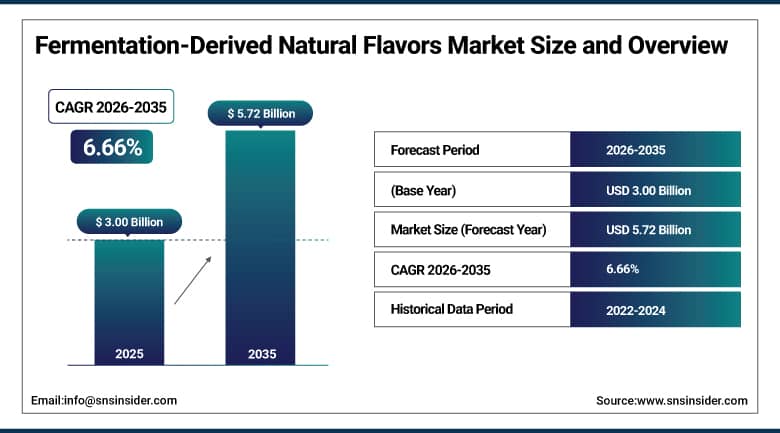
The Fermentation-Derived Natural Flavors Market was valued at USD 3.00 Billion in 2025 and is expected to reach USD 5.72 Billion by 2035, growing at a CAGR of 6.66% from 2026-2035.
The Fermentation-Derived Natural Flavors Market is expanding as food, beverage, and personal care brands look for taste ingredients that can carry a natural label without depending on crop harvests. Yeast, fungi, and bacteria convert sugars and other feedstocks into vanillin, lactones, terpenes, and savory flavor bases, and these outputs are increasingly accepted as natural under U.S. and European rules. Suppliers are moving from traditional batch fermentation toward precision processes that deliver single molecules at consistent purity. Scale-up capacity, regulatory clarity, and cost parity with extracted or synthetic equivalents remain the factors that decide how quickly new products reach commercial volumes.
⮞In June 2022, Givaudan launched BioNootkatone, a non-GMO natural nootkatone produced by fermenting sugar, and secured exclusive global commercial rights through its manufacturing partner. The launch showed that grapefruit-type flavor notes can be supplied without citrus harvests.
To Get More Information On Fermentation-Derived Natural Flavors Market - Request Free Sample Report
Fermentation-Derived Natural Flavors Market Trends:
-
Precision fermentation of single flavor molecules gaining ground over batch processes
-
Natural-status vanillin from fermentation reaching EU and U.S. customers
-
Flavor houses buying or partnering with synthetic biology start-ups
-
Plant-based dairy and meat alternatives widening the use of fermented taste bases
-
Upcycled sugar and lignocellulosic feedstocks entering commercial production
U.S. Fermentation-Derived Natural Flavors Market Outlook:
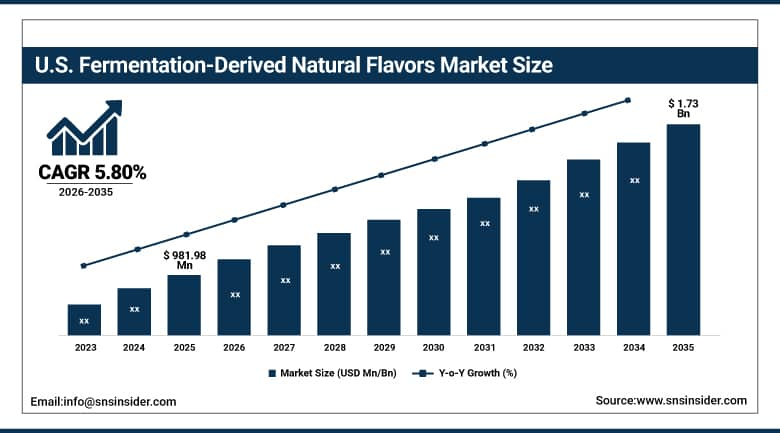
The U.S. Fermentation-Derived Natural Flavors Market was valued at USD 981.98 Million in 2025 and is expected to reach USD 1.73 Billion by 2035, growing at a CAGR of 5.80% from 2026-2035.
The U.S. Fermentation-Derived Natural Flavors Market is the largest national market, supported by a deep base of packaged food, beverage, and plant-based product manufacturers that reformulate toward clean labels. Regulatory routes through GRAS notification and the Flavor and Extract Manufacturers Association expert panel give new fermentation-derived molecules a defined path to commercial sale. Established flavor houses run application laboratories close to customers, while synthetic biology firms in California, Georgia, and the Midwest supply novel molecules. Fermentation capacity for flavors remains limited compared with demand, so contract manufacturing and joint development agreements are common.
⮞In June 2025, the U.S. Food and Drug Administration issued a no-questions letter on a GRAS notice from Sichuan Ingia Biosynthetic covering 98% vanillin made by fermenting engineered E. coli. The letter opened a regulatory route for fermented vanillin supply into the U.S. market.
Fermentation-Derived Natural Flavors Market Segment Analysis:
-
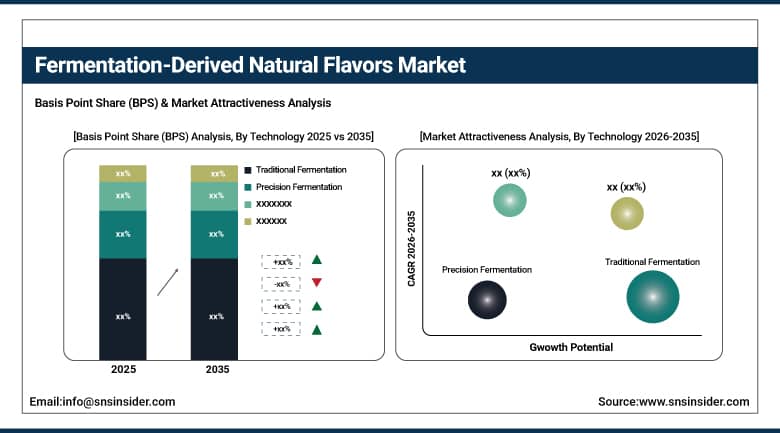
By Technology, the Traditional Fermentation segment dominated the Fermentation-Derived Natural Flavors Market with approximately 44.51% share in 2025, while the Precision Fermentation segment is the fastest growing with a CAGR of approximately 8.86%.
-
By Application, the Food segment dominated the Fermentation-Derived Natural Flavors Market with approximately 47.84% share in 2025, while the Dairy and Plant-Based Alternatives segment is the fastest growing with a CAGR of approximately 7.16%.
-
By Feedstock, the Sugar-Based segment dominated the Fermentation-Derived Natural Flavors Market with approximately 48.00% share in 2025, while the Other Substrates segment is the fastest growing with a CAGR of approximately 9.76%.
-
By Flavor Type, the Fruity segment dominated the Fermentation-Derived Natural Flavors Market with approximately 39.90% share in 2025, and is also the fastest growing with a CAGR of approximately 7.38%.
By Technology, Traditional Fermentation Dominates the Fermentation-Derived Natural Flavors Market and Precision Fermentation Grows Fastest
Traditional fermentation holds the lead because it relies on proven yeast, mold, and bacterial cultures that flavor manufacturers have operated for decades. Existing tanks, downstream recovery lines, and trained staff keep unit costs low, and the resulting extracts, yeast-derived bases, and cultured notes already qualify as natural in most jurisdictions. Customers in bakery, dairy, and savory categories value the complex flavor profiles that mixed cultures produce. Because the process does not demand gene-edited organisms, it also avoids the labeling and approval questions that follow engineered strains, which protects its position in conservative formulations.
Precision fermentation is advancing fastest as engineered microbes deliver single target molecules, such as vanillin, nootkatone, and ionones, at high purity and predictable yield. Buyers gain supply independent of vanilla pod harvests and citrus crops, and regulators in the United States and Europe are clarifying how the output can be labeled. Capital remains the main hurdle, since commercial-scale fermenters and recovery systems are expensive to build. Hybrid biotransformation, which converts natural precursors such as ferulic acid with enzymes or whole cells, sits between the two and appeals to suppliers seeking a quicker commercial path.
⮞In February 2026, Kerry Group's chief executive said that roughly 40% of the company's taste solutions are now fermentation-enabled. The statement shows how far fermentation has moved into mainstream flavor portfolios.
By Application, Food Dominates the Fermentation-Derived Natural Flavors Market and Dairy and Plant-Based Alternatives Grows Fastest
Applications for foods are highest in terms of volumes, as the makers of savory bases, bakery items, snacks, sauces, and confectionaries need flavors and are looking to get rid of any artificial components from their labels. Yeast-based savory bases, as well as fermented vanilla and fruit notes, will be easily incorporated into the formulas of these products without affecting the existing production lines. Large food producers use multi-year contracts, which allows manufacturers to plan investments in fermentation equipment. Beverages constitute the second main category; fermentation-derived citrus, fruit, and sweetness enhancers are used here.
Dairy and plant-based alternatives are growing fastest because removing animal ingredients strips away the fatty, creamy, and cultured notes that consumers expect. Fermentation-derived lactones, diacetyl-free butter notes, and flavor fats restore these cues, and several suppliers now target oat, pea, and almond products specifically. Retail growth in plant-based milks, cheeses, and yogurts keeps formulation work active across Europe and North America. Cosmetics and personal care use fermented fragrance and flavor molecules in oral care and lip products, where natural claims increasingly influence purchasing decisions among younger buyers.
⮞In August 2025, a Flavor and Extract Manufacturers Association expert panel determined Nourish Ingredients' precision-fermented Tastilux flavor fat to be GRAS. The Australian company said the finding permits immediate sales into the United States.
By Feedstock, Sugar-Based Dominates the Fermentation-Derived Natural Flavors Market and Other Substrates Grows Fastest
Sugar-based feedstocks lead since cane, beet, and corn-derived glucose are widely available, inexpensive per ton, and easily metabolized by common production strains. Fermentation plants located near sugar mills benefit from steady supply and established logistics, and the resulting products meet the natural label requirements of most food markets. Suppliers in North America, Brazil, and Europe tie contracts to sugar processors to stabilize input cost. Standard fermenter designs are optimized for sugar media, so switching feedstock requires process changes that most manufacturers prefer to avoid for established products.
Others such as synthetic biology media, algae biomass, glycerine, and food processing wastes are also gaining momentum among the producers who want cheaper and greener feedstocks. There is an effort to find lower-cost alternatives and avoid vulnerability to sugar price volatility. Plant biomass and lignin streams can be used for producing ferulic acid and other precursors for vanillin pathway, and starch and grain streams are good for producing savory bases using yeasts. The consumers like sustainable products with a sustainability story behind them, and this makes things easier for companies that have succeeded in demonstrating less land usage.
By Flavor Type, Fruity Dominates the Fermentation-Derived Natural Flavors Market and Also Grows Fastest
Fruity notes lead because they are required across beverages, confectionery, dairy desserts, and personal care, and several of the best-known fermentation-derived molecules fall into this family. Lactones deliver peach and coconut character, ionones supply raspberry and violet, and terpenes contribute citrus and grapefruit notes. Natural fruit extracts are exposed to crop failures and price swings, which makes a fermented alternative attractive to formulators who need stable supply. Large beverage groups have prioritized natural-status fruit flavors in recent reformulation cycles, reinforcing demand.
Fruity flavors are also growing fastest as new molecules are added to the commercial catalog each year. Suppliers are launching fermentation-made sesquiterpenes and ionones that give formulators more natural options for tropical, berry, and citrus profiles. Vanilla remains the second pillar, with fermentation-made vanillin gaining natural status in the European Union and United States, and caramel and savory notes add steady volume. Customers value supply continuity over price alone, which supports adoption even when fermentation-derived options carry a premium over synthetic benchmarks.
⮞In April 2023, Insempra introduced fermentation-made natural alpha-ionone, a violet and raspberry note marketed through Axxence Aromatic. The ingredient is certified as natural under European rules.
Regional Analysis:
|
Region |
Major Country |
Share within Region, 2025 (%) |
|---|---|---|
|
North America |
United States |
84.80% |
|
Europe |
Germany |
20.97% |
|
Asia Pacific |
China |
55.04% |
|
Latin America |
Brazil |
56.84% |
|
Middle East & Africa |
Saudi Arabia |
27.00% |
North America Fermentation-Derived Natural Flavors Market Insights
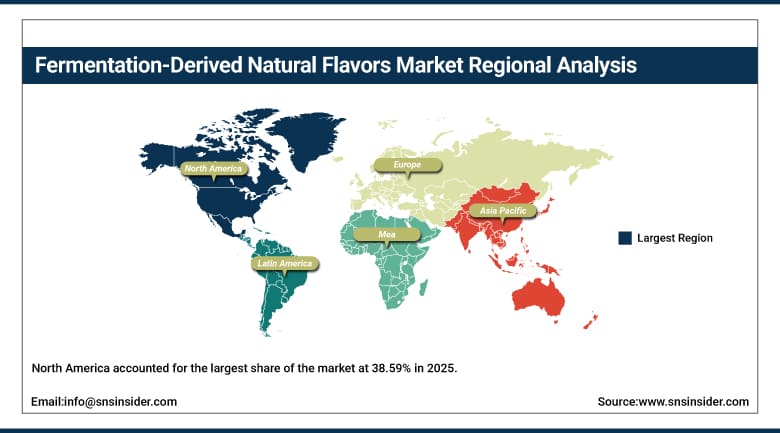
North America accounted for the largest share of the market at 38.59% in 2025, reflecting a deep customer base in packaged foods, beverages, and plant-based products, together with the world's most active synthetic biology sector. The United States supplies most regional demand, while Canada adds activity through dairy alternatives and beverage producers. Flavor houses operate application laboratories close to brand owners, which shortens development cycles for new molecules. Contract fermentation capacity in the Midwest and the Southeast provides a manufacturing base for start-ups that lack their own plants.
Competition is influenced by regulation in the region. There is a clear pathway through GRAS notification and the FEMA expert panel process for new ingredients, although approval takes many months and certain dossiers have to be supplemented with more safety information. Investment is being made in precision fermentation, with big flavor players taking equity positions in start-ups instead of developing capacity on their own. Consumers are demanding proof of sourcing and carbon footprints, favoring those with transparent supply chains. Price is an issue because fermentation-produced vanillin and terpenes compete with petrochemical and extract benchmarks.
⮞In October 2025, Symrise took an equity stake in San Diego-based Cellibre, securing preferred access to the company's precision fermentation platform for natural flavor ingredients. The deal reflects how large flavor houses are buying access to molecule discovery.
Get Customized Report as Per Your Business Requirement - Enquiry Now
Europe Fermentation-Derived Natural Flavors Market Insights
Europe which include Germany, France, and the UK, where several of the world’s top flavor companies have R&D facilities. Europe has a combination of heritage of industrial fermentation along with rigid natural labeling under European flavoring regulation. Bakery, dairy, beverages, and savory products have strong demand while customers are highly accepting of the fermented products. There are increasing capacities for terpenes and sesquiterpenes of Dutch and German producers serving both regional and export customers.
Regulatory interpretation is the most critical parameter here. Whether an ingredient produced using a genetically modified microbe can be considered natural will depend on its process description and strain description and companies create dossiers in order to get that kind of interpretation. Sustainability objectives under European Green Deal initiatives are favorable for bio-based production and reduced carbon feedstock, which is another driver. Specialty mid-sized and ingredient distributors from Germany and Italy are supplying fermentation-based flavor notes to specialty food & beverage manufacturers. The competition is growing among Asian producers of yeast extracts, making European companies focus on purity and traceability.
⮞In March 2025, BASF launched fermentation-made Natural beta-Sinensal 20 and Natural alpha-Humulene 90, produced at its Isobionics site in Geleen, the Netherlands. The products add citrus and hop notes to the natural palette.
Asia Pacific Fermentation-Derived Natural Flavors Market Insights
Asia Pacific is the fastest-growing region, having a CAGR projection of 7.66% between 2026 and 2035, which is driven by China, Japan, India, South Korea, and Australia. The largest market for fermentation technology is located in China, where there are vertically integrated producers of yeast extracts, amino acids, and vanillin catering to local and exporting consumers. Growing incomes and development of packaged foods, beverages, and cosmetics drive the need for natural flavor systems. The Japanese contribute to the industry with savory and umami innovation, and start-ups are supported in Australia and South Korea in precision fermentation.
Cost efficiency and economies of scale help regional producers to compete in export markets, and several Chinese manufacturers started receiving Western approvals. Governments are promoting bio-manufacturing through their industrial policies, which attracts investments in pilot plants and tolling facilities. Local flavor houses, as well as foreign subsidiaries of global players, cooperate closely with drink and snack brands to tailor products to local tastes. Standards for quality and traceability are improving, and buyers seek to receive documentation just like in Europe. India is increasing its capacities in fermented-based ingredients because of food processing growth in the country.
⮞In May 2025, Angel Yeast presented its YE series of yeast-extract savory solutions at the IFIA trade show in Tokyo, from 21 to 23 May. The showing highlights Chinese suppliers' push into Japanese food manufacturing.
MEA & Latin America Fermentation-Derived Natural Flavors Market Insights
Latin America benefits from abundant sugar and agricultural feedstocks, with Brazil as the focal point for fermentation capacity and a large food and beverage industry. Mexico belongs to this region in market estimates, and its beverage and confectionery sector adds steady flavor demand. Producers see the region both as a consumption base and as a low-cost source of fermentation inputs. Currency swings and uneven regulatory frameworks slow some imports of specialty molecules, so local blending and distributor partnerships carry weight, while Argentina and Colombia add demand through processed food and dairy production.
While the Middle East and Africa market is somewhat smaller, it is growing due to the investments by Gulf countries in terms of food security, halal certified ingredients, and food production. Flavor ingredients are imported by Saudi Arabia and the United Arab Emirates where blending facilities are being constructed, while South Africa has a developed food processing industry that employs yeast bases. It is important for halal and kosher certifications when it comes to fermentation derived products since the substrate and process need to be recorded. Due to the lack of local fermentation capacity, most of the supply comes from Europe and Asia.
Market Dynamics:
Growth Drivers: Clean-Label Reformulation and Supply Security Drive Growth in the Fermentation-Derived Natural Flavors Market
Clean-label reformulation is a primary driver. Food and beverage companies have committed to removing artificial flavors, and fermentation offers a route to natural-status molecules that extraction from plants cannot always deliver at scale. Vanillin, nootkatone, lactones, and ionones are now available from fermentation, and formulators can specify them with confidence that the label claim will hold. Retailers and consumers continue to reward natural positioning, so brand owners treat flavor conversion as a standing project rather than a one-time exercise, which keeps pipeline demand steady for suppliers.
Supply security is another contributing factor. Vanilla beans, citrus extracts, and rare plants are vulnerable to the elements, pathogens, and even political risk, leading to price volatility that is difficult for manufacturers to control. Fermentation offers quality consistency from a controlled facility, regardless of harvest times, and contractual agreements allow buyers to budget for costs. Progress in fermentation strain design and purification technology is reducing manufacturing cost and closing the gap with the natural and synthetic alternatives. This environment will continue to drive growth through 2035 among food, beverage, and personal care consumers.
Restraints: High Capital Cost and Regulatory Uncertainty Restrain Growth in the Fermentation-Derived Natural Flavors Market
High capital cost restrains growth. Building commercial fermenters, recovery trains, and quality systems requires substantial investment, and many synthetic biology start-ups have found scale-up harder and slower than projected. Fermentation-derived molecules must compete on price with petrochemical and extracted benchmarks, and buyers are often unwilling to pay a lasting premium. Failures among well-funded developers have made lenders and customers more cautious, and supply agreements increasingly require demonstrated production before volumes are committed. Smaller developers often depend on tolling partners, whose capacity is limited and booked well in advance.
Regulatory uncertainty adds a second constraint. Labeling a molecule made by an engineered organism as natural depends on the jurisdiction, and requirements differ between the United States, European Union, and Asian markets. Safety dossiers can take a year or longer, and consumer groups continue to question biotechnology claims on food labels. Feedstock price swings affect margins, and contamination or batch failures can interrupt supply. These factors lengthen commercialization timelines and favor established flavor houses with regulatory teams and existing customer relationships.
⮞In August 2023, Amyris filed for Chapter 11 protection in the U.S. Bankruptcy Court in Delaware, having been among the best-known synthetic biology ingredient developers. The filing underlined the financial risk of scaling fermentation-based products.
Opportunities: Precision Fermentation Scale-Up and Plant-Based Product Growth Create Opportunities in the Fermentation-Derived Natural Flavors Market
Precision fermentation scale-up offers a significant opportunity. As capacity comes online, unit costs should fall, opening applications in mid-priced beverages, snacks, and bakery where fermentation-derived molecules have been too expensive. Contract manufacturers able to offer shared fermentation capacity can serve start-ups that lack plants, while flavor houses can add exclusive molecules to their libraries. Regulators are also gaining experience with these products, which should shorten approval timelines and lower dossier risk for new entrants and established suppliers alike. Partnerships that pair a molecule developer with an established flavor house shorten the path from pilot batch to commercial listing.
Products from plants and those with functional properties give rise to a second chance. The meat, dairy, and egg alternatives must have a system of flavors that would provide for plant-sourced taste and not contain any animal ingredients, while fermentation can provide fats, lactones, and umami bases that will fit the clean label and vegan criteria. Sweetness and taste modulation solutions from sugar reduction programs open up an opportunity to create fermentation solutions for sweetness. Upcycled and lignocellulosic materials tell the sustainability story that works for big brands with carbon ambitions.
Recent Developments:
-
In March 2026, Lallemand Bio-Ingredients launched Hevani, a precision-fermented vanillin with 98% purity and natural status in the European Union and the United States. The product builds on technology acquired through the Evolva transaction and offers vanillin without vanilla pod dependence.
-
In May 2026, Biospringer, the yeast-based ingredient arm of Lesaffre, acquired selected intellectual property and technology from PTX Food Corp.
-
In June 2025, dsm-firmenich broke ground on a flavors and blends facility in Parma, Italy, covering concentrated powder flavors, reaction flavors, and culinary blends.
-
In April 2023, Axxence Aromatic began marketing natural alpha-ionone made by fermentation at Insempra. The molecule broadened the natural violet and raspberry palette available to European beverage and confectionery customers.
Fermentation-Derived Natural Flavors Market Key Players are:
-
Givaudan
-
dsm-firmenich
-
Kerry Group
-
International Flavors & Fragrances
-
Symrise
-
BASF
-
Lallemand Bio-Ingredients
-
Biospringer by Lesaffre
-
Manus Bio
-
Cellibre
-
Insempra
-
Conagen
-
Angel Yeast
-
Sichuan Ingia Biosynthetic
-
Syensqo
-
Nourish Ingredients
Fermentation-Derived Natural Flavors Market Report Scope:
| Report Attributes | Details |
|---|---|
| Market Size in 2025 | USD 3.00 Billion |
| Market Size by 2035 | USD 5.72 Billion |
| CAGR | CAGR of 6.66% From 2026 to 2035 |
| Base Year | 2025 |
| Forecast Period | 2026-2035 |
| Historical Data | 2022-2024 |
| Report Scope & Coverage | Market Size, Segments Analysis, Competitive Landscape, Regional Analysis, DROC & SWOT Analysis, Forecast Outlook |
| Key Segments | • By Technology (Traditional Fermentation, Precision Fermentation, and Hybrid Biotransformation) • By Application (Food, Beverages, Dairy and Plant-Based Alternatives, Cosmetics and Personal Care, and Pharmaceuticals and Nutraceuticals) • By Feedstock (Sugar-Based, Plant Biomass and Lignin, Starch and Grain, and Other Substrates) • By Flavor Type (Fruity, Vanilla, Caramel, and Others) |
| Regional Analysis/Coverage | North America (US, Canada), Europe (Germany, UK, France, Italy, Spain, Russia, Poland, Rest of Europe), Asia Pacific (China, India, Japan, South Korea, Australia, ASEAN Countries, Rest of Asia Pacific), Middle East & Africa (UAE, Saudi Arabia, Qatar, South Africa, Rest of Middle East & Africa), Latin America (Brazil, Argentina, Mexico, Colombia, Rest of Latin America). |
| Company Profiles | Givaudan, dsm-firmenich, Kerry Group, International Flavors & Fragrances, Symrise, BASF, Lallemand Bio-Ingredients, Biospringer by Lesaffre, Manus Bio, Cellibre, Insempra, Conagen, Angel Yeast, Sichuan Ingia Biosynthetic, Syensqo, Nourish Ingredients |

Frequently Asked Questions
Key players in the market include Givaudan, dsm-firmenich, Kerry Group, International Flavors & Fragrances, Symrise, and BASF, among others.
Key opportunities include precision fermentation scale-up, which should lower unit costs, and growth in plant-based and functional products that need animal-free flavor systems.
Clean-label reformulation and the need for secure supply are the major growth factors, as brand owners replace artificial and crop-dependent flavors.
The Traditional Fermentation segment dominated the market in 2025 with approximately 44.51% share, as proven cultures, existing plants, and established natural status keep unit costs low.
North America dominated the market in 2025 with approximately 38.59% share, supported by a deep packaged food and beverage base and the world's most active synthetic biology sector.
