
Passenger Drones Market Report Scope & Overview:
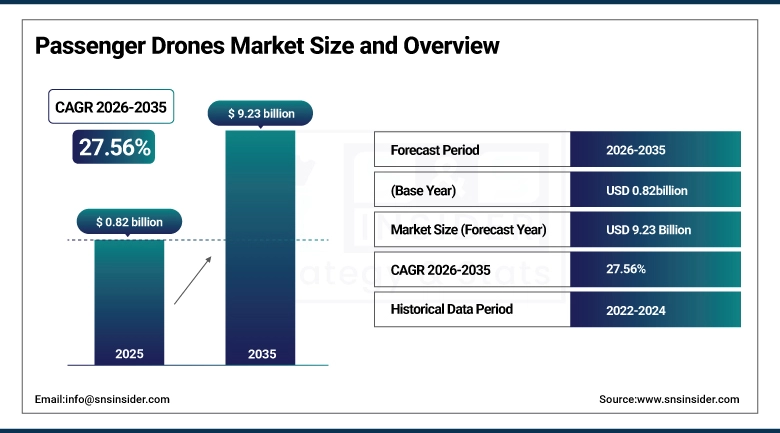
The Passenger Drones Market size is valued at USD 0.82 Billion in 2025 and is projected to reach USD 9.23 Billion by 2035, growing at a CAGR of 27.56% during the forecast period 2026–2035.
Analysis of the Passenger Drones Market report offers an exhaustive study on market trends, innovations, and mobility applications. Growth in urbanization, rising demand for next-generation air mobility solutions, quick advancements in autonomous flight systems, and significant investments in eVTOL infrastructure are some of the key factors fueling the market growth from 2026 to 2035.
In 2025, passenger drones had completed more than 1.1 million cumulative flight hours as a result of the growth in pilots’ programs and aerial mobility applications.
Market Size and Forecast:
-
Market Size in 2025: USD 0.82 Billion
-
Market Size by 2035: USD 9.23 Billion
-
CAGR: 27.56% from 2026 to 2035
-
Base Year: 2025
-
Forecast Period: 2026–2035
-
Historical Data: 2022–2024
To Get more information on Passenger Drones Market - Request Free Sample Report
Passenger Drones Market Trends:
-
Rising urban congestion and the need for faster intra-city mobility are driving demand for passenger drones as an alternative to traditional transportation.
-
Advancements in autonomous flight systems, AI-based navigation, and flight control technologies are improving safety, reliability, and operational efficiency.
-
Increasing investments in eVTOL aircraft development by aerospace companies and startups are accelerating commercialization of passenger drone solutions.
-
Growing focus on sustainable transportation is boosting adoption of fully electric propulsion systems with lower emissions and operating costs.
-
Expansion of urban air mobility (UAM) infrastructure, including vertiports and air traffic management systems, is supporting large-scale deployment.
-
Rising demand for air taxi services, emergency medical transport, and tourism applications is broadening the commercial use cases of passenger drones.
-
Supportive government regulations, pilot programs, and public-private partnerships are facilitating certification, testing, and market entry of passenger drone technologies.
U.S. Passenger Drones Market Insights:
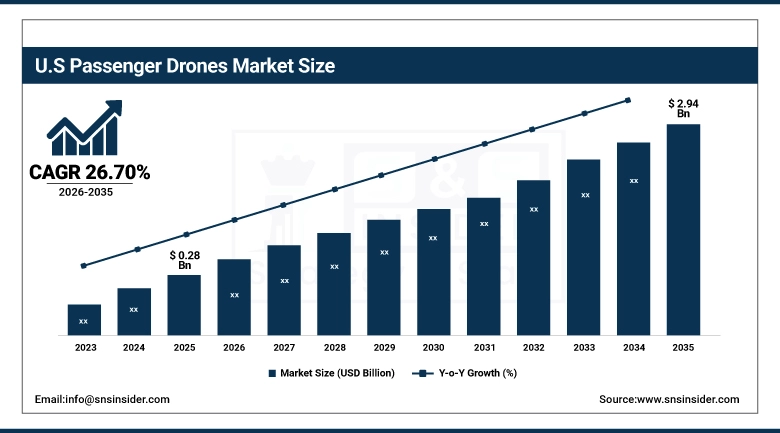
The U.S. Passenger Drones Market is projected to grow from USD 0.28 Billion in 2025 to USD 2.94 Billion by 2035, at a CAGR of 26.70%. Growth is motivated by growing urban congestion, an ever-increasing need for sophisticated urban air mobility services, substantial investment in the development of eVTOLs and self-piloting aircraft, conducive policies on regulation, and increasing developments of vertiports and air traffic control systems in cities.
Passenger Drones Market Growth Drivers:
-
Rising demand for urban air mobility and congestion-free transportation driving adoption of passenger drones.
Urbanization, traffic congestion, and need for increased intra and intercity transport have been identified as crucial factors propelling the Passenger Drones Market forward. Service providers in the field of transportation and aviation, in addition to mobility services firms, are making substantial investments in the development of next-generation passenger drones that will facilitate efficient air taxis, air shuttle transport, and emergency transportation services. Technological innovations such as fully electric engines, artificial intelligence-based navigation systems, lightweight technology, and efficient batteries are contributing to rapid market adoption, and safety and efficiency improvements.
More than 55% of urban air mobility pilots, aerospace operators, and mobility service providers have used passenger drones in the year 2025 for transportation, tourism, and emergencies.
Passenger Drones Market Restraints:
-
High development costs, regulatory complexities, and infrastructure limitations are restraining widespread adoption of passenger drones.
High investment costs, complex certification procedures, and sophisticated supporting infrastructure continue to be major constraints to the growth of the Passenger Drones Market. Research and development costs associated with the creation of autonomous electric vertical takeoff and landing drones are high, involving expenses on power systems, batteries, safety features, and artificial intelligence navigation software. Moreover, tight regulatory laws, complicated airspace management, and time-consuming certification processes hinder the commercialization process. Lack of vertiports, charging stations, and urban air traffic management systems limit wide-scale implementation. High operation costs and safety considerations, along with public acceptance, continue to impede the adoption of passenger drones.
Passenger Drones Market Opportunities:
-
Expansion of urban air mobility ecosystems and integration with smart city infrastructure presents significant market opportunities.
The growth of UAM networks, which includes building vertiports, developing air traffic management infrastructure, and integrating UAM with other transportation modes, provides ample possibilities for the Passenger Drones Market. Airlines, transportation service companies, and tech firms are increasingly allocating capital toward the deployment of unmanned drones for air taxi services, airport shuttles, and intra-urban connections. Innovations in batteries, hydrogen fuel cells, composite structures, and AI-powered flight controls are facilitating extended ranges, enhanced safety, and operational efficiency. Collaboration among government authorities, aviation companies, and private sector players is speeding up the commercialization process, whereas demonstration projects and regulatory testing are ensuring rapid adoption.
More than 50 percent of all urban mobility demonstrations and smart city projects launched by 2025 included testing or plans for deploying passenger drones.
Passenger Drones Market Segmentation Analysis:
-
By Type, Autonomous Passenger Drones held the largest market share of 38.25% in 2035, while Semi-Autonomous Passenger Drones are expected to grow at the fastest CAGR of 28.76% during 2026–2035.
-
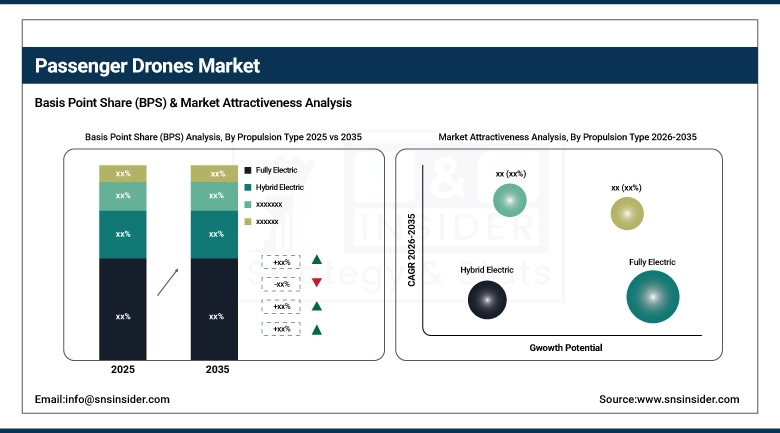
By Propulsion Type, Fully Electric systems accounted for the highest market share of 52.25% in 2035, while it is also expected to grow at the fastest CAGR of 28.21% during 2026–2035.
-
By Range, Short Range (0–50 km) dominated with a 42.25% market share in 2025, while Long Range (150+ km) is projected to grow at the fastest CAGR of 22.24% during the forecast period.
-
By Seating Capacity, 1–2 Passengers held the largest share of 45.12% in 2025, while 5+ Passengers capacity drones are expected to grow at the fastest CAGR of 21.24% during 2026–2035.
-
By Application, Urban Air Mobility (Air Taxi Services) dominated with a 41.23% share in 2025, while Military & Defense Transport is projected to grow at the fastest CAGR of 19.25% during the forecast period.
By Type, Autonomous Passenger Drones Dominate While Semi-Autonomous Passenger Drones Grow Rapidly:
The Autonomous Passenger Drones segment dominates due to technological breakthroughs in autonomous navigation using artificial intelligence technology and autonomous flight control systems and high investments in urban air mobility solutions that offer full automation. Companies would rather invest in autonomous technologies to enhance efficiency and minimize reliance on pilots.
The Semi-Autonomous Passenger Drones are the fastest-growing segment, since such aircraft need some sort of human intervention and oversight even though automation continues to be implemented in the system. This means that such aircraft find more applications in pilot projects and preliminary implementations.
By Propulsion Type, Fully Electric Systems Dominate While Hydrogen Fuel Cell Systems Grow Rapidly:
Fully Electric Propulsion dominates due to its eco-friendliness, cheaper operational cost, quieter operation, and ease of operation within urban areas. Progress in batteries, energy efficiency, and charging will propel adoption into the passenger drone industry further.
Hydrogen Fuel Cells represent the fastest-growing category owing to the increased need for endurance and quick fueling capabilities. Continued innovation in fuel cell systems, efficient energy use, and lightweight solutions will boost its adoption in future long-range passenger drones.
By Range, Short Range Dominates While Long Range Grows Rapidly:
Short Range (0-50km) is currently dominant due to its suitability for urban air taxis, airport shuttles, and intra-city transportation, where speed and efficiency matter more than anything else. Its strong compatibility with existing infrastructure and early adoption models makes it dominant in the industry.
Long Range (150km+) is currently the fastest growing sector owing to improvements in the propulsion system and power storage technologies and rising demand for long-range air transportation. The emphasis on improving the range will ensure that it sees more applications beyond urban transit systems.
By Seating Capacity, 1–2 Passengers Dominates While 5+ Passengers Grow Rapidly:
1-2 Passengers Segment dominated the market due to the early-stage commercialization efforts focused on small and light designs, reduced load capacity needs, and applicability in the initial phase of urban air mobility applications. Such vehicles are easier to certify, consume less energy, and fit well the existing restrictions in terms of propulsion and batteries currently available.
5+ Passengers Segment is the fastest-growing segment one due to the increased need for air mobility systems with high-capacity that could be used in air taxi and other transportation-related applications. Improvements in propulsion systems, lifting capability, and design are helping to create larger air mobility drones that can be used for future applications.
By Application, Urban Air Mobility Dominates While Military & Defense Transport Grows Rapidly:
Urban Air Mobility (Air Taxi Services) is the dominant segment in the market due to increased urban congestion, rising demand for fast intra-city travel, and higher investments in smart mobility infrastructure. The integration of passenger drones within urban transport systems, together with the construction of vertiports and air traffic management technology, has fueled the adoption of such vehicles for short-range passenger transport.
Military & Defense Transport is the fastest growing segment, thanks to the rising usage of passenger drones for rapid troop transport and mobility and logistics operations. The adoption of autonomous aerial platforms among defense departments has been fueled by investments aimed at enhancing mobility and mission responsiveness within defense departments.
Passenger Drones Market Regional Analysis:
North America Passenger Drones Market Insights:
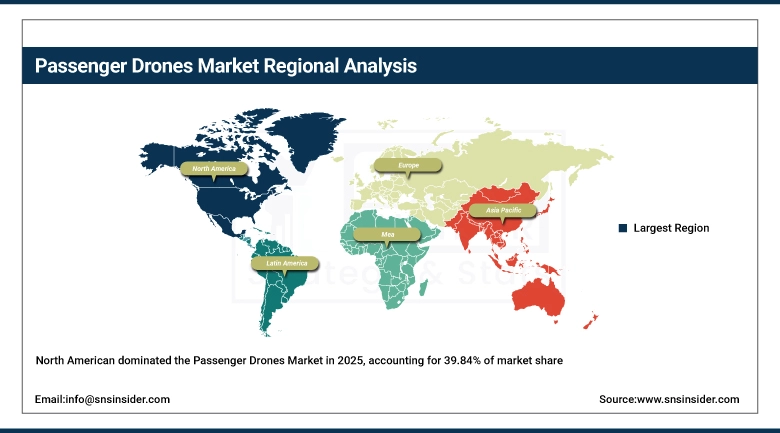
The North America Passenger Drones Market is dominated, holding a 39.84% share in 2025, due to substantial investments in advanced air mobility solutions, developed aerospace industry and technology infrastructure, and widespread adoption of autonomous eVTOL aircraft. The presence of an excellent aviation infrastructure, active participation of top companies in this market space, and implementation of pilot projects in various cities of the US and Canada contribute to the dominance of this region in the passenger drone market. Increasing demand for urban air mobility solutions, airport shuttles, and emergency response solutions, coupled with supportive regulatory environment, fuels growth in the market.
Get Customized Report as per Your Business Requirement - Enquiry Now
U.S. Passenger Drones Market Insights:
The U.S. Passenger Drones Market is characterized by substantial investments made by aerospace and technology firms, coupled with robust innovations in autonomous flight technologies and eVTOLs. Increasing urban congestion, rising demands for quick intercity transportation, and rising preferences for air taxis are some of the factors that are propelling the market. The expansion of smart cities, establishment of air mobility infrastructure, and partnerships between private organizations and government agencies are bolstering market penetration within the commercial, military, and emergency sectors.
Asia-Pacific Passenger Drones Market Insights:
The Asia-Pacific Passenger Drones Market is the fastest-growing region, projected to expand at a CAGR of 29.69% during 2026–2035. Rapid urbanization, dense population, and rising demand for transport solutions are responsible for high growth in the Asia Pacific region. Nations such as China, Japan, South Korea, and India are increasingly adopting urban air mobility initiatives and conducting pilot tests in order to build their infrastructure. The growth of the passenger drone industry will be boosted by increasing capability in the aerospace industry, increased participation by local manufacturing companies, favorable government policies, and collaborations between the public and private sectors.
China Passenger Drones Market Insights:
The China Passenger Drones Market include robust backing from the Chinese government for high-end aviation technology, the quick growth of the smart city ecosystem, and huge spending on self-driving mobility. Major local firms are working on eVTOL drones for their use in the transportation industry. The growing concern over the problem of traffic congestion in cities along with the progress in battery technology, navigation powered by AI, air traffic management, and urban planning are boosting demand.
Europe Passenger Drones Market Insights:
The Europe Passenger Drones Market include robust regulatory policies in favor of advanced air mobility solutions, growing investments in environmentally friendly transportation systems, and the availability of experienced aerospace industry companies. Germany, France, and the United Kingdom are frontrunners in adopting passenger drones through pilot projects, infrastructural development, and the incorporation of passenger drones within urban mobility plans. Growing concerns over emission reductions, increased connectivity among cities, and the construction of vertiports further aid in regional market growth.
Germany Passenger Drones Market Insights:
Germany is a key market in the European Passenger Drones landscape, supported by advanced aerospace engineering capabilities and strong investments in innovation. Growth is driven by ongoing development of eVTOL aircraft, integration of autonomous technologies, and active participation from leading manufacturers and research institutions. Government-backed initiatives promoting sustainable mobility, combined with structured regulatory oversight and expansion of test corridors and pilot projects, are enhancing adoption and positioning Germany as a major contributor to regional advancements.
Latin America Passenger Drones Market Insights:
The Latin America Passenger Drones Market is expanding due to the increasing congestion in urban areas, the growing interest in alternate modes of transportation, and the improvement of aviation infrastructure. Countries such as Brazil, Mexico, and Chile have embarked on pilot programs for the use of passenger drones for air taxis and tourism purposes. The investments made by private entities, coupled with the establishment of partnerships, have been fueling the adoption of these drones in the region.
Middle East and Africa Passenger Drones Market Insights:
The Middle East & Africa Passenger Drones Market is witnessing growth owing to the smart city projects of the governments, increased investment in futuristic mobility modes, and rise in demand for efficient transportation modes. Nations such as UAE, Saudi Arabia, and South Africa are making heavy investments in pilot projects, development of infrastructures, and formation of regulations for air mobility. The emphasis on tourism, luxurious transportation modes, use of autonomous aerial vehicles, development of navigation systems, and collaboration with international players is boosting the market growth in the region.
Passenger Drones Market Competitive Landscape:
Joby Aviation is a leading U.S.-based advanced air mobility company focused on the development of electric vertical takeoff and landing (eVTOL) aircraft for passenger transportation. The company is building a vertically integrated ecosystem encompassing aircraft design, manufacturing, and air taxi services. Its strong emphasis on autonomous flight systems, long-range electric propulsion, and strategic partnerships with aviation and infrastructure stakeholders has positioned it as a front-runner in the passenger drones market. Continuous flight testing, certification progress, and scaling of production capabilities support its competitive positioning in the urban air mobility landscape.
-
In March 2026, Joby Aviation advanced its FAA certification process for its S4 eVTOL aircraft and expanded conforming aircraft flight testing, marking key progress toward Type Inspection Authorization and commercial passenger operations.
EHANG, a company headquartered in China, is carving out a niche in autonomous aerial vehicles. They're developing passenger drones with an eye on urban air mobility, tourism, and short hops around town. The EH216-S is their main platform, built for fully autonomous, pilotless flights. This makes them a real trailblazer in the world of unmanned eVTOL systems. EHANG's success in navigating China's regulatory landscape, along with its international demonstration flights and efforts to get its products into the market, solidifies its position at the forefront of autonomous aviation.
-
In January 2026, EHANG continued expanding operational demonstrations of its EH216-S autonomous passenger eVTOL across international markets and maintained regulatory leadership following its type certification in China, supporting broader commercial trial operations and reinforcing its readiness for scalable urban air mobility deployment.
Volocopter, a German company, is working on electric multicopter eVTOL aircraft, aiming to revolutionize short-distance passenger travel. Think urban air taxis and getting people to and from airports. Safety is a big deal for them, as is getting the necessary certifications and fitting into existing European transportation systems. They're doing this by teaming up with regulators, cities, and others who build the necessary infrastructure. Their plans include developing vertiports, creating operational systems, and pushing for sustainable aviation practices. All of this is part of their goal: to make commercial urban air mobility a reality in crowded cities. Their partnerships and test flights are helping to get passenger drone services off the ground
-
In February 2026, Volocopter progressed its certification efforts for the VoloCity eVTOL aircraft and continued developing partnerships for vertiport infrastructure and urban air mobility networks, supporting preparations for limited commercial operations despite financial restructuring challenges that impacted its development timeline.
Passenger Drones Market Key Players:
Some of the Passenger Drones Market Companies are:
-
Joby Aviation
-
EHANG
-
Volocopter
-
Airbus
-
Boeing
-
Lilium
-
AeroMobil
-
Terrafugia
-
Uber Technologies
-
Cartivator
-
Archer Aviation
-
Beta Technologies
-
Vertical Aerospace
-
Wisk Aero
-
Jaunt Air Mobility
-
XTI Aircraft
-
Pipistrel (Textron eAviation)
-
EmbraerX
-
Supernal (Hyundai Motor Group)
-
Overair
| Report Attributes | Details |
|---|---|
| Market Size in 2025 | USD 0.82 Billion |
| Market Size by 2035 | USD 9.23 Billion |
| CAGR | CAGR of 27.56% From 2026 to 2035 |
| Base Year | 2025 |
| Forecast Period | 2026-2035 |
| Historical Data | 2022-2024 |
| Report Scope & Coverage | Market Size, Segments Analysis, Competitive Landscape, Regional Analysis, DROC & SWOT Analysis, Forecast Outlook |
| Key Segments | • By Type (Autonomous Passenger Drones, Semi-Autonomous Passenger Drones, Piloted eVTOL Aircraft, Others) • By Propulsion Type (Fully Electric, Hybrid Electric, Hydrogen Fuel Cell, Others) • By Range (Short Range (0–50 km), Medium Range (50–150 km), Long Range (150+ km), Others) • By Seating Capacity (1–2 Passengers, 3–4 Passengers, 5+ Passengers, Others) • By Application (Urban Air Mobility (Air Taxi Services), Airport Shuttle Services, Emergency Medical Services, Tourism & Recreational, Military & Defense Transport, Others) |
| Regional Analysis/Coverage | North America (US, Canada), Europe (Germany, UK, France, Italy, Spain, Russia, Poland, Rest of Europe), Asia Pacific (China, India, Japan, South Korea, Australia, ASEAN Countries, Rest of Asia Pacific), Middle East & Africa (UAE, Saudi Arabia, Qatar, South Africa, Rest of Middle East & Africa), Latin America (Brazil, Argentina, Mexico, Colombia, Rest of Latin America). |
| Company Profiles | Joby Aviation, EHANG, Volocopter, Airbus, Boeing, Lilium, AeroMobil, Terrafugia, Uber Technologies, Cartivator, Archer Aviation, Beta Technologies, Vertical Aerospace, Wisk Aero, Jaunt Air Mobility, XTI Aircraft, Pipistrel (Textron eAviation), EmbraerX, Hyundai Motor Group (Supernal), Overair |

Frequently Asked Questions
North America dominated with a 39.84% share in 2025, while Asia-Pacific is the fastest-growing region, expected to expand at a CAGR of 29.69% during 2026–2035.
1–2 passenger capacity aircraft dominated with a 45.12% share in 2025, while 5+ passenger capacity drones are projected to grow at the fastest CAGR of 21.24% during 2026–2035.
Growth is driven by rising urban congestion, increasing demand for faster intra-city and intercity transportation, advancements in electric propulsion and battery technologies.
The market is valued at USD 0.82 Billion in 2025 and is projected to reach USD 9.23 Billion by 2035.
The Passenger Drones Market is projected to grow at a CAGR of 27.56% during 2026–2035.
