
Pharmaceutical Quality Management Software Market Report Scope & Overview:
The Pharmaceutical Quality Management Software Market size is estimated at USD 1.85 billion in 2025 and is expected to reach USD 6.48 billion by 2035, growing at a CAGR of 13.37 % over the forecast period of 2026-2035.
The Pharmaceutical Quality Management Software (PQMS) Market is projected to grow significantly due to increasing regulatory compliance requirements and the rising complexity of pharmaceutical and biotech manufacturing. Companies are adopting digital solutions to streamline quality processes such as document control, audits, CAPA, and training, enhancing efficiency and reducing errors. Growing focus on patient safety, real-time monitoring, and integration with advanced analytics and manufacturing systems is further driving adoption, while expanding pharmaceutical production and stringent FDA and EMA regulations continue to fuel robust market growth globally.
87% of pharma and biotech firms deployed PQMS driven by global regulatory demands, manufacturing complexity, and the need for real-time quality control to ensure compliance, patient safety, and operational excellence.

To Get more information on Pharmaceutical Quality Management Software Market - Request Free Sample Report
Pharmaceutical Quality Management Software Market Trends
-
Rising adoption of PQMS to ensure regulatory compliance, improve product quality, and streamline pharmaceutical operations
-
Increasing integration of cloud-based PQMS solutions for real-time data access and cross-functional collaboration across organizations
-
Growing demand for AI and analytics-enabled platforms to enhance quality control and predictive risk management
-
Expansion of digital documentation and electronic batch record management for faster audits and reduced compliance errors
-
Rising focus on supplier quality management to mitigate risks in pharmaceutical supply chains and manufacturing processes
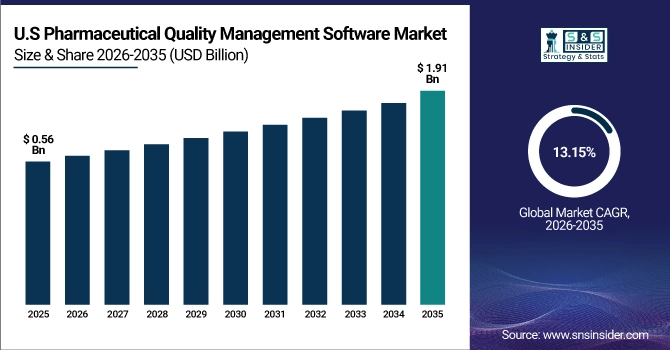
U.S. Pharmaceutical Quality Management Software Market is valued at USD 0.56 billion in 2025 and is expected to reach USD 1.91 billion by 2035, growing at a CAGR of 13.15% from 2026-2035.
The U.S. Pharmaceutical Quality Management Software Market is growing due to increasing regulatory compliance requirements and the need for efficient quality management in pharmaceutical and biotech manufacturing. Adoption of digital solutions for document control, audits, CAPA, and training, along with real-time monitoring and integration with advanced systems, is driving market expansion while ensuring patient safety and operational efficiency.
Pharmaceutical Quality Management Software Market Growth Drivers:
-
Increasing regulatory compliance requirements from FDA, EMA, and other authorities are driving adoption of PQMS to ensure product quality, safety, and audit readiness across pharmaceutical companies
Stringent global regulations, such as Good Manufacturing Practices (GMP) and FDA 21 CFR Part 11, require pharmaceutical companies to maintain accurate documentation, traceability, and real-time monitoring of quality processes. PQMS helps companies automate compliance workflows, manage deviations, track corrective actions, and ensure readiness for audits. As regulatory scrutiny increases worldwide, pharmaceutical manufacturers are investing in PQMS to reduce compliance risks, avoid penalties, and maintain high-quality standards. Adoption is especially strong among mid-to-large companies aiming to streamline regulatory reporting and ensure safe, consistent product manufacturing.
85% of pharmaceutical companies adopted PQMS spurred by stringent FDA, EMA, and global regulatory mandates to ensure consistent product quality, safety, and seamless audit readiness.
-
Growing demand for operational efficiency and process automation in drug manufacturing encourages pharmaceutical companies to implement PQMS for real-time monitoring and improved decision-making
Pharmaceutical companies face pressure to enhance productivity, reduce errors, and maintain consistent product quality. PQMS solutions enable automation of quality processes, including document control, training management, change management, and corrective/preventive actions (CAPA). Real-time monitoring and data analytics allow quick identification of deviations and faster decision-making. By integrating PQMS into manufacturing operations, companies can improve efficiency, reduce manual labor, and minimize operational delays. The increasing focus on digital transformation and Industry 4.0 initiatives in the pharmaceutical sector is driving PQMS adoption to optimize workflows and maintain high operational standards.
82% of pharmaceutical manufacturers implemented PQMS driven by the need for operational efficiency and automation to enable real-time quality monitoring and data-driven decision-making in drug production.
Pharmaceutical Quality Management Software Market Restraints:
-
High implementation costs and complex integration with existing IT systems limit adoption, particularly among small and mid-sized pharmaceutical companies
Implementing PQMS involves significant investment in software, hardware, and employee training, which can be prohibitive for small and mid-sized pharmaceutical firms. Integration with legacy ERP or manufacturing systems can be technically challenging, causing delays and increasing costs. Additionally, ongoing maintenance, updates, and compliance validation further add to the financial burden. These challenges can slow adoption in emerging markets or among smaller organizations with limited budgets. As a result, the high total cost of ownership and complex IT requirements act as key barriers to widespread PQMS deployment globally.
75% of small and mid-sized pharma companies delayed PQMS adoption due to high implementation costs and complex integration with legacy IT systems hindering quality digitization efforts.
-
Resistance to change and lack of skilled personnel in managing PQMS slow adoption, reducing its potential impact on quality management processes
Transitioning from manual or legacy quality management systems to PQMS often faces organizational resistance. Employees may be hesitant to adopt new digital workflows due to lack of training or unfamiliarity with the software. Additionally, skilled personnel capable of configuring, managing, and analyzing PQMS data are limited, particularly in emerging regions. This skills gap can reduce system efficiency, delay implementation, and lower overall return on investment. Resistance to digital transformation, combined with inadequate human resources, limits the potential benefits of PQMS, slowing its adoption across pharmaceutical manufacturing facilities.
73% of pharmaceutical organizations faced delayed PQMS adoption due to workforce resistance and a shortage of skilled personnel limiting the systems’ impact on quality efficiency and compliance.
Pharmaceutical Quality Management Software Market Opportunities:
-
Increasing adoption of cloud-based PQMS solutions offers opportunities for scalable, cost-effective, and accessible quality management across global pharmaceutical operations
Cloud-based PQMS solutions allow companies to reduce infrastructure costs, simplify deployment, and enable remote access to quality data. Cloud platforms provide scalability, easier software updates, and centralized management across multiple sites, which is particularly beneficial for multinational pharmaceutical firms. These solutions support collaboration between departments, improve real-time visibility, and reduce IT overhead. Growing acceptance of SaaS-based quality management systems among small and mid-sized companies provides an opportunity for software vendors to expand market share, penetrate new regions, and offer cost-effective, flexible, and reliable PQMS solutions globally.
86% of global pharmaceutical companies adopted cloud-based PQMS enabling scalable, cost-efficient quality management with real-time access, enhanced collaboration, and streamlined regulatory compliance across geographies.
-
Growing demand for data-driven insights, predictive analytics, and AI-enabled quality monitoring presents opportunities for advanced PQMS development and market expansion
The pharmaceutical industry is increasingly leveraging data analytics, machine learning, and AI to optimize quality processes, predict deviations, and prevent product defects. Advanced PQMS solutions integrate these technologies to provide actionable insights, enhance decision-making, and improve compliance. Predictive quality management reduces operational risks, ensures regulatory adherence, and strengthens overall product safety. The increasing focus on digital transformation, coupled with rising demand for proactive quality monitoring, presents significant opportunities for PQMS vendors to innovate, offer AI-enabled solutions, and capture new clients seeking more intelligent, data-driven quality management platforms.
84% of life sciences and manufacturing firms invested in AI-powered PQMS leveraging predictive analytics and real-time quality monitoring to drive compliance, efficiency, and market differentiation.
Pharmaceutical Quality Management Software Market Segment Highlights
-
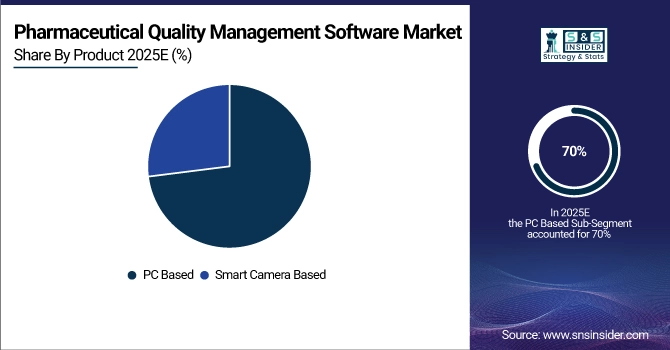
By Product: PC‑Based dominates with 70%, Smart Camera‑Based fastest growing at 30%.
-
By Solution Type: CAPA Management dominates with 30%, Supplier Quality Management fastest growing at 20%.
-
By Application: Predictive Maintenance dominates and fastest growing at 40%.
-
By End‑Use: Pharmaceuticals & Chemicals dominates with 40%, Food & Beverage / Logistics fastest growing at 12%.
Pharmaceutical Quality Management Software Market Segment Analysis
By Product: PC‑Based led, while Smart Camera‑Based is the fastest-growing segment.
PC‑Based systems dominate the pharmaceutical quality management software market due to their widespread adoption across large enterprises and regulatory-driven industries. These systems provide robust, centralized platforms for managing compliance, documentation, and quality workflows. Their established presence in legacy infrastructures ensures reliability and integration with other enterprise systems like ERP and LIMS. Enterprises prefer PC‑based QMS for secure data management, extensive reporting capabilities, and ease of compliance with FDA, EMA, and ISO regulations. The dominance of PC-based solutions reflects the current preference for tried-and-tested software in highly regulated environments.
Smart Camera-Based solutions are rapidly gaining traction, driven by the need for automation in quality inspection and real-time defect detection. These systems leverage AI and machine vision to enhance accuracy, reduce human error, and speed up production line monitoring. The growth is fueled by increased demand in pharmaceutical, food, and packaging sectors for high-precision quality control. As companies adopt Industry 4.0 technologies and smart manufacturing practices, the adoption of Smart Camera-Based QMS is expected to accelerate, making it the fastest-growing product segment in the market.
By Solution Type: Corrective & Preventive Action (CAPA) led, while Supplier Quality Management is the fastest-growing segment.
CAPA modules dominate the solution type segment because they are central to ensuring compliance with regulatory standards and continuous quality improvement. These solutions help identify root causes of defects, implement corrective measures, and prevent recurrence, reducing production risks and non-compliance penalties. CAPA management is critical in highly regulated sectors like pharmaceuticals, ensuring adherence to FDA, EMA, and ISO guidelines. Its dominance is reinforced by organizations prioritizing proactive quality management and systematic risk mitigation, making CAPA the backbone of most pharmaceutical quality management strategies.
Supplier Quality Management (SQM) is the fastest-growing solution segment due to globalization and complex supply chains in pharmaceuticals. Companies are increasingly focused on monitoring supplier compliance, ensuring consistent product quality, and managing risks associated with outsourced manufacturing. SQM software enables real-time tracking, auditing, and assessment of suppliers, facilitating transparent collaboration and compliance with regulatory requirements. As regulatory scrutiny intensifies and manufacturers source globally, the demand for robust SQM solutions is accelerating, driving rapid growth in this segment.
By Application: Predictive Maintenance led, while Quality Assurance & Inspection is the fastest-growing segment.
Predictive Maintenance dominates and grows fastest within applications due to its integration with AI and IoT technologies. By analyzing machine data, predictive maintenance systems can forecast equipment failures, optimize maintenance schedules, and prevent production downtime. In pharmaceutical manufacturing, this ensures continuous, compliant production with minimal quality risks. The segment’s dominance is driven by efficiency improvements, cost savings, and regulatory compliance, while its rapid growth is fueled by Industry 4.0 adoption, smart manufacturing initiatives, and increasing emphasis on proactive quality and operational management.
By End‑Use: Pharmaceuticals & Chemicals led, while Food & Beverage / Logistics is the fastest-growing segment.
The Pharmaceuticals & Chemicals segment dominates due to the sector’s stringent regulatory requirements and critical focus on product quality. Pharmaceutical manufacturers require comprehensive QMS solutions to comply with FDA, EMA, and ISO regulations, manage documentation, audits, and CAPA workflows. The dominance is reinforced by high investments in compliance, patient safety, and quality assurance, making this end-use the largest consumer of quality management software. The need for precision, traceability, and risk mitigation ensures sustained demand for QMS solutions in this sector.
Food & Beverage and Logistics are the fastest-growing end-use segments due to increasing regulatory oversight, consumer safety concerns, and adoption of digital quality management solutions. Companies are leveraging QMS software to monitor product quality, ensure compliance with food safety standards, and optimize supply chain operations. The surge in e-commerce, cold chain logistics, and packaging automation further drives the adoption of QMS solutions. Growth is accelerated by demand for traceability, efficiency, and reduced operational risks, positioning Food & Beverage and Logistics as the fastest-growing sectors in the market.
Pharmaceutical Quality Management Software Market Regional Analysis
North America Pharmaceutical Quality Management Software Market Insights:
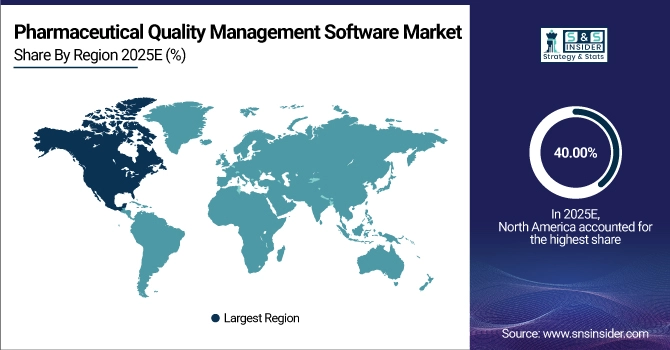
North America dominated the Pharmaceutical Quality Management Software Market with a 40.00% share in 2025 due to the presence of leading pharmaceutical companies, stringent regulatory compliance requirements, and high adoption of digital quality management solutions. Advanced IT infrastructure, continuous R&D investments, and focus on process automation further strengthened the region’s market leadership.
Get Customized Report as per Your Business Requirement - Enquiry Now
Asia Pacific Pharmaceutical Quality Management Software Market Insights
Asia Pacific is expected to grow at the fastest CAGR of about 15.05% from 2026–2035, driven by rapid expansion of pharmaceutical manufacturing, increasing regulatory focus on quality compliance, and growing adoption of cloud-based and automated QMS solutions. Rising healthcare investments, emerging biotech companies, and modernization of production facilities accelerate the region’s market growth during the forecast period.
Europe Pharmaceutical Quality Management Software Market Insights
Europe held a significant share in the Pharmaceutical Quality Management Software Market in 2025, supported by well-established pharmaceutical and biotech industries, strict regulatory frameworks such as EMA guidelines, and high adoption of digital quality management solutions. Continuous investments in compliance automation and process optimization further strengthened the region’s market position.
Middle East & Africa and Latin America Pharmaceutical Quality Management Software Market Insights
The Middle East & Africa and Latin America together showed moderate growth in the Pharmaceutical Quality Management Software Market in 2025, driven by increasing pharmaceutical manufacturing, rising adoption of quality management systems, and growing regulatory awareness. Expanding healthcare infrastructure, government initiatives to improve compliance, and modernization of production facilities contributed to the regions’ improving market presence.
Pharmaceutical Quality Management Software Market Competitive Landscape:
Veeva Systems Inc.
Veeva Systems Inc. is a leading provider of cloud-based software solutions for the life sciences industry, specializing in quality management, regulatory compliance, and content management. Its Pharmaceutical Quality Management Software (QMS) helps companies streamline document control, manage CAPA, audits, training, and supplier quality processes. Veeva emphasizes real-time data visibility, automation, and regulatory compliance, enabling faster decision-making and improved product quality. With a strong global presence, Veeva supports major pharmaceutical, biotechnology, and medical device companies in achieving operational excellence.
-
May 2024, Veeva launched QualityOne with AI-Powered CAPA Intelligence, a next-generation cloud-native Quality Management System (QMS) built on its Vault platform
IQVIA Holdings Inc.
IQVIA Holdings Inc. is a global provider of advanced analytics, technology solutions, and contract research services for the healthcare and life sciences sectors. In the pharmaceutical quality management space, IQVIA offers software solutions that integrate data analytics with quality processes, enabling organizations to monitor compliance, optimize risk management, and streamline regulatory reporting. Its platforms support CAPA, audits, and supplier quality management, helping pharmaceutical companies maintain high standards of product quality while meeting global regulatory requirements efficiently.
-
October 2023, IQVIA expanded its Quality & Compliance Cloud to include risk-based quality management (RBQM) for both manufacturing and clinical operations.
Dassault Systèmes SE
Dassault Systèmes SE is a French multinational software company known for its 3D design, engineering, and lifecycle management solutions, including quality management for pharmaceuticals. Its Pharmaceutical Quality Management Software provides comprehensive tools for document control, change management, audits, CAPA, and supplier quality processes. The company focuses on improving compliance, operational efficiency, and traceability through cloud-based and collaborative platforms. Dassault Systèmes enables pharmaceutical and biotechnology companies to maintain high-quality standards and accelerate time-to-market while ensuring regulatory adherence.
-
February 2025, Dassault Systèmes introduced 3DEXPERIENCE QMS for Life Sciences, featuring a “Digital Twin of Quality” that simulates the impact of process changes on compliance and product quality.
Pharmaceutical Quality Management Software Market Key Players
Some of the Pharmaceutical Quality Management Software Market Companies are:
-
Veeva Systems Inc.
-
MasterControl Solutions Inc.
-
Honeywell International Inc.
-
IQVIA Holdings Inc.
-
Dassault Systèmes SE
-
ComplianceQuest Inc.
-
Qualio Inc.
-
ETQ LLC
-
AssurX Inc.
-
QT9 Software Inc.
-
Oracle Corporation
-
SAP SE
-
Siemens AG
-
Ideagen Ltd.
-
SoftExpert Inc.
-
Instem PLC
-
Intelex Technologies Inc.
-
Intellect Inc.
-
AmpleLogic Inc.
-
Pilgrim Quality Solutions
| Report Attributes | Details |
|---|---|
| Market Size in 2025E | USD 1.85 Billion |
| Market Size by 2035 | USD 6.48 Billion |
| CAGR | CAGR of 13.37% From 2026 to 2035 |
| Base Year | 2025 |
| Forecast Period | 2026-2035 |
| Historical Data | 2022-2024 |
| Report Scope & Coverage | Market Size, Segments Analysis, Competitive Landscape, Regional Analysis, DROC & SWOT Analysis, Forecast Outlook |
| Key Segments | • By Product (PC Based, Smart Camera Based) • By Solution Type (Document Control, Audit Management, Corrective & Preventive Action (CAPA), Change Management, Training Management, Supplier Quality Management) • By Application (Quality Assurance and Inspection, Positioning and Guidance, Measurement, Identification, Predictive Maintenance) • By End-use (Automotive, Pharmaceuticals & Chemicals, Electronics & Semiconductor, Pulp & Paper, Printing & Labeling, Food & Beverage (Packaging and Bottling), Glass & Metal, Postal & Logistics, Others) |
| Regional Analysis/Coverage | North America (US, Canada), Europe (Germany, UK, France, Italy, Spain, Russia, Poland, Rest of Europe), Asia Pacific (China, India, Japan, South Korea, Australia, ASEAN Countries, Rest of Asia Pacific), Middle East & Africa (UAE, Saudi Arabia, Qatar, South Africa, Rest of Middle East & Africa), Latin America (Brazil, Argentina, Mexico, Colombia, Rest of Latin America). |
| Company Profiles | Veeva Systems Inc., MasterControl Solutions Inc., Honeywell International Inc., IQVIA Holdings Inc., Dassault Systèmes SE, ComplianceQuest Inc., Qualio Inc., ETQ LLC, AssurX Inc., QT9 Software Inc., Oracle Corporation, SAP SE, Siemens AG, Ideagen Ltd., SoftExpert Inc., Instem PLC, Intelex Technologies Inc., Intellect Inc., AmpleLogic Inc., Pilgrim Quality Solutions |
Frequently Asked Questions
North America dominated the Pharmaceutical Quality Management Software Market in 2025, holding approximately 40% market share.
The Predictive Maintenance segment dominated the Pharmaceutical Quality Management Software Market during the projected period.
Increasing regulatory compliance requirements and rising complexity of pharmaceutical manufacturing are the key growth drivers.
The Pharmaceutical Quality Management Software Market was valued at USD 1.85 billion in 2025.
The Pharmaceutical Quality Management Software Market is expected to grow at a CAGR of 13.37% from 2026 to 2035 globally.
