
Plastic Antioxidants Market Report Scope & Overview:
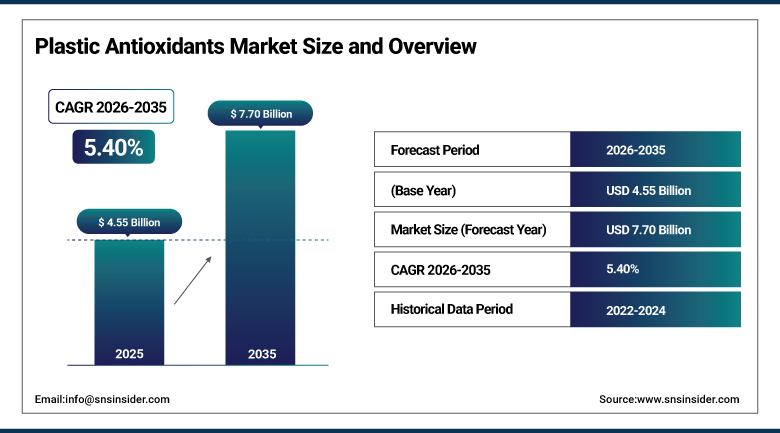
The Plastic Antioxidants Market was valued at USD 4.55 Billion in 2025 and is expected to reach USD 7.70 Billion by 2035, growing at a CAGR of 5.40% from 2026-2035.
The Plastic Antioxidants Market is growing steadily as producers and converters add stabilizers to polymers to prevent degradation during processing, storage and use. Growth is driven by rising consumption of polypropylene, polyethylene and engineering plastics in packaging, vehicles, construction and consumer goods, the replacement of metals with lightweight plastics, and stricter requirements for long-term heat stability, color retention and low migration in food contact and medical products. Suppliers are developing multifunctional blends, liquid and low-volatility grades, and phenol-free or lower-extractable alternatives, while also expanding capacity in Asia and North America. Raw material and energy costs, along with regional supply security, strongly influence pricing and contract strategies across the value chain.
To Get more information Plastic Antioxidants Market - Request Free Sample Report
⮞On March 4, 2026, BASF announced a worldwide price increase of up to 20 percent on its antioxidants, process stabilizers and light stabilizers for plastic applications, citing higher raw material, fixed and freight costs. On April 27, 2026, the company announced a second increase of up to 25 percent, effective immediately, which it attributed to higher raw material, energy and logistics costs linked to the military conflict in the Middle East. The two moves show how exposed additive producers are to feedstock and energy swings and how quickly those costs are passed to polymer converters.
Plastic Antioxidants Market Trends
-
Pass-through of raw material, energy and freight costs through repeated additive price increases
-
Growth of multifunctional antioxidant blends that combine phenolic and phosphite chemistry
-
Development of phenol-free and low-migration grades for medical and food contact uses
-
Capacity additions in China and India alongside backward integration in North America
-
Rising demand for liquid and low-volatility antioxidants in polyurethane and elastomer systems
-
Increased attention to recyclate stabilization to maintain properties in recycled plastics
U.S. Plastic Antioxidants Market Outlook
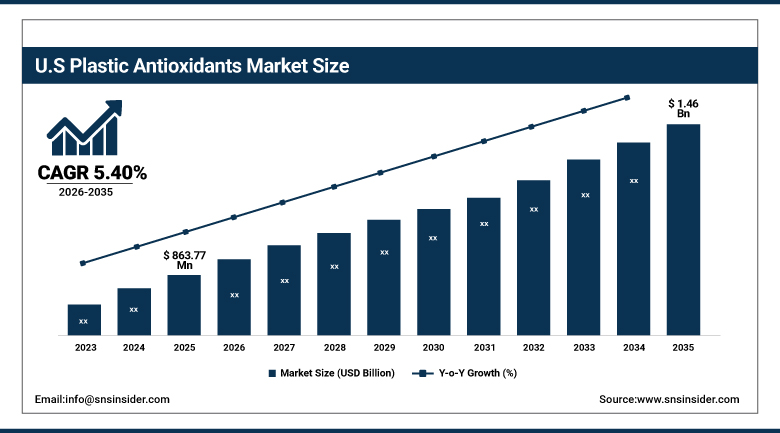
The U.S. Plastic Antioxidants Market was valued at USD 863.77 Million in 2025 and is expected to reach USD 1.46 Billion by 2035, growing at a CAGR of 5.40% from 2026-2035.
The U.S. Plastic Antioxidants Market is the largest national market in North America, supported by a large polyolefin industry on the Gulf Coast, strong demand from packaging, automotive and construction converters, and a base of specialty additive producers with local manufacturing. Customers value security of supply and technical service, especially after supply disruptions and price swings in recent years. Food contact and medical regulations require well-documented, low-migration grades, and the growing use of recycled content increases the need for stabilizers that restore processing stability. Trade policy and tariffs on imports from Asia influence sourcing, encouraging local capacity additions and longer-term supply agreements with producers.
⮞Local primary antioxidant capacity has been rebuilt to strengthen North American supply. In May 2021, SI Group announced an investment of more than USD 50.00 million across three manufacturing sites in North America to add primary antioxidant capacity, with new output expected in the second half of 2022. The company said the expansion would give customers in food packaging, automotive, construction and adhesives a fully integrated portfolio of phenolic antioxidants and increase supply security for U.S. buyers.
Plastic Antioxidants Market Segment Analysis
-
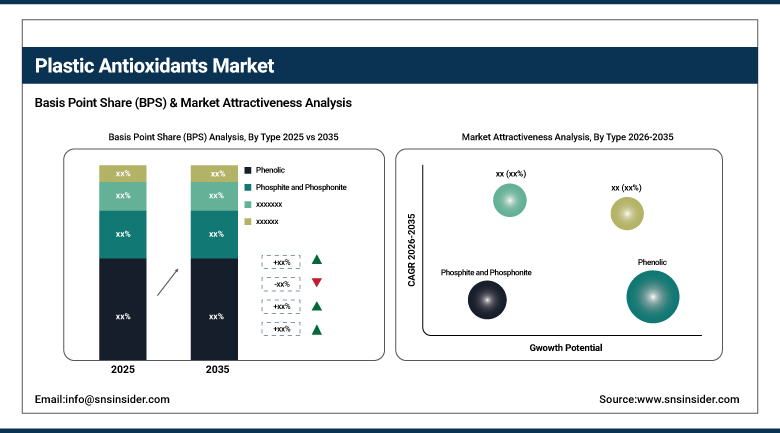
By Type, the Phenolic segment dominated the Plastic Antioxidants Market with approximately 41.00% share in 2025, and is also the fastest growing with a CAGR of approximately 5.80%.
-
By Polymer Resin, the Polypropylene segment dominated the Plastic Antioxidants Market with approximately 34.50% share in 2025, while the Polyethylene segment is the fastest growing with a CAGR of approximately 5.90%.
-
By Form, the Solid segment dominated the Plastic Antioxidants Market with approximately 78.00% share in 2025, while the Liquid segment is the fastest growing with a CAGR of approximately 6.80%.
-
By Application, the Packaging segment dominated the Plastic Antioxidants Market with approximately 38.50% share in 2025, while the Automotive segment is the fastest growing with a CAGR of approximately 6.20%.
By Type, Phenolic Antioxidants Lead and Grow Fastest
Phenolic antioxidants lead because they are the standard primary stabilizers that scavenge free radicals and protect polymers against thermal oxidation during processing and long-term service. Hindered phenols are effective at low loadings, compatible with most resins and cost competitive, and they have well-established regulatory clearances for food contact and medical use. Producers offer a wide range of molecular weights and volatilities tailored to different processing temperatures and end uses. Their central role in polyolefins, which account for the largest share of plastics consumption, keeps volumes high.
Growth in this segment is also fastest because new polymer capacity needs primary antioxidants in every grade, and developments in higher-molecular-weight and low-migration phenolics address food contact and medical requirements. Phosphite and phosphonite secondary antioxidants work together with phenolics to protect color and melt stability during extrusion and are widely used in blends. Antioxidant blends offer convenience and consistent dosing, reducing handling steps for converters, and other chemistries such as lactone, hydroxylamine and amine-based systems serve specialized needs in elastomers and engineering plastics.
By Polymer Resin, Polypropylene Leads While Polyethylene Grows Fastest
Polypropylene leads because it is highly susceptible to oxidative degradation during processing and has wide use in packaging, automotive parts, appliances, fibers and films. Stabilizer packages must protect the polymer through high-temperature extrusion and injection molding and then provide years of heat and light resistance in finished products. New polypropylene capacity in Asia and the Middle East adds steady demand, and the shift to non-phthalate catalysts and high-flow grades often requires customized additive systems. Automotive applications demand long-term thermal stability under the hood.
Polyethylene is advancing fastest as film, pipe, rotomolded products and packaging grow across regions, and as new capacity based on abundant ethane comes onstream. High-density and linear low-density grades require processing stabilizers to avoid gels and discoloration, and long-life pipes and geomembranes need strong long-term protection. Polyvinyl chloride, polystyrene and acrylonitrile butadiene styrene form the other main resin groups, each using specific antioxidant systems, and engineering plastics and recycled resins create additional demand for robust stabilization.
By Form, Solid Antioxidants Lead While Liquid Antioxidants Grow Fastest
Solid forms, including powders, granules and pastilles, lead because most antioxidants are crystalline materials that are easy to store, handle and meter in compounding and masterbatch operations. Converters have equipment designed for solid dosing, and the products offer good shelf life and consistent quality. Producers continue to improve particle size and dust control to enhance dispersion and workplace safety. Blends supplied as free-flowing granules simplify formulation and reduce the number of separate ingredients that customers must manage.
Liquid forms are growing fastest as polyurethane foam, elastomers, adhesives and some polyolefin processes benefit from antioxidants that dissolve readily and can be pumped directly into production lines. Low-volatility liquid phenolics and phosphites reduce scorch in flexible foam, improve color and avoid dust, and automation of dosing improves consistency. Liquid systems also support lubricants and related applications where the same chemistries are used. Suppliers invest in new liquid grades that meet emissions rules for automotive interiors and consumer products.
By Application, Packaging Leads While Automotive Grows Fastest
Packaging leads because polymers used in films, containers, closures and bottles consume large volumes of antioxidants, and these products must satisfy strict food contact and migration rules. Growth in packaged food, e-commerce and consumer goods in emerging markets supports steady demand, while brand owners push for lightweight designs and higher recycled content that depend on effective stabilization. Suppliers provide documentation, regulatory support and customized blends for flexible and rigid packaging producers.
Automotive is growing fastest as plastics replace metals in interiors, bumpers, under-hood components and electric vehicle systems, requiring long-term heat stability, low fogging and low emissions. Electric vehicles increase use of plastics in battery housings, connectors and cable insulation, which operate at elevated temperatures. Construction, consumer goods and electrical applications add further volume, with pipes, profiles, appliances and cables needing durable protection. Medical and hygiene products form a smaller but demanding area that favors low-extractable and phenol-free solutions.
Regional Analysis
|
Region |
Major Country |
Share within Region, 2025 (%) |
|
Asia Pacific |
China |
47.30 |
|
North America |
United States |
84.00 |
|
Europe |
Germany |
27.80 |
|
Latin America |
Brazil |
46.50 |
|
Middle East & Africa |
Saudi Arabia |
38.20 |
North America Plastic Antioxidants Market Insights
North America accounted for roughly one-fifth of global revenue in 2025 and is led by the United States, with additional demand in Canada and Mexico. The region has a large polyolefin sector concentrated on the Gulf Coast, along with strong demand from packaging, automotive, construction and consumer goods converters. Local producers have invested in primary antioxidant capacity and backward integration to improve supply security, and customers prefer suppliers with regional manufacturing and technical centers.
Regulatory requirements for food contact and medical devices, interest in recycled content and growth of electric vehicle production shape product development. Price increases announced by major suppliers in 2026 highlighted the region's sensitivity to raw material and freight costs. Buyers are signing longer agreements with fixed or indexed pricing, and some are qualifying alternative suppliers to reduce risk. Compounders and masterbatch producers are major channels, offering tailored stabilizer packages to end users.
Europe Plastic Antioxidants Market Insights
Europe is a mature, technology-rich market with Germany, France, Italy and the United Kingdom among the largest consumers, and with several global additive producers headquartered in the region. Demand comes from packaging, automotive, construction and engineering plastics, and regulation under the REACH framework and food contact rules strongly influences product choice. Suppliers emphasize low-migration, low-emission and phenol-free solutions, and sustainability reporting is a growing buying criterion.
High energy costs and competition from imports weigh on regional producers, and some have rationalized capacity or moved production to Asia. Stabilization of recycled plastics is a major focus, as European recycled content targets create a need for additives that restore melt stability and color. Collaboration among additive makers, recyclers and brand owners supports development of systems for mechanically recycled polyolefins.
Asia Pacific Plastic Antioxidants Market Insights
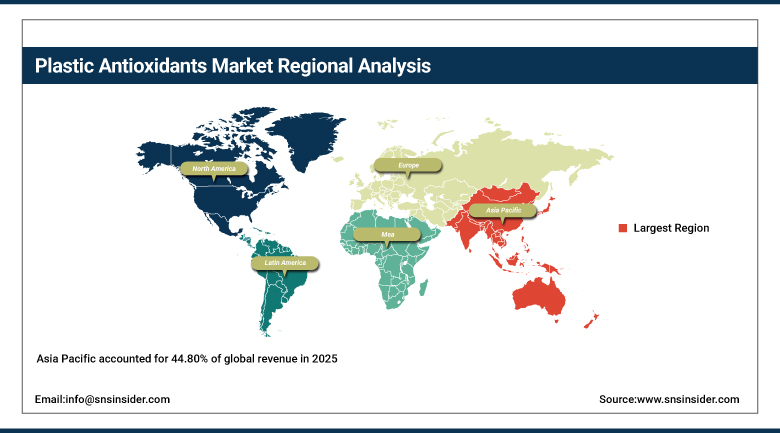
Asia Pacific accounted for 44.80% of global revenue in 2025, making it the largest regional market for plastic antioxidants, and it is also projected to be the fastest-growing region, advancing at a CAGR of 6.40% from 2026-2035. China leads regional demand through its enormous polymer production and converting industries and through local antioxidant manufacturers, followed by India, Japan, South Korea and Southeast Asia. New polyolefin plants, growth in packaging and automotive output and expanding electronics manufacturing sustain consumption.
India is a fast-growing market as polymer capacity expands and consumer demand rises, while Japan and South Korea focus on high-performance and specialty grades for electronics and automotive uses. Regional producers have scaled up quickly and compete on price in standard grades, while global suppliers emphasize specialty blends, technical service and regulatory support. Capacity additions by international firms at sites in China and India reflect the importance of local supply for fast-growing customers.
Get Customized Report as per Your Business Requirement - Enquiry Now
MEA & Latin America Plastic Antioxidants Market Insights
In the Middle East and Africa, demand is concentrated in Saudi Arabia, the United Arab Emirates, Iran, Egypt and South Africa, where large petrochemical complexes produce polyolefins for export and regional converting. Additive consumption follows polymer capacity, and expansions by national producers support steady demand. Local compounding is growing, creating opportunities for masterbatch and stabilizer blends tailored to hot climates and agricultural film.
In Latin America, Brazil, Mexico and Argentina lead consumption, supported by packaging, automotive and agricultural applications. Imports supply a large part of additive requirements, so currency movements and logistics influence cost. Regional compounders look for technical support and local stock, and global suppliers serve the market through distributors and regional warehouses. Both regions are expected to add steadily to global revenue from a smaller base.
Market Dynamics
Growth Drivers: Polymer Consumption, Lightweighting and Performance Requirements
Rising polymer consumption is a primary driver. Packaging, vehicles, construction products, appliances and medical devices all use plastics that require stabilization, and each new resin plant creates demand for antioxidants in every grade. Growth in emerging economies, urbanization and e-commerce supports volume, while the replacement of metals, glass and paper by plastics expands the base of applications that need heat and oxidation protection.
Lightweighting and performance requirements add momentum. Automotive makers demand plastics that withstand years of heat in engine compartments and electric vehicle systems, while food and medical customers require low-migration, low-odor additives. Longer product lifetimes, recycled content targets and higher processing temperatures call for more sophisticated stabilizer packages. Suppliers respond with multifunctional blends and new chemistries that deliver more protection at lower loadings, supporting both volume and value growth.
Restraints: Raw Material Volatility, Health Concerns and Regulatory Scrutiny
Raw material volatility restrains margins. Antioxidants depend on petrochemical feedstocks such as phenols, olefins and phosphorus compounds whose prices move with oil, gas and trade flows. Disruptions in the Middle East and elevated freight and energy costs led major suppliers to announce repeated price increases in 2026. Converters resist higher prices, particularly in competitive packaging markets, and may reduce dosage or switch suppliers, which pressures profitability.
Health concerns and regulatory scrutiny add risk. Some synthetic antioxidants and their degradation products face questions over migration, toxicity and environmental persistence, and regulators in several regions review substances used in food contact and medical products. Compliance and testing cost money and can remove products from the market. Competition from low-cost producers in Asia also limits pricing power for established suppliers in commodity grades.
Opportunities: Recycled Plastics, Phenol-Free Systems and Electric Vehicles
Recycled plastics offer a large opportunity. Mechanically recycled polyolefins have often lost some stabilizer during earlier use and processing, so they need additional antioxidants and processing stabilizers to restore performance. Brand owners and regulators are setting high recycled content targets, creating demand for tailored packages that allow recyclate to meet quality standards in packaging and automotive parts. Suppliers that offer proven recyclate stabilization can build premium positions.
Phenol-free systems and electric vehicles provide further opportunity. Medical devices and hygiene products sterilized by gamma radiation need antioxidants that avoid yellowing, and new phenol-free chemistries address this need. Electric vehicles use plastics in batteries, charging equipment and cables that operate at higher temperatures, favoring robust stabilization. Digital formulation tools and application laboratories near customers can speed development and deepen partnerships between additive makers and converters.
Recent Developments:
-
In August 2025, Clariant announced that its joint venture with Beijing Tiangang Auxiliary had finished commissioning a second production line for Nylostab S-EED at its Cangzhou, China, facility. The stabilizer protects nylon artificial turf against light, heat and oxidation. The company also presented AddWorks LXR 548, a phenol-free antioxidant for polyolefins that reduces yellowing after gamma radiation, aimed at medical devices and hygiene products.
-
In March 2022, SI Group increased production capacity for ETHANOX 4716 and NAUGARD PS48 hindered phenolic ester antioxidants at its Jinshan, China, facility, with the new capacity operational. The expansion targets rising antioxidant demand from lubricants and plastics customers in Asia Pacific. NAUGARD PS48 is a low-volatility liquid phenolic antioxidant that reduces scorch in flexible polyurethane foam.
-
In October 2022, SI Group announced plans to add capacity for the aminic antioxidant Ethanox 4757 at its Rasal, India, facility, with commercial volumes expected in the fourth quarter of 2022. The product, used in lubricants, greases and heat transfer fluids, adds several thousand tons of supply. It extends the company's antioxidant range beyond phenolic chemistries.
Plastic Antioxidants Market Key Players
-
BASF SE
-
SI Group, Inc.
-
Songwon Industrial Co., Ltd.
-
Clariant AG
-
Adeka Corporation
-
Sumitomo Chemical Co., Ltd.
-
Evonik Industries AG
-
Lanxess AG
-
Solvay S.A.
-
Dover Chemical Corporation
-
3V Sigma S.p.A.
-
Everspring Chemical Co., Ltd.
-
Synthomer plc
-
Milliken & Company
-
Eastman Chemical Company
-
Rianlon Corporation
-
Chitec Technology Co., Ltd.
-
Krishna Antioxidants Pvt. Ltd.
-
Emerald Performance Materials LLC
-
Oxiris Chemicals S.A.
Plastic Antioxidants Market Report Scope:
| Report Attributes | Details |
|---|---|
| Market Size in 2025 | USD 4.55 Billion |
| Market Size by 2035 | USD 7.70 Billion |
| CAGR | CAGR of 5.40% From 2026 to 2035 |
| Base Year | 2025 |
| Forecast Period | 2026-2035 |
| Historical Data | 2022-2024 |
| Report Scope & Coverage | Market Size, Segments Analysis, Competitive Landscape, Regional Analysis, DROC & SWOT Analysis, Forecast Outlook |
| Key Segments | • By Type (Phenolic, Phosphite and Phosphonite, Antioxidant Blends, Others) • By Polymer Resin (Polypropylene, Polyethylene, Polyvinyl Chloride, Polystyrene, Acrylonitrile Butadiene Styrene, Others) • By Form (Solid, Liquid) • By Application (Packaging, Automotive, Construction, Consumer Goods, Others) |
| Regional Analysis/Coverage | North America (US, Canada), Europe (Germany, UK, France, Italy, Spain, Russia, Poland, Rest of Europe), Asia Pacific (China, India, Japan, South Korea, Australia, ASEAN Countries, Rest of Asia Pacific), Middle East & Africa (UAE, Saudi Arabia, Qatar, South Africa, Rest of Middle East & Africa), Latin America (Brazil, Argentina, Mexico, Colombia, Rest of Latin America). |
| Company Profiles | BASF SE, SI Group, Inc., Songwon Industrial Co., Ltd., Clariant AG, Adeka Corporation, Sumitomo Chemical Co., Ltd., Evonik Industries AG, Lanxess AG, Solvay S.A., Dover Chemical Corporation, 3V Sigma S.p.A., Everspring Chemical Co., Ltd., Synthomer plc, Milliken & Company, Eastman Chemical Company, Rianlon Corporation, Chitec Technology Co., Ltd., Krishna Antioxidants Pvt. Ltd., Emerald Performance Materials LLC, Oxiris Chemicals S.A. |

Frequently Asked Questions
Key players include BASF SE, SI Group, Inc., Songwon Industrial Co., Ltd., Clariant AG, Adeka Corporation, Sumitomo Chemical Co., Ltd., Evonik Industries AG, and Oxiris Chemicals S.A.
Key opportunities include stabilizer packages for mechanically recycled plastics, phenol-free and low-migration systems for medical and food contact uses, and robust grades for electric vehicle components and new polymer capacity in Asia and the Middle East.
The major growth factor is rising polymer consumption in packaging, automotive and construction, combined with demands for longer service life, higher processing temperatures and low migration.
By Type, the Phenolic segment dominated the market with approximately 41.00% share in 2025, owing to its role as the standard primary stabilizer in polyolefins and engineering plastics.
Asia Pacific dominated the market with a share of 44.80% in 2025, supported by large polymer production and converting industries in China, India and Southeast Asia.
