
Private Healthcare Market Report Scope & Overview:
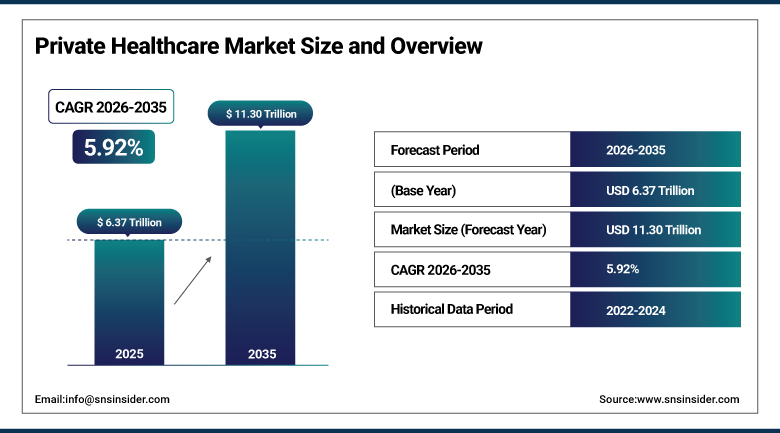
The Private Healthcare Market was valued at USD 6.37 trillion in 2026 and is expected to reach USD 11.30 trillion by 2035, growing at a CAGR of 5.92% from 2026–2035.
The private healthcare market is witnessing steady growth in the global market owing to the increasing demand for accessible and specialized healthcare services. Rising patient preference for shorter waiting times and personalized treatment options is accelerating market expansion. Growing investments in private hospitals, specialty clinics, and diagnostic centers are supporting infrastructure development. Increasing adoption of digital health technologies, telehealth platforms, and preventive care services is playing a major role in market growth. Rising healthcare expenditure, aging populations, and the growing burden of chronic diseases are further fueling the demand for private healthcare services worldwide.
As per WHO Global Health Expenditure & OECD Health at a Glance 2025, private health care sector is still one of the main sectors contributing towards health system, where 28% of health expenditures have been spent privately on an average from various countries around the world and average share of 72% has been made by public funds in OECD countries.
To Get more information Private Healthcare Market - Request Free Sample Report
Private Healthcare Market Trends:
-
Increasing adoption of telehealth platforms is transforming healthcare delivery by enabling remote consultations, improving accessibility, and reducing patient travel requirements.
-
Growing preference for faster access to specialized treatments is accelerating patient migration from public healthcare systems to private providers.
-
Rising integration of AI enabled healthcare technologies is improving personalized care, treatment efficiency, and overall patient engagement.
-
Expanding investments in private hospitals, specialty clinics, and digital infrastructure are strengthening healthcare service capabilities globally.
-
Increasing utilization of remote patient monitoring solutions is supporting continuous care management for chronic disease patients.
-
Growing demand for convenient, patient centric, and preventive healthcare services is reshaping private healthcare delivery models worldwide.
U.S. Private Healthcare Market Size Outlook:
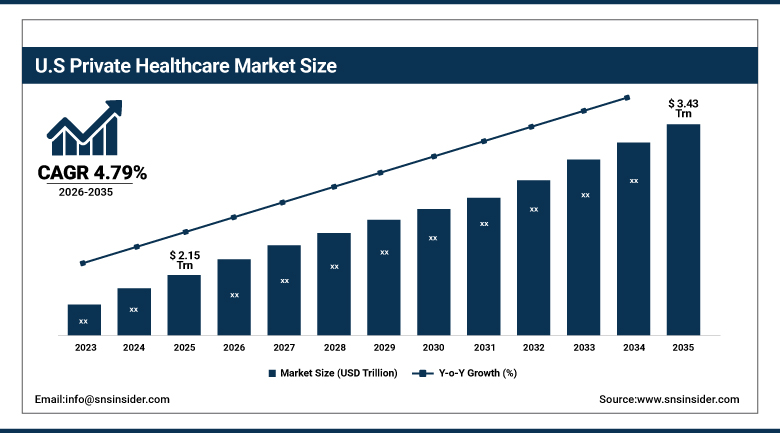
The U.S. Private Healthcare Market was valued at USD 2.15 trillion in 2025 and is expected to reach around USD 3.43 trillion by 2035, growing at a CAGR of 4.79% from 2026–2035.
The U.S. private healthcare market is growing consistently owing to increased demand for specialized healthcare services, advanced treatments, and faster patient access. The expansion of private hospitals, specialty clinics, and diagnostic centers has contributed to market growth in a consistent manner. Increased spending on healthcare infrastructure modernization and digital health adoption has generated an increase in demand for private healthcare services. Development of telehealth platforms, AI-enabled care management, and preventive healthcare programs is further driving the demand for this market.
According to the Centers for Medicare & Medicaid Services and the Centers for Disease Control and Prevention in the United States, the private healthcare sector in America still maintains dominance over healthcare access in 2025, where private health insurance constitutes 31% of healthcare expenditures and provides coverage for 65.4% of all Americans aged below 65 years old. The number of individuals covered under health insurance will stay at a high level of 92.1%, with the enrollment of private health insurance being fueled by consistent use of healthcare facilities.
Private Healthcare Market Segment Analysis:
-
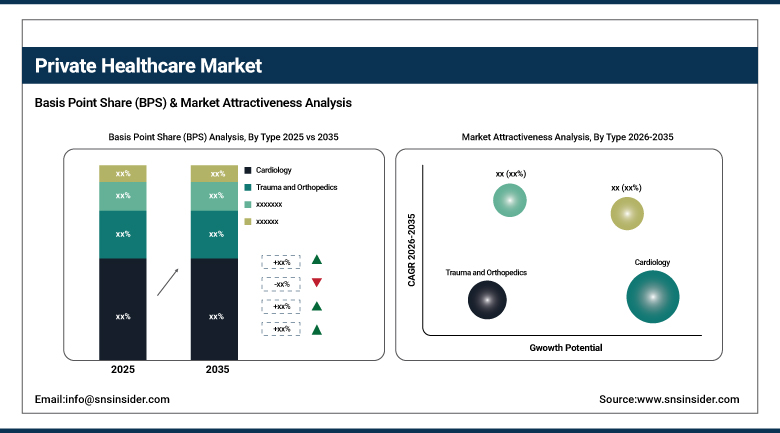
By Type, cardiology dominated the market with 23.50% share in 2025; while oncology is the fastest growing segment with CAGR of 9.30% during 2026 to 2035.
-
By Application, private acute care hospitals dominated the market with 42.80% share in 2025; while private diagnostics and imaging centers are the fastest growing segment with CAGR of 11.41% during 2026 to 2035.
-
By Service Model, outpatient services dominated the market with 38.60% share in 2025; while telehealth and remote care services are the fastest growing segment with CAGR of 15.23% during 2026 to 2035.
By Type, cardiology dominated the private healthcare market, while oncology is the fastest growing segment.
The cardiology segment led the private healthcare market based on revenue, holding the dominated market share in 2025 due to the high number of people suffering from heart problems around the globe and increasing demand for specialized cardiac procedures. The rising number of patients with heart disorders admitted in private health care has helped the segment gain strength in terms of service consumption. The adoption of new diagnostic techniques and treatments is also fueling growth in this segment.
The oncology segment is projected to witness significant growth from 2026 to 2035 at the fastest CAGR due to the rising number of cancer patients around the world and increasing awareness about the early detection of the disease. Investments in the development of cancer treatment and precision medicine are expected to support growth in the segment.
By Application, private acute care hospitals dominated the private healthcare market, while private diagnostics and imaging centers are the fastest growing segment.
The private acute care hospitals segment led the private healthcare market with the dominated share in terms of revenue in 2025. This high dominance is because such facilities can provide multispecialty treatment under one roof. They are equipped with facilities for performing complex surgeries, emergency treatments, and extended patient treatments. Increased patient interest in integrated treatment facilities and significant investments in private hospital facilities helped maintain the leading position in the global market.
The private diagnostics and imaging centers segment were expected to witness the fastest CAGR from 2026 to 2035. Rising demand for the detection of various diseases along with preventive healthcare services drives market growth. Increasing adoption of advanced imaging devices and artificial intelligence technology is aiding market growth. Patients have shown increased interest in rapid and cost-effective diagnosis services.
By Service Model, outpatient services dominated the private healthcare market, while telehealth and remote care services are the fastest growing segment.
Outpatient services emerged as the dominant category in the private healthcare market with the highest revenue contribution in 2025. The reason for this can be credited to rising patient preference towards efficient and quick treatments. Growing adoption of less invasive procedures and reduced hospital stays were some other factors aiding demand. Availability of specialist consults, diagnostics, and chronic diseases management from outpatient services was another factor reinforcing the leadership position of the category in the global market.
The telehealth & remote care services category is anticipated to witness the fastest CAGR during 2026-2035. The reasons behind this include growing adoption of digital health solutions and widespread availability of the internet. Increasing demand for convenient healthcare services and remote patient monitoring is further driving the adoption rate of telehealth services. Investments made in AI-enabled healthcare platforms have also been fueling the growth of the category.
Regional Analysis:
|
Region |
Major Country |
Share within Region, 2025(%) |
|---|---|---|
|
North America |
United States |
88.40% |
|
Europe |
Germany |
24.80% |
|
Asia Pacific |
China |
39.20% |
|
Middle East & Africa |
UAE |
18.70% |
|
Latin America |
Brazil |
46.30% |
North America Private Healthcare Market Insights.
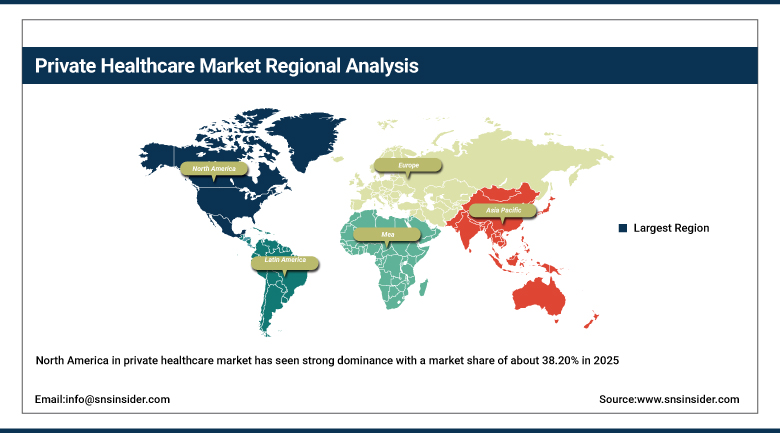
North America in private healthcare market has seen strong dominance with a market share of about 38.20% in 2025 due to advanced healthcare infrastructure and high private healthcare spending. The region benefits from strong demand for specialty care, outpatient services, and advanced diagnostic solutions. Increasing demand for personalized treatments, chronic disease management, and faster access to healthcare is driving market expansion across the United States and Canada. Rising adoption of telehealth and preventive healthcare services is further supporting market leadership. Strong investments are strengthening healthcare delivery capabilities.
According to the U.S. Centers for Disease Control and Prevention & National Health 2025, private healthcare remains dominant in North America through insurance-backed care access. In the United States, about 69% of adults aged 18–64 had private health insurance coverage in 2025, while approximately 8% of the population remained uninsured. Canada maintained universal public coverage, but around 67% of Canadians also held supplementary private health insurance for services not fully covered under provincial plans.
Get Customized Report as per Your Business Requirement - Enquiry Now
Europe Private Healthcare Market Insights.
The Europe private healthcare market shows strong presence in 2025 due to increasing demand for specialized healthcare services and growing private sector participation. Countries like Germany, France, United Kingdom, and Italy are key contributors to demand. High focus on aging population care, faster treatment accessibility, and hospital modernization is supporting steady market growth across the region. Increasing adoption of preventive care, specialty treatments, and telehealth services is further strengthening healthcare utilization. Expanding digital healthcare frameworks are driving advanced private healthcare adoption.
According to Eurostat and OECD Health at a Glance 2025, Europe’s private healthcare market is supported by strong healthcare infrastructure and ageing demographics. In 2025, the European Union had 511 hospital beds per 100,000 inhabitants, while OECD countries averaged 4.2 hospital beds per 1,000 population and a 72% acute care bed occupancy rate. Europe’s expanding private healthcare participation is further driven by increasing demand for faster access to specialist services and elective care.
Asia Pacific Private Healthcare Market Insights.
Asia Pacific is positioned to register the fastest CAGR growth in the private healthcare market during the forecast period with a market share of about 7.51% in 2025. Rapid healthcare infrastructure expansion and increasing private investments are driving strong demand across China, Japan, India, South Korea, and Southeast Asia. Expanding hospital networks, rising patient population, and growing medical tourism are significantly boosting adoption. Rising demand for affordable and specialized healthcare services is further accelerating market growth across the region. Large scale healthcare investments support strong regional demand outlook.
According to OECD Society at a Glance: Asia/Pacific 2025, health care finance in the Asia Pacific is still mixed, whereby two-thirds of health expenditure is financed through governments or obligatory insurance programs, while the rest one-third is financed privately. As observed by the OECD, on average, the health expenditure constituted 6.2% of GDP in the region, and in Bangladesh, for example, more than 75% of health expenditure is privately financed.
Middle East & Africa and Latin America Private Healthcare Market Insights.
The Middle East & Africa and Latin America region is witnessing steady growth due to rising healthcare infrastructure development and increasing private sector participation. Countries like Brazil, Mexico, UAE, Saudi Arabia, and South Africa are emerging as key demand centers. Increasing investments in hospitals, specialty clinics, and digital healthcare systems are supporting market expansion. Growing need for accessible and efficient healthcare services is further boosting adoption. Rising healthcare access and government initiatives strengthen long term demand outlook across both regions.
According to the WHO-WB on Tracking Universal Health Coverage 2025 and the WHO Private Sector, private health services continue to be a key source of health care in the Middle East, Africa, and Latin America. In the WHO Eastern Mediterranean Region, 66% of outpatient and 53% of inpatient services are provided by private for-profit providers. According to WHO, Latin America continues to experience high urbanization rates exceeding 80% in certain countries, making it possible to expand private hospitals and clinics.
Market Dynamics:
Growth Drivers: Increasing demand for faster access to specialized treatments and reduced waiting times across healthcare systems globally
Increased preferences from patients to gain quick access to consultations and specialized treatments are contributing to market growth. The long waits associated with the use of public health care systems are causing patients to move towards private health care institutions. In addition, increased demands from patients to gain personalized healthcare services are increasing the usage rates in the global healthcare industry. More capacity at private hospitals and clinics specializing in treating various diseases is becoming available as the number of patients increases. Improvements in diagnostics technologies are ensuring treatment efficiencies.
According to the OECD Health at a Glance 2025, long waiting times for specialist care continue to affect public healthcare systems, with 52% of patients across surveyed countries waiting one month or longer for specialist appointments and over 10% in Canada and the United Kingdom waiting more than a year. Additionally, 18% of people waited more than one week to see a primary care provider, reinforcing demand for private healthcare services that offer faster access to specialists and reduced treatment delays.
Restraints: Shortage of healthcare professionals and uneven healthcare infrastructure creating service delivery challenges
Scarcity of physicians, nurses, and other skilled healthcare professionals is an emerging trend. More patients mean more work pressure on staff members. Access to healthcare services remains problematic in rural and underprivileged communities. Costs of recruitment and retention of competent personnel have become important financial problems. Expansion of healthcare facilities also entails huge financial costs. Ensuring high-quality service standards in all areas can be difficult for healthcare institutions.
Opportunities: Expanding telehealth adoption and digital healthcare integration creating new service delivery models globally
The growing adoption of telehealth solutions is presenting huge growth potential for companies around the world. Consumers are becoming more inclined towards virtual doctor-patient meetings due to convenience and accessibility. The incorporation of digital healthcare technology is helping with patient engagement and continuity of treatments. AI-enabled healthcare platforms are also facilitating personalized treatment options. Health facilities have been putting considerable efforts into remote patient monitoring technologies. Better internet connectivity has been fast-tracking their reach to underdeveloped areas.
According to the World Health Organization & Global Strategy on Digital Health and OECD digital health indicators in 2025, 139 countries have adopted national digital health strategies, accelerating telehealth integration into healthcare delivery systems. The International Telecommunication Union also reports that 5.8 billion people, or 68% of the global population, were using the internet by 2024, creating a larger foundation for virtual care access.
Recent Developments:
-
2026: HCA Healthcare deployed AI staffing systems and partnered with Palantir, improving clinical workflow efficiency across hospital network operations.
-
2025: UnitedHealth Group adopted 23 action plans following an independent audit to strengthen governance and operational transparency.
-
2024: CVS Health advanced integration of Oak Street Health primary care clinics expanding value-based outpatient care delivery model.
-
2024: Apollo Hospitals Enterprise accelerated digital healthcare integration through Apollo 24|7 expansion and hospital network optimization.
Private Healthcare Market Key Players are:
-
HCA Healthcare
-
UnitedHealth Group
-
CVS Health
-
Ramsay Health Care
-
IHH Healthcare
-
Tenet Healthcare
-
Universal Health Services
-
Fresenius SE & Co. KGaA
-
Apollo Hospitals Enterprise
-
Fortis Healthcare
-
Aster DM Healthcare
-
NMC Healthcare
-
Mediclinic International
-
Spire Healthcare
-
Bupa
-
The Cigna Group
-
Sonic Healthcare
-
Healthscope
-
Netcare Limited
-
Acibadem Healthcare Group
Private Healthcare Market Report Scope:
| Report Attributes | Details |
|---|---|
| Market Size in 2025 | USD 6.37 Trillion |
| Market Size by 2035 | USD 11.30 Trillion |
| CAGR | CAGR of 5.92% From 2026 to 2035 |
| Base Year | 2025 |
| Forecast Period | 2026-2035 |
| Historical Data | 2022-2024 |
| Report Scope & Coverage | Market Size, Segments Analysis, Competitive Landscape, Regional Analysis, DROC & SWOT Analysis, Forecast Outlook |
| Key Segments | • By Type (Trauma and Orthopedics, General Surgery, Oncology, Maternity and OB-Gyn, Cardiology, Urology, Others) • By Application (Private Acute Care Hospitals, Private Patient Care Clinics, Private Specialist Services, Private Diagnostics and Imaging Centers, Private Urgent Care Centers, Others) • By Service Model (Inpatient Services, Outpatient Services, Preventive Healthcare Services, Diagnostic Services, Rehabilitation Services, Telehealth and Remote Care Services) |
| Regional Analysis/Coverage | North America (US, Canada), Europe (Germany, UK, France, Italy, Spain, Russia, Poland, Rest of Europe), Asia Pacific (China, India, Japan, South Korea, Australia, ASEAN Countries, Rest of Asia Pacific), Middle East & Africa (UAE, Saudi Arabia, Qatar, South Africa, Rest of Middle East & Africa), Latin America (Brazil, Argentina, Mexico, Colombia, Rest of Latin America). |
| Company Profiles | HCA Healthcare, UnitedHealth Group, CVS Health, Ramsay Health Care, IHH Healthcare, Tenet Healthcare, Universal Health Services, Fresenius SE & Co. KGaA, Apollo Hospitals Enterprise, Fortis Healthcare, Aster DM Healthcare, NMC Healthcare, Mediclinic International, Spire Healthcare, Bupa, The Cigna Group, Sonic Healthcare, Healthscope, Netcare Limited, Acibadem Healthcare Group |
Frequently Asked Questions
The private healthcare market is expected to grow at a CAGR of 5.92% from 2026 to 2035.
The private healthcare market was valued at USD 6.37 trillion in 2026.
Increasing demand for faster treatments, shorter waiting times, personalized healthcare services, and telehealth adoption is accelerating global private healthcare market growth.
The private acute care hospitals segment dominated in 2025 due to multispecialty treatments, emergency care, complex surgeries, and integrated services.
North America dominated the private healthcare market due to advanced infrastructure, high spending, specialized treatments, telehealth, and preventive care adoption.
