
Healthcare SaaS Market Report Scope & Overview:
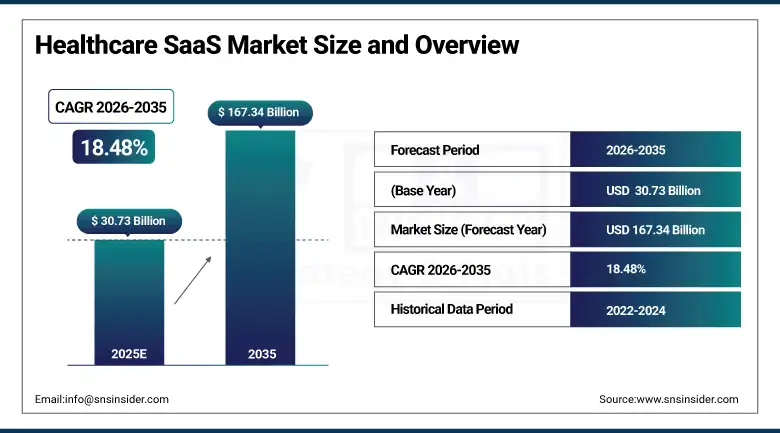
The Healthcare SaaS Market size is valued at USD 30.73 Billion in 2025 and is projected to reach USD 167.34 Billion by 2035, growing at a CAGR of 18.48% during the forecast period 2026–2035.
The Healthcare SaaS Market analysis report includes evolving cloud-based healthcare platforms, deployment environments, and software solutions. This growth will be fueled by factors such as digital healthcare transformation, the need for interoperability, the use of remote care, data management, and SaaS investments in the healthcare ecosystem, which will be seen in the period between 2026 and 2035.
Healthcare SaaS adoption exceeded 90,000 healthcare organizations in 2025, driven by growing demand for cloud-based EHR systems and telehealth platforms.
To Get more information On Healthcare SaaS Market - Request Free Sample Report
Healthcare SaaS Market Trends:
-
Rapid digital transformation across hospitals and clinics is accelerating adoption of cloud-based healthcare software platforms for scalable data management and clinical workflow optimization.
-
Increasing demand for telehealth, remote patient monitoring, and virtual care services is driving growth of SaaS-enabled healthcare communication and care coordination platforms.
-
Growing focus on interoperability, real-time patient data access, and integrated healthcare ecosystems is encouraging healthcare providers to migrate from on-premise systems to SaaS solutions.
-
Expansion of healthcare analytics, AI-driven clinical decision support, and predictive health management tools is strengthening the role of SaaS platforms in improving care outcomes.
-
Rising cybersecurity requirements and regulatory compliance standards are pushing healthcare organizations toward secure, HIPAA-compliant cloud software infrastructures.
-
Strategic partnerships between healthcare IT vendors, cloud providers, and healthcare organizations are accelerating innovation and global deployment of SaaS healthcare solutions.
U.S. Healthcare SaaS Market Insights:
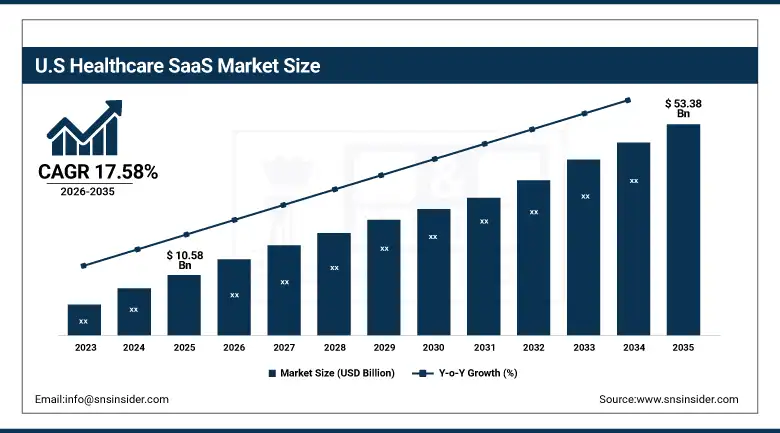
The U.S. Healthcare SaaS Market is projected to grow from USD 10.58 Billion in 2025 to USD 53.38 Billion by 2035, at a CAGR of 17.58%. Growth is driven by high adoption of cloud-based EHR solutions, growing telehealth services, increasing digitalization of the healthcare sector, and rising demand for scalable SaaS solutions related to data management and analytics and hospital operations.
Healthcare SaaS Market Growth Drivers:
-
Accelerating cloud-based digital health transformation among hospitals and clinics boosting adoption of scalable healthcare SaaS platforms.
Accelerating cloud-based digital health transformation among hospitals and clinics is a major driver of Healthcare SaaS Market growth. SaaS platforms have become a very usable, cost-effective and scalable solution to access real-time patient data in the healthcare domain. There are cloud-based solutions for electronic health records, telehealth services, billing, and healthcare analytics which is enhancing the efficiency of healthcare organizations. The growing number of digitalization initiatives, need for interoperability among healthcare systems, and increasing remote healthcare services are also the factors that support long term adoption of healthcare SaaS platforms.
Cloud-based healthcare SaaS platforms managed over 1.6 billion patient records in 2025, reflecting rapid digital health transformation across hospitals and clinics.
Healthcare SaaS Market Restraints:
-
Stringent healthcare data privacy regulations and cybersecurity risks are slowing cloud-based SaaS adoption across healthcare organizations.
Stringent healthcare data privacy regulations and rising cybersecurity risks remain significant restraints for Healthcare SaaS Market growth. Healthcare organizations deal with highly confidential data and hence complying with data protection regulations such as HIPAA, GDPR, and regional data protection regulations is challenging and costly. Data breach, unauthorized access, and security risks associated with cloud computing have made many hospitals and healthcare centres’ apprehensive about adopting SaaS solutions. The requirement to keep updating security features, conducting compliance audits, and deploying cyber security solutions has made it costly and challenging to adopt SaaS solutions on a large scale.
Healthcare SaaS Market Opportunities:
-
Expansion of AI-powered healthcare analytics and predictive care platforms creating new growth opportunities for SaaS providers.
Expansion of AI-powered healthcare analytics and predictive care platforms presents significant opportunities for the Healthcare SaaS Market. Currently, more and more healthcare providers are looking for high-scale SaaS solutions that can process massive amounts of data to ultimately improve both decision-making & patient outcomes. AI technology can facilitate predictive diagnostics, population- and optimize treatments for health. Need for data-driven healthcare models will continue to rise, and cutting-edge SaaS solutions can be a blessing for the hospitals and the healthcare industry.
Over 40% of large healthcare providers deployed AI-enabled SaaS analytics platforms in 2025 to improve predictive care and clinical decision-making.
Healthcare SaaS Market Segmentation Analysis:
-
By Deployment Model, Public Cloud held the largest market share of 52.64% in 2025, while Hybrid Cloud is expected to grow at the fastest CAGR of 21.37% during 2026–2035.
-
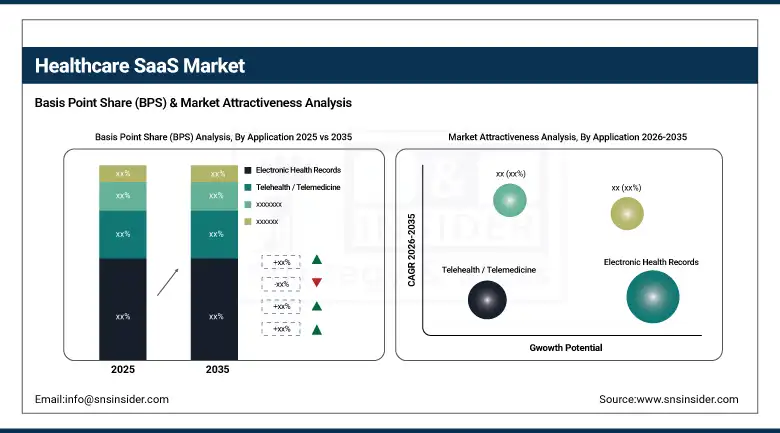
By Application, Electronic Health Records (EHR) accounted for the highest market share of 29.48% in 2025, whereas Healthcare Analytics is projected to register the fastest CAGR of 23.16% through 2026–2035.
-
By End User, Healthcare Providers captured the largest share of 71.53% in 2025, while Healthcare Payers are anticipated to grow at the fastest CAGR of 20.42% during the forecast period.
-
By Solution Type, Clinical Solutions dominated with a 36.27% market share in 2025, whereas Operational & Management Solutions are expected to expand at the fastest CAGR of 22.58% through 2026–2035.
By Deployment Model, Public Cloud Dominate While Hybrid Cloud Is Fastest Growing:
Public Cloud segment dominated the market due to its scalability, cost efficiency and ease of deployment within healthcare facilities. Hospitals and clinics use public cloud services such as EHRs, telemedicine services, and patient data management. Public cloud-based Saas platforms are used to deliver care by over 54,000 healthcare organizations in 2025..
Hybrid Cloud is the fastest growing segment, as it gives the best of flexible architecture and 21,000 healthcare facilities are adopting a hybrid setup requiring control over data. The healthcare sector also needs hybrid architecture for data security, interoperability and scalability in digital health service delivery.
By Application, Electronic Health Records (EHR) Dominate While Healthcare Analytics Is Fastest Growing:
Electronic Health Records (EHR) segment dominated the market owing to consolidation of patient information around healthcare providers. EHR solutions enable hospitals to handle clinical documentation and patient history along with coordinating care. SaaS-based EHR solutions manage over 1.2 billion patient records in 2025.
Healthcare Analytics is the fastest growing segment, with predictive insights enabling population health and data-driven decisions driving the segment. Around 420 million data sets are processed by healthcare analytics solutions yearly, which is fuelling segment growth due to the demand for AI-based clinical forecasting solutions.
By End User, Healthcare Providers Dominate While Healthcare Payers Are Fastest Growing:
Healthcare Providers dominated the market since hospitals, clinics and diagnostic centers are adopting SaaS technology more for managing patients, telemedicine services and operational needs. The healthcare providers need the software to deal with increasing volumes of clinical data and patient interactions for managing. Over 78,000 healthcare provider organizations were on SaaS healthcare solutions in 2025.
Healthcare Payers is the fastest-growing segment, owing to the increased use of SaaS technology for claims management, risk assessment and insurance analytics supporting over 620 million insurance policy records. Health insurance payers are demanding SaaS owing to the digital claim processing.
By Solution Type, Clinical Solutions Dominate While Operational & Management Solutions Are Fastest Growing:
Clinical Solutions segment dominated the market as hospitals are looking to adopt solutions that can help them in diagnosis, treatment planning and monitoring. The clinical solutions based on SaaS provide a real-time status of the patients which health professionals offer quality treatment. About 680 million clinical workflows are handled using SaaS clinical solutions in 2025.
Operational & Management Solutions are the fastest growing segment powered by a necessity for automated scheduling, workforce management, and optimization of hospital resources. This division serves basic systems in more than 36,000 healthcare facilities. SaaS adoption is fueled by the demand for efficient hospital operations.
Healthcare SaaS Market Regional Analysis:
North America Healthcare SaaS Market Insights:
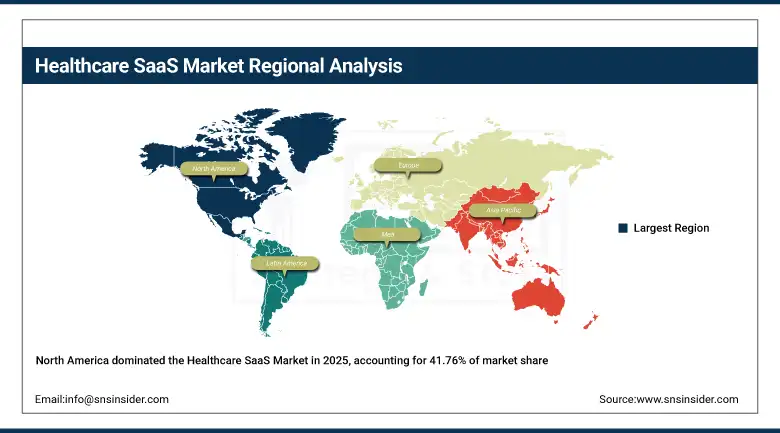
The North America Healthcare SaaS Market is dominant, holding a 41.76% share in 2025, along with a solid healthcare IT backbone, early adoption of cloud technologies and extensive use of digital health platforms across hospitals and clinics. This growth is driven by increasing investments in electronic health records, telehealth solutions and healthcare analytics within the region. Tight data compliance regulations also aid in bolstering the demand for SaaS adoption in region along with an ample number of marquee healthcare technology players.
Get Customized Report as per Your Business Requirement - Enquiry Now
U.S. Healthcare SaaS Market Insights:
The U.S. Healthcare SaaS Market is fuelled by advanced healthcare IT infrastructure, robust cloud computing adoption, and surging demand for digital patient management solutions. Expanding telehealth services, high EHR adoption rates, and increasing investments in healthcare analytics and AI-based solutions are bolstering the U.S. as the largest market in North America for healthcare SaaS solutions.
Asia-Pacific Healthcare SaaS Market Insights:
The Asia-Pacific Healthcare SaaS Market is the fastest-growing region, projected to expand at a CAGR of 21.29% during 2026–2035. It is also supported by rapid digitalization in the healthcare sector, a growing number of hospitals, and adoption of cloud-based health solutions in China, India, Japan, and Southeast Asia. Investment in telemedicine, electronic health records and other healthcare analytics is further fueling growth in SaaS solutions. Continued government efforts in digital health combined with increased development of private healthcare facilities are maintaining high growth rates across the Asia-Pacific.
China Healthcare SaaS Market Insights:
The China Healthcare SaaS Market is driven by digitalization in healthcare services, increasing hospital networks, and government initiatives in smart healthcare services. The adoption of cloud-based electronic health records, telemedicine services, and healthcare analytics is driving SaaS services. Increasing investments in healthcare IT infrastructure and digital hospitals are keeping China at the forefront of SaaS services in the Asian Pacific.
Europe Healthcare SaaS Market Insights:
The Europe Healthcare SaaS Market is fuelled by robust healthcare digitization, data protection legislation, and advanced healthcare infrastructure in countries such as Germany, France, and the UK. Cloud-based electronic health records, telemedicine, and healthcare analytics services are boosting the implementation of SaaS solutions. Growing investments in digital hospital systems, interoperability solutions, and patient data management solutions are further fuelling regional market growth. Ongoing healthcare IT system upgrades and telemedicine services are driving market growth in Europe.
Germany Healthcare SaaS Market Insights:
Germany Healthcare SaaS Market is a major hub in Europe driven by strong health care infrastructure and accelerated development of digital health. The growth of demand for SaaS solutions linked to cloud-based EHR solutions, telemedicine and healthcare analytic solutions. With government support, the Healthcare SaaS market in the region is also driven by digital health initiatives and investments in hospital IT infrastructure.
Latin America Healthcare SaaS Market Insights:
The Latin America Healthcare SaaS Market is growing due to the rising adoption of cloud-based healthcare platforms and increasing hospital networks in Brazil, Mexico, and Argentina. This has been contributing to the adoption of SaaS solutions for electronic health records, telehealth services, and healthcare analytics. Increasing need for digital patient management and interoperable healthcare platforms are supporting the region market growth.
Middle East and Africa Healthcare SaaS Market Insights:
The Middle East & Africa Healthcare SaaS Market is expanding due to the growing trend of digitalization of hospitals, clinics, and healthcare facilities in Saudi Arabia, UAE, and South Africa. Increasing demand for cloud-based EHR, telemedicine, and healthcare analytics solutions combined with significant spending on hospital IT infrastructure and patient data management will spur the growth of the SaaS market in these countries.
Healthcare SaaS Market Competitive Landscape:
Epic Systems is a prominent leader in healthcare IT and SaaS company, particularly noted for its EHR solutions integrated into the workflow of leading healthcare institutions including but not limited to hospitals/health systems. The company provides integrated approaches to revenue, administrative and clinical operations, while solutions for patients (e.g., MyChart) support greater engagement. Its leading market position is due to scalable, interlinked systems that provide real-time visibility of data and analytics, enabling health care facilities to operate smoothly while delivering better patient experience and adhering to regulations.
-
In January 2025, Epic launched Epic Connect+ Insights, a SaaS analytics module with predictive care, population health dashboards, and real‑time clinical trend tracking, improving interoperability, patient engagement, and care coordination across hospitals and health networks.
Oracle is also a major player in the healthcare SaaS and EHR (electronic health record software) space, serving hospitals and healthcare systems around the globe following its acquisition of acclaimed EHR provider Cerner. Cerner’s Millennium EHR solution helps healthcare systems improve data-driven decisions for their clinical, financial, and operational activities. Oracle, in its quest to solidify its presence in the market, is upgrading Cerner’s solutions to cloud-native infrastructure, artificial intelligence, and data analytics. This helps healthcare systems improve their operations, care delivery, and outcomes.
-
In February 2025, Oracle Health introduced Cerner CloudSuite+, a cloud‑native EHR platform with AI‑driven clinical support, predictive alerts, workflow automation, and enhanced telehealth integration, helping hospitals optimize operations and scale secure SaaS deployments.
Microsoft is a major contributor to the healthcare SaaS industry, and this is due to their cloud and AI-based solutions, specifically Microsoft Cloud for Healthcare. This solution is based on Microsoft Azure, Teams, and Dynamics 365 and helps in patient data management, telehealth solutions, automation, and analytics. Microsoft has already made a significant impact on the healthcare industry as it has enabled hospitals and clinics to modernize their IT infrastructure, and this has made it a major contributor to the healthcare SaaS industry.
-
In March 2025, Microsoft released Azure Health AI Studio, a SaaS platform for AI‑powered healthcare apps, featuring pre‑built healthcare APIs, FHIR connectors, and low‑code development tools to accelerate compliant digital health application delivery.
Healthcare SaaS Market Key Players:
-
Epic Systems
-
Oracle (Cerner)
-
Microsoft
-
Salesforce
-
Athenahealth
-
Allscripts
-
Veeva Systems
-
eClinicalWorks
-
NextGen Healthcare
-
Greenway Health
-
Meditech
-
IBM
-
Optum
-
Change Healthcare
-
SAP
-
ScienceSoft
-
ServiceNow
-
Suki AI
-
CitiusTech
-
WELL Health Technologies
| Report Attributes | Details |
|---|---|
| Market Size in 2025 | USD 30.73 Billion |
| Market Size by 2035 | USD 167.34 Billion |
| CAGR | CAGR of 18.48% From 2026 to 2035 |
| Base Year | 2025 |
| Forecast Period | 2026-2035 |
| Historical Data | 2022-2024 |
| Report Scope & Coverage | Market Size, Segments Analysis, Competitive Landscape, Regional Analysis, DROC & SWOT Analysis, Forecast Outlook |
| Key Segments | • By Deployment Model (Public Cloud, Private Cloud, Hybrid Cloud) • By Application (Electronic Health Records (EHR), Telehealth / Telemedicine, Patient Portal, e-Prescribing, Revenue Cycle Management, Practice Management, Healthcare Analytics, Others) • By End User (Healthcare Providers, Healthcare Payers) • By Solution Type (Clinical Solutions, Administrative Solutions, Financial Solutions, Operational & Management Solutions) |
| Regional Analysis/Coverage | North America (US, Canada), Europe (Germany, UK, France, Italy, Spain, Russia, Poland, Rest of Europe), Asia Pacific (China, India, Japan, South Korea, Australia, ASEAN Countries, Rest of Asia Pacific), Middle East & Africa (UAE, Saudi Arabia, Qatar, South Africa, Rest of Middle East & Africa), Latin America (Brazil, Argentina, Mexico, Colombia, Rest of Latin America). |
| Company Profiles | Epic Systems, Oracle (Cerner), Microsoft, Salesforce, Athenahealth, Allscripts, Veeva Systems, eClinicalWorks, NextGen Healthcare, Greenway Health, Meditech, IBM, Optum, Change Healthcare, SAP, ScienceSoft, ServiceNow, Suki AI, CitiusTech, WELL Health Technologies |
Frequently Asked Questions
The Healthcare SaaS Market is expected to grow at a CAGR of 18.48% during 2026–2035.
The market is valued at USD 30.73 Billion in 2025 and is projected to reach USD 167.34 Billion by 2035.
Growth is driven by cloud-based digital health adoption, telehealth, EHR expansion, AI analytics, and secure scalable SaaS investments.
Public Cloud dominated with a 52.64% market share in 2025, while Hybrid Cloud is projected to grow at the fastest CAGR of 21.37% during 2026–2035.
North America dominated with a 41.76% share in 2025, while Asia-Pacific is the fastest-growing region, expected to expand at a CAGR of 21.29% during 2026–2035.
