
Quantum Computing In Drug Discovery Market Report Scope & Overview:
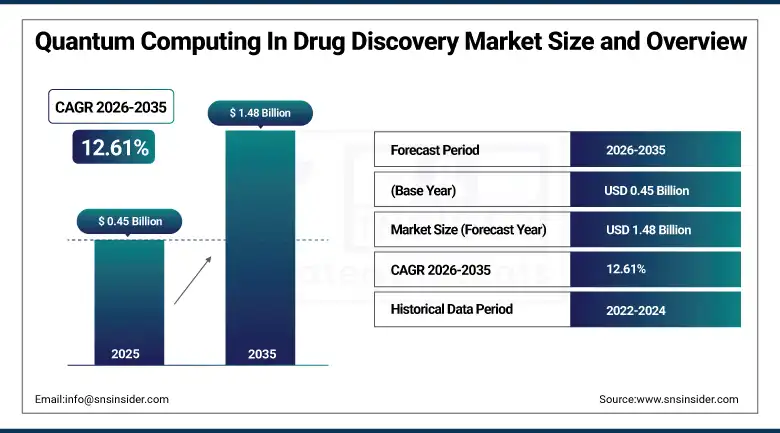
The Quantum Computing In Drug Discovery Market was valued at USD 0.45 Billion in 2025 and is projected to reach USD 1.48 Billion by 2035, expanding at a CAGR of 12.61% during the forecast period 2026–2035.
The quantum computing in drug discovery market is gaining traction and establishing itself as one of the most disruptive segments in the computational life sciences market, owing to rising investments in next generation computing platforms, complexity of molecular modeling processes, and rising need for speeding up the pharmaceutical innovations. Pharma companies, biotech companies, research organizations, and quantum computing solution providers have been actively pursuing quantum computing solutions for drug discovery that will help them solve molecular simulations issues which cannot be tackled by the existing computing platforms. The integration of quantum computing, artificial intelligence, computational chemistry, and biological modeling has enabled scientists to analyze molecular interactions more accurately without compromising on computation constraints of the existing discovery processes.
Some of the pharma companies and quantum computing companies extended their strategic collaborations in the year 2025-2026 for quantum chemistry simulation, optimization of drug candidates, protein interaction modeling, and quantum drug discovery applications using AI.
To Get more information On Quantum Computing In Drug Discovery Market - Request Free Sample Report
Quantum Computing In Drug Discovery Market Trends
-
Increasing deployment of hybrid quantum-classical drug discovery platforms.
-
Rising adoption of quantum-enabled molecular simulation and quantum chemistry applications.
-
Growing commercialization of Quantum-as-a-Service (QaaS) platforms for pharmaceutical research.
-
Expansion of cloud-based quantum computing infrastructure supporting life science workloads.
-
Increasing integration of artificial intelligence and quantum algorithms for molecular optimization and drug candidate identification.
The U.S. Quantum Computing In Drug Discovery Market Size Outlook
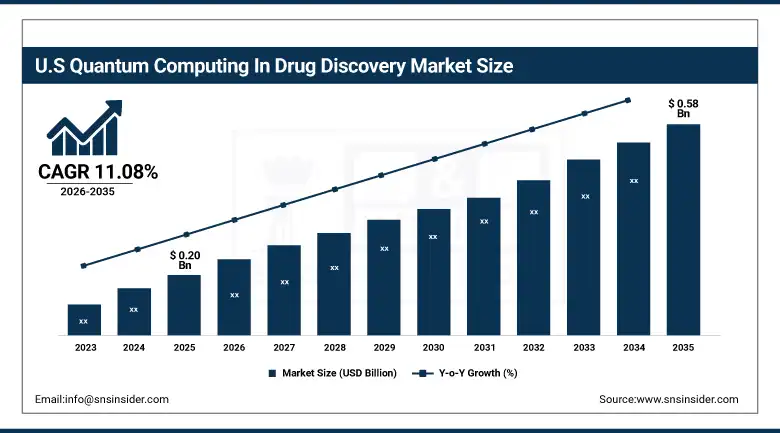
The U.S. Quantum Computing In Drug Discovery Market was valued at USD 0.20 billion in 2025 and is expected to reach approximately USD 0.58 billion by 2035, expanding at a CAGR of 11.08% during 2026–2035.
The U.S. remains the dominant player within the international quantum computing for drug discovery domain because of the presence of top pharmaceutical companies, quantum computing companies, cloud computing vendors, biotechnology companies, and federally funded research organizations. Various companies based within the U.S. have been making increased efforts towards investing in quantum chemistry software suites, quantum simulators, molecular design tools, and computational biology infrastructure for the purpose of advancing drug discovery operations. Favorable business conditions have emerged owing to the availability of venture capital funding, university-industry cooperation, and ongoing governmental investments in quantum technologies.
Several pharmaceutical and quantum technology companies based in the U.S. entered into quantum drug discovery partnerships in 2026 with a focus on accelerated molecular simulation, predictive bimolecular modeling, and cloud-enabled quantum computing platforms for advanced pharmaceutical research and development operations.
Quantum Computing In Drug Discovery Market Segment Analysis
-
By Technology, quantum software platforms dominated the market with 26.00% share in 2025, and are projected to witness the fastest growth with 14.74% CAGR during the forecast period.
-
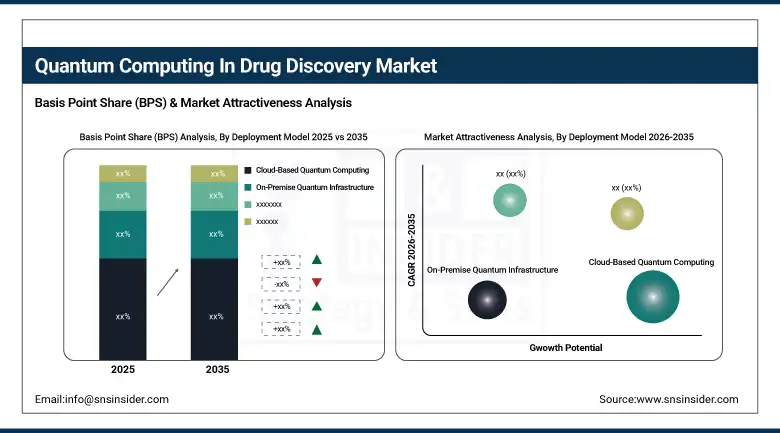
By Deployment Model, cloud-based quantum computing dominated the market with 48.00% share in 2025, and is projected to witness the fastest growth with 14.36% CAGR during the forecast period.
-
By Application, molecular simulation & quantum chemistry dominated the market with 29.00% share in 2025, while target identification & validation is projected to witness the fastest growth with 13.36% CAGR during the forecast period.
-
By End User, pharmaceutical companies dominated the market with 34.00% share in 2025, and are projected to witness the fastest growth with 13.09% CAGR during the forecast period.
By Technology, quantum software platforms dominated and also represent the fastest-growing segment.
Quantum Software Platforms captured the highest market share of 26.00% in 2025 due to the high demand for quantum software platforms, molecular simulation software, quantum chemistry software, and workflow integration software for pharmaceutical companies. The increase in the demand for quantum software that allows scientists to access quantum computing hardware, develop algorithms for drug discovery, and AI-enabled molecular modeling software can be witnessed from both pharmaceutical companies and biotechnology companies. The rising commercialization of cloud-enabled quantum development platforms, quantum chemistry libraries, and pharmaceutical research tool chains is expected to drive adoption among life science organizations.
Furthermore, the quantum software platforms will witness the highest CAGR of 14.74% over the forecast period of 2026–2035 owing to rapid developments in the field of quantum algorithm creation, increasing availability of quantum cloud resources, and rising experimentation in the pharmaceuticals industry involving quantum-based molecular designing techniques. Quantum technology players continue to upgrade their software platforms that make it easy to build quantum applications, conduct optimized molecular simulations, and carry out hybrid quantum-classical researches. In the year 2025-2026, various quantum technology players released updated versions of their software platforms incorporating AI optimization, quantum chemistry modeling, and cloud-based collaboration features targeted at pharmaceutical and biotechnology players.
By Deployment Model, cloud-based quantum computing dominated and is the fastest-growing deployment model.
The cloud-based quantum computing segment accounted for the largest market share of 48.00% in 2025 due to the increased preference of scalability and flexible access to quantum solutions in pharmaceutical firms without having to invest in costly quantum infrastructure. With cloud deployment, researchers are able to conduct quantum experiments, conduct molecular simulations, and even have quantum development environments through collaborations in geographically dispersed R&D networks. Availability of enterprise-level quantum cloud platforms, cloud AI services, and pharmaceutical research toolkits has spurred adoption within the drug discovery space.
On the other hand, the cloud-based quantum computing segment is projected to account for the highest CAGR of 14.36% in the forecast period as a result of growth in commercialization of Quantum as a Service solutions, improvement in cloud security frameworks, and increase in partnerships between quantum cloud providers and pharmaceutical firms. With cloud-based quantum computing systems, companies are evaluating quantum chemistry applications and optimizing bimolecular simulations in order to conduct drug discovery research at low costs. In 2026, cloud technology providers launched quantum computing solutions designed specifically for pharmaceutical modeling and molecular optimization.
By Application, molecular simulation & quantum chemistry dominated, while target identification & validation is the fastest-growing application.
In 2025, the molecular simulation and quantum chemistry segment had the highest market share of 29.00% due to the ability of quantum computing devices to carry out molecular simulations and chemical property analysis more precisely than traditional computer systems. Quantum chemistry applications are gaining popularity amongst pharmaceutical researchers in improving compound screening and analysis, reaction modeling and simulation, molecule behavior prediction, and drug-target interaction studies. The rising complexity of molecules used in developing new drugs along with the increased precision requirement in simulation would support continued adoption of quantum computing-based molecular modeling technologies.
The target identification & validation category would witness highest CAGR of 13.36% during 2026-2035 as more organizations are integrating quantum computing, artificial intelligence analytics, genomic tools, and biomarker discovery platforms into the early phase drug development process. Researchers are experimenting with quantum-enabled approaches to discover novel therapeutic targets, complex biological network analysis, and disease mechanisms study. The rise in demand for precision medicine and personalized therapeutic approach would create further growth opportunities in this category. During 2025-2026, there have been several research projects undertaken to combine quantum computing algorithms with biological data analysis for discovering and validating drug targets.
Regional Analysis
|
Region |
Major Country |
Share within Region, 2025 (%) |
|---|---|---|
|
North America |
United States |
95.00% |
|
Europe |
Germany |
29.00% |
|
Asia Pacific |
China |
18.00% |
|
Middle East & Africa |
UAE |
3.00% |
|
Latin America |
Brazil |
3.00% |
North America Quantum Computing In Drug Discovery Market Insights
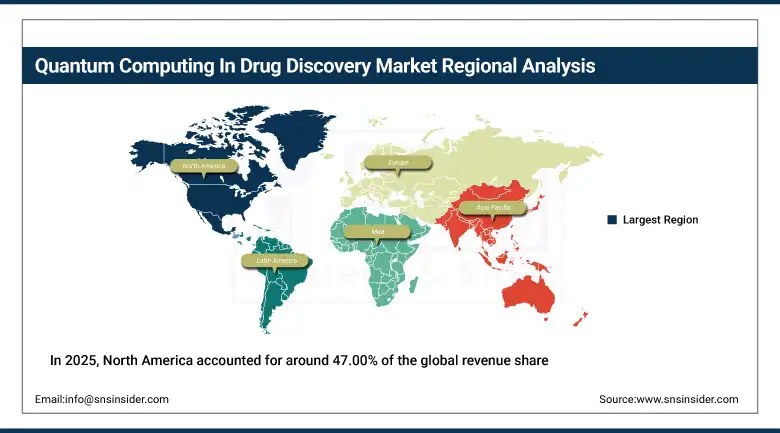
In 2025, North America accounted for around 47.00% of the global revenue share in the Quantum Computing In Drug Discovery Market, which makes it the largest regional market. It holds the advantage of being home to the presence of leading quantum computing hardware vendors, cloud service providers, pharmaceuticals, biotechnology firms, and government initiative for quantum computing. Many pharmaceutical firms in the US and Canada have shown interest in quantum computing for the purpose of molecular simulation, drug-target interaction, and quantum chemistry. The region witnesses substantial venture capital investments, innovation ecosystems, and collaboration between technology firms and life science firms, making it the leading region for the commercial deployment of quantum computing platforms in pharmaceuticals.
It should be noted that during the years 2025 and 2026, a number of North American companies in the field of quantum computing technologies have collaborated with pharmaceutical companies to accelerate hybrid quantum-classical algorithms for molecular modeling and bi-molecular studies.
Get Customized Report as per Your Business Requirement - Enquiry Now
Europe Quantum Computing In Drug Discovery Market Insights
The continent is supported by enhanced investments in quantum advancements, pharmaceutical R&D advancement, and enhanced use of drug discovery computational tools in Germany, the United Kingdom, France, Switzerland, and the Netherlands. Various research centers and pharmaceutical organizations in the region have been studying the potential of quantum computing in applications such as molecular modeling, quantum chemistry simulation, and precision medicine research. Quantum technology programs sponsored by the government and collaboration between academia and industry have been playing a significant role in the expansion of the market as well as developing unique applications of quantum computing for life sciences.
Between 2025 and 2026, some European pharmaceutical firms increased their pilot projects that included quantum computing platforms combined with AI molecular design and computation chemistry systems.
Asia Pacific Quantum Computing In Drug Discovery Market Insights
The region of Asia Pacific is expected to exhibit the highest CAGR of 17.27% during the forecast period, driven by rising investments in quantum technology infrastructure, rising expenditures on R&D in pharmaceuticals, and rising government investment in advanced computing research in China, Japan, South Korea, India, and Singapore. The organizations from the region are adopting quantum computing, computational biology, and AI-driven molecular research solutions to enhance their competitiveness in global pharmaceutical innovation market. The rise in biotech ecosystem, increase in precision medicine activities, and collaborations between the technology vendors and the pharmaceutical companies are also propelling the growth prospects in the region.
Several research institutes and biotechnology companies in the Asia Pacific region have expanded their usage of quantum technology-enabled molecular simulation solutions, which are supported by artificial intelligence and drug discovery analytics in 2026.
Middle East & Africa and Latin America Quantum Computing In Drug Discovery Market Insights
The Middle East & Africa market is slowly becoming a growing market due to increased investments into advanced research facilities, digital transformation of healthcare, and development of quantum technology initiatives in UAE, Saudi Arabia, and South Africa. There have been investments into research computations, scientific clouds, and innovations ecosystems fostering adoption of advanced technologies for pharmaceutical discovery. The market offers long-term prospects for quantum technology vendors interested in the use of quantum technologies in life science research.
Latin America was the representative for increased investments in pharmaceutical research, growth of biotechnology activities, and provision of cloud-based computational research tools in Brazil, Mexico, Argentina, and Chile. Companies from the region were actively using advanced simulation technologies and AI-driven research systems to enhance drug development capabilities. Increased interests in the adoption of next-generation technologies for healthcare innovations are expected to facilitate adoption of quantum research platforms in the coming decade. During 2025-2026 years, several research organizations from both markets increased collaboration with global cloud computing companies to gain access to advanced research environments including computational and quantum environments used for pharmaceutical innovations programs.
Market Dynamics
Growth Drivers: Increased demand for advancement of molecular simulations & speeding up of therapeutic discoveries.
The complexity in today’s drug development projects is creating a huge demand for computational technology which can help in making advancements in molecular modeling as well as speeding up of therapeutic discoveries. Conventional methods of computation are often unable to simulate the complex behavior of molecules, proteins and even quantum mechanical behavior of drugs in terms of drug development process. The solution to all such problems can be found through quantum computing that will make it possible to perform complex molecular simulations and advanced quantum chemistry computations.
The investment of pharmaceutical companies in quantum research projects will help in faster discovery, improved candidate selection and innovative therapeutic development processes. The integration of artificial intelligence, quantum computing and computational biology is making it easier to fulfill the commercial demands in pharmaceutical research settings. From 2025 to 2026, there have been several pharmaceutical companies investing heavily in quantum assisted molecular simulations platforms.
Restraints: Immature quantum hardware and high commercialization costs.
Though there is high potential for growth in the future, the commercialization of quantum computing in drug discovery still has some obstacles due to hardware limitations, scalability challenges, algorithm development complexities, and high costs. The current quantum computers are still prone to error rates, hardware stability issues, and processing problems that will hinder their deployment for pharmaceutical research purposes.
Moreover, heavy investments have been made in order to create the right quantum-friendly infrastructure, software ecosystem, and talented people to enable quantum computing projects. All these factors are hindering adoption, especially by smaller biotech companies and universities that have limited budget for conducting research. The stakeholders in 2026 year concentrated on quantum error correction and hardware stability as well as hybrid quantum-classical computing architectures in order to overcome these challenges.
Opportunities: Growth in hybrid quantum-classical computing architecture & quantum-as-a-service platforms.
Fast-growing hybrid quantum-classical computing architectures and Quantum-as-a-Service platforms on cloud computing represent long-term market opportunities for stakeholders. Hybrid models allow pharmaceutical enterprises to integrate traditional high-performance computing facilities with cutting-edge quantum computing technologies, thus increasing accessibility and lowering infrastructure investments. Cloud quantum computing platforms have made it possible for scientists to test quantum algorithms, simulations of molecules, and computational chemistry applications without having any proprietary quantum hardware at hand.
With further evolution of quantum computing ecosystems, growing availability of scalable QaaS will promote the widespread adoption of quantum computing by pharmaceuticals, biotech organizations, and research institutions. In 2025-2026, a number of leading players in the quantum technology market added cloud-based quantum services that were tailored to pharmaceutical research, molecular simulation, biomolecular modeling, and computational drug discovery applications.
Recent Developments
-
2026: IBM Quantum expanded collaborations with pharmaceutical and life science organizations to advance quantum chemistry simulations, molecular interaction modeling, and hybrid quantum-classical drug discovery workflows through cloud-accessible quantum computing infrastructure.
-
2026: Google Quantum AI continued enhancing quantum algorithm capabilities focused on molecular simulation, optimization problems, and computational chemistry applications supporting future pharmaceutical research initiatives.
-
2025: Quantinuum strengthened partnerships with biotechnology and pharmaceutical companies to evaluate quantum computing applications in molecular modeling, protein interaction analysis, and therapeutic discovery acceleration.
-
2025: IonQ, Inc. expanded enterprise quantum computing access through cloud platforms, enabling pharmaceutical researchers to explore quantum-enabled molecular simulation and computational drug discovery applications.
Quantum Computing In Drug Discovery Market Key Players are:
-
IBM Corporation
-
Google LLC (Quantum AI)
-
Microsoft Corporation
-
Amazon Web Services, Inc.
-
D-Wave Quantum Inc.
-
IonQ, Inc.
-
Rigetti Computing, Inc.
-
Quantinuum Ltd.
-
Pasqal SAS
-
Xanadu Quantum Technologies Inc.
-
Zapata AI, Inc.
-
QC Ware Corp.
-
Classiq Technologies Ltd.
-
QunaSys Inc.
-
ProteinQure Inc.
-
Menten AI, Inc.
-
Polaris Quantum Biotech LLC
-
C12 Quantum Electronics GmbH
-
Riverlane Ltd.
-
Oxford Quantum Circuits Ltd.
Quantum Computing In Drug Discovery Market Report Scope:
| Report Attributes | Details |
|---|---|
| Market Size in 2025 | USD 0.45 Billion |
| Market Size by 2035 | USD 1.48 Billion |
| CAGR | CAGR of12.61% From 2026 to 2035 |
| Base Year | 2025 |
| Forecast Period | 2026-2035 |
| Historical Data | 2022-2024 |
| Report Scope & Coverage | Market Size, Segments Analysis, Competitive Landscape, Regional Analysis, DROC & SWOT Analysis, Forecast Outlook |
| Key Segments | • By Technology (Quantum Hardware Platforms, Quantum Software Platforms, Quantum Algorithms, Hybrid Quantum-Classical Computing, Quantum Cloud Services) • By Deployment Model (Cloud-Based Quantum Computing, On-Premise Quantum Infrastructure, Hybrid Quantum-Classical Platforms, Quantum-as-a-Service (QaaS)) • By Application (Target Identification & Validation, Molecular Simulation & Quantum Chemistry, Lead Discovery & Optimization, Protein Folding & Biomolecular Modeling, ADMET Prediction) • By End User (Pharmaceutical Companies, Biotechnology Companies, Contract Research Organizations (CROs), Academic & Research Institutions, Others) |
| Regional Analysis/Coverage | North America (US, Canada), Europe (Germany, UK, France, Italy, Spain, Russia, Poland, Rest of Europe), Asia Pacific (China, India, Japan, South Korea, Australia, ASEAN Countries, Rest of Asia Pacific), Middle East & Africa (UAE, Saudi Arabia, Qatar, South Africa, Rest of Middle East & Africa), Latin America (Brazil, Argentina, Mexico, Colombia, Rest of Latin America). |
| Company Profiles | IBM Corporation, Google LLC, Microsoft Corporation, Amazon Web Services, Inc., D-Wave Quantum Inc., IonQ, Inc., Rigetti Computing, Inc., Quantinuum Ltd., Pasqal SAS, Xanadu Quantum Technologies Inc., Zapata AI, Inc., QC Ware Corp., Classiq Technologies Ltd., QunaSys Inc., ProteinQure Inc., Menten AI, Inc., Polaris Quantum Biotech LLC, C12 Quantum Electronics GmbH, Riverlane Ltd., Oxford Quantum Circuits Ltd. |
Frequently Asked Questions
North America dominated the global market in 2025 with approximately 47.00% revenue share.
Asia Pacific is projected to register the fastest CAGR of 17.27% during 2026–2035.
The market is expected to expand at a CAGR of 12.61% during the forecast period.
The market is projected to reach USD 1.47 Billion by 2035.
The Quantum Computing In Drug Discovery Market was valued at USD 0.45 Billion in 2025.
