
Reed Sensor Market Report Scope & Overview:
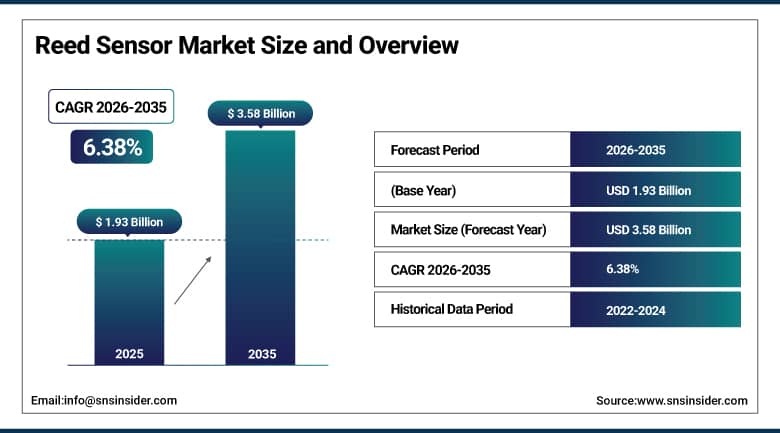
The Reed Sensor Market was valued at USD 1.93 Billion in 2025 and is expected to reach USD 3.58 Billion by 2035, growing at a CAGR of 6.38% from 2026-2035.
The Reed Sensor Market covers magnetically actuated sensing devices built around a reed switch, a pair of ferromagnetic contacts sealed in a glass capsule that close or open when a magnet or coil field approaches. The category includes bare reed switches, reed relays and packaged sensors with housings, cables or electronics. Because the contacts are hermetically sealed, they offer very low leakage, high isolation and no standby power draw, which suits position sensing, level detection, security contacts and metering. Automotive, industrial automation, consumer devices and medical equipment are the main buyers. Competition from Hall-effect and magnetoresistive chips limits some sockets, yet harsh-environment and high-voltage uses keep reed technology steadily relevant through 2035.
⮞In May 2025, Allegro MicroSystems stated in its annual report filed that it ships about 1.5 billion units a year to more than 10,000 customers, indicating the scale of the magnetic sensing field in which reed products compete and cooperate.
To Get More Information On Reed Sensor Market - Request Free Sample Report
Reed Sensor Market Trends
-
Hermetic high-voltage reed relays are being specified in electric vehicle battery systems, charging equipment and semiconductor test cards.
-
Latching and bistable reed designs are spreading into battery-powered smart meters and wireless sensor nodes that must sleep for years.
-
Surface mount reed switches and relays with overmolded bodies are replacing leaded parts on automated assembly lines.
-
Packaged reed sensors with cables, connectors and integrated electronics are moving suppliers from bare components toward finished sensing modules.
-
Hall-effect and magnetoresistive chips are being marketed as direct replacements, pushing reed makers to stress zero standby current and high isolation.
U.S. Reed Sensor Market Outlook
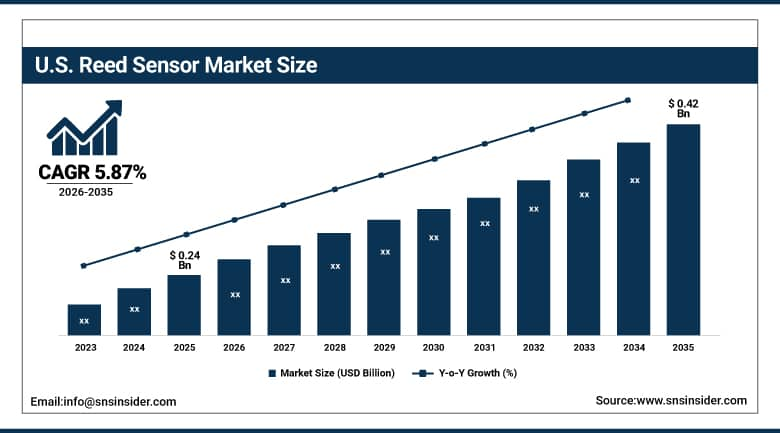
The U.S. Reed Sensor Market was valued at USD 0.24 Billion in 2025 and is expected to reach USD 0.42 Billion by 2035, growing at a CAGR of 5.87% from 2026-2035.
The U.S. Reed Sensor Market is the largest national market in North America, supported by a mature base of automotive component plants, industrial automation integrators, medical device makers, security system manufacturers and test equipment suppliers. Several leading reed switch and relay producers operate manufacturing sites and engineering centers in the country, which gives buyers access to custom designs and short lead times. Demand from electric vehicle platforms, smart utility meters, semiconductor test systems and aerospace programs sustains orders, while the shift toward higher voltage battery systems favors hermetic reed relays. Specialist catalog distributors help small engineering teams source parts quickly, supporting growth through 2035.
⮞On 25 September 2025, the International Federation of Robotics reported that 34,200 industrial robots were installed in the United States in 2024, out of 542,000 worldwide.
Reed Sensor Market Segment Analysis
-
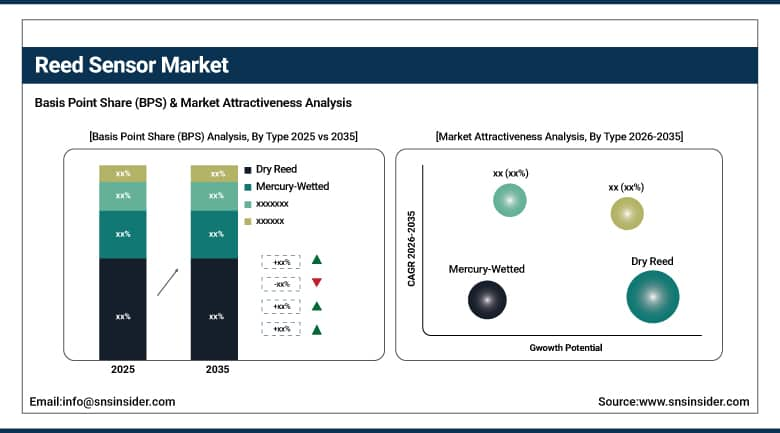
By Type, the Dry Reed segment dominated the Reed Sensor Market with approximately 78.42% share in 2025 and is also the fastest growing with a CAGR of approximately 6.71%.
-
By Contact Type, the Form A segment dominated the Reed Sensor Market with approximately 53.86% share in 2025, while the Latching segment is the fastest growing with a CAGR of approximately 8.67%.
-
By Mounting Type, the Through-Hole segment dominated the Reed Sensor Market with approximately 47.93% share in 2025, while the Surface Mount segment is the fastest growing with a CAGR of approximately 8.54%.
-
By Application, the Automotive & Transportation segment dominated the Reed Sensor Market with approximately 35.74% share in 2025 and is also the fastest growing with a CAGR of approximately 8.21%.
By Type, Dry Reed Dominates the Reed Sensor Market and Also Grows Fastest
Dry reed sensors hold the largest share of the Reed Sensor Market at approximately 78.42% in 2025 because they avoid mercury, meet environmental rules easily and cover the full range of low-power switching tasks. The contacts are plated with metals such as rhodium or ruthenium to deliver stable resistance over Billions of operations, and the glass capsule protects them from dust, moisture and gases. Manufacturers can produce them in large volumes on automated lines, which keeps unit prices low. They are specified in vehicles, appliances, meters, alarms and medical equipment, and design engineers know their characteristics well, which shortens qualification.
Dry reed devices are also the fastest growing type, advancing at a CAGR of approximately 6.71% through 2035, as mercury-wetted designs lose ground. Regulations on hazardous substances and shipping restrictions make mercury components costly to handle, and few new programs adopt them. Dry reed products now cover higher currents, higher voltages and smaller capsules, closing most of the performance gap. Improved contact materials and sealed relays extend life in demanding duty cycles, and retrofit programs replace older wetted parts with dry equivalents in test equipment and industrial controls.
⮞In September 2025, MedTech Europe reported that the European medical technology sector employs more than 930,000 people across over 38,000 companies, a broad customer base for sealed, low-power switching components.
By Contact Type, Form A Dominates the Reed Sensor Market and Latching Grows Fastest
Form A, or normally open, contacts account for approximately 53.86% of the market in 2025 because most applications need a circuit that closes only when a magnet is present. The design is simple, reliable and inexpensive, and it works well for proximity detection, door and window alarms, fluid level floats, speed pickup and security tamper loops. A single contact pair has fewer failure points than changeover devices, and designers can tune sensitivity through capsule length and magnet strength. Large installed volumes in appliances, meters and vehicles give Form A devices a scale advantage that keeps prices and lead times competitive.
Latching, or bistable, contacts are the fastest growing contact type, with a CAGR of approximately 8.67% during 2026-2035. They hold their state after the magnet pulse ends, which saves energy in battery-powered meters, remote sensors and electric vehicle controls. Designers building wireless nodes and smart valves value the memory function, since the microcontroller can sleep until a state change occurs. Latching designs also help in safety circuits that need to remember a fault. Suppliers are adding compact packages and multiple pole options, widening the range of products that can adopt this feature.
⮞In May 2026, the Society of Indian Automobile Manufacturers reported that April passenger vehicle dispatches rose 25.4% to 437,312 units, supporting demand for compact switching and sensing parts.
By Mounting Type, Through-Hole Dominates the Reed Sensor Market and Surface Mount Grows Fastest
Through-hole and leaded formats retain the largest share, at approximately 47.93% in 2025, since the glass capsule is fragile and many users prefer to mount it with leads on boards, in plastic housings or in custom assemblies. Wire leaded switches are easy to overmold, solder and adapt to different geometries, which suits cost-sensitive volume builds in appliances and alarm contacts. Automotive and industrial designs that must survive vibration and thermal cycling often use leaded constructions with potting. Long established tooling at assemblers and a wide range of lead forms keep this format dominant, even as automated assembly moves toward surface mounting.
Surface mount reed switches and relays are the fastest growing group, with a CAGR of approximately 8.54%, because electronics makers want components that fit pick-and-place lines and shrink board area. Smaller capsules, improved terminations and overmolded bodies protect the glass during reflow soldering. Reed relays in surface mount packages serve test and measurement cards, telecom line interfaces and medical instruments where density matters. Demand for automated testing of semiconductors and batteries pushes channel counts higher, and each added channel increases the number of relays on a board. Better yields and wider supplier availability are lowering cost.
⮞In March 2026, the Japan Automobile Manufacturers Association reported that Japan produced 8,410,334 vehicles in 2025, up 2.1%.
By Application, Automotive & Transportation Dominates the Reed Sensor Market and Also Grows Fastest
Automotive and transportation applications account for approximately 35.74% of the market in 2025. Reed sensors are used for fluid level detection, seat belt buckle and door status, pedal and gear position, brake fluid monitoring and battery management interlocks. Their low quiescent current and robustness against electrical noise are valued in electronic control units that must remain safe over a decade of service. Rail, trucking and marine equipment add further demand, since sealed contacts tolerate moisture and vibration. Because vehicle platforms are produced in the tens of Billions, even small content per vehicle translates into large component volumes for suppliers.
The same segment is also the fastest growing, at a CAGR of approximately 8.21% through 2035, helped by vehicle electrification. Battery packs, high-voltage contactors, charging connectors and thermal management systems create new sockets for hermetic high-voltage reed relays and compact position sensors. Safety interlocks that confirm a connector is seated before high voltage is applied rely on simple, dependable switches. Trucks and buses moving to electric drivetrains increase the number of monitoring points. Competition from Hall-effect parts exists, yet reed devices keep an advantage where zero standby current and high isolation matter.
⮞In April 2026, the International Organization of Motor Vehicle Manufacturers reported that global vehicle production reached about 96.4 Billion units in 2025, up 3.9%.
Regional Analysis
|
Region |
Major Country |
Share within Region, 2025 (%) |
|---|---|---|
|
North America |
United States |
61.37% |
|
Asia Pacific |
China |
41.36% |
|
Europe |
Germany |
27.91% |
|
Latin America |
Brazil |
46.58% |
|
Middle East & Africa |
United Arab Emirates |
29.74% |
Asia Pacific Reed Sensor Market Insights
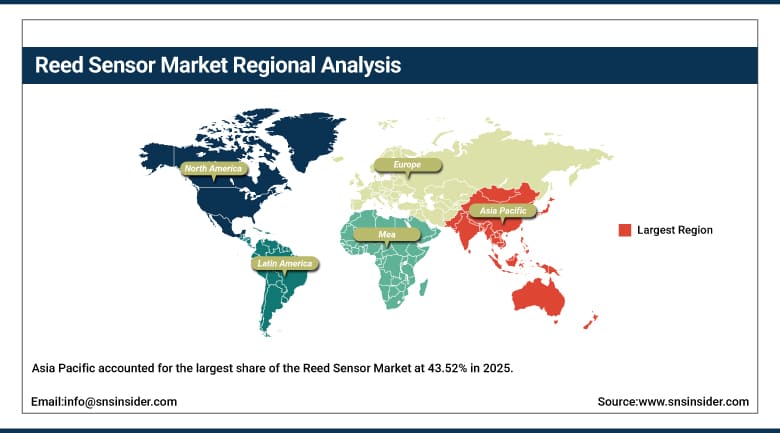
Asia Pacific accounted for the largest share of the Reed Sensor Market at 43.52% in 2025 and is also the fastest growing region, expanding at a CAGR of 7.84% during 2026-2035. China, Japan, South Korea, India and Southeast Asia host extensive electronics, appliance, automotive and meter manufacturing, and most glass capsule and reed switch output is concentrated in the region. Local producers supply cost-competitive switches and relays to nearby assemblers, while Japanese specialists focus on high-reliability and high-voltage designs. Large installed manufacturing capacity gives buyers short supply chains.
China leads regional consumption through vehicle, appliance and utility meter output, and rapid adoption of electric vehicles raises demand for sealed switches in battery and charging systems. Japan contributes technology leadership in miniaturized capsules and automotive components. India is a fast growth country because of expanding vehicle assembly, smart meter programs and electronics manufacturing under production-linked incentives. South Korea and Taiwan add demand through battery makers, semiconductors and test equipment. Thailand and Vietnam attract assembly plants that source sensors regionally, reinforcing the Asia Pacific supply base.
⮞In January 2026, the China Association of Automobile Manufacturers reported that China produced 34.53 Billion vehicles in 2025, a record, with new energy vehicles above half of new vehicle sales.
Get Customized Report as Per Your Business Requirement - Enquiry Now
North America Reed Sensor Market Insights
North America held approximately 23.01% of the Reed Sensor Market in 2025, with the United States accounting for about 61.37% of regional demand and Canada providing the remainder. The region has a strong base of reed relay and sensor makers, test and measurement companies, aerospace contractors and medical device producers, which favor hermetic, high-reliability components. Automotive plants in the Midwest and Southeast, together with growing battery manufacturing, create stable demand for sealed switches. Defense and space programs value glass-sealed contacts for their long shelf life and consistent contact resistance.
Suppliers such as Sensata, Teledyne Relays, Comus International, Reed Switch Developments and HSI Sensing offer custom designs and short lead times, which appeals to engineering teams building low-volume products. Utility metering upgrades, security alarm contacts, level sensors for appliances and recreational vehicles, and industrial machine safety interlocks provide further volume. Catalog distributors make small quantities available overnight, supporting prototyping. Canada contributes through mining equipment, rail and heavy trucks, which require sealed sensors that withstand cold and dust. Aerospace testing labs also buy sealed relays.
Europe Reed Sensor Market Insights
Europe accounted for approximately 23.44% of the Reed Sensor Market in 2025, led by Germany, the United Kingdom and France. The region combines strong automotive supply chains, industrial automation, medical technology and a tradition of precision component engineering. German manufacturers of switches and relays supply automotive and industrial customers worldwide, while British specialists focus on high-voltage and high-density reed relays for test equipment. Strict environmental regulations have accelerated the move to mercury-free dry reed designs, and quality standards in automotive and medical markets favor suppliers with traceable production.
Vehicle electrification is the main source of fresh demand, as battery pack interlocks, charging inlets and high-voltage monitoring need dependable switching. Smart metering programs and building automation add volume, and security equipment makers in the Nordic countries and Italy purchase large quantities of door and window contacts. Semiconductor and battery test systems built in Germany and the Netherlands specify reed relays for low leakage. Component shortages in recent years encouraged buyers to qualify second sources, giving regional specialists chances to win design positions.
⮞In January 2026, the European Automobile Manufacturers' Association reported that 1,880,370 new battery-electric cars were registered in the European Union in 2025, up 29.9%, a 17.4% share of registrations.
MEA & Latin America Reed Sensor Market Insights
The Middle East and Africa and Latin America together account for approximately 10.03% of the Reed Sensor Market in 2025, with the Middle East and Africa at 5.86% and Latin America at 4.17%. Demand in the Middle East comes from utility metering programs, building security, oil and gas instrumentation and growing appliance assembly in the United Arab Emirates and Saudi Arabia. South Africa is the leading African market, where automotive assembly, mining equipment and alarm system makers use reed switches. Imports supply most needs, so distributors and trading houses play a central role in reaching small manufacturers and installers.
Latin America is led by Brazil and Mexico, whose automotive and appliance plants consume reed switches for level detection, door contacts and position sensing. Brazil also has local capsule and reed switch production that serves regional buyers, and Mexico's electronics assembly sector imports components for export products. Argentina and Colombia add smaller volumes through meter and security equipment programs. Currency swings and import costs make price a primary consideration, which favors simple dry reed devices and strong distributor networks. Local assembly is growing slowly.
⮞The National Association of Automobile Manufacturers of South Africa reported 597,194 new vehicle sales in 2025, up 16% and the highest since 2015, as cited in February 2026.
Market Dynamics
Growth Drivers: Vehicle Electrification and Industrial Automation Drive Growth in the Reed Sensor Market
Vehicle electrification is the strongest force behind the Reed Sensor Market. Electric platforms add battery packs, high-voltage junctions, charging interfaces and thermal systems that all need dependable position, level and interlock sensing. Reed devices consume no power while idle, withstand electrical noise and isolate circuits at high voltage, qualities that matter when a vehicle sits parked for weeks. Hermetic reed relays are specified in battery disconnect monitoring and insulation test circuits. Rising content per vehicle, together with growth in commercial electric trucks and buses, lifts component volumes across regions.
Industrial automation provides a second driver. Factories use reed sensors on pneumatic cylinders, safety guards, conveyor stations and packaging machines, where robust contacts detect magnet positions without wiring complexity. Semiconductor, battery and electronics test equipment relies on reed relays for low leakage and high isolation, and the growth of automated testing increases channel counts. Medical instruments, laboratory analyzers and security devices add steady demand. Suppliers are responding with custom magnet-and-switch assemblies and longer-life contact materials that support heavier cycling on production lines.
⮞The International Energy Agency reported in its Global EV Outlook 2026, published in May 2026, that electric car sales grew about 20% to more than 20 Billion in 2025.
Restraints: Hall-Effect and Solid-State Substitution Restrains Growth in the Reed Sensor Market
Substitution by solid-state magnetic sensors is the main restraint on the Reed Sensor Market. Hall-effect, anisotropic magnetoresistive and tunneling magnetoresistive chips now offer low-power operation, small size and programmable thresholds at falling prices, and semiconductor makers explicitly market them as replacements for reed switches. Because these chips integrate easily with microcontrollers and diagnostics, automotive and consumer designers often choose them for new platforms. The glass capsule is also fragile, which complicates handling and mounting and limits miniaturization compared with silicon.
Supply chain exposure adds a second challenge. Contact plating relies on precious metals such as rhodium and ruthenium whose prices swing widely, and glass tubing and ferrous alloy wire come from limited sources. Price pressure from high-volume Asian producers narrows margins for premium suppliers. Customers in some industries are also migrating to solid-state relays, which have no moving parts. Reed makers must therefore stress strengths such as zero standby current, high isolation, hermetic sealing and tolerance of harsh conditions to retain design positions.
Opportunities: Smart Metering and Connected Devices Create Opportunities in the Reed Sensor Market
Smart metering and connected devices create a substantial opportunity. Utilities are replacing mechanical meters with electronic ones that use reed switches for tamper detection, magnetic field sensing and pulse counting, and latching types suit battery-powered designs expected to last a decade or more. Water and gas utilities also use reed contacts in flow meters and valve position indicators. As meters join wireless networks, each unit includes sensors that report events, enlarging the addressable volume. Suppliers with low-leakage, long-life products can secure multi-year supply agreements with meter manufacturers.
Additional openings exist in medical wearables, device programming interfaces, security systems, energy storage cabinets and smart home sensors. Battery energy storage systems need interlock and door status sensing, and the buildout of grid storage adds demand. Customized sensor packages with integrated electronics, cables and connectors let suppliers move up the value chain and compete on solutions rather than bare components. Collaboration with module makers on pre-assembled sensing kits can shorten customers' design cycles and increase supplier content per product. Wearable makers value the small size.
⮞Great Britain's Department for Energy Security and Net Zero reported on 27 August 2026 that 42 Billion smart and advanced meters were in operation at the end of June 2026.
Recent Developments:
-
2025: Littelfuse added the 59150 flange-mount reed sensor, a hermetically sealed device rated to IP67 and up to 105 degrees Celsius. The product targets level sensing and position detection in harsh industrial and vehicle environments.
-
2025: Pickering Electronics released its Series 600 customizable high-voltage reed relays, with switching from 3.5 kV to 12.5 kV and stand-off voltage up to 20 kV. The family was shown at electronica India and targets semiconductor, battery and medical test systems.
-
2025: Coto Technology launched the CotoClassic 9105 high-voltage reed relay in surface mount and dual in-line packages, with hermetically sealed contacts, switching up to 1 kV and dielectric strength up to 7 kV.
-
2026: Standex Electronics listed its new MK36, MK37 and MK38 recessed reed sensors, extending the Meder MK series. The company also exhibited reed switches, relays and sensors for electric vehicles and battery energy storage at The Battery Show India in October 2026.
Reed Sensor Market Key Players are:
-
Littelfuse, Inc.
-
Standex Electronics, Inc. (Meder Electronic)
-
Coto Technology, Inc.
-
Pickering Electronics Ltd.
-
Sensata Technologies Holding plc (Cynergy3)
-
Teledyne Relays
-
Comus International
-
Celduc Relais
-
Reed Switch Developments Corp.
-
HSI Sensing (Hermetic Switch, Inc.)
-
TE Connectivity Ltd.
-
Metaltex Indústria e Comércio Ltda.
Reed Sensor Market Report Scope:
| Report Attributes | Details |
|---|---|
| Market Size in 2025 | USD 1.93 Billion |
| Market Size by 2035 | USD 3.58 Billion |
| CAGR | CAGR of 6.38% From 2026 to 2035 |
| Base Year | 2025 |
| Forecast Period | 2026-2035 |
| Historical Data | 2022-2024 |
| Report Scope & Coverage | Market Size, Segments Analysis, Competitive Landscape, Regional Analysis, DROC & SWOT Analysis, Forecast Outlook |
| Key Segments | • By Type (Dry Reed, Mercury-Wetted, and Others) • By Contact Type (Form A, Form B, Form C, Latching, and Others) • By Mounting Type (Through-Hole, Surface Mount, Panel Mount, Thread Mount, Screw Mount, and Others) • By Application (Automotive and Transportation, Industrial, Consumer Electronics, Healthcare, and Others) |
| Regional Analysis/Coverage | North America (US, Canada), Europe (Germany, UK, France, Italy, Spain, Russia, Poland, Rest of Europe), Asia Pacific (China, India, Japan, South Korea, Australia, ASEAN Countries, Rest of Asia Pacific), Middle East & Africa (UAE, Saudi Arabia, Qatar, South Africa, Rest of Middle East & Africa), Latin America (Brazil, Argentina, Mexico, Colombia, Rest of Latin America). |
| Company Profiles | Littelfuse, Inc., Standex Electronics, Inc. (Meder Electronic), Coto Technology, Inc., Pickering Electronics Ltd., Sensata Technologies Holding plc (Cynergy3), Teledyne Relays, Comus International, Celduc Relais, Reed Switch Developments Corp., HSI Sensing (Hermetic Switch, Inc.), TE Connectivity Ltd., Metaltex Indústria e Comércio Ltda. |

Frequently Asked Questions
The key players in the Reed Sensor Market include Littelfuse, Inc., Standex Electronics, Inc., Coto Technology, Inc., Pickering Electronics Ltd., Sensata Technologies Holding plc, among others.
Key opportunities include smart electricity, water and gas meters, battery energy storage systems, and packaged sensing modules with integrated electronics for medical and smart home devices.
The major growth factor is vehicle electrification and industrial automation, which require sealed, low-power and high-isolation switching for battery systems, charging equipment and machinery.
The Dry Reed segment dominated the Reed Sensor Market with approximately 78.42% share in 2025, because it avoids mercury and covers a wide range of low-power switching tasks.
Asia Pacific dominated the Reed Sensor Market with a 43.52% share in 2025, driven by electronics, appliance, meter and vehicle manufacturing in China, Japan, South Korea and India.
