
Piezoelectric Sensors Market Report Scope and Overview:
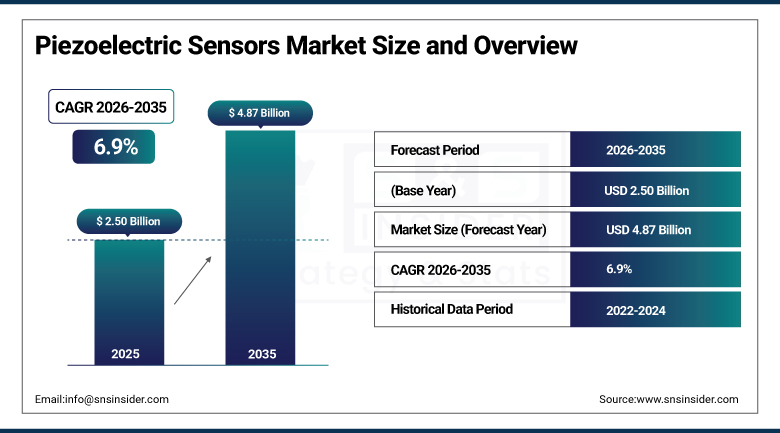
The Piezoelectric Sensors Market size was valued at USD 2.50 Billion in 2025 and is projected to reach USD 4.87 Billion by 2035, registering a CAGR of 6.9% from 2026 to 2035.
The Piezoelectric Sensors Market is making strides in the field of precise measurements with applications ranging from industries to vehicles, aerospace to healthcare using sensing units that can convert mechanical stresses, pressures, and vibrations into electricity. The key drivers behind the piezoelectric sensors market include the increasing requirement for vibration detection and structural health monitoring in automation in the industrial sector, increased use of piezoelectric accelerometers in automotive safety systems, and inclusion in wearable devices used for diagnosis of patients. Increasing use in predictive maintenance systems, ultrasonic medical imaging techniques, and navigation systems in aerospace is expected owing to the fact that industrial equipment makers and healthcare device makers are heavily investing in high-precision sensing devices that can operate in hostile conditions.
CTS Corporation expanded its piezoelectric ceramic sensor portfolio throughout 2025, introducing new high-temperature accelerometer sensors for industrial vibration monitoring and predictive maintenance applications following its integration of Ferroperm Piezoceramics technology.
To Get more information On Piezoelectric Sensors Market - Request Free Sample Report
Piezoelectric Sensors Market Trends
-
Growing adoption of piezoelectric accelerometers continues expanding vibration monitoring and structural health monitoring across industrial automation.
-
Rising integration of piezoelectric pressure sensors into wearable healthcare devices continues broadening demand beyond traditional industrial applications.
-
Increasing use of piezoelectric sensors in predictive maintenance programs continues driving adoption across manufacturing and process industries.
-
Expanding automotive safety system deployment continues supporting sustained demand for piezoelectric accelerometer and force sensor technology.
-
Growing development of lead-free, eco-friendly piezoelectric materials continues shaping next-generation sensor design across the industry.
U.S. Piezoelectric Sensors Market Size Outlook
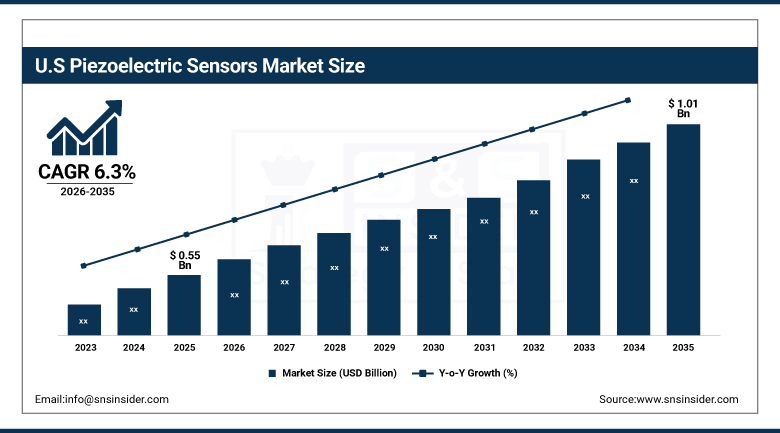
The U.S. Piezoelectric Sensors Market was valued at approximately USD 0.55 Billion in 2025 and is projected to reach approximately USD 1.01 Billion by 2035, registering a CAGR of approximately 6.3% from 2026 to 2035.
The United States demand continued to be shaped by strong industrial automation and predictive maintenance spending, a deep concentration of leading sensor and ceramic component manufacturers, and rising demand for high-precision sensing across aerospace, defense, and healthcare applications. Rising deployment of piezoelectric accelerometers and pressure sensors by domestic industrial equipment manufacturers continued reinforcing the country's position as both a premium-quality hub and a genuine innovation leader for precision sensing technology. Growing adoption across automotive safety systems, wearable healthcare devices, and aerospace navigation systems added further layers of sustained domestic demand well beyond the technology's traditional industrial vibration monitoring use case.
Murata Manufacturing introduced a new series of miniaturized piezoelectric pressure sensors throughout 2025, designed for wearable health monitoring devices requiring compact, low-power sensing capability for U.S. and global healthcare customers.
Piezoelectric Sensors Market Segment Analysis
-
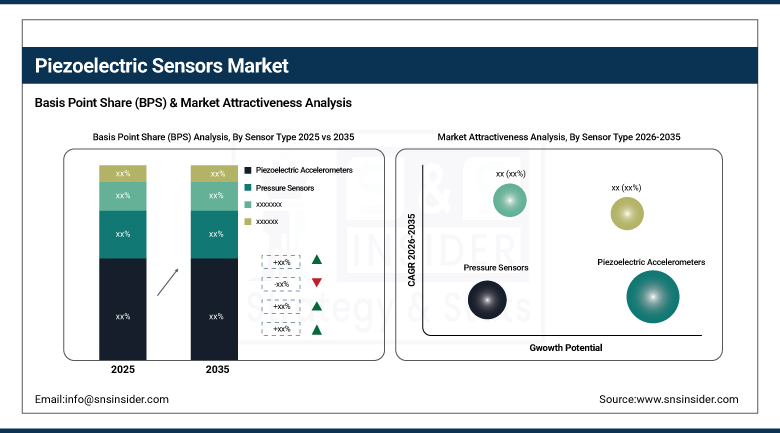
By Sensor Type, Piezoelectric Accelerometers dominated the market with a 38.00% share in 2025, while Pressure Sensors is the fastest-growing sensor type segment with a CAGR of 7.80% from 2026–2035.
-
By Material Type, Ceramics dominated the market with a 61.00% share in 2025, while Polymers is the fastest-growing material type segment with a CAGR of 8.40% from 2026–2035.
-
By Application, Industrial & Manufacturing dominated the market with a 40.00% share in 2025, while Healthcare is the fastest-growing application segment with a CAGR of 8.10% from 2026–2035.
-
By End-User, Industrial Manufacturers dominated the market with a 39.00% share in 2025, while Healthcare Providers is the fastest-growing end-user segment with a CAGR of 8.30% from 2026–2035.
By Sensor Type, Accelerometers Lead While Pressure Sensors Grow Fastest
The Piezoelectric Accelerometers segment dominated the Piezoelectric Sensors Market in 2025 owing to widespread use in vibration monitoring, seismic analysis, structural health monitoring, and automotive safety applications. Their high sensitivity, broad frequency range, and suitability for harsh environments make them the preferred choice across industrial, automotive, and aerospace end-users. Continued expansion of predictive maintenance programs across manufacturing facilities has kept accelerometers the largest single revenue contributor within the sensor type landscape tracked in this report.
The Pressure Sensors segment is the fastest growing in the Piezoelectric Sensors Market owing to rising adoption in medical diagnostic devices, industrial process monitoring, and automotive fuel injection systems requiring precise pressure measurement. Designers increasingly favor piezoelectric pressure sensors for their fast response time and reliable performance in dynamic pressure applications. Growing healthcare diagnostic device adoption continues accelerating demand for miniaturized, low-power piezoelectric pressure sensor technology across the industry.
By Material Type, Ceramics Dominate While Polymers Record Fastest Growth
The Ceramics segment dominated the Piezoelectric Sensors Market in 2025 due to the established performance, durability, and cost-effectiveness of lead zirconate titanate and related ceramic materials across mainstream industrial and automotive sensing applications. Manufacturers continue relying on ceramic-based piezoelectric elements for their proven reliability and broad temperature tolerance. Sustained mainstream industrial and automotive sensor production has kept ceramics the largest overall contributor to market revenue.
The Polymers segment is the fastest growing in the Piezoelectric Sensors Market owing to rising demand for flexible, lightweight sensing elements in wearable healthcare devices and conformable structural monitoring applications. Designers increasingly favor polyvinylidene fluoride and related polymer materials for applications requiring mechanical flexibility unavailable with rigid ceramic elements. Growing wearable healthcare device adoption continues driving sustained growth in polymer-based piezoelectric sensor demand.
By Application, Industrial & Manufacturing Leads While Healthcare Grows Fastest
The Industrial & Manufacturing segment dominated the Piezoelectric Sensors Market in 2025 due to sustained demand for vibration monitoring, process control, and predictive maintenance across manufacturing facilities adopting smart factory initiatives. Equipment manufacturers continue prioritizing piezoelectric sensor integration given the segment’s scale and recurring equipment maintenance cycles. Sustained global industrial automation investment has kept this application the largest overall revenue contributor across the market.
The Healthcare segment is the fastest growing in the Piezoelectric Sensors Market owing to rising adoption of piezoelectric sensors in medical imaging, patient monitoring, and wearable diagnostic devices requiring high-precision, low-power sensing capability. Healthcare device developers increasingly integrate piezoelectric sensors to enable accurate, real-time physiological monitoring. Growing global healthcare innovation and wearable diagnostic device investment continues driving sustained growth in healthcare-oriented piezoelectric sensor demand.
By End-User, Industrial Manufacturers Lead While Healthcare Providers Grow Fastest
The Industrial Manufacturers segment dominated the Piezoelectric Sensors Market in 2025 due to sustained demand for vibration monitoring and process control sensing across manufacturing facilities implementing Industry 4.0 initiatives. Manufacturers continue driving the majority of piezoelectric sensor procurement given their central role in predictive maintenance and quality control programs. Continued global manufacturing automation investment has kept this end-user segment the largest overall contributor to market revenue.
The Healthcare Providers segment is the fastest growing in the Piezoelectric Sensors Market owing to expanding adoption of piezoelectric-based diagnostic imaging and patient monitoring equipment across hospitals and outpatient care facilities. Healthcare providers increasingly invest in advanced diagnostic technology incorporating high-precision piezoelectric sensing elements. Growing global healthcare infrastructure investment continues accelerating growth in this end-user category.
Regional Analysis
|
Region |
Major Country |
Share within Region, 2025 (%) |
|---|---|---|
|
North America |
United States |
85.00% |
|
Europe |
Germany |
33.00% |
|
Asia Pacific |
China |
38.00% |
|
Middle East and Africa |
UAE |
26.00% |
|
Latin America |
Brazil |
30.00% |
North America Piezoelectric Sensors Market Insights
North America accounted for a notable market share in 2025. Strong industrial automation and predictive maintenance spending, a deep concentration of leading sensor and ceramic component manufacturers, and rising demand for high-precision sensing across aerospace, defense, and healthcare applications continued reinforcing the region’s strong position. Growing deployment of piezoelectric accelerometers and pressure sensors across industrial, automotive, and healthcare applications further strengthened North America’s standing as a premium-quality, innovation-driven market tracked in this report, with continued industrial automation investment expected to sustain regional demand through the forecast period.
The United States growth anchored by its deep concentration of leading sensor and ceramic component manufacturers and substantial industrial automation and healthcare technology investment. Canada added further regional demand through its own growing industrial and healthcare technology sectors, and that combined strength kept the continent a resilient, premium-value addressable market for piezoelectric sensor vendors through the forecast period, with continued predictive maintenance adoption expected to sustain regional demand.
Europe Piezoelectric Sensors Market Insights
Europe held a meaningful share of global revenue, supported by strong automotive, aerospace, and industrial automation demand and continued expansion of advanced manufacturing capability across the region’s major economies. Regulatory momentum around industrial safety and emissions standards continued shaping regional investment priorities without meaningfully slowing commercialization across the continent, while sustained automotive and aerospace demand kept the region among the more resilient piezoelectric sensor markets tracked in this report.
Germany led demand of European revenue, supported by its substantial automotive sector and advanced industrial automation adoption. France contributed additional demand through its aerospace industry and growing healthcare technology investment, and continued European investment in smart manufacturing should keep regional demand for piezoelectric sensor technology climbing steadily through the forecast period.
Asia Pacific Piezoelectric Sensors Market Insights
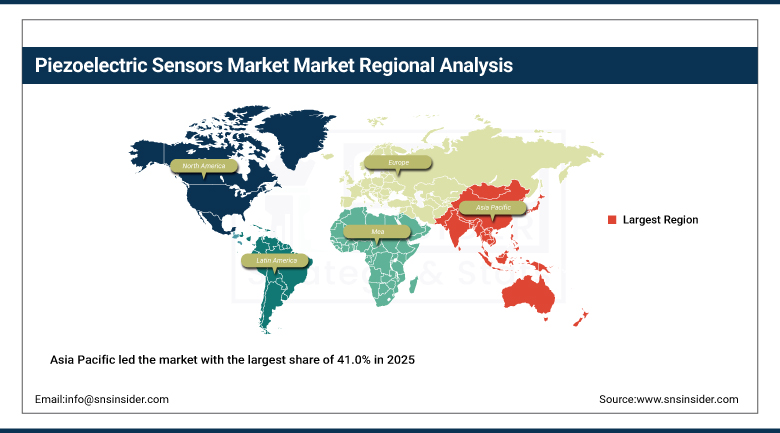
Asia Pacific led the market with the largest share of 41.0% in 2025 and is also advancing at the fastest pace among all regions, registering a CAGR of 7.3% from 2026 to 2035, driven by rapid industrialization, large-scale automotive and electronics manufacturing, and significant government investment in smart manufacturing across the region’s largest economies. That combination of manufacturing scale and genuine downstream demand across industrial, automotive, and healthcare device categories kept the region’s growth trajectory well ahead of every other region tracked in this report, with a growing healthcare device sector adding a further, sustained layer of demand.
China led the pack, supported by its substantial domestic electronics manufacturing base and rapid expansion of industrial automation and automotive production. Japan and South Korea contributed meaningful additional demand, with China’s expanding manufacturing ecosystem and Japan’s advanced sensor technology capability both reinforcing the region’s position as the largest and fastest-growing piezoelectric sensor market tracked in this report.
Get Customized Report as per Your Business Requirement - Enquiry Now
MEA and Latin America Piezoelectric Sensors Market Insights
The Middle East and Africa and Latin America both showed steady growth, driven by expanding industrial and healthcare infrastructure investment, growing government focus on manufacturing sector diversification, and rising demand for precision sensing capability across both regions. As these markets continued building out modern industrial and healthcare infrastructure, piezoelectric sensor technology proved a genuinely valuable enabler of increasingly capable, locally supported diagnostic and industrial monitoring systems.
The UAE led Middle East and Africa demand, supported by the country’s growing industrial diversification and healthcare infrastructure investment. Saudi Arabia contributed further demand through its own industrial diversification programs. In Latin America, Brazil accounted for the largest share of regional revenue, with growing industrial and automotive manufacturing investment continuing to anchor regional demand for piezoelectric sensor technology.
Market Dynamics
Growth Drivers: Rising Industrial Automation and Healthcare Diagnostic Innovation
The industry is driven by rising demand for vibration monitoring and structural health monitoring in industrial automation, growing adoption of piezoelectric accelerometers in automotive safety systems, expanding integration into wearable healthcare diagnostic devices, and increasing use in predictive maintenance programs. As manufacturers and healthcare device developers continue prioritizing precise, reliable sensing capability, the need for durable, high-precision piezoelectric sensing technology continues driving sustained adoption across virtually every major end market.
Rising healthcare innovation continues reinforcing this driver, as medical imaging and patient monitoring applications require increasingly accurate, low-power piezoelectric sensing elements. Growing aerospace and automotive safety system demand continues defining a further layer of sustained demand, and that combination of healthcare innovation and industrial automation investment is exactly what keeps overall demand climbing at such a steady, sustained pace.
Restraints: Material Brittleness and High-Temperature Performance Limitations
The inherent brittleness of ceramic piezoelectric materials continues posing a genuine restraint on faster market-wide expansion, particularly for applications involving mechanical shock or repeated flexing where alternative sensing technologies may offer superior durability. That material limitation has kept certain harsh-environment and flexible-form-factor applications more challenging for traditional ceramic-based piezoelectric sensors to address.
Ongoing performance degradation of piezoelectric materials at elevated operating temperatures continues posing a further restraint, as aerospace, automotive, and industrial customers increasingly require sensors capable of reliable operation in extreme thermal environments. Limited availability of qualified high-temperature piezoelectric formulations in certain deployment scenarios keeps some demanding application qualification processes more administratively complicated than standard sensor deployment would otherwise require.
Opportunities: Wearable Healthcare Diagnostics and Lead-Free Material Innovation
Rising wearable healthcare diagnostic device adoption represents a genuinely significant opportunity, as healthcare providers and consumers increasingly demand compact, low-power sensing technology for continuous physiological monitoring. Vendors positioned early in flexible, polymer-based piezoelectric sensor technology stand to capture meaningful share as this capability continues expanding from traditional industrial applications into broader wearable and implantable healthcare devices.
Expanding development of lead-free, eco-friendly piezoelectric materials offers a second substantial opportunity, as regulatory pressure and sustainability commitments increasingly favor environmentally responsible sensor materials over traditional lead-based ceramics. Vendors with proven, lead-free piezoelectric material technology stand to capture meaningful share as global sustainability initiatives continue reshaping sensor material sourcing decisions across established and emerging application markets alike.
Recent Developments:
-
2026: Murata launched the PKGM-210D-R, an SMD-type piezoelectric ceramic vibration sensor designed for predictive maintenance, capable of detecting high-frequency vibrations up to 20 kHz.
-
2026: Sumitomo Electric continued development of Filasense, a thin, flexible piezoelectric sensing wire targeting micro-detection applications in industrial robotics, medical care, and automotive systems.
-
2024: Ionix Technology advanced development of eco-friendly, lead-free piezoelectric materials, targeting sustainable sensor and actuator applications for industrial and consumer electronics customers.
Piezoelectric Sensors Companies are:
-
PCB Piezotronics, Inc.
-
Kistler Instrumente AG
-
TE Connectivity Ltd.
-
Murata Manufacturing Co., Ltd.
-
APC International, Ltd.
-
Physik Instrumente (PI) GmbH & Co. KG
-
Morgan Advanced Materials plc
-
Fuji Ceramics Corporation
-
Honeywell International Inc.
-
STMicroelectronics N.V.
-
Robert Bosch GmbH
-
Yokogawa Electric Corporation
-
Baumer Group
-
piezosystem jena GmbH
-
Parker Hannifin Corporation
-
Hottinger Brüel & Kjær (HBK)
-
CeramTec GmbH
-
Piezo Kinetics, Inc.
Piezoelectric Sensors Market Report Scope:
| Report Attributes | Details |
|---|---|
| Market Size in 2025 | USD 2.50 Billion |
| Market Size by 2035 | USD 4.87 Billion |
| CAGR | CAGR of 6.9% From 2026 to 2035 |
| Base Year | 2025 |
| Forecast Period | 2026-2035 |
| Historical Data | 2022-2024 |
| Report Scope & Coverage | Market Size, Segments Analysis, Competitive Landscape, Regional Analysis, DROC & SWOT Analysis, Forecast Outlook |
| Key Segments | • By Sensor Type (Piezoelectric Accelerometers, Pressure Sensors, Force Sensors, Others) • By Material Type (Ceramics, Polymers, Composites, Others) • By Application (Industrial & Manufacturing, Automotive, Healthcare, Aerospace & Defense, Consumer Electronics, Others) • By End-User (Automotive OEMs, Healthcare Providers, Industrial Manufacturers, Aerospace & Defense, Consumer Electronics OEMs) |
| Regional Analysis/Coverage | North America (US, Canada), Europe (Germany, UK, France, Italy, Spain, Russia, Poland, Rest of Europe), Asia Pacific (China, India, Japan, South Korea, Australia, ASEAN Countries, Rest of Asia Pacific), Middle East & Africa (UAE, Saudi Arabia, Qatar, South Africa, Rest of Middle East & Africa), Latin America (Brazil, Argentina, Mexico, Colombia, Rest of Latin America). |
| Company Profiles | CTS Corporation, PCB Piezotronics, Inc., Kistler Instrumente AG, TE Connectivity Ltd., Murata Manufacturing Co., Ltd., TDK Corporation, APC International, Ltd., Physik Instrumente (PI) GmbH & Co. KG, Morgan Advanced Materials plc, Fuji Ceramics Corporation, Honeywell International Inc., STMicroelectronics N.V., Robert Bosch GmbH, Yokogawa Electric Corporation, Baumer Group, piezosystem jena GmbH, Parker Hannifin Corporation, Hottinger Brüel & Kjær (HBK), CeramTec GmbH, Piezo Kinetics, Inc. |

Frequently Asked Questions
The major growth factor is rising industrial automation and predictive maintenance adoption, growing healthcare diagnostic innovation, and expanding automotive safety system demand.
The Piezoelectric Accelerometers segment dominated the Piezoelectric Sensors Market by sensor type, representing the largest share of revenue in 2025.
Asia Pacific dominated the Piezoelectric Sensors Market in 2025, holding an estimated 41.0% share of total global market revenue.
