
Chassis Sensors Market Report Scope & Overview:
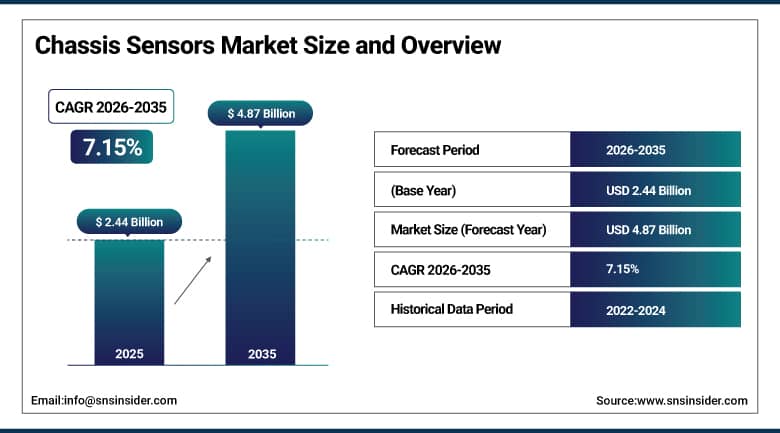
The Chassis Sensors Market was valued at USD 2.44 Billion in 2025 and is expected to reach USD 4.87 Billion by 2035, growing at a CAGR of 7.15% from 2026-2035.
Growth in the Chassis Sensors Market is largely attributable to the rise in focus on stringent emission standards and safety standards, resulting in the increasing importance of chassis sensors in the measurement of ride height, suspension stroke, steering angle, and many other dynamic factors required for vehicle stability and comfort systems. These sensors offer the necessary data for various features, such as electronic stability control, adaptive suspension, and headlight leveling systems that improve the stability, comfort, and safety of vehicles.
More than 55% of the cars being manufactured today use various chassis sensors for monitoring their suspension, steering, and braking systems, which highlights the importance of these sensors in providing stability, efficiency, and real-time diagnosis for the vehicles. With the rising sophistication of passenger and commercial vehicles, the requirement for more accurate measurements of the dynamics of chassis has been rising, which is further aided by incentive schemes for the manufacturing of electric vehicles.
In July 2025, the release of the new generation of the Infineon Technologies XENSIV 3D magnetic Hall effect sensors including the TLE493D-W3B6-Bx, TLE493D-P3B6, and TLE493D-P3I8 families designed according to the ISO 26262 standard with built-in diagnostics for fulfilling ASIL-B requirements for precise long stroke linear and angular position detection is highlighting major players in the semiconductor industry move forward with development of their functional safety certified magnetic sensor solutions for chassis position, ride height, and steering angle detection applications.
To Get More Information On Chassis Sensors Market - Request Free Sample Report
Chassis Sensors Market Trends
-
Rising integration of chassis sensor data into broader ADAS and autonomous driving perception systems.
-
Growing adoption of adaptive suspension systems requiring precise ride-height and acceleration sensor input.
-
Expansion of functional-safety-certified magnetic sensing technology for steering angle and position measurement.
-
Increasing demand for chassis sensors on light commercial vehicles supporting logistics and delivery fleet applications.
-
Rising integration of IoT and AI capabilities within chassis sensors to enhance vehicle control and diagnostics.
-
Growing adoption of chassis sensor technology across both electric and conventional vehicle platforms.
U.S. Chassis Sensors Market Outlook
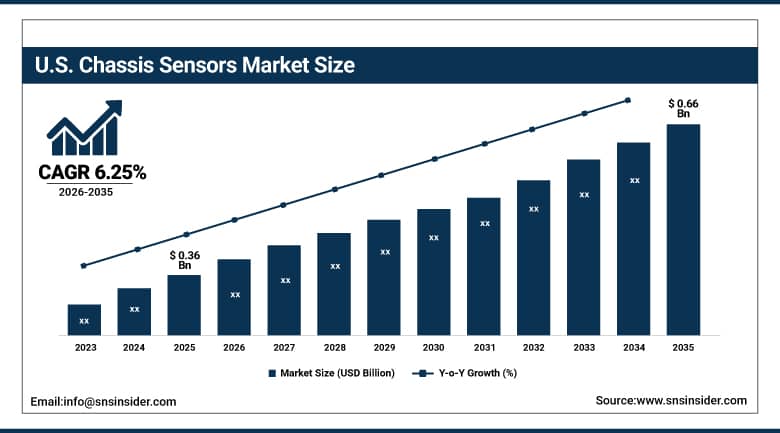
The U.S. Chassis Sensors Market was valued at USD 0.36 Billion in 2025 and is expected to reach USD 0.66 Billion by 2035, growing at a CAGR of 6.25% from 2026-2035.
The U.S. Chassis Sensors Market growth is further being boosted by ongoing domestic focus on vehicle safety legislation and increasing consumer preference for advanced comfort and stability systems within the passenger and commercial vehicle categories. Domestic automakers and tier one suppliers are continuing to invest in the use of chassis sensors to facilitate the adoption of technologies, such as electronic stability control, adaptive suspension systems, and headlight leveling, which are now increasingly offered as standard equipment within an expanding variety of vehicle models. Testing and deployment of electric vehicles and autonomous vehicles within the country is also contributing to the growth, as accurate monitoring of chassis dynamics is a key requirement for such applications due to the heavy reliance of these vehicles on ride height and suspension information.
Massachusetts-based Sensata Technologies, a maker of sensors and electrical protection devices, unveiled its Tire Mounted Sensor product to be used by automotive and tire original equipment manufacturers (OEMs) to improve safety, performance, and data insights by using the tire’s connection to the ground to provide vehicle dynamics data going beyond just pressure and temperature. It is an example of how existing sensor makers in the U.S. market keep expanding their chassis-sensing capabilities.
Chassis Sensors Market Segment Analysis
-
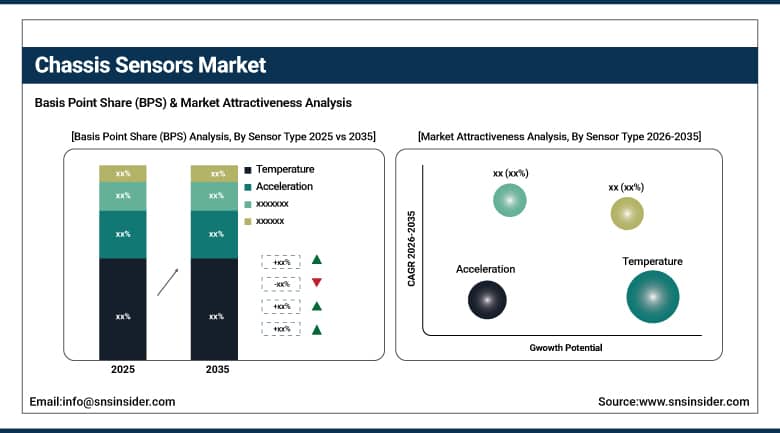
By Sensor Type, the Temperature segment dominated the Chassis Sensors Market with approximately 28.60% share in 2025, while the Acceleration segment is the fastest growing with a CAGR of approximately 9.20%.
-
By Vehicle Type, the Passenger Cars segment dominated the Chassis Sensors Market with approximately 68.40% share in 2025, while the LCV segment is the fastest growing with a CAGR of approximately 9.60%.
-
By Application, the Electronic Stability Control segment dominated the Chassis Sensors Market with approximately 34.80% share in 2025, while the Adaptive Suspension segment is the fastest growing with a CAGR of approximately 9.80%.
-
By Sales Channel, the OEM segment dominated the Chassis Sensors Market with approximately 84.60% share in 2025, while the Aftermarket segment is the fastest growing with a CAGR of approximately 6.80%.
By Sensor Type, Temperature Dominates the Chassis Sensors Market and Acceleration Grows Fastest
Temperature sensors remain the most popular category of automotive sensors as they serve an important safety function in avoiding overheating of adjacent chassis-related systems such as braking and suspension system components, since excess heating could cause malfunction or fires. The well-established and cost-effective manufacturing process of temperature sensors, as well as their wide range of applications within almost all subsystems of chassis systems, continue to contribute to their market dominance.
Acceleration sensors represent the fastest growing category of automotive sensors due to the increased use of electronic stability control and adaptive suspension systems, which require highly accurate readings regarding the lateral and longitudinal acceleration of vehicles in order to be able to detect changes in dynamics. Acceleration sensor data become more widely used in ADAS and autonomous driving perception systems along with camera and radar data.
By Vehicle Type, Passenger Cars Dominates the Chassis Sensors Market and LCV Grows Fastest
Passenger vehicles, especially SUVs, have the largest market share due to the level of production of SUVs and passenger vehicles globally, alongside the high investments in advanced suspension and stability systems among passenger vehicles. Automotive manufacturers continue to incorporate more chassis sensors in the interior of passenger vehicles as more safety and comfort systems become available from premium SUVs to mainstream passenger vehicles.
Light commercial vehicles are the fastest growing segment of vehicles as their multifunctional uses in the retail, construction and logistics industries, together with their easy maintenance and lower operating costs, continue to facilitate their incorporation into fleets with chassis sensors incorporated. The growing light commercial vehicle fleet is bolstered by increased delivery fleets owing to e-commerce, where operators include stability and suspension systems to enable efficient operations.
By Application, Electronic Stability Control Dominates the Chassis Sensors Market and Adaptive Suspension Grows Fastest
The Electronic stability control application segment is dominant in the market as the ESC systems require continuous input from multiple types of chassis sensors, such as acceleration sensors, steering sensors, and wheel sensors to detect and stabilize traction loss in real-time situations. The technology has become mandatory in most automotive markets globally and thus remains one of the largest categories of applications for the chassis sensor makers as it ensures stable demand regardless of the overall automotive production cycle.
The adaptive suspension application category emerges as one of the fastest-growing segments as car makers use ride height and acceleration sensors in order to enable electronically adjustable damping and ride height according to road and driving conditions. The growth of this segment has been fueled by the increasing use of adaptive suspension system technology in electric vehicles and luxury vehicles.
By Sales Channel, OEM Dominates the Chassis Sensors Market and Aftermarket Grows Fastest
The OEM channel has become dominant due to the fact that chassis sensors have to be perfectly integrated into a car’s suspension geometry and stability system during the development and manufacturing processes. OEMs' long-term contracts with reliable tier-one chassis sensors suppliers are the major drivers of this channel dominance in the global vehicle industry.
The aftermarket channel has been becoming the most rapidly developing sales channel due to aging of global fleet vehicles and growing need for replacement of sensors used in chassis systems, especially stability and suspension sensors. The growing awareness of consumers about warning diagnostics for stability and suspension systems will stimulate replacement of chassis sensors in developed and emerging markets.
Regional Analysis
|
Region |
Major Country |
Share within Region, 2025 (%) |
|---|---|---|
|
Asia Pacific |
China |
45.60% |
|
Europe |
Germany |
29.80% |
|
North America |
United States |
82.60% |
|
Middle East & Africa |
United Arab Emirates |
25.40% |
|
Latin America |
Brazil |
30.60% |
Asia Pacific Chassis Sensors Market Insights
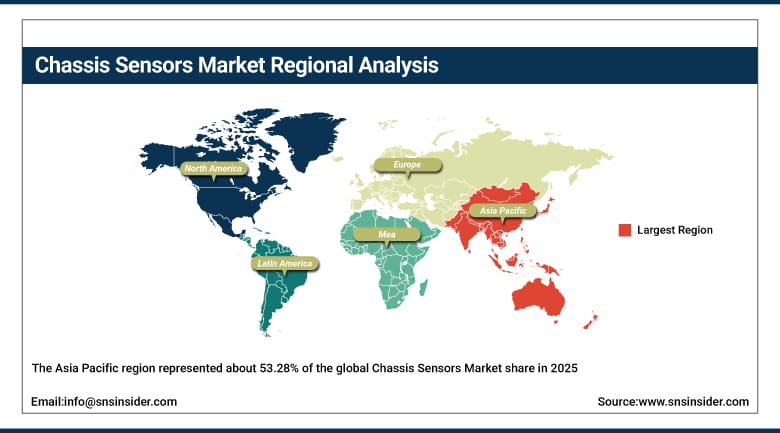
The Asia Pacific region represented about 53.28% of the global Chassis Sensors Market share in 2025 and is the largest and fastest-growing regional market with an approximate CAGR of 8.60% from 2026 to 2035. Being the largest manufacturer of vehicles in the world along with rapid industrialization and increasing manufacture of vehicles is the reason behind the rising demand for chassis sensors in domestic as well as exported vehicles.
India represents the large incremental growth in the market due to its fast-growing automobile industry that manufactures both passenger and commercial vehicles along with rising incentives for EVs. The presence of tier one manufacturers of sensors and development programs for chassis technology in Japan and South Korea adds another level of scale to the region and this is expected to continue throughout the forecast period.
Get Customized Report as Per Your Business Requirement - Enquiry Now
Europe Chassis Sensors Market Insights
The region of Europe is seen to represent a significant proportion of the global Chassis Sensors Market, owing largely to the high number of automakers in the country of Germany along with its high presence of premium vehicles that incorporate chassis sensors in their vehicles. Europe continues to have strict emission and safety norms for the automotive industry, which have driven demand for chassis sensors in the region.
Countries such as France, the United Kingdom, and Italy have been driving demand in the region through increased usage of chassis sensors for applications in mass-produced vehicle platforms. There is continued investment in functional safety certified chassis sensors by suppliers in the region in order to comply with the high quality and safety standards set in the automotive market in the region.
North America Chassis Sensors Market Insights
North America is an important geographical region in the Chassis Sensors Market owing to the continuous focus of the United States on automobile safety regulations and the increasing demand from consumers for high-end comfort and stability systems. Local vehicle manufacturers and suppliers keep on adding more chassis sensors for electronic stability control, adaptive suspension, and headlamp leveling systems.
Demand from Canada and Mexico is on the rise because of their integration of chassis sensors within the automotive industry value chain in the form of component manufacturing activities. Testing and development of electric and autonomous vehicles in North America are providing a boost to the growth of this market.
MEA & Latin America Chassis Sensors Market Insights
The Middle East & Africa market remains comparatively small but is expanding due to the increasing ownership of vehicles in the UAE and Saudi Arabia, which in turn leads to a higher demand for more advanced stability and suspension systems. The assembly of vehicles in the region is still low, and many chassis’ sensors from the region are still being supplied from Asia, Europe, and North America.
The largest market in Latin America is the Brazilian market, where high domestic vehicle production is sustaining demand for chassis sensors through both the OEM and aftermarket segments. Mexico has been contributing heavily to the growth due to the increased capacity through the nearshoring approach in manufacturing the components of vehicles in North American platforms.
Market Dynamics
Growth Drivers: Stringent Safety Regulations and Rising Vehicle Sophistication
The growing importance of strict emission standards and safety requirements can be cited as the most significant factor behind the growth of the Chassis Sensors Market, owing to the fact that regulatory bodies in major automotive regions have begun to require the installation of electronic stability control and other safety systems that rely heavily on chassis sensors. This regulatory trend compels the automotive industry players to adopt chassis sensors in a comprehensive manner in various vehicle types, irrespective of vehicle production cycles.
Growing complexity of the vehicles due to increasing interest in autonomous and connected car technology serves as another important growth catalyst, since these technologies rely on information provided by chassis sensors in addition to environmental sensing capabilities provided by cameras and radars. The increasing sophistication of passenger cars and commercial vehicles further necessitates precision measurement of suspension, steering, and braking systems, fueling the content growth of chassis sensors.
Restraints: High Integration Cost and Data Fusion Complexity
The high level of initial investments required for integrating multi-sensor chassis monitoring systems is seen as an important restraint in the growth of this industry because there is a need to find a balance between providing extensive sensor coverage and maintaining a reasonable price level in vehicles. The challenge is especially acute in relation to mass market vehicles.
The growing complexity of data fusion and processing from a variety of sensors used in the chassis is another constraint that poses challenges to manufacturers as well as to their partners who supply chassis sensors. It is important to combine the temperature, acceleration, positioning, and pressure data and to make decisions regarding the stability of the vehicle based on the results.
Opportunities: Autonomous Vehicle Integration and Adaptive Suspension Expansion
Ongoing incorporation of chassis sensor technology into the autonomous driving perception and decision-making systems holds significant potential in the sense that the suppliers who will be able to design sensors in alignment with the functional safety and data fusion needs of higher levels of autonomous vehicles can capitalize on capturing the design wins within next generation of vehicle platforms. This is highly relevant in the light of increasing need among auto manufacturers for designing vehicle control systems which combine chassis dynamics with the perception of the external environment.
The ongoing penetration of adaptive suspension technology from the segments of premium cars and electric cars into mainstream market segments also represents a potential growth opportunity in the form of increasing need among auto manufacturers to differentiate themselves through their ride comfort and handling performance.
Recent Developments:
-
In May 2024, Melexis unveiled the MLX90427 magnetic position sensor tailored for embedded position sensor applications requiring high functional safety levels, particularly steer-by-wire systems, featuring SPI output with rotary, joystick, and raw data output modes.
-
In June 2024, TDK Corporation launched the TAS8240 tunnel-magnetoresistance angle sensor for industrial and automotive applications, delivering excellent performance in spatially limited areas through low energy consumption while enabling accurate angle measurements.
-
In October 2024, Melexis introduced the MLX90424, a comprehensive brake pedal position sensor integrating two position-sensing integrated circuits and a wake-up switch isolated in a single package.
-
In July 2022, Allegro MicroSystems launched its A33110 and A33115 magnetic position sensors targeting autonomous vehicle and motorsport applications, combining vertical Hall technology with tunneling magnetoresistance for enhanced redundancy.
Chassis Sensors Market Key Players
-
Amphenol Corporation
-
BorgWarner Inc.
-
DENSO Corporation
-
Sensata Technologies Holding plc
-
TE Connectivity Ltd.
-
Robert Bosch GmbH
-
Continental AG
-
ZF Friedrichshafen AG
-
Infineon Technologies AG
-
NXP Semiconductors N.V.
-
Melexis NV
-
Hitachi Astemo, Ltd.
-
Bourns, Inc.
-
CTS Corporation
-
EFI Automotive
-
KYOCERA Corporation
-
TDK Corporation
-
Littelfuse, Inc.
-
Valeo SA
-
HELLA GmbH & Co. KGaA
Chassis Sensors Market Report Scope:
| Report Attributes | Details |
|---|---|
| Market Size in 2025 | USD 2.44 Billion |
| Market Size by 2035 | USD 4.87 Billion |
| CAGR | 7.15% from 2026-2035 |
| Base Year | 2025 |
| Forecast Period | 2026-2035 |
| Historical Data | 2022-2024 |
| Report Scope & Coverage | Market Size, Segments Analysis, Competitive Landscape, Regional Analysis, DROC & SWOT Analysis, Forecast Outlook |
| Key Segments | • By Sensor Type: Dominant – Temperature (28.60% share in 2025); Fastest-Growing – Acceleration (CAGR 9.20%) • By Vehicle Type: Dominant – Passenger Cars (68.40% share in 2025); Fastest-Growing – LCV (CAGR 9.60%) • By Application: Dominant – Electronic Stability Control (34.80% share in 2025); Fastest-Growing – Adaptive Suspension (CAGR 9.80%) • By Sales Channel: Dominant – OEM (84.60% share in 2025); Fastest-Growing – Aftermarket (CAGR 6.80%) |
| Regional Analysis/Coverage | North America (US, Canada), Europe (Germany, UK, France, Italy, Spain, Russia, Poland, Rest of Europe), Asia Pacific (China, India, Japan, South Korea, Australia, ASEAN Countries, Rest of Asia Pacific), Middle East & Africa (UAE, Saudi Arabia, Qatar, South Africa, Rest of Middle East & Africa), Latin America (Brazil, Argentina, Mexico, Colombia, Rest of Latin America). |
| Company Profiles | Amphenol Corporation, BorgWarner Inc., DENSO Corporation, Sensata Technologies Holding plc, TE Connectivity Ltd., Robert Bosch GmbH, Continental AG, ZF Friedrichshafen AG, Infineon Technologies AG, NXP Semiconductors N.V., Melexis NV, Hitachi Astemo, Ltd., Bourns, Inc., CTS Corporation, EFI Automotive, KYOCERA Corporation, TDK Corporation, Littelfuse, Inc., Valeo SA, HELLA GmbH & Co. KGaA |
Frequently Asked Questions
Key players include Robert Bosch GmbH, Continental AG, DENSO Corporation, ZF Friedrichshafen AG, Sensata Technologies Holding plc, Infineon Technologies AG, and Melexis NV, among other tier-one and semiconductor sensor suppliers.
Continued integration of chassis sensor data into autonomous driving perception systems and expansion of adaptive suspension technology into mainstream vehicle segments represent the primary opportunities.
Growth is primarily driven by increasing emphasis on stringent emissions norms and safety regulations combined with rising vehicle sophistication driven by autonomous and connected car technology demand.
By Sensor Type, Temperature dominated the market with approximately 28.60% share in 2025, reflecting its critical safety role in preventing overheating across chassis-adjacent systems.
Asia Pacific dominated the market with approximately 53.28% share in 2025, supported by China's position as the world's largest vehicle producer.
