
Robotic Kitchen Appliance Market Report Scope & Overview:
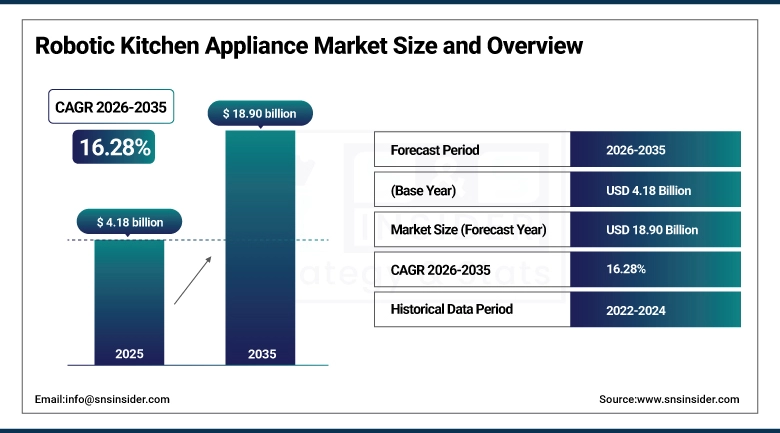
The Robotic Kitchen Appliance Market size is valued at USD 4.18 Billion in 2025 and is expected to reach USD 18.90 Billion by 2035 and grow at a CAGR of 16.28% over the forecast period 2026-2035.
The Robotic Kitchen Appliance market is expected to grow rapidly due to increasing demand for automation in food preparation and kitchen operations across residential, commercial, and industrial settings. Rising labor costs and the need for operational efficiency are driving restaurants, hotels, and cloud kitchens to adopt robotic systems that reduce manual effort and improve consistency. Technological advancements in AI, robotics, sensors, and IoT connectivity are enhancing appliance functionality, precision, and safety, enabling broader deployment. Additionally, growing investments in smart kitchens, AI-enabled culinary solutions, and supportive government initiatives promoting automation are accelerating market adoption, driving significant market growth over the forecast period 2026-2035.
According to industry studies, over 60% of Robotic Kitchen Appliance demand is driven by commercial kitchens, fueled by rising restaurant automation, cloud kitchen expansion, and the need for labor-efficient food preparation.
Robotic Kitchen Appliance Market Size and Forecast:
-
Market Size in 2025: USD 4.18 Billion
-
Market Size by 2035: USD 18.90 Billion
-
CAGR: 16.28% from 2026 to 2035
-
Base Year: 2025
-
Forecast Period: 2026–2035
-
Historical Data: 2022–2024
To Get more information on Robotic Kitchen Appliance Market - Request Free Sample Report
Robotic Kitchen Appliance Market Trends:
-
Rising Commercial Kitchen Automation: Restaurants, cloud kitchens, and hotels are increasingly adopting robotic systems to improve efficiency, consistency, and speed of food preparation.
-
Integration of AI and IoT: Advanced AI, computer vision, and IoT-enabled appliances are enabling smart cooking, recipe personalization, and remote monitoring.
-
Growing Smart Home Adoption: Residential consumers are adopting robotic kitchen assistants and automated cooking devices for convenience and time-saving.
-
Labor Cost Reduction & Workforce Efficiency: Businesses are using robots to reduce dependence on manual labor, minimize errors, and manage staffing shortages.
-
Technological Innovation: Development of multifunctional robots, robotic arms, automated cooking systems, and sensor-based ingredient management is expanding market capabilities.
U.S. Specialty Robotic Kitchen Appliance Market Size Outlook:
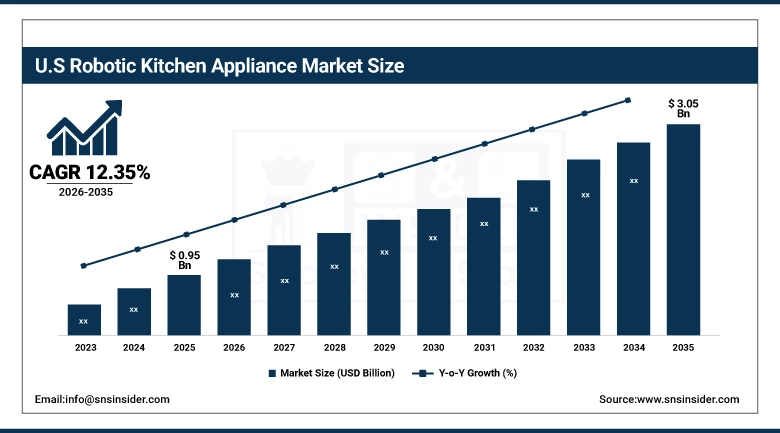
U.S. Robotic Kitchen Appliance Market size was valued at USD 0.95 Billion in 2025 and is projected to reach USD 3.05 Billion by 2035, growing at a CAGR of 12.35% over the forecast period 2026–2035. The market is experiencing rapid growth driven by increasing automation adoption in commercial kitchens, restaurants, and cloud kitchens to enhance efficiency and consistency. Rising labor costs and workforce shortages are pushing businesses to implement robotic solutions. Additionally, growing demand for smart kitchen technologies in homes, advancements in AI, robotics, sensors, and IoT integration, along with strong consumer preference for convenience and time-saving cooking solutions, are fueling market expansion.
Robotic Kitchen Appliance Market Growth Drivers:
-
Rising Adoption of Automation in Commercial and Residential Kitchens
The Robotic Kitchen Appliance market is strongly driven by increasing adoption of automation across commercial kitchens, restaurants, cloud kitchens, hotels, and even smart residential kitchens. Businesses are seeking faster, consistent, and cost-efficient food preparation solutions to meet growing consumer expectations. According to industry studies, over 60% of market demand comes from commercial kitchens adopting robotics to reduce labor dependency and enhance operational efficiency. Additionally, rising labor costs, workforce shortages, and the need for precise, hygienic food preparation further fuel market growth. Technological advancements in AI, machine learning, computer vision, sensors, and IoT integration enable more sophisticated and multifunctional robotic solutions, boosting adoption across both industrial and residential segments.
Robotic Kitchen Appliance Market Growth Restraints:
-
High Initial Costs and Technological Complexity
Market growth is restrained by the high capital expenditure required to deploy robotic kitchen systems, which can be prohibitive for smaller businesses and households. Many appliances require complex installation, integration with existing kitchen workflows, and technical expertise to operate, which increases deployment time and operational challenges. Studies indicate that nearly 45% of potential adopters cite cost and system complexity as key barriers. Furthermore, ongoing maintenance, calibration, and software updates can add operational expenses. Public apprehension regarding machine reliability, potential errors in cooking, and cybersecurity concerns around connected smart kitchen devices also hinder large-scale adoption, slowing overall market expansion.
Robotic Kitchen Appliance Market Growth Opportunities:
-
Smart Kitchen and AI-Integrated Culinary Solutions
Significant opportunities exist in expanding smart kitchen ecosystems, integrating robotic appliances with AI, IoT, and cloud-based recipe management platforms. Growing investments in AI-driven cooking assistants, predictive maintenance, and personalized recipe customization enable real-time monitoring, precise ingredient management, and seamless coordination between multiple robotic units. Industry reports show that adoption of AI-enabled kitchen robotics in residential and commercial segments is growing at over 18% annually, indicating strong future market potential. Increasing focus on energy-efficient, hygienic, and time-saving cooking solutions, coupled with rising interest in automation in hotels, restaurants, and cloud kitchens, presents long-term growth prospects across developed and emerging regions.
Robotic Kitchen Appliance Market Segment:
-
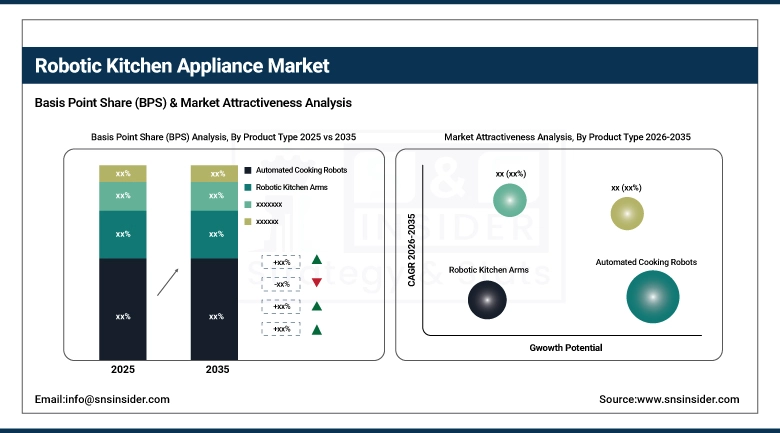
By Product Type: In 2025, Automated Cooking Robots dominated with 48% share; Smart Kitchen Assistants are the fastest-growing segment during 2026–2035.
-
By Component: In 2025, Hardware dominated with 52% share; Sensors & Control Systems are the fastest-growing segment during 2026–2035.
-
By Level of Autonomy: In 2025, Semi-Autonomous Robots dominated with 55% share; Fully Autonomous Robots are the fastest-growing segment during 2026–2035.
-
By Application: In 2025, Commercial Kitchens dominated with 60% share; Residential segment is the fastest-growing during 2026–2035.
By Product Type: Automated Cooking Robots Lead as Smart Kitchen Assistants Expand Rapidly
Automated Cooking Robots dominate the Robotic Kitchen Appliance market due to widespread adoption in commercial kitchens, restaurants, cloud kitchens, and institutional food services. These systems provide consistent cooking quality, labor savings, and seamless integration with existing kitchen workflows, making them the preferred choice for businesses seeking efficiency and precision.
Smart Kitchen Assistants are expanding rapidly, driven by growing residential adoption, increasing consumer demand for convenience, and integration with AI and IoT-enabled recipe management systems. Advancements in voice control, personalization, and multifunctional cooking capabilities are accelerating their adoption, particularly in smart homes and premium commercial kitchens.
By Component: Hardware Leads as Sensors & Control Systems Gain Momentum
Hardware dominates the market due to the high demand for robotic arms, motors, processors, and kitchen-grade platforms required for safe and efficient operation. The significant upfront investment in physical components and appliance manufacturing keeps hardware as the largest revenue segment.
Sensors & Control Systems are gaining momentum as companies integrate AI, computer vision, temperature, and ingredient detection sensors into appliances. These technologies improve precision, enable automated decision-making, and enhance safety. Cloud-based monitoring, predictive maintenance, and remote control capabilities are increasingly adopted to enable scalable and reliable deployment across both commercial and residential applications.
By Level of Autonomy: Semi-Autonomous Robots Lead as Fully Autonomous Accelerates
Semi-autonomous robots dominate due to current technological maturity, regulatory acceptance, and the need for occasional human supervision in complex kitchen environments. Many deployments rely on human oversight for tasks such as monitoring cooking processes, ingredient handling, and ensuring food safety, making semi-autonomous robots the most widely adopted segment.
Fully autonomous robots are accelerating rapidly as advancements in AI, computer vision, and sensor fusion improve reliability and allow end-to-end cooking automation with minimal human intervention. Pilot deployments in cloud kitchens, hotels, and high-volume restaurants demonstrate efficiency gains and consistency, encouraging faster adoption of fully autonomous solutions in controlled environments.
By Application: Commercial Kitchens Lead as Residential Adoption Expands
Commercial kitchens dominate the market due to high demand from restaurants, cloud kitchens, hotels, and institutional food services. Businesses adopt robotic kitchen appliances to reduce labor dependency, improve operational efficiency, maintain food consistency, and meet growing consumer expectations for high-quality, fast service.
Residential adoption is expanding rapidly, driven by smart home integration, AI-assisted cooking solutions, and increasing consumer preference for convenience and time-saving appliances. Robotic kitchen appliances provide scalable, hygienic, and user-friendly solutions for households, making them ideal for the fast-growing connected kitchen and smart home market.
Robotic Kitchen Appliance Market Regional Analysis:
North America Robotic Kitchen Appliance Market Insights:
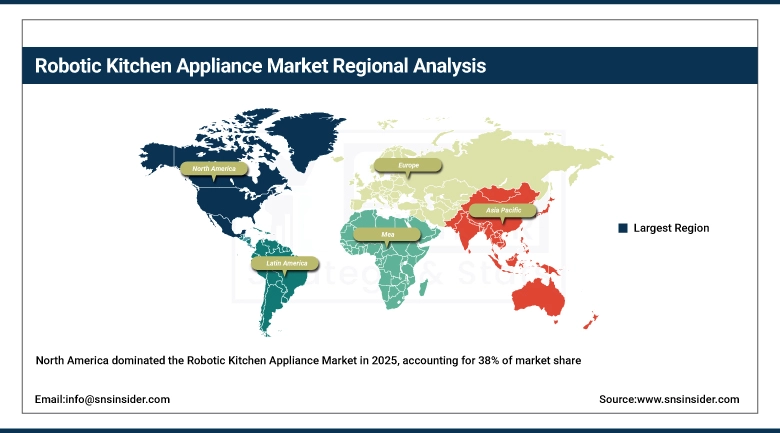
In 2025, North America’s Robotic Kitchen Appliance Market accounting for the highest regional revenue share of approximately 38% in 2025. North America’s dominance is attributed to high adoption of automation in commercial and residential kitchens, increasing demand for labor-efficient food preparation, and strong investments in robotic kitchen appliances. Advanced technology infrastructure, including AI, robotics, IoT, and smart kitchen platforms, has supported large-scale deployments. Additionally, favorable regulatory support, extensive pilot programs, and strong consumer acceptance of automation have further accelerated market growth in the region.
Get Customized Report as per Your Business Requirement - Enquiry Now
U.S. and Canada Robotic Kitchen Appliance Market insights:
The U.S. and Canada dominate the North American Robotic Kitchen Appliance market, driven by high adoption of automation in commercial kitchens, cloud kitchens, and restaurants, rising labor costs, and increasing consumer demand for smart home cooking solutions. Advanced AI, robotics, sensors, and IoT integration, along with strong infrastructure and supportive regulations, have enabled large-scale deployments. Pilot programs and growing acceptance of smart kitchen technologies further accelerate market expansion in both countries.
Asia Pacific Robotic Kitchen Appliance Market Insights:
Asia Pacific represents a high-growth region for the Robotic Kitchen Appliance market, registering a CAGR of 20.08% during 2026–2035. This high growth is driven by rapid adoption of automation in commercial and residential kitchens, increasing demand for labor-efficient food preparation, and rising investments in robotic kitchen appliances. The region’s large population, growing urbanization, and expanding food service industry have created strong demand for fast, consistent, and cost-effective cooking solutions. Additionally, supportive government initiatives, smart kitchen programs, and advancements in AI, robotics, and IoT have accelerated pilot projects and commercial deployments, boosting market growth during 2026–2035.
Europe Robotic Kitchen Appliance Market Insights:
Europe’s growth is driven by increasing adoption of automation in restaurants, hotels, and commercial kitchens, rising labor costs, and strong demand for consistent, high-quality food preparation. The region’s focus on smart kitchens, advanced technology infrastructure, and integration of AI, robotics, and IoT has supported large-scale deployments. Additionally, supportive regulations, pilot programs, and growing consumer acceptance of automation are accelerating market adoption, contributing to steady growth in Europe during 2026–2035.
Latin America Robotic Kitchen Appliance Market Insights:
Latin America’s growth is driven by increasing adoption of automation in commercial kitchens, restaurants, and hospitality sectors, coupled with rising labor costs and the need for operational efficiency. Growing urbanization, expansion of food delivery services, and rising consumer demand for convenient and time-saving cooking solutions are fueling market expansion. Additionally, supportive government initiatives, pilot programs, and advancements in AI, robotics, and IoT integration are accelerating deployments, boosting the Robotic Kitchen Appliance market in the region during 2026–2035.
Middle East and Africa Robotic Kitchen Appliance Market Insights:
The Middle East and Africa’s growth is driven by increasing adoption of automation in commercial kitchens, hotels, and institutional food services, rising labor costs, and the need for consistent, efficient food preparation. Rapid urbanization, expansion of food delivery services, and growing demand for smart cooking solutions are fueling market expansion. Additionally, supportive government initiatives, pilot programs, and advancements in AI, robotics, and IoT integration are accelerating deployments, boosting the Robotic Kitchen Appliance market in the region during 2026–2035.
Robotic Kitchen Appliance Market Competitive Landscape:
ABB Group (ABB Robotics) is a leading automation and robotics company providing advanced robotic solutions, including food service and kitchen automation systems that enhance speed, precision, and consistency in meal preparation. ABB’s robots are used to assemble meals, automate prep tasks, and support smart kitchen workflows across commercial and hospitality environments.
-
April 2025, ABB and BurgerBots unveiled a robotic burger‑making kitchen in Los Gatos, California, deploying IRB 360 FlexPicker and YuMi robots for precision meal assembly.
Anova Culinary is a major smart kitchen appliance brand known for connected cooking devices that simplify home food preparation through precise temperature control and intelligent features. The company’s products, such as sous vide and connected combi ovens, integrate smart technology to elevate everyday cooking.
-
July 2025, Anova Culinary announced global availability of its Anova Precision Oven 2.0, a connected countertop oven with AI food recognition and live remote monitoring to revolutionize home cooking
Bear Robotics Inc. specializes in AI‑powered autonomous service robots for restaurant and hospitality operations, automating tasks like food delivery, bussing, and logistics to improve efficiency and reduce labor strain. Its flagship products include Servi, Servi Plus, and Carti robots built for dynamic service environments.
-
January 2025, LG Electronics secured a majority stake (51%) in Bear Robotics to accelerate innovation across commercial and home robotics platforms.
Robotic Kitchen Appliance Companies are:
-
ABB Group (ABB Robotics)
-
Bear Robotics Inc.
-
Briggo, Inc.
-
Chowbotics (Sally)
-
Dexai Robotics Inc.
-
Dishcraft Robotics
-
KUKA AG
-
Miso Robotics
-
Moley Robotics
-
Niryo Robotics SAS
-
Nymble Labs / Posha
-
Panasonic Holdings Corporation
-
QSR Automations
-
Remy Robotics
-
Samsung Electronics Co. Ltd.
-
Sony Group Corporation
-
Sweetgreen (Infinite Kitchen automation)
-
Zimplistic / Rotimatic
| Report Attributes | Details |
|---|---|
| Market Size in 2025 | USD 4.18 Billion |
| Market Size by 2035 | USD 18.90 Billion |
| CAGR | CAGR of 16.28% From 2026 to 2035 |
| Base Year | 2025 |
| Forecast Period | 2026-2035 |
| Historical Data | 2022-2024 |
| Report Scope & Coverage | Market Size, Segments Analysis, Competitive Landscape, Regional Analysis, DROC & SWOT Analysis, Forecast Outlook |
| Key Segments | •By Product Type: (Robotic Kitchen Arms, Automated Cooking Robots, Smart Kitchen Assistants) •By Component: (Hardware, Software, Sensors & Control Systems) •By Level of Automation: (Semi-Autonomous Robots, Fully Autonomous Robots, Assisted Robotics) •By Application: (Residential, Commercial Kitchens, Industrial Kitchens) |
| Regional Analysis/Coverage | North America (US, Canada), Europe (Germany, UK, France, Italy, Spain, Russia, Poland, Rest of Europe), Asia Pacific (China, India, Japan, South Korea, Australia, ASEAN Countries, Rest of Asia Pacific), Middle East & Africa (UAE, Saudi Arabia, Qatar, South Africa, Rest of Middle East & Africa), Latin America (Brazil, Argentina, Mexico, Colombia, Rest of Latin America). |
| Company Profiles | ABB Group (ABB Robotics), Anova Culinary, Bear Robotics Inc., Briggo, Inc., Chowbotics (Sally), Dexai Robotics Inc., Dishcraft Robotics, HeroX, KUKA AG, Miso Robotics, Moley Robotics, Niryo Robotics SAS, Nymble Labs / Posha, Panasonic Holdings Corporation, QSR Automations, Remy Robotics, Samsung Electronics Co. Ltd., Sony Group Corporation, Sweetgreen (Infinite Kitchen automation), Zimplistic / Rotimatic. |
Frequently Asked Questions
North-America dominated the Robotic Kitchen Appliance market in 2025.
The Commercial Kitchens segment dominated the Robotic Kitchen Appliance market, driven by high adoption in restaurants, cloud kitchens, and hospitality sectors.
The key drivers of the Robotic Kitchen Appliance market are increasing automation in food preparation, rising smart kitchen adoption, labor cost reduction, and advancements in AI, robotics, and IoT integration.
The market was valued at USD 4.18 Billion in 2025 and is projected to reach USD 18.90 Billion by 2035.
The Robotic Kitchen Appliance market is expected to grow at a CAGR of 16.28% during 2026-2035.
