
Sesame Seeds Market Report Scope & Overview:
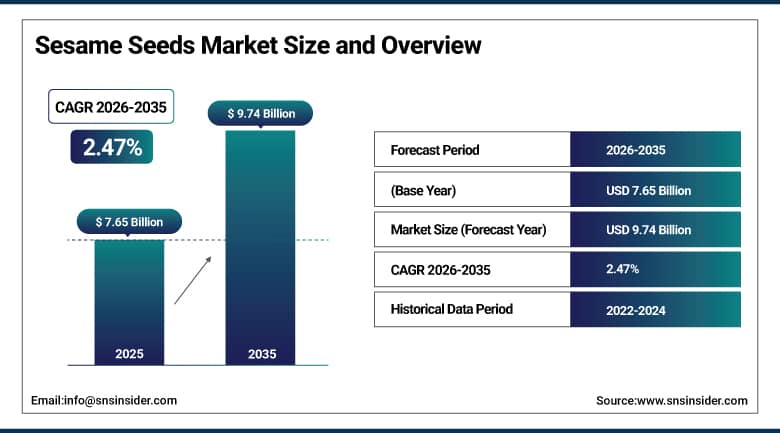
The Sesame Seeds Market was valued at USD 7.65 Billion in 2025 and is expected to reach USD 9.74 Billion by 2035, growing at a CAGR of 2.47% from 2026–2035.
Sesame seeds belong to the category of oilseeds and are one of the most ancient cultivated plants by humans. They have been used throughout history in different industries such as baking and candy-making, cooking oil production, tahini and sesame paste manufacture, as well as in a new health supplement market. Global consumption of sesame seeds is increasing constantly since there is increased production by food processors and consumption by health-oriented individuals. In terms of production, Sub-Saharan Africa and South Asia are leading countries, while East and Southeast Asia are driving consumer demand and imports. The industry has both supply-driven characteristics and is dependent on consumer demand. The harvesting process is relatively laborious and weather-dependent. The world's biggest producers include Sudan, India, Myanmar, China, Ethiopia, and Tanzania, which produce more than 80% of world production.
Aflatoxin contamination limits in the European Union and Japan have forced sesame-exporting countries to invest significantly in pre-shipment testing and quality assurance infrastructure. These standards have raised the barrier to EU and Japanese market entry for producers without certified testing capabilities and bonded storage facilities.
To Get More Information On Sesame Seeds Market - Request Free Sample Report
Sesame Seeds Market Trends
-
Growing consumer preference for plant-based proteins and healthy fats is driving sesame adoption in health-conscious food categories including protein bars, trail mixes, and functional snack products across North American and European markets.
-
Demand for organic sesame seeds is growing faster than the overall market as food manufacturers respond to clean-label consumer preference for naturally grown, pesticide-free ingredients in premium bakery and health food formulations.
-
Sesame oil demand is rising in Asia Pacific food processing as health-focused consumers choose it for its recognized antioxidant content and nutritional profile relative to other widely available cooking oil alternatives.
-
Japanese, South Korean, and Chinese food manufacturers are increasing sesame seed procurement as traditional culinary applications and sesame-enriched functional food launches expand beyond conventional staple ingredient uses.
-
Mechanization investment in sesame cultivation and post-harvest processing in Sudan, Ethiopia, and India is gradually improving supply chain efficiency and reducing the post-harvest losses that have historically constrained export quality and volume.
The U.S. Sesame Seeds Market Outlook
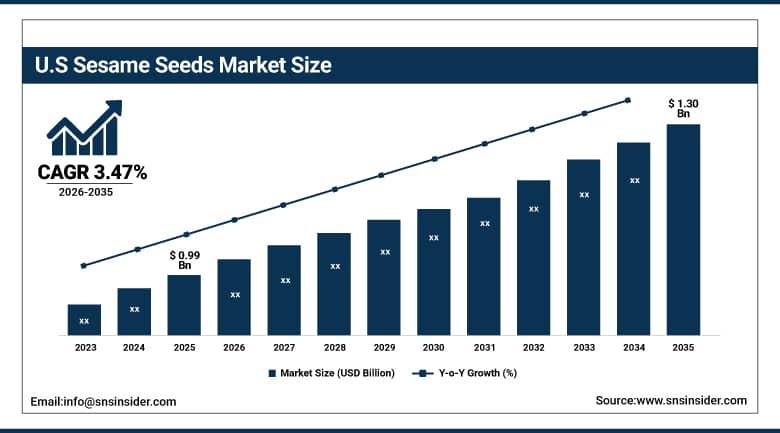
The U.S. Sesame Seeds Market was valued at approximately USD 0.99 Billion in 2025 and is expected to reach approximately USD 1.30 Billion by 2035, growing at a CAGR of 3.47%.
The U.S. is among the world’s biggest importers of sesame seeds. The country obtains its sesame seeds mainly from India, Ethiopia, Guatemala, Nigeria, and Paraguay. There is very little sesame production within the U.S. The main source of sesame seed consumption in the U.S. comes from the food processing industry; especially commercial bakeries and hamburger bun manufacturing. Quick-service restaurants have large chains requiring large amounts of sesame seeds in making buns. Retail tahini, sesame oil, and sesame snacks are gaining a lot of customers due to an increase in health food retail stores. Increased health food retailing has been a significant factor in the increased demand of sesame-based products in the U.S. The sale of tahini has been increasing steadily because of the increased popularity of Middle Eastern cuisine in the U.S.
U.S. imports of sesame seeds from India exceeded 45,000 metric tons in 2024, making India the single largest supply source. Import diversification toward Ethiopia, Paraguay, and Guatemala has grown as buyers seek supply chain resilience beyond single-country dependency and manage aflatoxin risk through broader sourcing.
Sesame Seeds Market Segment Analysis
-
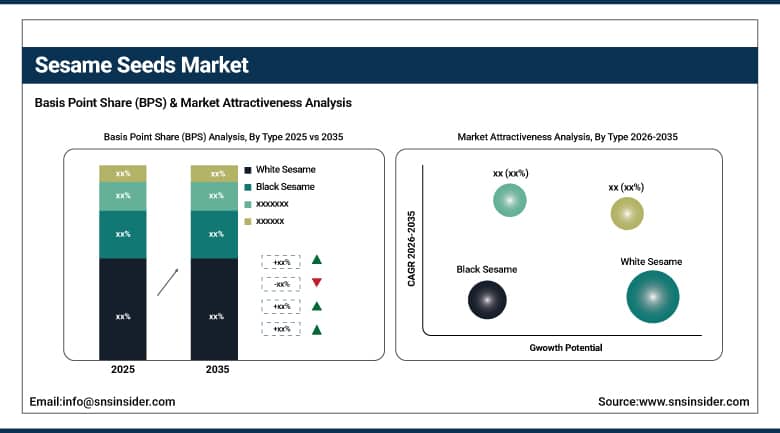
By Type, White Sesame dominated with approximately 42.36% share in 2025; Black Sesame is the fastest-growing type at a CAGR of 4.12%, driven by rising popularity in Asian cuisine, functional food, and premium consumer health products in Western markets.
-
By Application, Food & Bakery held the largest share of approximately 47.21% in 2025; Health Supplements are the fastest-growing application at a CAGR of 4.28%, driven by sesame lignan and sesamin supplement products targeting cardiovascular and antioxidant health.
-
By Distribution Channel, Supermarkets and Hypermarkets held approximately 44.67% share in 2025; Online Retail is the fastest-growing channel at a CAGR of 4.41% as specialty and organic sesame products reach consumers beyond local retail availability.
-
By Source, Conventional sesame seeds dominated with the large majority of revenues in 2025; Organic sesame seeds are the fastest-growing source segment as food manufacturers developing clean-label products seek certified traceable sesame ingredient supply.
By Type, white sesame dominates, black sesame grows fastest
The share of white sesame seeds in the total sesame seed market revenue was approximately 42.36%. This commercial prevalence of white sesame seeds derives from its broadest spectrum of applications among all types of sesame. White sesame seeds are generally used as hamburger bun and bread toppings, tahini manufacturing, sesame oil preparation, and confectionery products all over the world. Its somewhat more neutral taste than the one of the black varieties makes it the standard product when food companies need sesame in foods but with little distinctive flavor.
Black sesame seeds represent the fastest growing type at a CAGR of 4.12% till 2035. The unique flavor that is nutty and a bit bitter, associated with black sesame seeds, becomes widely accepted in Asian cuisine where black sesame soup, paste, and other types of confectionery products made with this variety are already popular. More and more health-conscious consumers in Western countries are beginning to appreciate the nutritional benefits of black sesame products. This is because black sesame seeds contain more antioxidants than white sesame varieties.
By Application, food & bakery dominates, health supplements grow fastest
The food and bakery segment accounted for approximately 47.21% of revenues in the market for sesame seeds in 2025. This category comprises all commercial food processing applications ranging from bread and bun toppings, crackers and biscuits, candies and confections coatings, to processed snacks. The growth in bakery production globally is the key driving force behind this category. The size of bakery production by industries in Asia, North America, and Europe translates into large quantities of sesame seed requirements that are largely predictable and steady. Topping of bread buns for use in quick-service restaurants has been noted as among the largest individual applications in the whole market.
Health supplements represent the fastest-growing application area in the market at a CAGR of 4.28% to 2035. Sesame seeds contain lignans which include compounds such as sesamin and sesamolin that exhibit antioxidant activity and reduce cholesterol levels in humans. Standardized sesame lignan supplements and sesame-containing proteins are emerging among sports nutritional and general wellness supplements. The organic nature of the seed aligns with current demands for supplements and their components. Some of the nutraceutical companies have introduced sesame-containing products recently addressing various aspects such as cardiovascular support, joint health, and antioxidants.
Regional Analysis
|
Region |
Major Country |
Share within Region, 2025 (%) |
|---|---|---|
|
North America |
United States |
78.3% |
|
Europe |
Germany |
24.8% |
|
Asia Pacific |
India |
38.7% |
|
Middle East & Africa |
Sudan |
33.5% |
|
Latin America |
Mexico |
38.6% |
Asia Pacific Sesame Seeds Market Insights
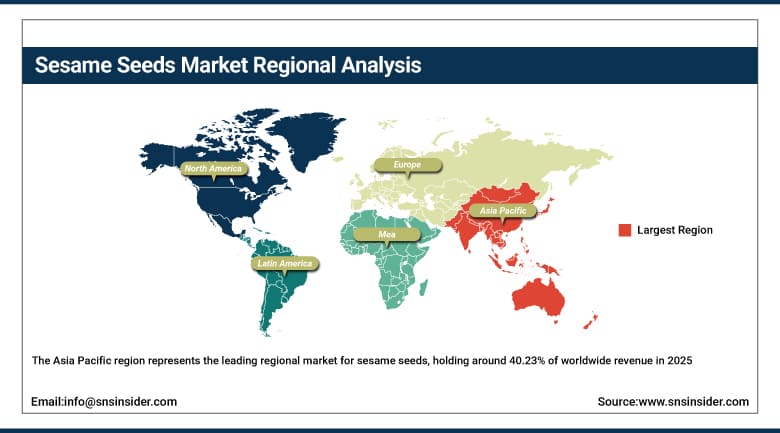
The Asia Pacific region represents the leading regional market for sesame seeds, holding around 40.23% of worldwide revenue in 2025. The country of India holds around 38.7% of the revenue share in Asia Pacific since the nation represents one of the biggest producers as well as exporters of sesame as a consumer. The country of China is one of the biggest producers of sesame and also serves as the leading sesame processing market across the globe. Countries such as Japan, South Korea, and some Southeast Asian nations represent important importers of sesame due to their high per capita sesame consumption.
Get Customized Report as Per Your Business Requirement - Enquiry Now
North America Sesame Seeds Market Insights
The fastest-growing sesame seeds market is North America, which has a CAGR of 3.33% up until 2035. In North America, approximately 78.3% of revenues come from the United States, owing to the nation's position as one of the largest consumers and importers. The market growth in North America is fueled by the increased adoption of Asian cuisine among mainstream consumers, increased market size for tahini and hummus, as well as the increased use of sesame-based products in the premium health food segment. Market supply is almost completely comprised of imports. Among the main countries supplying sesame seeds to the United States market are India, Ethiopia, and Guatemala. The Canadian sesame seeds market, although relatively small, has been experiencing considerable growth due to increasing numbers of health food consumers and the development of an Asian restaurant culture in large urban centers in the country. There has been an increase in the number of different brands of organic sesame seeds, tahini, and black sesame seeds sold in Canadian health food stores from Asia and the Middle East.
Europe Sesame Seeds Market Insights
The sesame seed market in Europe is a mature market, driven by bakery products, consumption of tahini and hummus products, and increased imports of organic ingredients from sesame seeds. Germany constitutes about 24.8% of the European market since it is the biggest food processing country in the EU region. The restrictions on aflatoxins in sesame seeds in the EU have contributed to sourcing certified sesame from pre-tested sources. This has created a competitive advantage for sesame exporters from India and Ethiopia due to the quality control and testing infrastructure that comply with the stringent standards required by the European food processors. The Middle East food culture is now the norm in Europe's urban areas. Tahini, hummus, and sesame topped flat breads have been included in the normal foods in Europe's grocery stores.
MEA & Latin America Sesame Seeds Market Insights
The Middle East and Africa are strategically important as both the world's largest sesame production base and a substantial consuming market. Sudan accounts for approximately 33.5% of MEA revenues as the world's leading sesame exporter by volume. Ethiopia, Tanzania, Nigeria, and Mozambique are major producers whose export volumes supply Asian and European importing markets. Sub-Saharan African sesame is primarily exported in raw seed form, capturing limited downstream processing value. Mexico leads Latin American revenues at approximately 38.6% through extensive sesame use in traditional confectionery, mole sauces, and bakery with a deeply established food culture that sustains consistent domestic demand.
Market Dynamics
Growth Drivers: Expanding bakery and food processing industries, growing health-focused consumer demand for sesame products, and rising Asian food culture adoption in Western markets are driving sesame seeds market growth.
Expansion of the global bakery and food processing industries is the most economically important cause of increased demand for sesame seeds. Baking of bread in North America, confectionary in Asia, and snack making all over the world use large quantities of sesame. Rising global population and urbanization trends are increasing the number of consumers for processed foods containing sesame as a regular ingredient. Consistency of purchasing behavior of the bakery industry accounts for the most steady element of demand for sesame seeds. Growing awareness of consumers about health issues is fueling a new premium market for products made from sesame seeds. Sesame seeds naturally contain calcium, iron, and zinc. Lignan content of sesame seeds has made them of great interest for researchers within the supplement industry and academia. Tahini is now used as a regular food product in Western countries.
Restraints: Supply chain concentration in a limited number of producing countries, aflatoxin contamination risk, and weather-related crop price volatility are restraining sesame seeds market growth.
Risk of prices/availability is posed by the concentration of the supply chain. The largest five producers account for more than 80% of world production. Climatic changes such as droughts in Sudan, cyclones damaging Indian farms, and floods in Myanmar have all been responsible for huge crop failures in the past, thus causing price surges. Companies involved in the manufacturing of food products that require consistent supplies of sesame find it difficult to mitigate against such disruptions since there are no functional substitutes for sesame in the existing bakery and confectionery product formulations. One quality problem associated with the supply chain of sesame is aflatoxins. These fungi survive in warm and moist conditions which exist in the main production zones after harvesting. The rejection of imported sesame from the EU or Japan due to aflatoxin infestation is a business opportunity lost.
Opportunities: Organic and certified sesame supply chain development, black sesame health product expansion in Western markets, and sesame oil growth in premium cooking categories represent the key sesame seeds market opportunities.
Organic sesame seeds represent a premium growth market. Food manufacturers developing clean-label, organically certified products need sesame that is traceable, consistently quality-certified, and available in commercial volumes. The supply of certified organic sesame is limited relative to demand. Producers and exporters investing in organic certification and building long-term supply relationships with premium food brands can capture meaningful price premiums over conventional sesame. This premium makes organic sesame one of the more commercially attractive investment cases in the sesame value chain. Black sesame's commercial potential in Western health food markets is largely underdeveloped. Its nutritional differentiation from white sesame is genuine and scientifically supportable. Its distinctly flavored profile creates sensory differentiation that supports premium product positioning.
Recent Developments:
-
2025: Olam Agri expanded its sesame processing capacity in Nigeria, investing in cleaning, sorting, and quality testing infrastructure to reduce post-harvest loss rates and improve the export grade quality meeting EU and Japanese import standards.
-
2025: The Ethiopian Agricultural Transformation Institute reported expanded sesame mechanization programmes in the Humera and Metema regions, supporting productivity improvements that are gradually reducing Ethiopia's per-kilogram production cost.
-
2025: Kikkoman and Otafuku expanded their sesame product range with new black sesame-flavored condiments and cooking sauces targeting both domestic Japanese consumers and export retail markets in Europe and North America.
Sesame Seeds Market Key Players are:
-
Olam International Ltd.
-
Sanjay Agro Industries
-
Agro Products and Agencies
-
Dipasa Group
-
Avi-Agro Industries Ltd.
-
BIO Sesame Ltd.
-
Sardin Food Industries Ltd.
-
Shyam Industries
-
Siam Sesame Co. Ltd.
-
Selet Hulling PLC
-
SunOpta Inc.
-
Purity Foods Inc.
-
Sesacom SA
-
Bunge Limited
-
Louis Dreyfus Company
-
ADM (Archer Daniels Midland)
-
Once Again Nut Butter
-
Dipasa USA Inc.
-
Yakin Maritime Trading
-
Ethiopian Oil Seeds and Pulses Export Association
Sesame Seeds Market Report Scope:
| Report Attributes | Details |
|---|---|
| Market Size in 2025 | USD 7.65 Billion |
| Market Size by 2035 | USD 9.74 Billion |
| CAGR | CAGR of 2.47% From 2026 to 2035 |
| Base Year | 2025 |
| Forecast Period | 2026-2035 |
| Historical Data | 2022-2024 |
| Report Scope & Coverage | Market Size, Segments Analysis, Competitive Landscape, Regional Analysis, DROC & SWOT Analysis, Forecast Outlook |
| Key Segments | • By Type (White Sesame, Black Sesame, Brown Sesame, Others) • By Application (Food & Bakery, Confectionery, Oil Extraction, Health Supplements, Cosmetics & Personal Care, Others) • By Source (Organic, Conventional) • By Distribution Channel (Supermarkets & Hypermarkets, Specialty Stores, Online Retail, Wholesale Distributors, Others) |
| Regional Analysis/Coverage | North America (US, Canada), Europe (Germany, UK, France, Italy, Spain, Russia, Poland, Rest of Europe), Asia Pacific (China, India, Japan, South Korea, Australia, ASEAN Countries, Rest of Asia Pacific), Middle East & Africa (UAE, Saudi Arabia, Qatar, South Africa, Rest of Middle East & Africa), Latin America (Brazil, Argentina, Mexico, Colombia, Rest of Latin America). |
| Company Profiles | Olam International Ltd., Sanjay Agro Industries, Agro Products and Agencies, Dipasa Group, Avi-Agro Industries Ltd., BIO Sesame Ltd., Sardin Food Industries Ltd., Shyam Industries, Siam Sesame Co. Ltd., Selet Hulling PLC, SunOpta Inc., Purity Foods Inc., Sesacom SA, Bunge Limited, Louis Dreyfus Company, ADM (Archer Daniels Midland), Once Again Nut Butter, Dipasa USA Inc., Yakin Maritime Trading, and Ethiopian Oil Seeds and Pulses Export Association. |
Frequently Asked Questions
Asia Pacific dominated the Sesame Seeds Market in 2025 with approximately 40.23% of global revenues.
White Sesame dominated with approximately 42.36% of revenues in 2025.
Expanding global bakery and food processing industries are the primary volume driver. Growing consumer health awareness is creating a premium demand segment for organic sesame and sesame-derived functional food and supplement products.
The Sesame Seeds Market was valued at USD 7.65 Billion in 2025.
The Sesame Seeds Market is expected to grow at a CAGR of 2.47% from 2026 to 2035.
