
Sleep Tracking Device Market Scope & Overview:
The Sleep Tracking Device Market was estimated at USD 31.35 billion in 2025 and is expected to reach USD 129.12 billion by 2035 and grow at a CAGR of 15.22% over the forecast period of 2026-2035.
The global sleep tracking device market is the rising preference for lightweight, wrist-based, and compact wearables that allow continuous, non-intrusive monitoring. Improved comfort, advanced sensors, and accurate tracking of heart rate variability, oxygen saturation, and movement encourage daily and nighttime use, increasing adoption worldwide.

To Get more information On Sleep Tracking Device Market - Request Free Sample Report
Sleep Tracking Device Market Trends:
-
Rising Focus on Sleep Health & Wellness
-
Growing Adoption of Wearable Technologies
-
Integration with Smartphones & Digital Health Platforms
-
Use of Artificial Intelligence & Advanced Analytics
-
Expansion of Preventive & Remote Health Monitoring
The U.S. Sleep Tracking Device Market is projected to grow from USD 9.29 Billion in 2025 to USD 29.50 Billion by 2035, at a CAGR of 8.83%. Growth is driven by high wearable adoption, rising sleep health awareness, advanced digital health infrastructure, and increasing use of preventive and remote health monitoring solutions.

Sleep Tracking Device Market Drivers:
The global sleep tracking device market is driven by rising awareness of sleep’s impact on physical and mental health. Demand is fueled by the growing prevalence of sleep-related issues linked to stress, long working hours, and lifestyle factors. Widespread adoption is supported by the increasing penetration of smartwatches and connected wearable devices, which integrate seamlessly with smartphones, fitness apps, and wellness platforms.
Advances in sensors, artificial intelligence, and data analytics are enhancing accuracy and personalization. At the same time, preventive healthcare, remote monitoring, and employer-supported wellness initiatives are further boosting adoption and market growth worldwide
Sleep Tracking Device Market Restraints:
The sleep tracking device market faces several constraints that may limit growth. Data privacy and security concerns are significant, as the collection and storage of sensitive health information can affect user trust and regulatory compliance. Accuracy limitations, especially compared with clinical-grade sleep studies, reduce confidence in detecting sleep disorders.
High device costs and recurring subscription fees further restrict adoption among price-sensitive consumers. Limited awareness of sleep tracking benefits, battery life constraints, and discomfort during sleep can reduce consistent usage, negatively impacting long-term user engagement and retention.
Sleep Tracking Device Market Opportunities:
The sleep tracking device market offers significant growth opportunities driven by evolving consumer behavior and healthcare trends. Rising awareness of preventive healthcare supports broader adoption of sleep trackers for early detection and long-term wellness monitoring. Integration with digital health platforms, telehealth services, and employer wellness programs extends use beyond personal fitness.
Advances in artificial intelligence and data analytics enable personalized and predictive sleep insights, while increasing acceptance of remote patient monitoring and collaboration with healthcare providers opens clinical and insurance-supported applications. Demand for premium devices, subscription-based insights, and non-intrusive wearables further strengthens global revenue potential.
Sleep Tracking Device Market Segment Analysis:
-
By product type, wearable sleep tracking devices held the largest share of approximately 57.28% in 2025, and non-wearable sleep monitors are expected to register the highest growth with a CAGR of 16.04%.
-
By technology, actigraphy-based sleep tracking dominated the market with approximately 61.35% share in 2025, while AI-based sleep analytics and multi-sensor technology are expected to register the highest growth with a CAGR of 16.87%.
-
By application, personal wellness and lifestyle improvement accounted for the leading share of nearly 42.16% in 2025, and clinical health monitoring is expected to register the highest growth with a CAGR of 15.98%.
-
By connectivity, Bluetooth and connectivity segment held the largest share of approximately 64.22% in 2025, while Wi-Fi connectivity is expected to register the highest growth with a CAGR of 15.74%.
-
By end user, individual consumers accounted for the leading share of nearly 49.63% in 2025, and hospitals and sleep clinics are expected to register the highest growth with a CAGR of 16.11%.
By Product Type, Wearable Sleep Tracking Devices Lead the Market, While Non-Wearable Sleep Monitors Register Fastest Growth
The segment of wearable sleep trackers generated the largest revenue share of around 57.28% in 2025 owing to the high penetration of advanced wearable gadgets such as smartwatches, fitness trackers, and biosensors that offer uninterrupted sleep analysis and insights into user health. These sleep tracking devices are portable and convenient, and their ability to connect to mobile health apps makes them the most sought-after by individuals concerned about their fitness and health management. Conversely, the category of non-wearable sleep trackers is expected to witness the highest CAGR of around 16.04% from 2026 to 2035 owing to growing preference for touchless sleep tracking systems.
By Technology, Actigraphy-Based Sleep Tracking Dominates, While AI-Based Sleep Analytics and Multi-Sensor Technology Show Rapid Growth
The actigraphy-based sleep tracking method held the maximum market share of 61.35%, driven by its wide use and clinical acceptability in monitoring the sleep-wake cycle and circadian rhythm. The actigraphy-based technology is highly reliable and affordable, suitable for wide consumer use and long-term tracking of sleep patterns. AI-based sleep analysis and multisensors are anticipated to have the maximum CAGR of around 16.87% during 2026 to 2035, owing to rising use of algorithms for analysis of heart rate variation, respiration, body movements, and environment variables. Some of the factors fueling the demand include personalized sleep data analytics and prediction of sleep problems.
By Application, Personal Wellness and Lifestyle Improvement Lead, and Clinical Health Monitoring Registers Fastest Growth
The Personal wellness and lifestyle improvement segment with the highest market share accounted for approximately 42.16% of the market in 2025 due to growing awareness among consumers about sleep health, fitness trend, and increasing use of digital health applications. Consumers are using sleep tracking devices to help them in organizing their days and being productive. Clinical health tracking is expected to record the highest growth rate or CAGR of around 15.98% from 2026 to 2035 because hospitals will be adopting more sleep tracking devices as part of the clinical process. The rise in sleep disorders such as insomnia and sleep apnea and increased demand for remote patient monitoring will drive the adoption rate.
By Connectivity, Bluetooth Segment Leads, While Wi-Fi Connectivity Registers Fastest Growth
The Bluetooth and connectivity segment was the most dominant one with around 64.22%, backed up by its low power usage, easy pairing with smartphone devices, and high levels of compatibility among consumer goods. Sleep trackers with Bluetooth technology ensure easy data syncing and convenient application connectivity. The Wi-Fi connectivity market is predicted to be the fastest growing segment at a CAGR of around 15.74%. This trend is expected due to the rising need for data transfer via clouds and integration into a connected health care system in the household.
By End User, Individual Consumers Lead, and Hospitals and Sleep Clinics Register Fastest Growth
The individual consumer was found to be holding the largest market share of about 49.63% in 2025 due to the rising demand for wearable health technologies among consumers and their growing interest in preventive healthcare and self-monitoring. Availability and affordability of devices, along with high awareness of digital solutions, have been supporting rapid adoption among this group of users. It is expected that hospitals and sleep clinics would post the fastest CAGR of about 16.11% during 2026 to 2035, owing to the rising adoption of sleep monitoring technologies in the diagnostic process.
Regional Insights:
North America Sleep Tracking Device Market
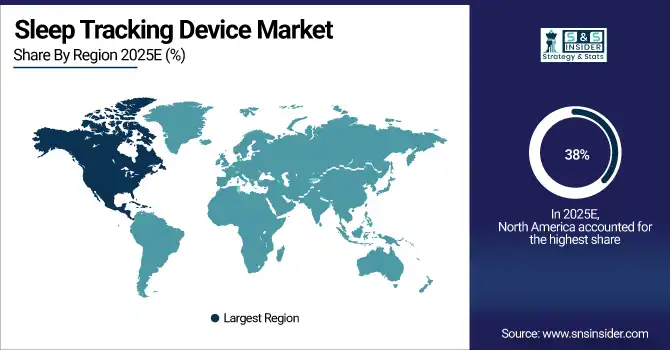
North America leads the sleep tracking device market with a 38% share, driven by strong digital health infrastructure and high adoption of wearable technologies. Growing awareness of sleep’s role in overall well-being supports widespread use of devices tracking heart rate, movement, and oxygen levels.
Get Customized Report as per Your Business Requirement - Enquiry Now
The United States dominates the regional market due to high consumer spending, early adoption of smart wearables, and advanced healthcare integration. Strong presence of leading manufacturers, extensive smartphone usage, and preventive health initiatives continue to reinforce U.S. market leadership.
Asia Pacific Sleep Tracking Device Market
The Asia Pacific sleep tracking devices market is projected to grow at an 18.60% CAGR from 2026 to 2035, driven by rising health awareness, increasing disposable incomes, and growing adoption of wearable technologies. Lifestyle stress and long working hours are boosting demand for sleep monitoring solutions.
China, Japan, and South Korea dominate regional adoption due to advanced technology uptake and strong consumer awareness. Rapid growth in India and Southeast Asia is supported by expanding smartphone penetration, digital health ecosystems, and a growing middle class, despite cost, privacy, and regulatory challenges.
Europe Sleep Tracking Device Market
The European sleep tracking device market is being driven by rising health awareness and increasing adoption of wearable and connected technologies. Greater emphasis on preventive care and overall well-being is supporting demand for continuous monitoring of heart rate, movement, and blood oxygen levels.
Germany, the United Kingdom, France, and Nordic countries dominate regional adoption due to strong fitness culture, employer wellness programs, and advanced digital health infrastructure. Growing use of remote monitoring and partnerships between device manufacturers and healthcare providers continue to support market expansion.
Middle East, Africa and Latin American Sleep Tracking Device Market
The sleep tracking device market in the Middle East & Africa and Latin America is showing gradual growth, driven by rising health awareness and increasing adoption of wearable technologies. Growing emphasis on sleep quality and overall well-being is boosting demand for monitoring heart rate, movement, and blood oxygen levels. Smartphone and internet penetration support adoption, especially in urban areas. Higher uptake is seen in Gulf countries, Brazil, and Mexico, with improved connectivity and affordable devices supporting future growth.
Competitive Landscape:
Apple Inc.: Apple Inc. is the leading brand in the global smart sleep tracking device market, driven by the widespread adoption of its Apple Watch portfolio. Sleep tracking is deeply integrated into Apple’s broader health ecosystem, enhancing user engagement and long-term usage. Apple holds a significant share of the global smartwatch installed base, with tens of millions of Apple Watch units shipped annually. This large installed base enables extensive adoption of sleep tracking features over the product lifecycle, reinforcing Apple’s strong numerical and competitive position in the global market.
-
September, 2025: Apple introduces groundbreaking health features to support conditions impacting billions of people, Apple Watch delivers new sleep apnea notifications.
Fitbit(Google): Fitbit has established a strong presence in the sleep tracking and wearable market through the widespread adoption of its fitness and health wearables. Many Fitbit devices include integrated sleep monitoring features, with approximately 72% of users regularly engaging with sleep tracking functions.
The company’s registered global user base exceeds 128 million, creating a large ecosystem for collecting and analyzing health and sleep data. This extensive user engagement supports Fitbit’s continued relevance and influence in the global sleep tracking device market.
-
August, 2025: Fitbit has rolled out a sleep tracking update that makes sleep stage measurements more precise and captures brief awakenings that were previously missed, resulting in more accurate reflection of a night’s rest, while indicating further improvements are planned.
Oura Health Ltd.: Oura Health Ltd. is recognized as a leading participant in the sleep tracking device market through its Oura Ring, a smart wearable focused on sleep, recovery, and readiness monitoring. Advanced sensors are used to track sleep stages, heart rate variability, body temperature, and respiration with high precision. The company is estimated to hold a dominant share of the global smart ring segment, supported by strong user adoption worldwide. Continuous software updates of Oura Health Ltd. , data analytics, and integrations with wellness platforms are being used to strengthen its position in sleep health monitoring.
-
October, 2025: Oura Health Ltd. has secured over USD 900 million in new funding, valuing the smart ring maker at about USD 11 billion and signaling strong investor confidence in smart ring technology within the expanding wearables market
Sleep Tracking Device Market Key Players:
-
Apple Inc.
-
Fitbit (Google)
-
Samsung Electronics
-
Garmin Ltd.
-
Huawei Device Co., Ltd.
-
Xiaomi Corporation
-
Withings (Nokia Health)
-
Philips Healthcare
-
ResMed Inc.
-
Oura Health Ltd.
-
Sleepace
-
Polar Electro Oy
-
Eight Sleep Inc.
-
Dreem SAS
-
Nox Medical
-
Emfit Ltd.
-
Beddit (Apple brand)
-
Sleep Number Corporation
-
Zepp Health (Amazfit)
-
Whoop, Inc.
Sleep Tracking Device Market Report Scope:
| Report Attributes | Details |
|---|---|
| Market Size in 2025 | USD 31.35 Billion |
| Market Size by 2035 | USD 129.12 Billion |
| CAGR | CAGR of 15.22% From 2026 to 2035 |
| Base Year | 2025 |
| Forecast Period | 2026-2035 |
| Historical Data | 2022-2024 |
| Report Scope & Coverage | Market Size, Segments Analysis, Competitive Landscape, Regional Analysis, DROC & SWOT Analysis, Forecast Outlook |
| Key Segments | • By Product Type (Wearable sleep tracking devices , Non-wearable sleep monitors ) • By Technology (Actigraphy-based sleep tracking , AI-based sleep analytics and multi-sensor technology , Others) • By Application (Clinical health monitoring , Sleep monitoring & management application, Personal wellness and lifestyle improvement) • By Connectivity (Bluetooth and connectivity, Wi-Fi connectivity,, Others) • By End User (Individual consumers, Hospitals, Sleep clinics , Home healthcare providers , Others) |
| Regional Analysis/Coverage | North America (US, Canada, Mexico), Europe (Eastern Europe [Poland, Romania, Hungary, Turkey, Rest of Eastern Europe] Western Europe] Germany, France, UK, Italy, Spain, Netherlands, Switzerland, Austria, Rest of Western Europe]), Asia Pacific (China, India, Japan, South Korea, Vietnam, Singapore, Australia, Rest of Asia Pacific), Middle East & Africa (Middle East [UAE, Egypt, Saudi Arabia, Qatar, Rest of Middle East], Africa [Nigeria, South Africa, Rest of Africa], Latin America (Brazil, Argentina, Colombia, Rest of Latin America) |
| Company Profiles | Apple Inc., Fitbit (Google), Samsung Electronics, Garmin Ltd., Huawei Device Co., Ltd., Xiaomi Corporation, Withings (Nokia Health), Philips Healthcare, ResMed Inc., Oura Health Ltd., Sleepace, Polar Electro Oy, Eight Sleep Inc., Dreem SAS, Nox Medical, Emfit Ltd., Beddit (Apple brand), Sleep Number Corporation, Zepp Health (Amazfit), Whoop, Inc |
Frequently Asked Questions
North America dominated the Sleep Tracking Device market in 2025.
The wearable sleep tracker segment, particularly wrist-worn devices (such as smartwatches and fitness bands), dominated the Sleep Tracking Device market during the projected period.
The key drivers of the Sleep Tracking Device market include rising awareness of the importance of sleep for overall physical and mental health, increasing prevalence of sleep disorders linked to stress and lifestyle changes, and growing adoption of wearable and connected health devices.
The market was valued at USD 31.35 Billion in 2025 and is projected to reach USD 129.12 Billion by 2035.
The Sleep Tracking Device market is expected to grow at a CAGR of 15.22% during 2026–2035.
