
Sports Drink Market Report Scope & Overview:
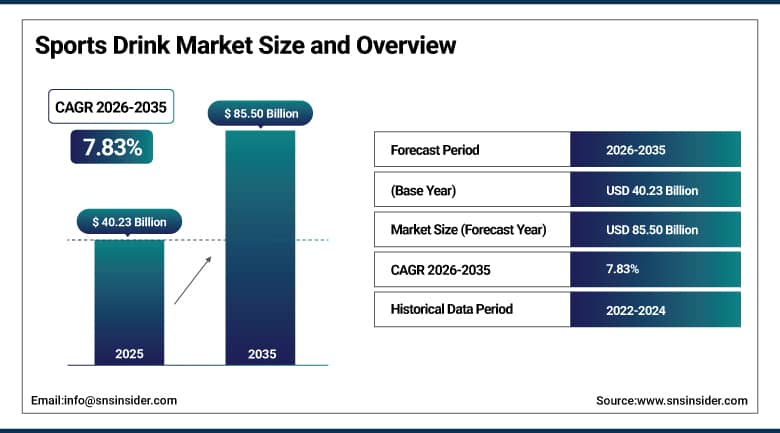
The Sports Drink Market size was valued at USD 40.23 Billion in 2025 and is expected to reach USD 85.50 Billion by 2035, growing at a CAGR of 7.83% from 2026–2035.
The global sports drink market is experiencing broad-based expansion driven by the structural shift in consumer beverage purchasing toward functional products that deliver measurable physiological benefit alongside hydration. Sports drink consumption reached 5.4 billion litres in 2025, reflecting both the growth of formal athletic participation and the far larger market opportunity created by fitness-active casual consumers who adopt sports drinks as everyday performance and wellness beverages rather than products reserved for competitive athletic events. This consumer base broadening has been commercially transformative. It has expanded the addressable market for established brands beyond sports venue and gym channel distribution into mainstream retail, convenience, and online channels.
PepsiCo launched Gatorade Zero with enhanced plant-derived electrolytes across North America and Europe in March 2025, targeting the growing health-focused consumer segment seeking clean-label hydration without synthetic additives. The launch reflects the commercial pressure that challenger brands including Prime Hydration and Electrolit are applying to legacy sports drink formulations, compelling the category’s dominant incumbents to accelerate functional ingredient transparency and natural sourcing investment across their mainstream product portfolios.
To Get More Information On Sports Drink Market - Request Free Sample Report
Sports Drink Market Trends
-
Rising consumer demand for low-sugar, zero-calorie, and clean-label sports drink formulations is compelling established brands to reformulate core product lines while creating commercially viable premium market positioning for challenger entrants.
-
Growing adoption of protein-enriched and BCAA-fortified sports beverages among recreational gym users is expanding sports drink consumption occasions beyond intra-workout hydration into post-workout recovery and meal replacement adjacent use cases.
-
Increasing online retail penetration for sports drinks is enabling direct-to-consumer brand building that bypasses traditional shelf space constraints, supporting the commercial scaling of challenger and specialty brands without the marketing investment legacy channels require.
-
Expanding sports drink adoption in Asia Pacific driven by rising youth fitness participation, urbanisation, and e-commerce accessibility is creating the fastest-growing regional demand pool that global and domestic brands are investing simultaneously to capture.
-
Rising investment in smart packaging and hydration monitoring integration, including connected bottles that track electrolyte intake and adjust replenishment recommendations, is positioning sports drinks within the broader health technology ecosystem.
U.S. Sports Drink Market Size Outlook
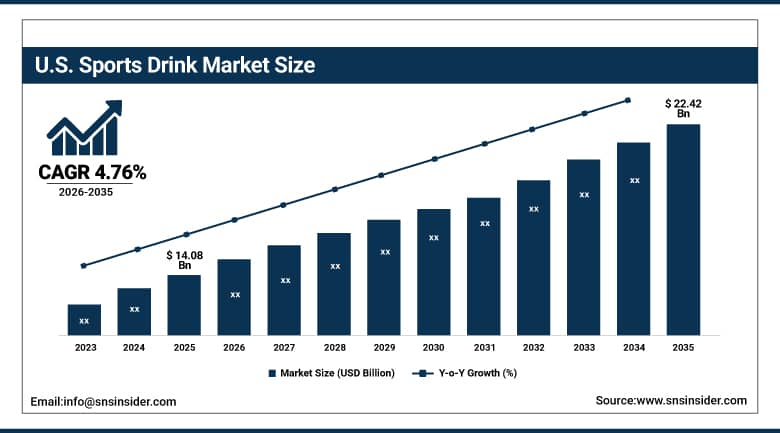
The U.S. Sports Drink Market was valued at approximately USD 14.08 Billion in 2025 and is expected to reach approximately USD 22.42 Billion by 2035, growing at a CAGR of approximately 4.76%.
The United States is the world’s largest sports drink market by revenue and the most commercially competitive. PepsiCo’s Gatorade holds approximately 70% of the U.S. market, backed by scientific credibility, deep sports partnership infrastructure, and multi-channel distribution. Coca-Cola’s dual-brand strategy with Powerade and BodyArmor captures approximately 25% of the market. The balance is increasingly contested by Prime Hydration, Electrolit, and Liquid I.V., whose social media-driven brand building and clean-label positioning are capturing younger consumer segments. Convenience stores and supermarkets dominate distribution, but online retail is growing at double-digit rates as subscription hydration models and DTC brand strategies gain commercial scale.
Powerade launched a new line of smart bottles in January 2025 that track real-time hydration levels and connect with a consumer wellness app. This technology investment signals the U.S. market’s commercial evolution from product differentiation through formulation alone toward integrated consumer engagement platforms that combine beverage consumption with personalised health monitoring.
Sports Drink Market Segment Analysis
-
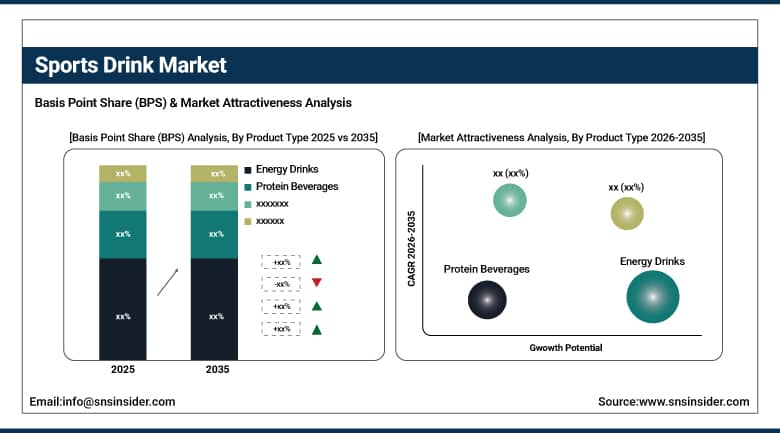
By Product Type, the Energy Drinks segment dominated the Sports Drink Market with 38.45% share in 2025, while the Protein Beverages segment is the fastest growing at a CAGR of 9.18% during 2026–2035.
-
By Packaging Type, the Bottles segment dominated the Sports Drink Market with 42.31% share in 2025, while the Powder Formulations segment is the fastest growing at a CAGR of 10.03%.
-
By Distribution Channel, the Supermarkets & Hypermarkets segment dominated the Sports Drink Market in 2025, while the Online Retail segment is the fastest growing at a CAGR of 12.8%.
-
By End User, the Athletes segment dominated the Sports Drink Market in 2025, while the Recreational & Fitness Users segment is the fastest growing as mainstream gym participation continues to expand globally.
By Product Type, energy drinks dominate, protein beverages grow fastest
Energy drinks retained the dominant product type position with 38.45% of the sports drink market in 2025. Their commercial dominance reflects the breadth of their consumer appeal, spanning dedicated athletes seeking endurance support, professionals using caffeinated formulations for focus and productivity, and younger consumers who purchase energy-enhanced beverages as lifestyle products independent of formal athletic participation. This broad consumer base creates sales volume stability that protein-specific and electrolyte-specialist products cannot match at equivalent distribution scale. Brands including Red Bull, Monster, and the energy-enhanced extensions of Gatorade and Powerade collectively sustain the category’s dominant share through multi-channel distribution and significant retail promotional investment.
Protein beverages are the fastest-growing product segment at a CAGR of 9.18% through 2035. The commercial driver is the post-workout recovery occasion’s progressive integration into mainstream consumer health behaviour beyond the dedicated bodybuilding demographic that originally defined the category. Gym membership growth across Asia Pacific and North America has created a large first-time consumer population whose daily post-workout protein requirement creates a recurring beverage purchase occasion that ready-to-drink protein sports drinks serve more conveniently than powder mixing alternatives. Brands like Muscle Milk, Premier Protein, and Gatorade’s Recover line are capturing this demand. The premium positioning of higher-protein formulations also supports above-average margin contribution relative to standard electrolyte drink products.
By Packaging Type, bottles dominate, powder formulations grow fastest
Bottles retained the dominant packaging position with 42.31% of the sports drink market in 2025. The format’s commercial advantage is its versatility across consumption contexts. A reclosable bottle is suitable for gym use, sports venue consumption, office desk hydration, and convenience store impulse purchase equally. Plastic PET bottles captured 95.57% of U.S. sports drink packaging in 2025, reflecting their combination of lightweight portability, shatter resistance, and production cost efficiency that makes them the economically rational default across the market’s highest-volume product lines. The format’s visual shelf presence and label real estate also provide branding advantages that sachet and powder formats cannot match in high-traffic retail environments where impulse purchase drives a significant proportion of sports drink sales volume.
Powder formulations are the fastest-growing packaging segment at a CAGR of 10.03% through 2035. The commercial logic is compelling. Powder concentrates offer significantly lower cost per serving than ready-to-drink alternatives. They are highly portable in sachet format and compatible with the reusable bottle culture that environmentally conscious consumers increasingly adopt. The DTC subscription model is particularly well-suited to powder sports drink delivery, as subscription-box personalisation, flavour variety, and recurring revenue dynamics align naturally with the regular purchase behaviour of committed fitness consumers. Brands including Liquid I.V., LMNT, and Hydrant have built commercially significant businesses primarily through subscription powder delivery without meaningful retail shelf presence, demonstrating the packaging format’s commercial independence from traditional channel dependency.
Regional Analysis
|
Region |
Major Country |
Share within Region, 2025 (%) |
|---|---|---|
|
North America |
United States |
87.4% |
|
Europe |
Germany |
22.3% |
|
Asia Pacific |
China |
55.2% |
|
Middle East & Africa |
UAE |
38.4% |
|
Latin America |
Brazil |
44.2% |
North America Sports Drink Market Insights
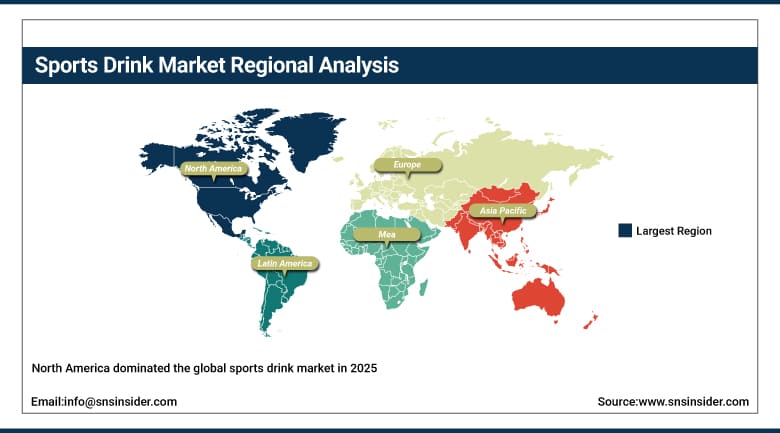
North America dominated the global sports drink market in 2025, with the United States accounting for approximately 87.4% of North American revenues and representing the world’s largest and most commercially competitive national sports drink market. The category’s commercial depth reflects the combination of high formal athletic participation, the world’s most extensive gym and fitness facility network, and the commercial sophistication of brand marketing infrastructure whose sports sponsorship, celebrity partnership, and social media investment collectively sustain the category’s extraordinary consumer visibility. Gatorade’s scientific credibility rooted in its University of Florida research origins, Powerade’s Coca-Cola distribution reach, and BodyArmor’s premium natural ingredient positioning collectively serve the full spectrum of the U.S. market’s consumer demand profile.
Canada contributes approximately 12.6% of North American revenues through a fitness-active consumer population whose sports drink purchasing mirrors U.S. market trends, a well-developed retail and convenience store distribution network, and the growing presence of premium and natural sports hydration brands that have extended their U.S. commercial success into the Canadian market through existing retail partnership channels.
Get Customized Report as Per Your Business Requirement - Enquiry Now
Europe Sports Drink Market Insights
Europe is a significant and commercially sophisticated sports drink market where regulatory pressure on sugar content, strong consumer preference for natural ingredients, and a well-developed sports participation culture across football, cycling, running, and gym fitness collectively sustain above-average per-capita sports drink consumption in the United Kingdom, Germany, France, and the Nordic countries. Germany accounts for approximately 22.3% of European revenues as the region’s largest national market, driven by its strong sports club culture, above-average fitness supplement market sophistication, and the commercial presence of both international brands and domestic functional beverage specialists competing for retail shelf position and online visibility.
The United Kingdom is the European market’s most commercially dynamic sports drink environment, anchored by Lucozade Sport’s strong domestic brand equity, Powerade’s distribution strength through Coca-Cola’s UK network, and the rapid commercial growth of premium hydration challengers. Sugar tax legislation in the UK has materially reshaped the category’s formulation landscape, compelling major brands to reformulate core products with reduced sugar and natural sweetener alternatives that simultaneously achieve regulatory compliance and respond to consumer preference trends.
Asia Pacific Sports Drink Market Insights
Asia Pacific is the fastest-growing regional sports drink market, driven by the region’s extraordinary combination of the world’s largest youth population increasingly engaging in organised fitness and sports activities, rapid urbanisation creating new gym and fitness facility density in tier-two and tier-three cities, and e-commerce infrastructure maturity that makes sports drink brand discovery and trial accessible to consumers who lack proximity to specialist sports nutrition retail. China accounts for approximately 55.2% of Asia Pacific revenues through its combination of a massive urban middle class with growing disposable income allocated to health and fitness products, a well-developed domestic functional beverage industry, and the explosive growth of social commerce platforms through which sports drink brands build consumer communities and drive purchase conversion simultaneously.
India and Southeast Asia represent the most commercially significant emerging market growth opportunities within Asia Pacific. Rising gym membership, growing professional sports leagues increasing sports drink category awareness, and the expansion of convenience store and online retail distribution into smaller urban centres are collectively accelerating first-time sports drink trial and adoption among consumer demographics whose health behaviour is progressively aligning with the fitness-active lifestyle identity that sports drink brands have successfully commercialised across more mature markets.
MEA & Latin America Sports Drink Market Insights
The Middle East and Africa and Latin America are growing sports drink markets where expanding youth fitness participation, rising disposable incomes in urban centres, and increasing retail distribution infrastructure are creating commercially accessible demand for sports hydration products. UAE leads MEA revenues at approximately 38.4% of the regional total through its highly active expatriate and local population, a well-developed retail and convenience store distribution network, and above-average consumer willingness to invest in premium health and performance products that sustain premium-tier sports drink pricing.
Brazil leads Latin American revenues at approximately 44.2% of the regional total through its combination of a passionate sports culture anchored by football and athletics, a large urban youth population with growing fitness participation, and the commercial infrastructure of PepsiCo and Coca-Cola’s extensive Brazilian distribution networks that ensure Gatorade and Powerade maintain broad retail availability across the country’s geographically extensive consumer market. AJE Group’s Big Power and domestic challenger brands are simultaneously gaining commercial traction in price-sensitive consumer segments where international brand premium pricing creates accessible market space for locally produced alternatives.
Market Dynamics
Growth Drivers: Mainstream fitness culture broadening the addressable consumer base beyond athletes, functional ingredient innovation elevating product value, and online retail enabling DTC brand scaling
The structural broadening of sports drink consumption from professional and semi-professional athletic use into everyday fitness consumer behaviour is the market’s most commercially significant and durable growth driver. Gym membership has grown consistently across North America, Europe, and Asia Pacific, creating a large and recurring purchase occasion for post-workout hydration products that did not exist at scale a decade ago. This consumer base expansion does not depend on sports performance improvement to sustain it. It is anchored in the health identity and wellness lifestyle investment of a consumer demographic whose purchasing behaviour is structurally recurring rather than event-driven.
Functional ingredient innovation is simultaneously creating premium tier commercial opportunities that expand revenue per unit above the baseline electrolyte drink value proposition. Protein, BCAAs, adaptogens, and natural caffeine derivatives each represent new functional benefit claims that justify higher retail pricing and create differentiated consumer positioning. The 45% growth in patent filings for functional ingredient combinations since 2022 reflects the commercial intensity of innovation investment across both established brands and challenger entrants seeking proprietary product differentiation in an increasingly competitive category.
Restraints: Sugar content regulatory pressure reducing formulation flexibility, commodity ingredient cost volatility, and competition from alternative hydration categories including coconut water and functional water
Regulatory pressure on sugar content represents a meaningful restraint on sports drink formulation across the market’s most regulated geographies. Sugar taxes in the UK, Mexico, and Thailand, and health labelling regulations across the EU, create commercial incentives to reduce sugar content that conflict with the taste profile preferences that drive repeat purchase among mainstream consumer segments. Reformulation to meet regulatory requirements while maintaining consumer-preferred taste characteristics requires substantial R&D investment whose cost is ongoing rather than a one-time transition expense.
Competition from adjacent hydration categories is progressively eroding the sports drink market’s exclusive claim on the active hydration consumer occasion. Coconut water, functional sparkling water, enhanced water, and kombucha each compete for the same consumer’s hydration budget across the same retail and gym channel environments. These alternatives carry natural ingredient credentials and lower sugar positioning that resonate with health-conscious consumers whose purchasing criteria partially overlap with the sports drink category’s traditional functional benefit messaging.
Opportunities: Plant-based electrolyte innovation, powder subscription DTC channel growth, and Asia Pacific market penetration through e-commerce and social commerce
Plant-based electrolyte innovation represents a high-growth commercial opportunity that simultaneously addresses regulatory pressure, consumer preference trends, and differentiation requirements. Coconut water electrolyte blends, mineral-sourced sodium-potassium formulations, and fruit-derived natural sweeteners collectively enable sports drink brands to develop formulations that achieve clean-label positioning and reduced synthetic additive content without compromising the electrolyte replenishment efficacy that defines the category’s core consumer benefit. Brands successfully executing plant-based transition across their product portfolios are achieving premium retail pricing and e-commerce growth rates that standard formulations cannot sustain.
Social commerce in China, India, and Southeast Asia represents the most commercially accessible route to rapid Asia Pacific brand building for both international and domestic sports drink companies. The purchase conversion model of live-stream commerce and influencer-led product trials removes the retail distribution infrastructure dependency that has historically created category entry barriers in geographically extensive emerging markets. Brands that build social commerce communities around fitness lifestyle content are achieving customer acquisition economics that traditional advertising and retail placement investment cannot match in the speed and conversion efficiency they deliver.
Recent Developments:
-
2025: PepsiCo launched Gatorade Zero with enhanced plant-derived electrolytes across North America and Europe in March 2025, targeting health-focused consumers seeking clean-label hydration and responding to competitive pressure from challenger brands whose natural ingredient positioning had been capturing younger consumer segments previously loyal to Gatorade’s conventional formulations.
-
2025: Powerade launched a new line of smart bottles in January 2025 that track real-time hydration levels through sensor integration and connect with a consumer wellness app, positioning Powerade as a hydration technology platform rather than a standalone beverage brand and creating a consumer engagement infrastructure that subscription-based hydration monitoring programmes can build upon.
-
2025: Red Bull announced in April 2025 that its entire sports drink aluminium can range would transition to 100% recyclable packaging, responding to both European regulatory sustainability requirements and the growing consumer preference for environmentally responsible packaging that is measurably influencing purchase decisions among the premium sports drink consumer segment across European and North American markets.
Sports Drink Companies are:
-
PepsiCo Inc.
-
Red Bull GmbH
-
Monster Beverage Corporation
-
Danone S.A.
-
Nestlé S.A.
-
Britvic plc
-
Otsuka Pharmaceutical Co., Ltd.
-
AJE Group
-
Congo Brands
-
Electrolit USA
-
GlaxoSmithKline plc
-
Keurig Dr Pepper
-
Liquid I.V.
-
Nuun Health
-
LMNT Inc.
-
Hydrant Inc.
-
Abbott Nutrition
-
Extreme Drinks Co.
Sports Drink Market Report Scope:
| Report Attributes | Details |
|---|---|
| Market Size in 2025 | USD 40.23 Billion |
| Market Size by 2035 | USD 85.50 Billion |
| CAGR | CAGR of 7.83% From 2026 to 2035 |
| Base Year | 2025 |
| Forecast Period | 2026-2035 |
| Historical Data | 2022-2024 |
| Report Scope & Coverage | Market Size, Segments Analysis, Competitive Landscape, Regional Analysis, DROC & SWOT Analysis, Forecast Outlook |
| Key Segments | • By Product Type (Energy Drinks, Protein Beverages, Electrolyte Drinks, Hypertonic Drinks, Hypotonic Drinks, Isotonic Drinks, Others) • By Packaging Type (Bottles, Cans, Sachets/Pouches, Powder Formulations, Others) • By Distribution Channel (Supermarkets & Hypermarkets, Convenience Stores, Online Retail, Specialty Stores, Others) • By End User (Athletes, Recreational & Fitness Users, Others) |
| Regional Analysis/Coverage | North America (US, Canada, Mexico), Europe (Eastern Europe [Poland, Romania, Hungary, Turkey, Rest of Eastern Europe] Western Europe] Germany, France, UK, Italy, Spain, Netherlands, Switzerland, Austria, Rest of Western Europe]), Asia Pacific (China, India, Japan, South Korea, Vietnam, Singapore, Australia, Rest of Asia Pacific), Middle East & Africa (Middle East [UAE, Egypt, Saudi Arabia, Qatar, Rest of Middle East], Africa [Nigeria, South Africa, Rest of Africa], Latin America (Brazil, Argentina, Colombia, Rest of Latin America) |
| Company Profiles | PepsiCo Inc., The Coca-Cola Company, Red Bull GmbH, Monster Beverage Corporation, Danone S.A., Nestlé S.A., Suntory Holdings Ltd., Britvic plc, Otsuka Pharmaceutical Co., Ltd., AJE Group, Congo Brands, Electrolit USA, GlaxoSmithKline plc, Keurig Dr Pepper Liquid I.V., Nuun Health, LMNT Inc., Hydrant Inc., Abbott Nutrition, Extreme Drinks Co. |
Frequently Asked Questions
The Sports Drink Market is expected to grow at a CAGR of 7.83% from 2026 to 2035.
The Sports Drink Market was valued at USD 40.23 Billion in 2025.
Ans: Growth is driven by rising fitness participation, increasing demand for energy and electrolyte drinks, and growing preference for low-sugar, functional hydration products.
Energy Drinks dominated the Sports Drink Market with 38.45% share in 2025.
North America dominated the Sports Drink Market in 2025, with the United States accounting for approximately 87.4% of North American revenues.
