
Sports Nutrition Market Report Scope & Overview:
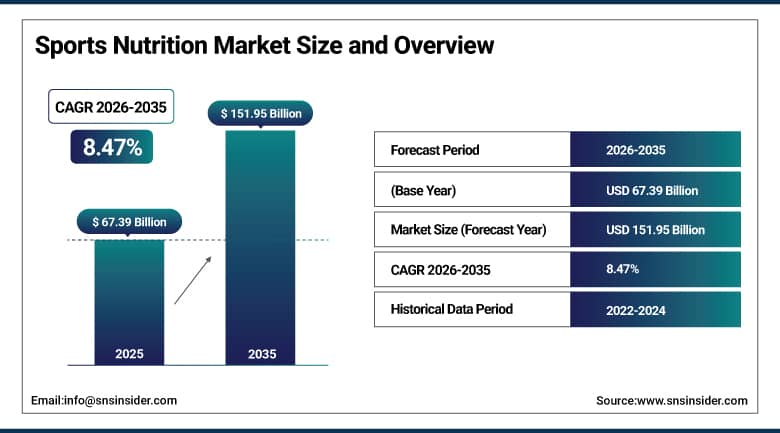
The Sports Nutrition Market was valued at USD 67.39 Billion in 2025 and is expected to reach USD 151.95 Billion by 2035, growing at a CAGR of 8.47% from 2026 to 2035.
Sports nutrition used to mean a narrow customer base, competitive athletes and serious bodybuilders buying protein powder from a handful of specialty brands, but that definition has expanded considerably. Nearly 70% of consumers now say they actively manage their diet and exercise routine, and the world's 200,000-plus fitness clubs have created a customer base that extends well past anyone training for competition. Endurance sports participation has climbed roughly 85% over the past decade, and that growth alone has pulled in a wave of recreational athletes who need hydration and recovery products but do not necessarily identify as serious athletes. Product innovation has followed the audience, plant-based proteins, functional ingredients, and clean-label formulations are reshaping a category that used to be defined almost entirely by whey protein and pre-workout powder.
In September 2025, Nutrabolt expanded its strategic investment in Bloom Nutrition, building on its January 2024 minority stake, following the nationwide expansion of the Bloom Sparkling Energy drink collaboration in early 2025.
To Get More Information On Sports Nutrition Market - Request Free Sample Report
Sports Nutrition Market Trends
-
Creatine and amino acid products are gaining share fastest as clinical research and social media coverage both reinforce their performance benefits.
-
Ready-to-drink protein and hydration formats are pulling share away from powders as convenience becomes a bigger purchase driver.
-
Recreational and casual fitness participants are becoming the category's fastest-growing end-user segment, expanding well beyond serious athletes.
-
Functional beverage collaborations between sports nutrition brands and mainstream consumer brands are broadening category reach.
-
Clean-label and plant-based protein formulations are expanding as brands respond to growing scrutiny of artificial ingredients.
U.S. Sports Nutrition Market Outlook
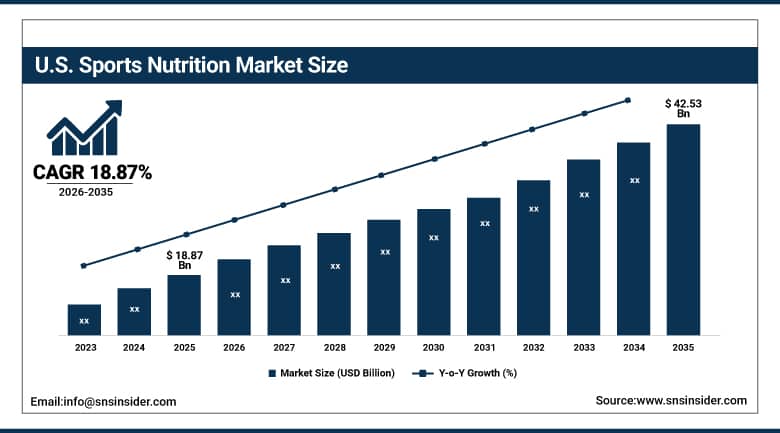
The U.S. Sports Nutrition Market was valued at USD 18.87 Billion in 2025 and is projected to reach USD 42.53 Billion by 2035, growing at a CAGR of 18.87% during 2026-2035.
The U.S. market's growth is more measured than the fast-expanding markets pulling up the global average, reflecting how mature and saturated sports nutrition already is across American gyms, grocery stores, and specialty retailers. Even so, real shifts are happening beneath that steady headline number: protein products keep expanding well beyond their traditional gym-focused audience into mainstream grocery and convenience retail, while functional beverage brands built around irreverent marketing or wellness positioning are pulling meaningful share from legacy sports nutrition names. Creatine in particular has seen a genuine surge in mainstream consumer interest, driven partly by growing clinical research into cognitive and healthy-aging benefits that extend well beyond its traditional athletic performance use case. E-commerce and subscription-based direct-to-consumer models continue reshaping distribution, particularly for newer, digitally native brands without established retail shelf presence.
In late 2025, BellRing Brands, Inc. introduced a sparkling protein soda line under its Premier Protein brand, delivering 15 grams of whey protein isolate per can.
Sports Nutrition Market Segment Analysis
-
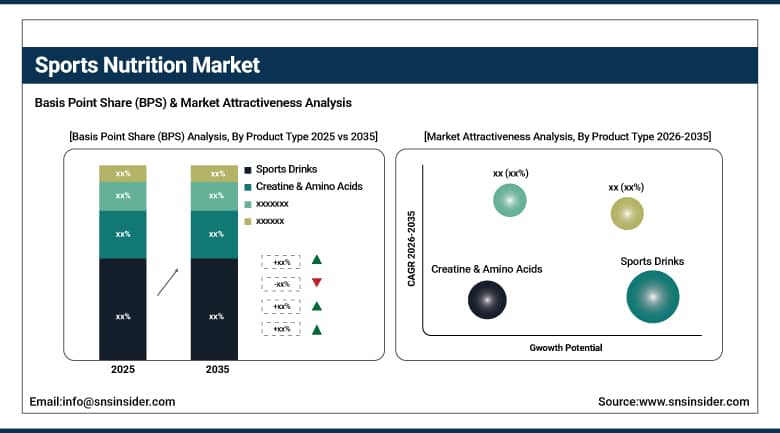
By Product Type, Sports Drinks segment dominated the Sports Nutrition Market in 2025 with 38.70% share; Creatine & Amino Acids segment is the fastest-growing segment, registering a CAGR of 9.35% from 2026 to 2035.
-
By Form, Powder segment dominated the market in 2025 with 42% share; Ready-to-Drink segment is the fastest-growing segment, registering a CAGR of 9.54% from 2026 to 2035.
-
By Application, Pre-Workout segment dominated the market in 2025 with 35% share; Post-Workout segment is the fastest-growing segment, registering a CAGR of 8.96% from 2026 to 2035.
-
By End User, Active Lifestyle Consumers segment dominated the market in 2025 with 38% share; Recreational Sports Participants segment is the fastest-growing segment, registering a CAGR of 9.15% from 2026 to 2035.
By Product Type, Sports Drinks Lead the Sports Nutrition Market While Creatine & Amino Acids Gain Ground Fastest
Sports Drinks hold 38.70% of the Sports Nutrition Market, the largest single product category, benefiting from a distribution footprint that extends far beyond specialty supplement retail into virtually every grocery store, convenience store, and gas station in developed markets. Electrolyte replacement and hydration remain the most universally understood and least intimidating sports nutrition use case for casual consumers who might feel out of place buying a tub of protein powder but see no barrier to grabbing a sports drink.
Creatine & Amino Acids are growing at a 9.35% CAGR, the fastest pace among product types, as creatine in particular has broken out of its traditional bodybuilding niche into mainstream wellness conversation, driven by growing clinical research into cognitive function and healthy aging that extends well beyond its established athletic performance benefits. This crossover appeal has pulled in a meaningfully broader buyer base than the category's traditional core athletic audience.
By Form, Powder Dominates While Ready-to-Drink Emerges as the Fastest-Growing Format
Powder holds 42% of the market by form, remaining the default choice largely because it offers the best value per serving and the most flexibility for consumers who want to control exact dosing and mix products into their own recipes. Established manufacturing infrastructure across the sports nutrition industry is also built predominantly around powder production, keeping this format the most cost-effective option for high-volume protein and pre-workout products.
Ready-to-Drink is growing fastest, at a 9.54% CAGR, as convenience increasingly outweighs the cost savings powder formats offer, particularly among busy consumers who want a grab-and-go option rather than mixing a shake at home or in a gym locker room. Improved formulation technology has also closed much of the taste and texture gap that used to make RTD protein products noticeably inferior to fresh-mixed alternatives.
By Application, Pre-Workout Dominates While Post-Workout Registers the Fastest Growth
Pre-Workout applications account for 35% of the market, the largest single category, reflecting how central pre-training energy and focus products have become to gym culture, particularly among younger consumers who treat pre-workout as close to a ritual part of their training routine. Caffeine and other stimulant-based formulations remain the category's core, though functional ingredient additions like beta-alanine and citrulline have expanded what a typical pre-workout product actually claims to do.
Post-Workout is the fastest-growing application, expanding at a 8.96% CAGR, as recovery science gains mainstream attention and consumers increasingly understand that what they consume after training matters as much as pre-workout energy for actual performance and muscle-building outcomes. Growing interest in sleep quality and its connection to recovery has also pulled post-workout products into broader wellness conversations beyond pure athletic performance.
By End User, Active Lifestyle Consumers Dominates While Recreational Sports Participants Registers the Fastest Growth
Active Lifestyle Consumers account for 38% of end-user demand, the largest single category, reflecting how far the sports nutrition audience has expanded beyond competitive athletes and dedicated bodybuilders into a much broader population of people who exercise regularly without necessarily training for competition. This demographic shift has been the single biggest force reshaping product development and marketing across the industry over the past decade.
Recreational Sports Participants is the fastest-growing end-user segment, expanding at a 9.15% CAGR, as casual sports leagues, running clubs, and group fitness classes continue drawing in consumers who need hydration and recovery support but do not identify with the serious-athlete positioning that once defined most sports nutrition marketing. Brands increasingly designing products and messaging specifically for this less intimidating, more socially oriented fitness audience are capturing a meaningful share of this growth.
Regional Analysis
|
Region |
Country |
Share (2025) |
|
North America |
United States |
86.40% |
|
Asia Pacific |
China |
33.60% |
|
Europe |
Germany |
218.87% |
|
Middle East & Africa |
UAE |
17.60% |
|
Latin America |
Brazil |
28.20% |
Asia Pacific Sports Nutrition Market Insights
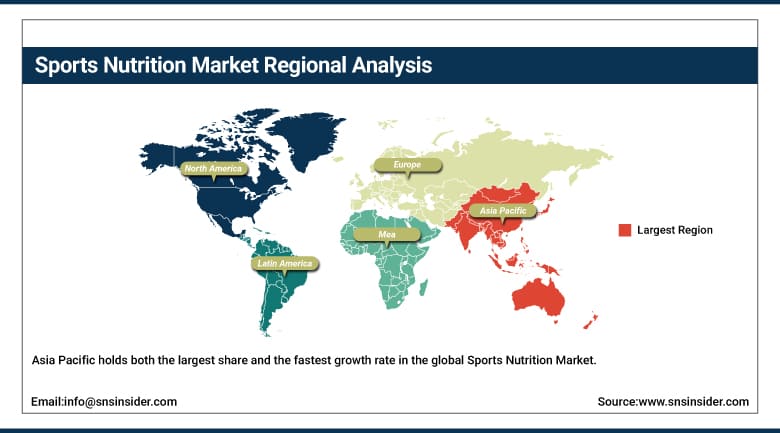
Asia Pacific holds both the largest share and the fastest growth rate in the global Sports Nutrition Market, at 39% of global revenue in 2025, driven by rising disposable incomes, expanding urban populations, and growing sports participation across the region's large population base. Rising fitness and wellness awareness in markets where organized gym culture is still relatively new is creating exactly the kind of first-time adoption growth that mature markets like North America can no longer generate.
China holds roughly 33.60% of the regional market, supported by its massive consumer base and rapidly expanding fitness and gym culture. India and Southeast Asian markets are growing quickly as sports participation and organized fitness infrastructure both expand, while Japan and South Korea contribute through their established, quality-focused sports nutrition retail sectors.
Get Customized Report as Per Your Business Requirement - Enquiry Now
North America Sports Nutrition Market Insights
North America's sports nutrition market is mature and steady, supported by decades of established gym culture, deep specialty and mainstream retail distribution, and a broad consumer base that now extends well beyond serious athletes into everyday wellness-focused shoppers. Growth here is more measured than in faster-expanding regions, reflecting how saturated the category already is across American and Canadian retail.
The United States accounts for approximately 86.40% of the North American market, reflecting its deeply established sports nutrition retail infrastructure and broad consumer adoption across fitness and wellness categories. Canada contributes a smaller but steady share, tied to its own fitness culture and comparable retail distribution.
Europe Sports Nutrition Market Insights
Europe's sports nutrition market is mature and steady, shaped by strong fitness culture and comparatively strict regulatory frameworks around health claims and novel ingredient approval that, while slowing new product launches, have reinforced strong consumer trust in product safety and efficacy across the region. Clean-label and plant-based formulation trends have found a particularly receptive audience here.
Germany leads the European market with a 218.87% share, supported by its strong fitness culture and well-established sports nutrition retail base. The United Kingdom and France follow, with demand in both countries tied to established gym culture and growing endurance sports participation.
Middle East & Africa and Latin America Sports Nutrition Market Insights
The Middle East & Africa segment is registering a steady growth due to the development of a fitness culture and increase in disposable incomes in the Gulf nations along with increasing gym facilities and a huge fitness-conscious expatriate population in the region. The Latin American region, similarly, is experiencing steady growth owing to Brazil's long-established tradition of fitness and bodybuilding, along with retail availability of sports nutrition products in the region.
UAE holds the largest market share in the Middle East & Africa region with 17.60%, due to the high gym memberships and good retail infrastructure in the country for imported sports nutrition products. Brazil is the largest contributor in the Latin American region with a market share of 28.20%.
Market Dynamics
Growth Drivers: Widening Consumer Base and Fitness Participation Fueling Market Growth
The sports nutrition category's widening consumer base is doing most of the heavy lifting behind its growth, as products once marketed almost exclusively to competitive athletes and bodybuilders now reach a much broader population of everyday fitness enthusiasts and wellness-focused consumers. Rising global fitness club membership and endurance sports participation, both climbing steadily over the past decade, are reinforcing this shift by creating a larger pool of consumers who need hydration, recovery, and performance products regardless of competitive ambition.
Product format innovation, ready-to-drink protein, functional sports drinks, creatine gummies, is expanding the category's reach even further by making sports nutrition accessible to consumers who never would have bought a tub of powder in the first place.
Restraints: Regulatory Complexity and Ingredient Cost Volatility Limiting Market Expansion
Regulatory requirements around health claims, novel ingredient approval, and labeling accuracy vary considerably across markets, creating genuine compliance complexity for brands trying to sell the same product internationally without running into differing national standards. Raw material costs for whey protein, creatine, and other core sports nutrition ingredients have also been volatile, tied to broader agricultural and specialty chemical commodity markets.
Consumer skepticism toward efficacy claims for certain trending ingredients, periodically reinforced by studies questioning whether specific formulations deliver meaningful performance benefits, remains a persistent headwind that brands with strong clinical backing are generally better positioned to weather.
Opportunities: Recreational Fitness Targeting and Functional Innovation Creating New Growth Avenues
There is a very strong growth opportunity presented by products that have been specifically targeted towards recreational and casual fitness enthusiasts, especially considering how this approach continues to attract customers who had not associated themselves with the conventional bodybuilding-oriented image of sports nutrition products. This opportunity is available for those brands that can connect with this wider audience while not alienating their existing customer base.
Innovations related to functional ingredients that deliver both sports performance advantages as well as general wellness advantages, cognitive function, anti-aging benefits, improved sleep quality, etc., provide another opportunity that lies at the intersection of athletics and overall wellness. The example of creatine's expansion into general wellness products shows how much room there is for growth here.
Recent Developments:
-
September 2025: Nutrabolt expanded its strategic investment in Bloom Nutrition, building on its January 2024 minority stake, following the nationwide expansion of the Bloom Sparkling Energy drink collaboration in early 2025.
-
2025: Nutrabolt brought its C4, XTEND, and Cellucor active nutrition brands to India through a locally driven manufacturing and distribution agreement.
-
August 2025: Vital Proteins LLC launched a ready-to-drink Collagen & Protein Shake delivering 30 grams of protein and 10 grams of collagen peptides per serving.
-
Late 2025: BellRing Brands, Inc. introduced a sparkling protein soda line under its Premier Protein brand, featuring 15 grams of whey protein isolate per can.
Sports Nutrition Market key players are:
-
Glanbia plc
-
BellRing Brands, Inc.
-
Iovate Health Sciences International Inc.
-
Abbott Laboratories
-
Clif Bar & Company
-
The Coca-Cola Company
-
Quest Nutrition LLC
-
PepsiCo, Inc.
-
BA Sports Nutrition, LLC
-
Cardiff Sports Nutrition
-
GNC Holdings, LLC
-
Nutrabolt
-
Herbalife Nutrition Ltd.
-
Amway Corporation
-
Nestlé Health Science
-
Isagenix International LLC
-
Monster Beverage Corporation
-
MusclePharm Corporation
-
Nutraceutical International Corporation
-
Vitaco Health Group Limited
Sports Nutrition Market Report Scope:
| Report Attributes | Details |
|---|---|
| Market Size in 2025 | USD 67.39 Billion |
| Market Size by 2035 | USD 151.95 Billion |
| CAGR | CAGR of 8.47% From 2026 to 2035 |
| Base Year | 2025 |
| Forecast Period | 2026-2035 |
| Historical Data | 2022-2024 |
| Report Scope & Coverage | Market Size, Segments Analysis, Competitive Landscape, Regional Analysis, DROC & SWOT Analysis, Forecast Outlook |
| Key Segments | • By Product Type (Sports Drinks, Protein Supplements, Energy & Protein Bars, Creatine & Amino Acids) • By Form (Powder, Ready-to-Drink, Bars, Capsules & Tablets) • By Application (Pre-Workout, Post-Workout, Weight Loss, Endurance) • By End User (Active Lifestyle Consumers, Athletes, Bodybuilders, Recreational Sports Participants) |
| Regional Analysis/Coverage | North America (US, Canada), Europe (Germany, UK, France, Italy, Spain, Russia, Poland, Rest of Europe), Asia Pacific (China, India, Japan, South Korea, Australia, ASEAN Countries, Rest of Asia Pacific), Middle East & Africa (UAE, Saudi Arabia, Qatar, South Africa, Rest of Middle East & Africa), Latin America (Brazil, Argentina, Mexico, Colombia, Rest of Latin America). |
| Company Profiles | Glanbia plc, BellRing Brands, Inc., Iovate Health Sciences International Inc., Abbott Laboratories, Clif Bar & Company, The Coca-Cola Company, Quest Nutrition LLC, PepsiCo, Inc., BA Sports Nutrition, LLC, Cardiff Sports Nutrition, GNC Holdings, LLC, Nutrabolt, Herbalife Nutrition Ltd., Amway Corporation, Nestlé Health Science, Isagenix International LLC, Monster Beverage Corporation, MusclePharm Corporation, Nutraceutical International Corporation, Vitaco Health Group Limited |
Frequently Asked Questions
Key players include Glanbia plc, BellRing Brands, Inc., Iovate Health Sciences International Inc., Abbott Laboratories, Clif Bar & Company, The Coca-Cola Company, Quest Nutrition LLC, and PepsiCo, Inc., alongside other established sports nutrition manufacturers.
Key opportunities include products and marketing designed for recreational and casual fitness participants, functional ingredient innovation combining performance and wellness benefits, and expanding ready-to-drink and convenience-focused formats.
The market is driven by a widening consumer base beyond competitive athletes, rising global fitness participation, and continued product format innovation.
The Sports Drinks segment dominated the Sports Nutrition Market in 2025.
The Asia Pacific region dominated the Sports Nutrition Market in 2025, accounting for approximately 39% of global market share.
