
Starch-blended Bioplastic Market Report Scope & Overview:
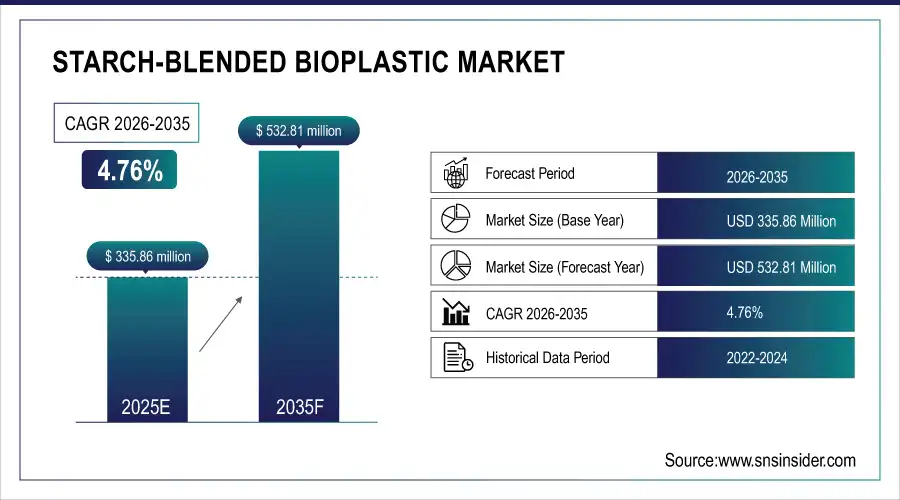
The Starch-blended Bioplastic Market size was valued at USD 335.86 Million in 2025 and is projected to reach USD 532.81 Million by 2035, growing at a CAGR of 4.76% during 2026-2035.
The Starch‑Blended Bioplastic Market is growing primarily due to increasing environmental concerns and the global shift toward sustainable and biodegradable materials. Rising demand for eco-friendly packaging in food, retail, and e-commerce sectors, coupled with stringent government regulations restricting single-use plastics, is driving adoption. Growth in agriculture applications, such as mulch films and plant pots, and the rising preference for sustainable consumer goods further boost the market. Additionally, technological advancements in starch-polymer blending, cost reductions, and growing awareness among consumers about environmental sustainability are key growth drivers.
To Get more information On Starch-blended Bioplastic Market - Request Free Sample Report
Key Starch-blended Bioplastic Market Trends
-
Growing adoption of starch‑blended bioplastics in packaging, driven by sustainability and regulatory pressures.
-
Expansion of applications into agriculture, including biodegradable mulch films and plant pots.
-
Increased focus on technological advancements in starch-polymer blends to improve performance, flexibility, and durability.
-
Rising demand in emerging markets such as Asia Pacific, Latin America, and MEA due to industrialization and government incentives.
-
Continuous innovation in sustainable textiles, consumer goods, and specialty products, supported by R&D and circular economy initiatives.
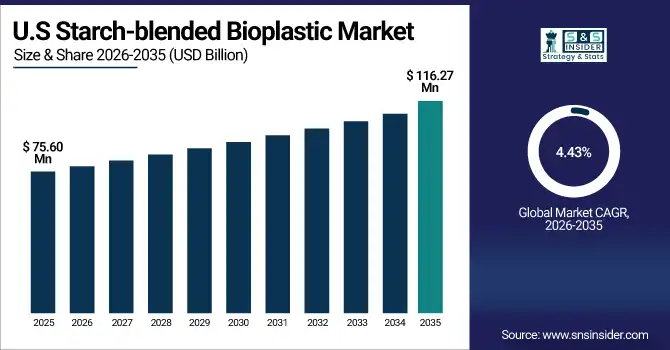
The U.S. Starch-blended Bioplastic Market size was valued at USD 75.60 Million in 2025 and is projected to reach USD 116.27 Million by 2035, growing at a CAGR of 4.43% during 2026-2035. The U.S. Starch‑Blended Bioplastic Market is growing due to increasing demand for sustainable packaging, stringent regulations limiting single-use plastics, rising consumer awareness of environmental impact, and adoption of biodegradable materials across food, retail, and consumer goods industries.
Starch-blended Bioplastic Market Growth Drivers:
-
Environmental Concerns and Sustainable Packaging Drive Global Starch-Blended Bioplastics Adoption
The global starch‑blended bioplastic market is primarily driven by growing environmental concerns and the increasing demand for sustainable alternatives to conventional plastics. Governments worldwide are implementing stringent regulations and policies to reduce single-use plastic consumption, encouraging industries to adopt biodegradable materials. The food and beverage sector, in particular, is fueling demand for eco-friendly packaging such as bags, wraps, and containers. Additionally, rising consumer awareness regarding environmental sustainability is influencing purchasing decisions, prompting companies to invest in starch-based bioplastics. Technological advancements in blending starch with polymers like PLA, PHA, and PBS have improved material performance, flexibility, and cost-effectiveness, further supporting market growth. Expansion in agriculture applications, such as biodegradable mulch films and plant pots, also contributes to the increasing adoption of starch-blended bioplastics globally.
In 2024, global bioplastics production capacity reached about 2.47 million tonnes, with actual output around 1.44 million tonnes showing the scale of industrial adoption for sustainable plastics, including starch‑based blends
Starch-blended Bioplastic Market Restraints:
-
Market Growth Hindered by Mechanical Limitations Moisture Sensitivity and Biodegradation Challenges
The global starch‑blended bioplastic market faces restraints such as limited mechanical strength compared to conventional plastics, susceptibility to moisture and temperature variations, and shorter shelf life. Inconsistent biodegradation rates in different environments and challenges in scaling up production without compromising quality also hinder broader adoption, especially in demanding packaging and industrial applications.
Starch-blended Bioplastic Market Opportunities:
-
Emerging Markets Offer High-Growth Opportunities in Starch Bioplastics Driven by Sustainability and Innovation
Opportunities in the market are substantial as industries and regions seek innovative, sustainable solutions. Emerging markets in Asia Pacific, Latin America, and the Middle East & Africa present high-growth potential due to rising industrialization, increasing disposable incomes, and government incentives promoting green materials. Companies can capitalize on the growing demand for sustainable textiles, consumer goods, and specialty packaging applications. Moreover, continuous research and development in novel starch-polymer blends, advanced manufacturing processes, and bio-based product innovation offer significant opportunities for differentiation and long-term growth.
Scientific research shows that starch‑based bioplastics blended with plasticizers and fillers (e.g., glycerol, calcium carbonate) can significantly improve tensile strength by ~22–30 % and enhance flexibility, making them more viable for sustainable packaging application.
Starch-blended Bioplastic Market Segment Analysis
-
By Type, Starch–PLA Blends dominated with 38.46% in 2025, and Other Starch-Based Polymer Blends is expected to grow at the fastest CAGR of 5.64% from 2026 to 2035.
-
By Application, Packaging (bags, wraps, food containers) dominated with 42.58% in 2025, and Textile & Fibers is expected to grow at the fastest CAGR of 5.32% from 2026 to 2035.
-
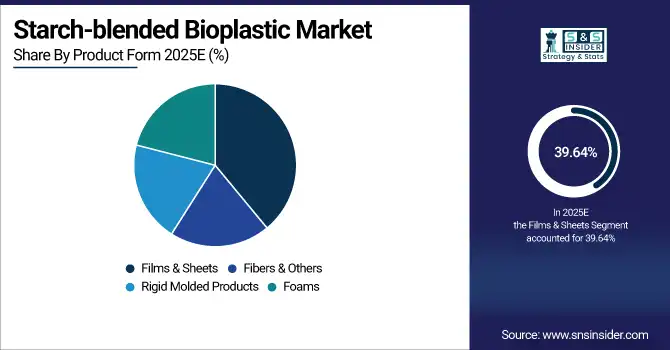
By Product Form, Films & Sheets dominated with 39.64% in 2025, and Fibers & Others is expected to grow at the fastest CAGR of 5.56% from 2026 to 2035.
-
By End-User Industry, Food & Beverage dominated with 38.52% in 2025, Consumer Products Manufacturing is expected to grow at the fastest CAGR of 5.41% from 2026 to 2035.
By Product Type, Starch–PLA Blends Lead Market with Other Polymer Blends Driving Future Sustainable Innovation Growth
In 2025, starch–PLA blends led the market, driven by strong adoption in packaging and consumer products due to their biodegradability and performance. Over the next decade, other starch-based polymer blends are expected to gain traction as research and innovation introduce new formulations with enhanced mechanical and thermal properties. Increased environmental awareness, regulatory support, and demand for sustainable alternatives are anticipated to encourage manufacturers to diversify their offerings, promoting broader adoption of novel starch-polymer blends between 2026 and 2035.
By Application, Packaging Leads Starch Bioplastics Market with Textiles Driving Future Sustainable Application Growth
In 2025, packaging applications such as bags, wraps, and food containers dominated due to the high demand for eco-friendly alternatives in the food and retail sectors. Between 2026 and 2035, textile and fiber applications are expected to expand rapidly, driven by sustainable fashion trends and biodegradable fiber adoption. Growing consumer awareness, environmental regulations, and industry innovations will continue to create opportunities for diverse applications of starch-blended bioplastics across multiple sectors.
By Product Form, Films and Sheets Dominate Starch Bioplastics Market with Fibers Driving Future Innovative Product Growth
Films and sheets were the primary product form in 2025, widely used in packaging and protective films for consumer goods. From 2026 to 2035, fibers and other forms are expected to see significant growth, fueled by demand in textiles, specialty products, and innovative applications. Technological advancements in starch blending, material performance improvements, and increasing sustainability requirements will support the development of diverse product forms, enhancing versatility and adoption in both industrial and consumer applications.
By End-User Industry, Food and Beverage Leads Starch Bioplastics Market with Consumer Products Driving Future Sustainable Growth
In 2025, the food and beverage industry dominated demand for starch-blended bioplastics, largely for packaging and disposable items. Between 2026 and 2035, consumer products manufacturing is expected to drive market growth as companies shift toward sustainable materials for household goods, personal care, and retail products. Rising environmental awareness, regulatory pressures, and innovation in biodegradable materials will encourage wider adoption across industries, fostering new opportunities for starch-blended bioplastics in emerging and established end-user sectors.
Starch-blended Bioplastic Market Report Analysis
North America Starch-blended Bioplastic Market Insights
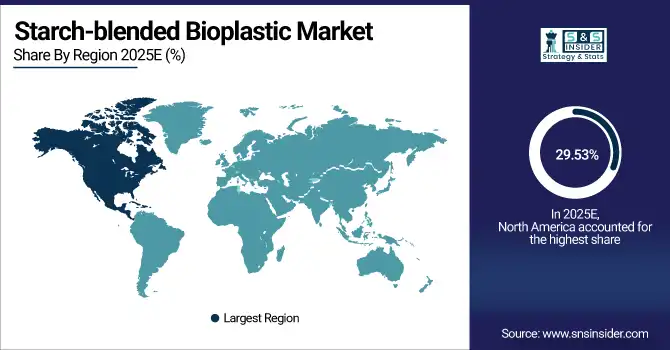
In 2025, North America accounted for approximately 29.53% of the global starch‑blended bioplastic market, driven by strong adoption in sustainable packaging, food service, and consumer goods industries. The region benefits from stringent environmental regulations, increasing consumer awareness of eco-friendly products, and established infrastructure for bioplastic production and recycling. Growth is further supported by ongoing research in advanced starch-polymer blends, industrial collaborations, and investments in innovative biodegradable solutions, making North America a key market for starch-blended bioplastics during 2026–2035.
Get Customized Report as per Your Business Requirement - Enquiry Now
U.S. Starch-blended Bioplastic Market Insights
In North America, the United States dominates the starch‑blended bioplastic market, driven by high consumer demand for sustainable packaging, supportive environmental regulations, advanced manufacturing infrastructure, and widespread adoption across food, retail, and consumer goods industries.
Europe Starch-blended Bioplastic Market Insights
In 2025, Europe dominated the global starch‑blended bioplastic market with approximately 37.34% share, led by countries such as Germany, France, and Italy. Strong regulatory frameworks promoting sustainable packaging, bans on single-use plastics, and incentives for biodegradable materials have driven adoption across food, retail, and consumer goods sectors. High environmental awareness among consumers and investments in research for advanced starch-polymer blends have further strengthened market growth. Europe remains a key hub for innovation, production, and commercialization of starch‑blended bioplastics during 2026–2035.
Germany Starch-blended Bioplastic Market Insights
In Europe, Germany dominates the starch‑blended bioplastic market, driven by strong environmental regulations, advanced manufacturing infrastructure, high consumer awareness of sustainable products, and widespread adoption of biodegradable packaging across food, retail, and industrial sectors.
Asia Pacific Starch-blended Bioplastic Market Insights
The Asia Pacific starch‑blended bioplastic market is expected to grow at the fastest CAGR of 5.37% from 2026 to 2035. Growth is driven by rapid industrialization, rising disposable incomes, and increasing demand for sustainable packaging in food, retail, and consumer goods sectors. Countries like China, India, and Japan are investing in production facilities, research, and development of advanced starch-polymer blends. Government initiatives promoting eco-friendly materials further support market expansion across the region.
China Starch-blended Bioplastic Market Insights
In the Asia Pacific region, China dominates the starch‑blended bioplastic market, driven by large-scale manufacturing capacity, increasing demand for sustainable packaging, government support for biodegradable materials, and rapid adoption across food, retail, and consumer goods industries.
Latin America (LATAM) and Middle East & Africa (MEA) Starch-blended Bioplastic Market Insights
In 2025, the starch‑blended bioplastic market in LATAM and MEA is emerging steadily, driven by growing environmental awareness, government initiatives promoting sustainable materials, and increasing demand in packaging and agriculture sectors. Countries such as Brazil, Mexico, South Africa, and the UAE are investing in production facilities and adopting biodegradable alternatives to reduce plastic waste. Expansion in food packaging, consumer goods, and agricultural applications, combined with supportive policies, is expected to create opportunities for market growth and adoption of starch‑blended bioplastics across these regions.
Competitive Landscape for Starch-blended Bioplastic Market:
Novamont S.p.A. is a leading Italian company specializing in starch‑blended and biodegradable bioplastics, including its flagship Mater‑Bi range. The company focuses on sustainable solutions for packaging, agriculture, and consumer goods, leveraging innovative starch-polymer blends, circular economy principles, and environmental compliance to drive adoption globally in the bioplastics market.
-
In January 2026, Novamont unveiled a rebranding campaign for its Mater‑Bi bioplastics at Marca 2025, emphasizing sustainability, circularity, and natural connection in marketing and identity.
NatureWorks LLC is a U.S.‑based bioplastics company that produces Ingeo™ biopolymers, renewable, low‑carbon PLA plastics made from plant sugars as sustainable alternatives to conventional plastics. Headquartered in Minnesota and jointly owned by Cargill and PTT Global Chemical, NatureWorks supplies Ingeo for packaging, fibers, food serviceware, and 3D printing, advancing eco‑friendly materials with cradle‑to‑cradle lifecycle options.
-
In March 2025, NatureWorks and FLO Group introduced KEYGEA, a compostable single‑serve coffee pod made with Ingeo™ PLA biopolymer, designed for performance and industrial compostability in North America.
Starch-blended Bioplastic Market Key Players:
-
Novamont S.p.A.
-
NatureWorks LLC
-
BASF SE
-
Biome Bioplastics Ltd.
-
Toray Industries Inc.
-
Roquette Frères
-
FKuR Kunststoff GmbH
-
Cardia Bioplastics
-
Plantic Technologies Limited
-
Futerro
-
Biotec GmbH & Co. KG
-
Tianan Biologic Material Co., Ltd.
-
AGRANA Beteiligungs-AG
-
Danimer Scientific
-
Green Dot Bioplastics
-
Treva (Eastman Chemical Company)
-
Kingfa Sci. & Tech. Co., Ltd.
-
Solanyl Biopolymers Inc.
| Report Attributes | Details |
|---|---|
| Market Size in 2025 | USD 335.86 Million |
| Market Size by 2035 | USD 532.81 Million |
| CAGR | CAGR of 4.76% From 2026 to 2035 |
| Base Year | 2025 |
| Forecast Period | 2026-2035 |
| Historical Data | 2022-2024 |
| Report Scope & Coverage | Market Size, Segments Analysis, Competitive Landscape, Regional Analysis, DROC & SWOT Analysis, Forecast Outlook |
| Key Segments | • By Type (Starch–PLA Blends, Starch–PHA Blends, Starch–PBS Blends, and Other Starch-Based Polymer Blends) • By Application (Packaging (bags, wraps, food containers), Agriculture (mulch films, plant pots), Consumer Goods, and Textile & Fibers) • By Product Form (Films & Sheets, Rigid Molded Products, Foams, and Fibers & Others) • By End-User Industry (Food & Beverage, Agriculture, Retail & E-commerce, and Consumer Products Manufacturing) |
| Regional Analysis/Coverage | North America (US, Canada), Europe (Germany, UK, France, Italy, Spain, Russia, Poland, Rest of Europe), Asia Pacific (China, India, Japan, South Korea, Australia, ASEAN Countries, Rest of Asia Pacific), Middle East & Africa (UAE, Saudi Arabia, Qatar, South Africa, Rest of Middle East & Africa), Latin America (Brazil, Argentina, Mexico, Colombia, Rest of Latin America). |
| Company Profiles | Novamont S.p.A., NatureWorks LLC, BASF SE, Biome Bioplastics Ltd., Corbion N.V., Toray Industries Inc., Roquette Frères, FKuR Kunststoff GmbH, Cardia Bioplastics, Plantic Technologies Limited, Mitsubishi Chemical Corporation, Futerro, Biotec GmbH & Co. KG, Tianan Biologic Material Co., Ltd., AGRANA Beteiligungs-AG, Danimer Scientific, Green Dot Bioplastics, Eastman Chemical Company, Kingfa Sci. & Tech. Co., Ltd., Solanyl Biopolymers Inc. |
Frequently Asked Questions
Europe dominated the Starch-blended Bioplastic Market in 2025.
Starch–PLA Blends dominated the Starch-blended Bioplastic Market.
The key driver of the starch‑blended bioplastic market is the rising demand for sustainable, biodegradable alternatives to conventional plastics across packaging, agriculture, and consumer goods sectors
The Starch-blended Bioplastic Market size was USD 335.86 Million in 2025 and is expected to reach USD 532.81 Million by 2035.
The Starch-blended Bioplastic Market is expected to grow at a CAGR of 4.76% from 2026-2035.
