
Laboratory Disc Mills Market Report Scope & Overview:
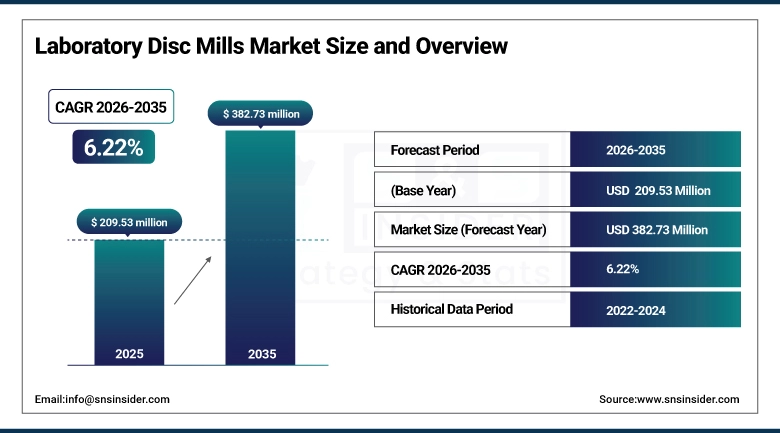
The Laboratory Disc Mills Market was valued at USD 209.53 million in 2025 and is expected to reach USD 382.73 million by 2035, growing at a CAGR 6.22% of from 2026-2035.
The Laboratory Disc Mills Market is growing steadily, driven by increasing demand for precise, efficient, and reproducible sample preparation in laboratories. Rising industrial research, quality control requirements, and adoption of automated laboratory equipment are key growth factors. Continuous innovation, equipment reliability, and productivity improvements further support market expansion across various laboratory applications.
The Laboratory Disc Mills Market is growing, with over 70% of industrial laboratories adopting disc mills for routine sample preparation.
To Get more information on Laboratory Disc Mills Market - Request Free Sample Report
Trends in the Laboratory Disc Mills Market
-
Rising Automation: Growing adoption of fully automatic disc mills for improved safety, efficiency, and reproducibility.
-
High-Precision Grinding: Increased focus on achieving consistent particle size for accurate analytical results.
-
Material-Specific Milling: Expansion of specialized grinding sets (ceramic, tungsten carbide) for diverse applications.
-
Integration with Laboratory Workflows: Greater use in automated sample-preparation lines and high-throughput testing.
-
Sustainability & Energy Efficiency: Development of energy-efficient, low-maintenance mills to reduce operational costs.
U.S. Laboratory Disc Mills Market Insights:
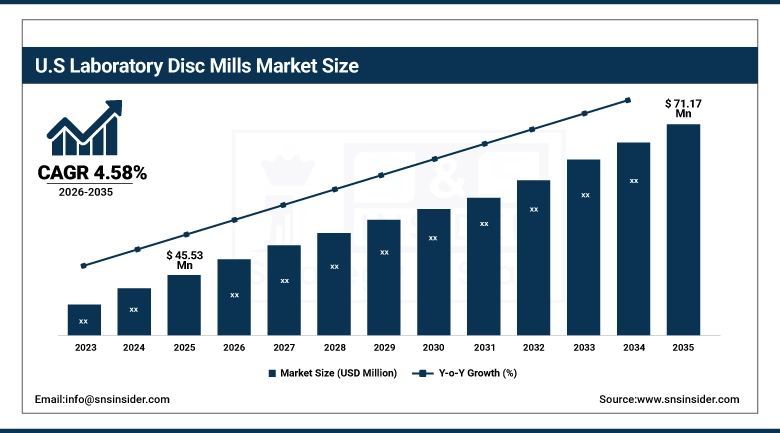
The U.S. Laboratory Disc Mills Market is projected to grow from USD 45.53 Million in 2025 to USD 71.17 Million by 2035, at a CAGR of 4.58%. Growth is driven by increasing demand for precise sample preparation, rising industrial and academic research activities, stringent quality control standards, and growing adoption of automated, high-efficiency laboratory disc mills.
Laboratory Disc Mills Market Growth Drivers:
-
Rising Demand for Accurate and Reproducible Sample Preparation
Growth is driven by laboratories increasing need for consistent and reliable sample preparation, critical for research, quality control, and analytical testing. Over 70% of industrial laboratories now use laboratory disc mills as a core tool for sample grinding and homogenization. The trend reflects the growing emphasis on data accuracy, reproducibility, and standardized testing protocols, particularly in mining, cement, chemical, pharmaceutical, and academic research laboratories, supporting the market’s steady expansion globally.
Laboratory Disc Mills Market Restraints:
-
High Initial Equipment Cost Limiting Adoption
The high initial cost of laboratory disc mills remains a key restraint, particularly for small and budget-constrained laboratories. Advanced models with fully automatic operation, precision grinding sets, and safety features require significant investment, making them less accessible to smaller facilities. As a result, many laboratories continue using manual or alternative grinding equipment, which slows overall adoption. This financial barrier limits market penetration despite increasing demand for accurate, reproducible, and efficient sample preparation across various laboratory applications.
Laboratory Disc Mills Market Opportunities:
-
Development of Energy-Efficient and Low-Maintenance Disc Mills
The development of energy-efficient and low-maintenance laboratory disc mills presents a significant market opportunity. Manufacturers are focusing on reducing power consumption, minimizing wear and tear, and simplifying maintenance requirements to enhance equipment reliability and lower operational costs. These advancements make disc mills more appealing to laboratories seeking long-term efficiency and productivity. By improving durability and reducing downtime, such innovations help laboratories maintain consistent sample preparation standards while supporting sustainable and cost-effective operations.
Laboratory Disc Mills Market Segment:
-
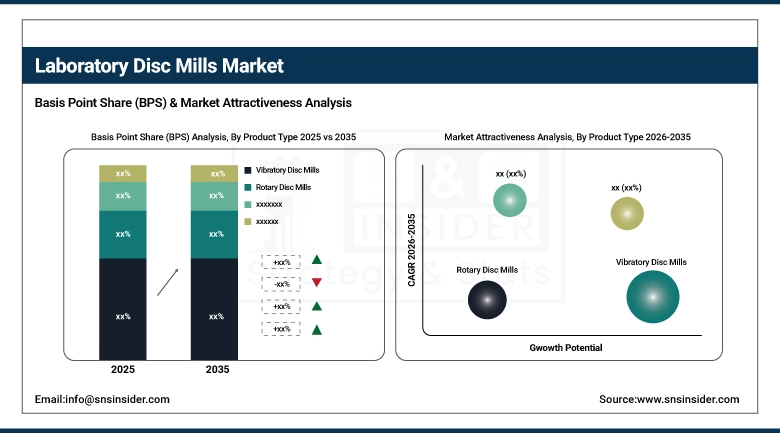
By Product Type: In 2025, Vibratory Disc Mills dominated with 63% share; Rotary Disc Mills fastest growing segment during 2026-2035
-
By Operation Mode: In 2025, Manual dominated with 48% share; Fully Automatic fastest growing segment during 2026-2035
-
By Application: In 2025, Mining & Metallurgy dominated with 29% share; Pharmaceuticals fastest growing segment during 2026-2035
-
By End User: In 2025, Industrial Laboratories dominated with 43% share; Contract Testing Laboratories fastest growing segment during 2026-2035
Laboratory Disc Mills Market Segment Analysis:
By Product Type: Vibratory Disc Mills Dominate as Rotary Disc Mills Emerge as Fastest-Growing
Vibratory disc mills dominate the product type segment due to their superior grinding efficiency, high sample reproducibility, and widespread use in mining, cement, and materials testing laboratories for routine and high-throughput sample preparation.
Rotary disc mills are the fastest-growing segment, driven by increasing demand for flexible grinding solutions, improved automation compatibility, and growing adoption in specialized laboratory applications.
By Operation Mode: Manual Systems Dominate as Fully Automatic Systems Gain Rapid Traction
Manual disc mills dominate the operation mode segment owing to their lower cost, ease of use, and extensive installed base across small and mid-sized laboratories.
Fully automatic disc mills are the fastest-growing segment, supported by rising demand for labor efficiency, enhanced safety features, and consistent sample preparation in high-throughput laboratory environments.
By Application: Mining & Metallurgy Dominate as Pharmaceuticals Emerge as Fastest-Growing
Mining and metallurgy dominate the application segment due to continuous demand for accurate particle size reduction and quality control in mineral exploration, processing, and materials characterization laboratories.
Pharmaceuticals represent the fastest-growing application segment, driven by stricter quality regulations, increased drug development activities, and the need for precise and reproducible sample preparation.
By End User: Industrial Laboratories Dominate as Contract Testing Laboratories Grow Fastest
Industrial laboratories dominate the end-user segment as manufacturers increasingly rely on in-house testing for quality assurance, process optimization, and regulatory compliance.
Contract testing laboratories are the fastest-growing end-user segment, supported by rising outsourcing of analytical testing services and growing demand for cost-effective, high-precision laboratory solutions.
Laboratory Disc Mills Market - Regional Analysis
Europe Laboratory Disc Mills Market Insights:
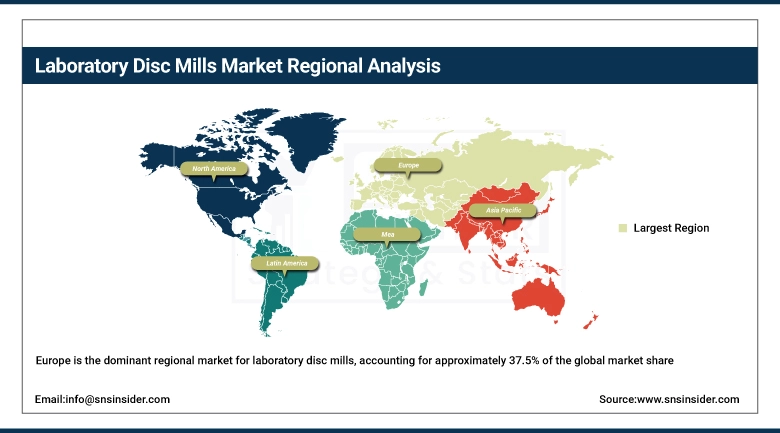
Europe is the dominant regional market for laboratory disc mills, accounting for approximately 37.5% of the global market share. This dominance is driven by the strong presence of leading manufacturers, well-established industrial and research laboratories, high adoption of advanced sample preparation equipment, and stringent quality and testing standards across multiple laboratory applications.
Get Customized Report as per Your Business Requirement - Enquiry Now
Asia-Pacific Laboratory Disc Mills Market Insights:
Asia-Pacific is the fastest-growing region in the Laboratory Disc Mills Market, expected to register a CAGR of approximately 8.99% during 2026-2035. This growth is driven by expanding industrial laboratories, increasing mining and construction activities, rising research investments, and growing adoption of advanced laboratory equipment across emerging economies.
North America Laboratory Disc Mills Market Insights:
North America represents a mature and steadily growing market for laboratory disc mills, driven by strong demand from industrial and research laboratories. Growth is supported by increasing focus on laboratory modernization, automation, and strict quality control requirements across mining, chemical, pharmaceutical, and materials testing applications.
Latin America Laboratory Disc Mills Market Insights:
Latin America is an emerging market for laboratory disc mills, supported by growing mining, cement, and materials testing activities. Increasing investments in industrial laboratories, expanding research capabilities, and rising focus on quality control and standardized testing are gradually driving adoption across the region.
Middle East & Africa Laboratory Disc Mills Market Insights:
The Middle East & Africa region is a developing market for laboratory disc mills, driven by growth in mining, construction materials testing, and industrial quality control laboratories. Increasing infrastructure projects, expanding research activities, and gradual adoption of modern laboratory equipment are supporting steady market development across the region.
Laboratory Disc Mills Market Competitive Landscape:
RETSCH GmbH, headquartered in Haan, Germany, is a leading player in the Laboratory Disc Mills Market, offering advanced sample preparation solutions for mining, cement, chemical, pharmaceutical, and research laboratories. The company is known for its high-performance vibratory and rotary disc mills, emphasizing precision, reproducibility, safety, and automation to support accurate material analysis and quality control across laboratory environments.
-
In February 2025: RETSCH introduced enhancements to its laboratory disc mill portfolio, focusing on improved automation features, noise reduction, and durability to support high-throughput and standardized laboratory testing applications.
FLSmidth, headquartered in Copenhagen, Denmark, is a prominent player in the Laboratory Disc Mills Market, particularly serving mining, minerals, and cement testing laboratories. The company provides robust disc milling solutions designed for reliable sample preparation, process optimization, and quality assurance, leveraging its strong expertise in mineral processing and laboratory equipment integration.
-
In April 2025: FLSmidth strengthened its laboratory equipment offerings by upgrading its disc mill systems to improve energy efficiency, safety compliance, and integration with automated laboratory workflows for mining and cement laboratories.
Laboratory Disc Mills Market Key Players
-
RETSCH GmbH
-
FLSmidth
-
NETZSCH Group
-
Metso
-
Verder Scientific
-
FRITSCH GmbH
-
SPEXS SamplePrep
-
Brabender GmbH & Co. KG
-
Buehler (ITW)
-
IKA Werke GmbH & Co. KG
-
SIEBTECHNIK GmbH
-
Laarmann Group B.V.
-
Cole-Parmer (Antylia Scientific)
-
Torontech Group
-
MRC Laboratory Equipment
-
Changsha Tianchuang Powder Technology
-
Shanghai Jingxin Industrial Development
-
Nanjing Chishun Technology Development
| Report Attributes | Details |
|---|---|
| Market Size in 2025 | USD 209.53 Million |
| Market Size by 2035 | USD 382.73 Million |
| CAGR | CAGR of 6.22% From 2026 to 2035 |
| Base Year | 2025 |
| Forecast Period | 2026-2035 |
| Historical Data | 2022-2024 |
| Report Scope & Coverage | Market Size, Segments Analysis, Competitive Landscape, Regional Analysis, DROC & SWOT Analysis, Forecast Outlook |
| Key Segments | • By Product Type: (Vibratory Disc Mills, Rotary Disc Mills) • By Operation Mode: (Manual, Semi-automatic, Fully automatic) • By Application: (Mining & metallurgy, Cement & construction materials, Chemicals & materials, Pharmaceuticals, Research & testing laboratories) • By End User: (Industrial laboratories, Contract testing laboratories, Academic & research institutes) |
| Regional Analysis/Coverage | North America (US, Canada), Europe (Germany, UK, France, Italy, Spain, Russia, Poland, Rest of Europe), Asia Pacific (China, India, Japan, South Korea, Australia, ASEAN Countries, Rest of Asia Pacific), Middle East & Africa (UAE, Saudi Arabia, Qatar, South Africa, Rest of Middle East & Africa), Latin America (Brazil, Argentina, Mexico, Colombia, Rest of Latin America). |
| Company Profiles | RETSCH GmbH, FLSmidth, NETZSCH Group, Hosokawa Micron Group, Metso, Verder Scientific, FRITSCH GmbH, SPEX SamplePrep, Brabender GmbH & Co. KG, Buehler (ITW), IKA Werke GmbH & Co. KG, Anton Paar GmbH, SIEBTECHNIK GmbH, Laarmann Group B.V., Cole-Parmer (Antylia Scientific), Torontech Group, MRC Laboratory Equipment, Changsha Tianchuang Powder Technology, Shanghai Jingxin Industrial Development, Nanjing Chishun Technology Development |

Frequently Asked Questions
Europe dominated the Laboratory Disc Mills Market in 2025.
The “vibratory disc mills” segment dominated during the projected period.
The key drivers of the Laboratory Disc Mills Market include rising demand for precise sample preparation, expanding mining and cement laboratories, stricter quality standards, growing R&D activities, and increased laboratory automation.
The market was valued at USD 209.53 Million in 2025 and is projected to reach USD 382.73 Million by 2035.
The Laboratory Disc Mills Market is expected to grow at a CAGR of 6.22% during 2026–2035.
