
Supersonic Jet Market Report Scope & Overview:
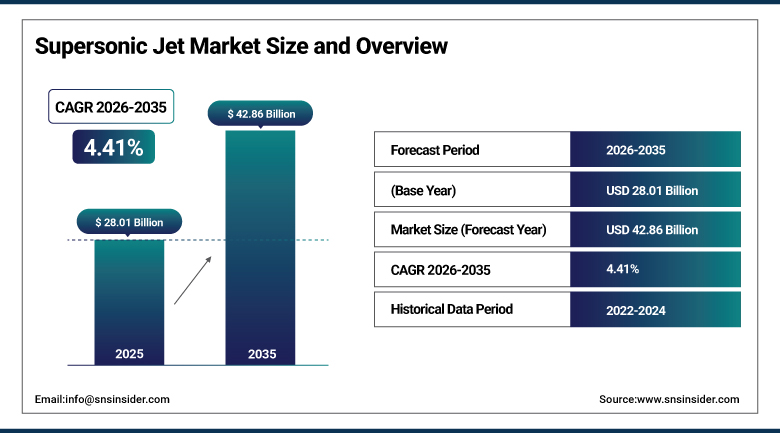
The Supersonic Jet Market was valued at USD 28.01 billion in 2025 and is expected to reach USD 42.86 billion by 2035, growing at a CAGR of 4.41% from 2026–2035.
The supersonic jet segment is experiencing steady growth due to growing need for ultra-fast intercontinental flights, increasing financial commitment toward new generation technologies in aerospace, and efforts to minimize intercontinental travel time. Aviation and defense sectors have begun to show increasing interest in innovative supersonic solutions that can offer higher efficiency, better aerodynamic characteristics, and shorter travel times. The fast-paced advancement in technologies such as low boom designs, efficient propulsion, advanced composite materials, and sustainable fuel capabilities is expected to fuel the development of the market in the near future.
In June 2025, Boom Supersonic continued advancement of its Overture supersonic airliner program by progressing manufacturing and testing activities associated with next-generation high-speed commercial aviation platforms. The company also expanded strategic supplier and infrastructure initiatives supporting future commercial deployment.
To Get more information Supersonic Jet Market - Request Free Sample Report
Supersonic Jet Market Trends
-
Rising adoption of low-boom technologies is improving next-generation supersonic aircraft development.
-
Increasing investments in advanced propulsion systems are accelerating high-speed aviation innovation.
-
Growing integration of AI-enabled flight analytics is enhancing aircraft performance optimization.
-
Rising demand for sustainable aviation fuel (SAF)-compatible platforms is supporting greener supersonic travel.
-
Increasing aerospace and defense investments are driving global supersonic jet programs.
The US Supersonic Jet Market Size Outlook
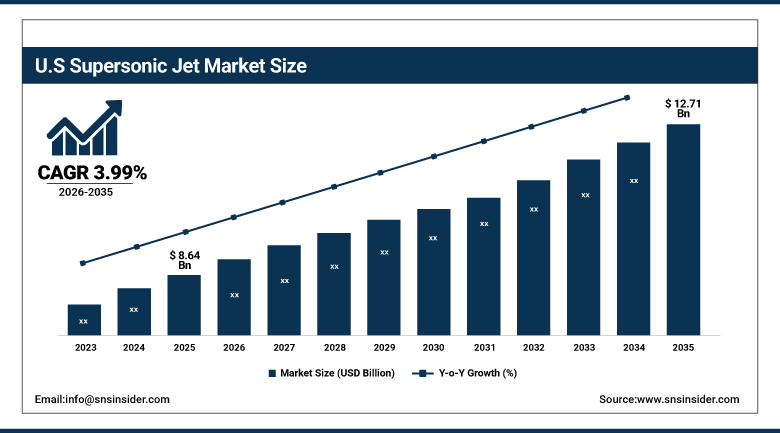
The U.S. Supersonic Jet Market was valued at USD 8.64 billion in 2025 and is projected to reach USD 12.71 billion by 2035, growing at a CAGR of 3.99% from 2026–2035.
The United States is still the leading nation in the supersonic jet business because of its strong aerospace innovations ecosystem, robust military modernization policies, and the existence of aerospace giants such as Boom Supersonic, Lockheed Martin, Northrop Grumman, and RTX Corporation. Increased funding for low-boom technology, propulsion, and advanced aircraft programs is reinforcing U.S. dominance in high-speed flight technologies. Additionally, robust aerospace research initiatives by federal authorities, state-of-the-art flight-testing facilities, and collaboration among defense departments and aerospace firms have greatly reinforced this dominance.
In 2025, Boom Supersonic progressed testing and validation activities for its Symphony supersonic engine program, aimed at powering future Overture aircraft with improved efficiency and performance capabilities.
Supersonic Jet Market Segment Analysis
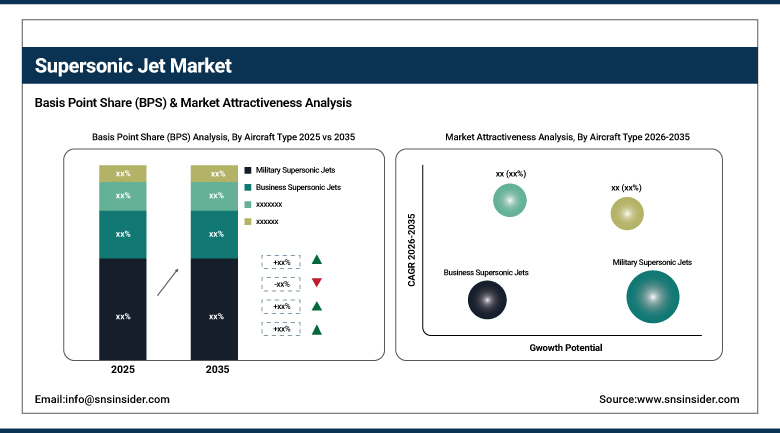
• By Aircraft Type, military supersonic jets dominated the supersonic jet market with 57.56% share in 2025; commercial supersonic jets fastest growing CAGR.
• By Speed Range, mach 1–2 dominated the supersonic jet market with 68.29% share in 2025; above mach 3 fastest growing CAGR.
• By Application, defense & military operations dominated the supersonic jet market with 52.42% share in 2025; space tourism / specialized missions fastest growing CAGR.
• By Technology, aerodynamic design technologies dominated the supersonic jet market with 34.84% share in 2025; advanced propulsion systems fastest growing CAGR.
By Aircraft Type, military supersonic jets dominates the supersonic jet market, while commercial supersonic jets is the fastest-growing segment.
Military supersonic jets segment dominated the supersonic jet market with the highest revenue share of about 57.56% in 2025 due to increasing defense modernization programs, continuous procurement of advanced fighter aircraft, and rising investments in high-speed combat capabilities. Growing geopolitical tensions, demand for rapid-response missions, and integration of advanced avionics and propulsion technologies continue to strengthen adoption across defense forces globally.
Commercial supersonic jets segment is estimated to register the highest CAGR during 2026–2035 due to increasing interest in ultra-fast premium air travel and growing investments in next-generation commercial supersonic programs. Rising focus on reducing long-haul travel time and development of low-boom aircraft technologies is expected to accelerate market growth.
By Speed Range, mach 1–2 dominates the supersonic jet market, while above mach 3 is the fastest-growing segment.
Mach 1–2 segment dominated the supersonic jet market with the highest revenue share of about 68.29% in 2025 owing to its broad use across current military aircraft and near-term commercial supersonic development programs. This speed range offers an effective balance between operational performance, fuel efficiency, and technological feasibility.
Above Mach 3 segment is projected to experience the fastest CAGR during the forecast period of 2026–2035 due to increasing investments in hypersonic and next-generation ultra-high-speed aircraft programs. Growing research in advanced propulsion systems and thermal-resistant materials is further supporting future development.
By Application, defense & military operations dominates the supersonic jet market, while space tourism / specialized missions is the fastest-growing segment.
Defense & military operations segment dominated the supersonic jet market with the highest revenue share of about 52.42% in 2025 driven by increasing demand for high-speed surveillance, air superiority missions, and tactical response capabilities. Rising defense budgets and continuous advancements in combat aircraft technologies are supporting segment expansion.
Space tourism / specialized missions segment is projected to witness the fastest CAGR during 2026–2035 due to increasing private aerospace investments and growing demand for high-speed specialized flight applications. Expansion of future space mobility concepts and premium aviation experiences is contributing to segment growth.
By Technology, aerodynamic design technologies dominates the supersonic jet market, while advanced propulsion systems is the fastest-growing segment.
Aerodynamic design technologies segment dominated the supersonic jet market with the highest revenue share of about 34.84% in 2025 owing to growing emphasis on low-boom aircraft configurations, drag reduction, and high-efficiency airframe structures. Continuous investments in computational design and performance optimization technologies are further driving adoption.
Advanced propulsion systems segment is projected to register the fastest CAGR during the forecast period of 2026–2035 due to rising development of fuel-efficient supersonic engines and next-generation high-thrust technologies. Increasing focus on sustainability, operational efficiency, and future commercial aircraft programs is accelerating market demand.
Regional Analysis
|
Region |
Major Country |
Share within Region, 2025(%) |
|---|---|---|
|
North America |
United States |
79.54% |
|
Europe |
Germany |
27.80% |
|
Asia Pacific |
China |
41.97% |
|
Middle East & Africa |
UAE |
17.36% |
|
Latin America |
Brazil |
39.83% |
North America Supersonic Jet Market Insights
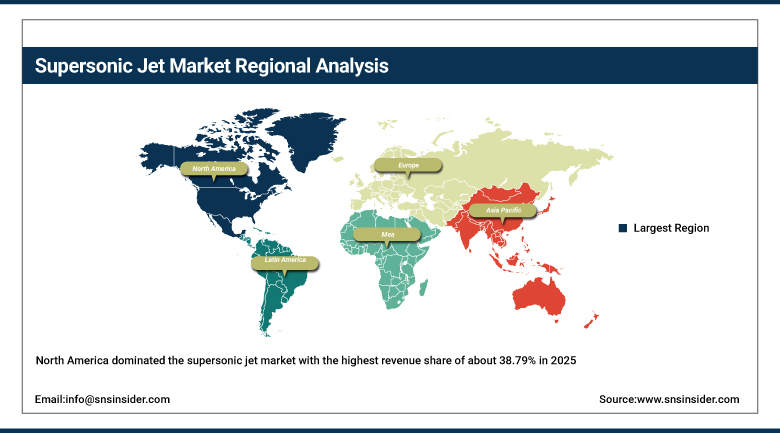
North America dominated the supersonic jet market with the highest revenue share of about 38.79% in 2025 because of the high level of capabilities for aerospace manufacturing, substantial defense modernization efforts, and increased investment in future generation technologies related to fast aviation. Increased developments in programs for low boom aircraft, advanced propulsion systems, and military fast aircraft have created an increased market demand. With the influence of large aerospace corporations and strong research efforts of the government, the region is bound to maintain its dominance in the aviation sector.
Get Customized Report as per Your Business Requirement - Enquiry Now
Europe Supersonic Jet Market Insights
Europe is recognized as an important region within the supersonic jet industry due to growing investment in sustainable aviation technology, advanced aerospace research, and development of futuristic aircrafts. Nations such as the United Kingdom, France, Germany, and Italy are playing vital roles by emphasizing aerospace engineering, efficient propulsion systems, and innovative aerospace development programs. Increasing importance given to emission-free aviation technology and high-speed transportation systems is driving market growth in the region.
Asia Pacific Supersonic Jet Market Insights
Asia Pacific is expected to grow at a 5.68% CAGR during 2026–2035 owing to rapid expansion of aviation infrastructure, increasing government defense expenditures, and rising investments in advanced aerospace technologies across China, India, Japan, and Southeast Asian countries. The growing demand for premium air travel services, high-speed transportation systems, and modernization of military aviation capabilities is significantly contributing to market expansion. Rising urbanization and increasing passenger traffic across major economies are further encouraging investments in next-generation aviation platforms. Additionally, governments and aerospace organizations across the region are actively supporting domestic aircraft development initiatives and high-speed aviation research programs to strengthen long-term aerospace competitiveness.
Middle East & Africa and Latin America Supersonic Jet Market Insights
Middle East & Africa (MEA) and Latin America regions have been reporting steady growth in the supersonic jet market due to increasing investments in aerospace infrastructure, defense modernization initiatives, and advanced aviation technologies. In the MEA region, countries such as the UAE and Saudi Arabia are actively investing in next-generation aerospace ecosystems, high-speed aviation programs, and long-term aviation diversification strategies to strengthen regional aerospace capabilities. Meanwhile, in Latin America, countries including Brazil and Mexico are supporting market growth through expansion of aviation infrastructure, strengthening domestic aerospace industries, and increasing investments in defense and commercial aviation programs.
Market Dynamics
Growth Drivers: Rising demand for ultra-fast air travel and next-generation aviation technologies is accelerating supersonic jet development globally
Growing need to minimize travel times across continents and enhance movement of first-class passengers is increasingly contributing towards spending on programs involving development of cutting-edge supersonic aircraft. Airlines, aircraft manufacturers, and defense agencies have been making efforts to develop aircraft that will ensure quicker movements with higher efficiency. Advances in technology pertaining to aerodynamics, lightweight materials, and efficient engines have contributed towards enhanced performance of aircraft. Moreover, modernizing of defense sector and developments in quick and efficient movements have also added to growth opportunities in the industry.
Restraints: High development costs and strict regulatory requirements are limiting large-scale commercialization of supersonic aircraft
The design of supersonic planes involves heavy expenditures on advanced engines, heat-resistant materials, testing, and certification processes, imposing major economic constraints on manufacturers. Stringent regulatory requirements about restrictions concerning sonic boom, environmental impact, noise pollution, and overland supersonic flight impose major obstacles to wider commercial use of such technology. Furthermore, cost factors may hinder the process of implementing the technology.
Opportunities: Advancements in low-boom technologies and sustainable propulsion systems are creating future growth opportunities
The fast-paced developments in low-boom design technology of aircraft, compatibility of sustainable aviation fuels, and advanced propulsion technologies are opening promising prospects for the future in the realm of supersonic aviation. Advances in AI-powered flight optimization, digital engineering tools, and simulation technology are enhancing the process of aircraft design. The rising preference for premium long-distance air travel, air mobility solutions of the future, and commercialization of supersonic flights are anticipated to provide good growth prospects in the coming years.
Recent Developments
-
2026: Hermeus Corporation accelerated development and validation activities for its high-speed aircraft program focused on advanced propulsion architecture and next-generation hypersonic flight technologies for defense and commercial applications.
-
2026: RTX Corporation expanded research collaborations in advanced aerospace propulsion and thermal management systems aimed at improving efficiency and high-speed flight performance for future supersonic platforms.
-
2025: Boom Supersonic completed additional XB-1 flight testing milestones, supporting aerodynamic validation and high-speed performance assessment for future commercial supersonic aircraft programs.
-
2025: Northrop Grumman continued investments in advanced high-speed aerospace systems and next-generation aircraft technologies focused on future defense aviation capabilities and rapid-response missions.
Supersonic Jet Market Key Players are:
-
Boom Supersonic
-
Lockheed Martin Corporation
-
Northrop Grumman Corporation
-
Boeing Defense, Space & Security
-
RTX Corporation (Pratt & Whitney / Collins Aerospace)
-
GE Aerospace
-
Rolls-Royce Holdings plc
-
Spike Aerospace Inc.
-
Exosonic Inc.
-
Hermeus Corporation
-
Aerion Supersonic Corporation
-
Dassault Aviation S.A.
-
Airbus SE
-
Safran S.A.
-
Leonardo S.p.A.
-
BAE Systems plc
-
Gulfstream Aerospace Corporation
-
Virgin Galactic Holdings Inc.
-
Japan Aerospace Exploration Agency (JAXA)
-
National Aeronautics and Space Administration (NASA)
Supersonic Jet Market Report Scope:
| Report Attributes | Details |
|---|---|
| Market Size in 2025 | USD 28.01 Billion |
| Market Size by 2035 | USD 42.86 Billion |
| CAGR | CAGR of 4.41% From 2026 to 2035 |
| Base Year | 2025 |
| Forecast Period | 2026-2035 |
| Historical Data | 2022-2024 |
| Report Scope & Coverage | Market Size, Segments Analysis, Competitive Landscape, Regional Analysis, DROC & SWOT Analysis, Forecast Outlook |
| Key Segments | • By Aircraft Type (Military Supersonic Jets,Business Supersonic Jets,Commercial Supersonic Jets) • By Speed Range (Mach 1–2, Mach 2–3, Above Mach 3) • By Application ( Defense & Military Operations ,Passenger Transportation, Space Tourism / Specialized Missions, Research Applications) • By Technology (Aerodynamic Design Technologies, Advanced Propulsion Systems, Noise Reduction Technologies, Sustainable Aviation Fuel Compatibility) |
| Regional Analysis/Coverage | North America (US, Canada), Europe (Germany, UK, France, Italy, Spain, Russia, Poland, Rest of Europe), Asia Pacific (China, India, Japan, South Korea, Australia, ASEAN Countries, Rest of Asia Pacific), Middle East & Africa (UAE, Saudi Arabia, Qatar, South Africa, Rest of Middle East & Africa), Latin America (Brazil, Argentina, Mexico, Colombia, Rest of Latin America). |
| Company Profiles | Boom Supersonic, Lockheed Martin Corporation, Northrop Grumman Corporation, Boeing Defense, Space & Security, RTX Corporation (Pratt & Whitney / Collins Aerospace), GE Aerospace, Rolls‑Royce Holdings plc, Spike Aerospace Inc., Exosonic Inc., Hermeus Corporation, Aerion Supersonic Corporation, Dassault Aviation SA, Airbus SE, Safran S.A., Leonardo S.p.A., BAE Systems plc, Gulfstream Aerospace Corporation, Virgin Galactic Holdings Inc., Japan Aerospace Exploration Agency (JAXA), National Aeronautics and Space Administration (NASA). |

Frequently Asked Questions
The supersonic jet market was valued at USD 28.01 billion in 2025.
Rising demand for ultra-fast air travel, increasing investments in next-generation supersonic aircraft technologies, and growing defense modernization programs are driving demand for advanced supersonic jet systems globally.
Military supersonic jets segment dominated the below grade waterproofing membranes market in 2025
North America dominated the supersonic jet market in 2025.
