
Triboelectric Nanogenerator Market Report Scope & Overview:
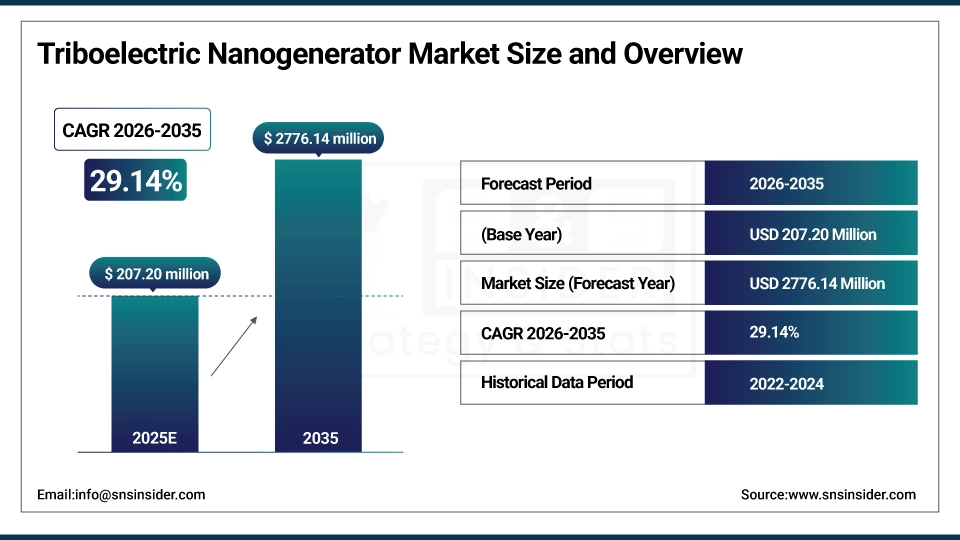
The Triboelectric Nanogenerator Market was valued at USD 207.20 Million in 2025 and is expected to reach USD 2776.14 Million by 2035, growing at a CAGR 29.14% of from 2026-2035.
The market for Triboelectric Nanogenerator is increasing significantly due to high demand for self-powering and energy-harvesting solution from consumer electronics, medical equipment, automotive and wearable industries. The higher utilization of IOT, wearable devices and green energy devise is rapid toward the integration of TENG system. Advanced materials, flexible structure and hybrid nanogenerator device constructions are exploited for improved energy conversion efficiency, miniaturized devices and the stability of operation in order to work towards changing this process.
In 2025, Triboelectric Nanogenerators were deployed in over 40 countries, powering consumer electronics, medical devices, and wearable systems, enabling up to 30% energy savings and 20% longer device operational life through efficient energy harvesting and self-powered integration.
To Get more information on Triboelectric Nanogenerator Market - Request Free Sample Report
Key Trends in the Triboelectric Nanogenerator Market
-
Rising adoption of wearables and IoT devices: TENGs are integrated into consumer electronics, medical devices, and smart sensors for self-powered operation.
-
Advancements in flexible and nanostructured materials: High-performance polymers and nanocomposites improve energy efficiency and durability.
-
Focus on sustainable energy harvesting: TENGs reduce battery dependence and support eco-friendly, low-power technologies.
-
Expansion into automotive and industrial applications – Used in smart vehicles, industrial monitoring, and infrastructure systems.
-
Hybrid nanogenerators for higher output: Combining TENGs with piezoelectric or electromagnetic systems enhances energy generation.
-
Increasing R&D and commercialization: Accelerated prototyping, pilot projects, and large-scale deployment of TENG solutions.
U.S. Triboelectric Nanogenerator Market Insights:
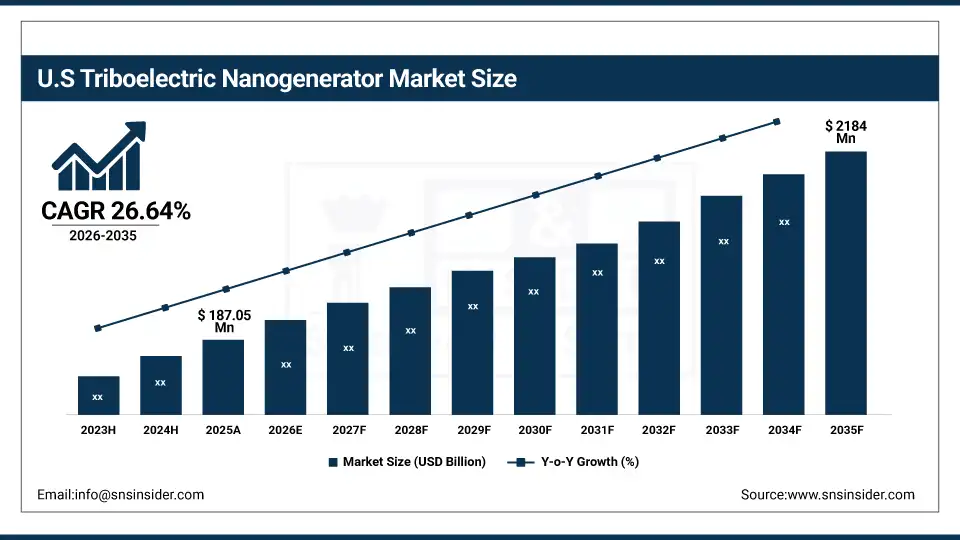
The U.S. Triboelectric Nanogenerator Market is projected to grow from USD 187.05 Million in 2025 to USD 2184 Million by 2035, at a CAGR of 26.64%. Growth is driven by rising adoption of self-powered and energy-harvesting devices, increasing demand for IoT and wearable technologies, expansion into automotive and industrial applications, continuous advancements in flexible and nanostructured materials, and increasing R&D and commercialization of TENG solutions.
Triboelectric Nanogenerator Market Growth Drivers:
-
Rising Demand for Self-Powered and Energy-Harvesting Devices Across Industries
The Triboelectric Nanogenerator market is driven by the growing demand for self-powered sensors, wearable electronics and IoT devices in consumer, healthcare and industrial sector. Technical Feature Electricity Freedom Automation Energy efficiency, sustainability, battery-free operation emphasis is increasingly becoming the driving force of adoption. By 2025, a large part of wearable and IoT devices worldwide are integrating TENG solutions to enhance the life of device, reduce maintenance cost and make continuous energy harvesting available.
Triboelectric Nanogenerator Market Restraints:
-
High Development Costs and Material Challenges Limiting Widespread Adoption
The market growth is inhibited by the high R&D and manufacturing cost of advanced TENG device including flexible polymers, nano-structured composites, and hybrid materials. The lack of standardization, complex fabrication procedures and variable performance across applications are also the bottleneck problems. Secondly, there are alternative energy-harvesting technologies like piezoelectric and electromagnetic generators available as competitive solutions, which place obstacles on the application of TENGs.
Triboelectric Nanogenerator Market Opportunities:
-
Expansion in Wearable, Automotive, and Industrial Energy-Harvesting Applications
The market offers abundant opportunities for the in-tandem TENG market in response to rising adoption of TENGs with smart textiles, medical device components, automotive sensors and industrial monitoring system kits. Worldwide applications of energy-harvesting techniques in such sectors have, moreover, experienced a rapid advancement resulting in a growing demand for high performance and small size TENG devices by 2025. The development of hybrid nanogenerator technology, flexible materials, and scalable fabrication process is currently expected to increase revenue for TENGs, leading to increasingly rapid market growth.
Triboelectric Nanogenerator Market Segment:
-
By Device: In 2025, vertical contact‑separation TENGs dominated with 45% share; single‑electrode TENGs are projected to be the fastest-growing segment during 2026–2035.
-
By Material Type: In 2025, polymer‑based TENGs led with 50% share; nanostructured material‑based TENGs are expected to be the fastest-growing segment during 2026–2035.
-
By Application: In 2025, consumer electronics dominated with 42% share; medical devices are projected to be the fastest-growing segment during 2026–2035.
-
By End-user Industry: In 2025, energy harvesting systems held 40% share; smart textiles & wearables are expected to be the fastest-growing segment during 2026–2035.
Triboelectric Nanogenerator Market Segment Analysis:
By Device: Vertical Contact‑Separation TENGs Lead as Single-Electrode TENGs Emerge as Fastest-Growing Segment
Vertical contact‑separation TENGs accounted for the largest share of the device segment as these have a simple design, high energy conversion efficiency and are applicable in various consumer electronics, medical devices and industrial systems. These are commercial off the shelf devices perfect for high performance energy harvesting applications where reliability, ruggedness and easy of integration are paramount. Scalability in manufacturing, strong power output, and compatibility with a variety of motion or vibration sources that will foster large-scale market acceptance.
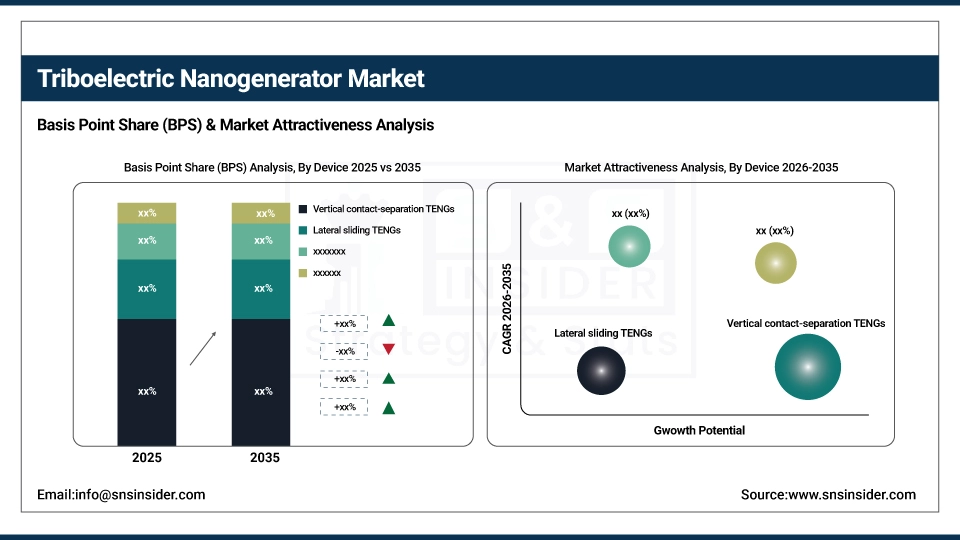
The single-electrode TENGs are experiencing the fastest growth, attributed to the rising need for wearable and portable devices that demand small-sized, flexible and cost-effective energy-harvesting techniques. The reason for their usefulness, aside from their minimal BOM requirement since they can work with one active electrode, is that they are suitable for miniaturized IoT devices and promising markets dedicated to self-powered electronics.
By Material Type: Polymer-Based TENGs Lead as Nanostructured Material-Based TENGs Emerge as Fastest-Growing Segment
Polymer-based TENGs hold the dominant position among materials on account of their maximum flexibility, low cost, light weight and easy processing. They are widely used in consumer electronics and healthcare products where form factor, comfort and mechanical robustness of the device is crucial. Periodic advancements in polymer coatings, surface modification, as well as mechanical resistance have continued to support the lead of this segment.
TENGs based on nanostructured materials are the fast-developing area with emphasis on nanocomposites, surface modification and hybrid material technology that significantly increase energy conversion efficiency. These materials have been pushing into more high performance applications including industrial energy harvesting, smart textiles, and advanced IoT hardware.
By Application: Consumer Electronics Lead as Medical Devices Emerge as Fastest-Growing Segment
In the application portion, consumer electronics represent the largest sector wherein TENG is extensively applied for self-powered operation in smartphones, wearables, smart sensors, and portable devices. The increasing interest in battery-less operation, device towards miniaturization and sustainable energy also contributes to the strong uptake from this segment.
Medical devices is the fastest growing application segment driven by increasing demand for self-powered wearable health monitors, biosensors and remote diagnostic equipment. Inclusion of TENGs in the field of medical technology allows for enhancing patient mobility, reducing maintenance cost and following up patients both in hospitals and at home.
By End-User Industry: Energy Harvesting Systems Lead as Smart Textiles & Wearables Emerge as Fastest-Growing Segment
The end-user segment is led by the energy harvesting systems, since TENGs are utilized extensively in industry-monitoring services, structural sensing applications and smart infrastructure projects for self-powered solutions. Its high reliability and long service life provide robust adoption, as with compatibility with IoT platforms.
Smart textiles & wearables to be the fastest growing end-use field due to the growing inclusion of TENGs in clothing, fitness trackers, and wearable electronics. Emerging demand for energy harvesters to be integrated into wearable devices, strengthened by breakthroughs in flexible and stretchable electronics materials advances market growth in this field.
Triboelectric Nanogenerator Market - Regional Analysis
Asia-Pacific Triboelectric Nanogenerator Market Insights:
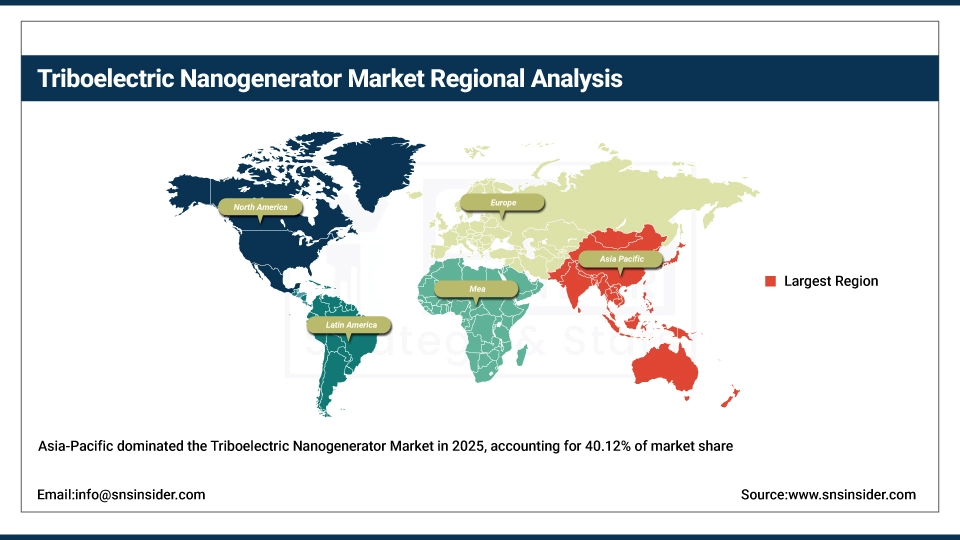
In 2025, Asia-Pacific holds the largest market share of approximately 40.12%, making it both the dominant and fastest-growing region in the Triboelectric Nanogenerator market. The region is projected to grow at a CAGR of around 31.65% during 2026-2035. Market growth in the Asia-Pacific region can be attributed to a large number of electronics and wearable device manufacturers, early adoption of IoT and smart technologies, and increasing demand for self-powered energy-harvesting solutions. Well-established investment in R&D directed by the government toward sustainable energy technologies, and increasing consumer sensitivity to environmentally friendly gadgets are fueling markets growth. China, Japan and South Korea along are faster growing in the region of TENG R&D, manufacturing and commercialization which causes both dominance and fastest growth.
Get Customized Report as per Your Business Requirement - Enquiry Now
North America Triboelectric Nanogenerator Market Insights:
Market growth in North America is influenced by a robust technological infrastructure, and higher adoption of IoT devices along with rising demand for self-powered and energy-harvesting solutions across consumer electronics, healthcare & industrial. Heavy investments for research & development, availability of top TENG manufacturers and its premature commercialization in wearable as well as smart sensor technologies foster the market growth. The region is dominated by the United States and Canada, which concentrate on sustainable, battery-less energy solutions to propel steady expansion from 2026 to 2035.
Europe Triboelectric Nanogenerator Market Insights:
Europe Triboelectric Nanogenerator Market size is influenced by stringent safety and quality norms set by the EU, inclination towards nutritional labeling and deployment of standardized analytical and energy-harvesting solutions. Consistent demand is underpinned by the region’s robust consumer electronics, industrial and healthcare industries. Furthermore, strong research institutions, sustainable projects and growing penetration of automated as well as flexible TENG devices result in uniform market growth in Western and Eastern Europe.
Latin America Triboelectric Nanogenerator Market Insights:
Triboelectric Nanogenerator Market in Latin America is growing due to increasing electronics, wearable and energy-harvesting application scope and improving safety standards & quality regulations. Increasing automation in various applications, increasing industrial and consumer electronics sectors have boosted steady growth. In addition, TENG technology has seen a significant market traction with more and more emerging countries in Asia starting to produce self-powered, flexible, and miniaturized TENG devices.
Middle East & Africa Triboelectric Nanogenerator Market Insights:
The Middle East & Africa Triboelectric Nanogenerator Market would exhibit a promising growth due to the increasing demand for self-powered and power-efficient devices along various sectors such as consumer, industrial, and healthcare. Market growth is driven by growing electronics production, investment in smart infrastructure and slowly evolving regulatory forces. The integration of flexible TENG materials including wearable technologies and energy harvesting sensors is encouraging long-term prospects in developed and developing markets.
Triboelectric Nanogenerator Market Competitive Landscape:
Samsung Electronics Co. Ltd., based in Suwon, South Korea, is one of the leading developers of technologies in the Triboelectric Nanogenerator Market; it extensively specializes in consumer electronics, materials science as well as energy-harvesting research. In collaboration with academic institutions, the company is working on integrating TENG technology into next‑generation wearables and low‑power IoT devices, to develop energy independent products and multifunctional systems that improve device autonomy and efficiency.
-
In 2025, Samsung expanded research collaborations to integrate TENG modules into flexible electronics and smart garments, pushing energy harvesting closer to large‑scale commercialization.
Xiaomi Corporation, headquartered in Beijing, China, is actively exploring triboelectric nanogenerator technologies as part of its strategy to develop low‑power consumer gadgets and smart home solutions. With strong product adaptation capabilities and partnerships with research institutes, Xiaomi focuses on integrating TENGs into cost‑effective mobile devices and IoT platforms to enhance battery independence and sustainability.
-
In 2025, Xiaomi strengthened R&D efforts with external research partners to accelerate TENG‑enabled prototypes for wearables and smart sensors, targeting energy‑efficient product lines.
TENGTech Co., Ltd., a dedicated innovator striving to accelerate the commercialization of triboelectric nanogenerator technology. The company is focused on developing and improving TENGs systems, building energy-harvesting solutions for self-powered sensors, portable electronics, as well industrial use. Specializing in niche markets, TENGTech leads the way in product development and scalable energy harvesting system design.
-
In 2025, TENGTech advanced its prototype portfolio by optimizing triboelectric configurations for enhanced output and began pilot engagements with IoT device manufacturers to integrate TENG modules into commercial products.
Triboelectric Nanogenerator Market Market Key Players
-
Samsung Electronics Co. Ltd.
-
Xiaomi Corporation
-
TENGTech Co. Ltd.
-
Texas Instruments Incorporated
-
Analog Devices Inc.
-
STMicroelectronics N.V.
-
Powercast Corporation
-
EnOcean GmbH
-
e‑peas S.A.
-
Pavegen Systems Ltd.
-
Fujitsu Limited
-
NGK Insulators Ltd.
-
Murata Manufacturing Co. Ltd.
-
Apple Inc.
-
Sony Corporation
-
LG Electronics Inc.
-
Nano Energy
-
Blue Marble Energy
| Report Attributes | Details |
|---|---|
| Market Size in 2025 | USD 207.20 Million |
| Market Size by 2035 | USD 2776.14 Million |
| CAGR | CAGR of 29.64% From 2026 to 2035 |
| Base Year | 2025 |
| Forecast Period | 2026-2035 |
| Historical Data | 2022-2024 |
| Report Scope & Coverage | Market Size, Segments Analysis, Competitive Landscape, Regional Analysis, DROC & SWOT Analysis, Forecast Outlook |
| Key Segments | • By Device: (Vertical contact‑separation TENGs, Lateral sliding TENGs, Single‑electrode TENGs) • By Material Type: (Polymer‑based TENGs, Metal‑based TENGs, Nanostructured material‑based TENGs) • By Application: (Consumer electronics, Medical devices, Automotive) • By End User: (Energy harvesting systems, Self‑powered sensors, Smart textiles & wearables) |
| Regional Analysis/Coverage | North America (US, Canada), Europe (Germany, UK, France, Italy, Spain, Russia, Poland, Rest of Europe), Asia Pacific (China, India, Japan, South Korea, Australia, ASEAN Countries, Rest of Asia Pacific), Middle East & Africa (UAE, Saudi Arabia, Qatar, South Africa, Rest of Middle East & Africa), Latin America (Brazil, Argentina, Mexico, Colombia, Rest of Latin America). |
| Company Profiles | Samsung Electronics Co. Ltd., Xiaomi Corporation, TENGTech Co. Ltd., Texas Instruments Incorporated, Analog Devices Inc., STMicroelectronics N.V., Powercast Corporation, EnOcean GmbH, e‑peas S.A., Pavegen Systems Ltd., Omron Corporation, Fujitsu Limited, NGK Insulators Ltd., Murata Manufacturing Co. Ltd., Apple Inc., Panasonic Corporation, Sony Corporation, LG Electronics Inc., Nano Energy, Blue Marble Energy |

Frequently Asked Questions
Asia Pacific dominated the Triboelectric Nanogenerator System market in 2025.
The Device segment dominated, driven by widespread adoption of vertical contact‑separation, lateral sliding, and single‑electrode TENGs.
Key drivers include rising demand for self-powered devices, growth of IoT and wearable electronics, and advancements in nanomaterials.
The market was valued at USD 207.20 Million in 2025 and is projected to reach USD 2776.14 Million by 2035.
The Triboelectric Nanogenerator System market is expected to grow at a CAGR of 10.94% during 2026-2035.
