
Video Switcher Market Report Scope & Overview:
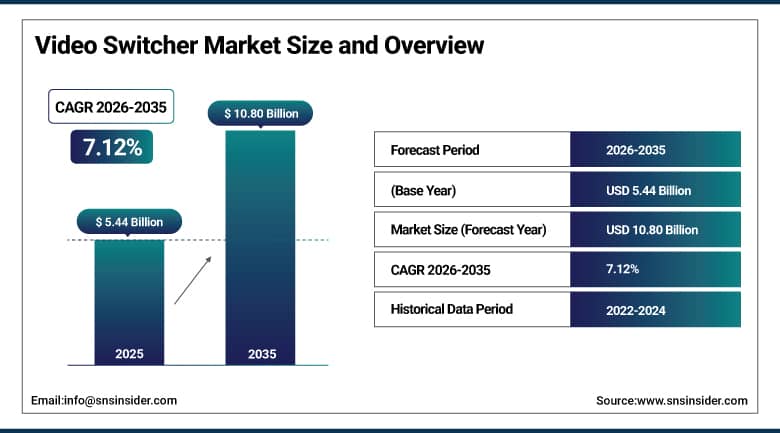
The Video Switcher Market was valued at USD 5.44 Billion in 2025 and is expected to reach USD 10.80 Billion by 2035, growing at a CAGR of 7.12% from 2026–2035.
The video switcher market is witnessing steady growth in the global market owing to increasing demand for live production and broadcasting solutions. Rising adoption of OTT platforms and streaming services is supporting market expansion. Expanding esports and live event production activities are driving equipment demand. Manufacturers are focusing on IP-based and software-defined video switching systems. Growing adoption of hybrid and digital switchers is improving production flexibility. Increasing emphasis on high-quality multi-camera production is further accelerating market adoption.
According to the U.S. Federal Communications Commission and European Broadcasting Union technical standards updates, over 85% of global broadcast infrastructure has transitioned to digital or hybrid IP-based production workflows as of 2025, increasing reliance on video switching systems for live signal routing.
As per the International Telecommunication Union media technology framework, more than 70% of broadcasters globally now use high-definition or ultra-high-definition production standards requiring multi-input switching environments. Additionally, SMPTE interoperability guidelines indicate that IP-based video transport protocols such as ST 2110 are now deployed in over 40% of new broadcast facility installations, driving advanced video switcher integration.
To Get More Information On Video Switcher Market - Request Free Sample Report
Video Switcher Market Trends:
-
Increased use of 4K and 8K broadcasting technology is leading to a change in production process, thus requiring better video switcher technology across the globe.
-
The quick move towards ultra-high-definition broadcasting technology is pushing broadcasters to revamp their systems to include new generation video switchers.
-
Growth in IP-based broadcasting technology is contributing towards efficient production of videos both in studios and at live events across the globe.
-
Increased use of cloud-based production technology is helping with remote broadcasting, thereby ensuring better collaboration and cost reductions for media companies.
-
Increase in investments in sports and entertainment broadcasting is further leading to increased use of high-performance multi-format video switchers all across the world.
-
Digital and hybrid switcher technologies are helping increase efficiency of video production and content delivery systems.
U.S. Video Switcher Market Outlook:
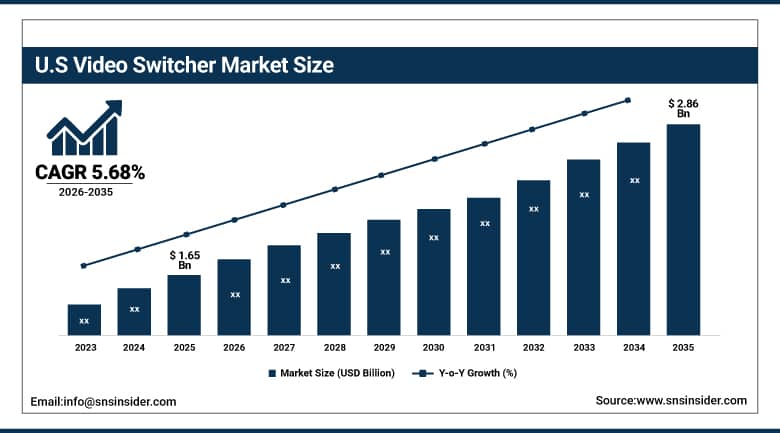
The U.S. Video Switcher Market was valued at USD 1.65 Billion in 2025 and is expected to reach around USD 2.86 Billion by 2035, growing at a CAGR of 5.68% from 2026–2035.
The U.S. video switcher market is growing steadily owing to strong demand from broadcasting and media industries. Increasing adoption of live streaming platforms is supporting market expansion. Rising usage in sports production and esports events is driving consistent demand. Growth in OTT content creation is further increasing deployment of advanced switchers. Manufacturers are focusing on IP-based and software-driven switching systems. Advancements in 4K and hybrid production workflows are improving efficiency and output quality.
According to the U.S. Federal Communications Commission broadcast infrastructure filings and the National Association of Broadcasters 2025 technical standards updates, over 90% of U.S. television stations have transitioned to digital HD or UHD production workflows requiring multi-input video switching systems. As per the U.S. Bureau of Labor Statistics and Department of Commerce media production indicators, more than 70% of professional video production environments now operate with IP-based or hybrid SDI-IP signal routing systems.
Video Switcher Market Segment Analysis:
-
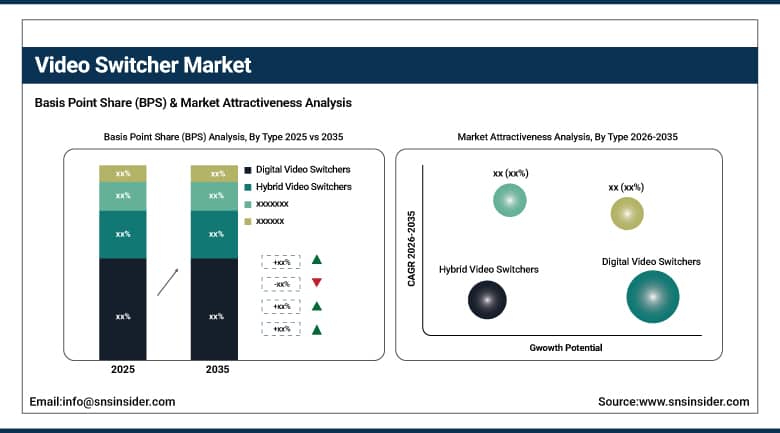
By Type, digital video switchers dominated the market with 56.30% share in 2025; while hybrid video switchers are the fastest growing segment with CAGR of 12.23% during 2026 to 2035.
-
By Application, broadcasting dominated the market with 41.80% share in 2025; while live event production is the fastest growing segment with CAGR of 10.06% during 2026 to 2035.
-
By End Use, media and entertainment dominated the market with 52.75% share in 2025; while education is the fastest growing segment with CAGR of 11.27% during 2026 to 2035.
-
By Broadcasting Format, HD dominated the market with 48.65% share in 2025; while 4K is the fastest growing segment with CAGR of 11.49% during 2026 to 2035.
By Type, digital video switchers dominated the video switcher market, while hybrid video switchers are the fastest growing segment.
The digital video switchers segment emerged as the leading segment in the video switcher market by generating the highest revenue share in 2025. The factors responsible for leading this segment include higher adoption rate in broadcasting studios as well as live production. The features such as high signal quality, ability to handle multiple formats, and reliability help this segment dominate the market. High demand for real-time video switching in the fields of sports and television broadcasting also adds to its popularity.
The hybrid video switchers segment is estimated to register the fastest CAGR from 2026 to 2035. The main reasons behind this growth include growing need for flexible production environment that can accommodate both hardware and software. Adoption of cloud-based and IP-enabled broadcasting solutions is also driving the growth of this segment. The hybrid video switchers offer the benefit of easy integration of traditional and modern production processes.
By Application, broadcasting dominated the video switcher market, while live event production is the fastest growing segment.
Broadcasting application segment is leading the video switcher market with the largest revenue share in 2025. Dominance in the market can be attributed to the growing demand for video switchers from television channels and news production companies. Growing demand for continuous real-time content switching in multiple cameras is fueling the market growth. Increasing usage in live sports broadcasting and studio production is also bolstering market growth. Investments made in broadcast infrastructure and upgrading of production quality is adding impetus to the market dominance.
Live event production application segment is anticipated to witness the fastest CAGR during 2026-2035. Factors such as increasing number of live concerts, esport events, and hybrid events are driving the growth of the market. Increasing demand for multi-camera switching and real-time audience engagement is also propelling market growth. Growth in the number of OTT live streaming services is also adding impetus to the growth of the market.
By End Use, media and entertainment dominated the video switcher market, while education is the fastest growing segment.
The media and entertainment category led the video switcher market by holding the dominated share of revenue in 2025, owing to rising demand from broadcasting studios, OTT, live sports productions, and film industries. The increased adoption of multi-camera shooting and real-time video switching in quality production setups is driving dominance in the market. Increased spending on advanced broadcasting infrastructures and rising demand for digital video content are also contributing to media and entertainment segment dominance.
The education category is anticipated to witness the fastest CAGR during the forecast period of 2026-2035, owing to the growing acceptance of digital learning platforms, hybrid classrooms, and virtual training platforms in academia. Rising adoption of video-based learning solutions and live lectures streaming is contributing to the demand for switching solutions. Increased spending on smart campus facilities and remote learning solutions is further fueling the adoption rate.
By Broadcasting Format, HD dominated the video switcher market, while 4K is the fastest growing segment.
HD segment had the dominated market share by revenue in the video switcher market in 2025. The reason behind HD segment market domination is due to the popularity of HD broadcast standards in various television networks and studios. The infrastructure of HD format is already well established, and thus the format has become popular for most of the live production work. Apart from cost-effectiveness and performance stability, the compatibility of HD with existing formats adds up to the popularity of HD.
4K segment is projected to grow at the fastest CAGR during 2026-2035 owing to the growing requirement of ultra-high-definition content. Increased use of 4K cameras in broadcasting and live production industry is driving the growth in the segment. Various OTT channels and sports broadcasting are increasingly adopting immersive viewing technology. Development in display technology and decreasing equipment cost has driven the adoption of 4K format.
Regional Analysis:
|
Region |
Major Country |
Share within Region, 2025(%) |
|---|---|---|
|
North America |
United States |
82.35% |
|
Europe |
Germany |
28.10% |
|
Asia Pacific |
China |
43.20% |
|
Middle East & Africa |
UAE |
18.40% |
|
Latin America |
Brazil |
48.60% |
North America Video Switcher Market Insights.
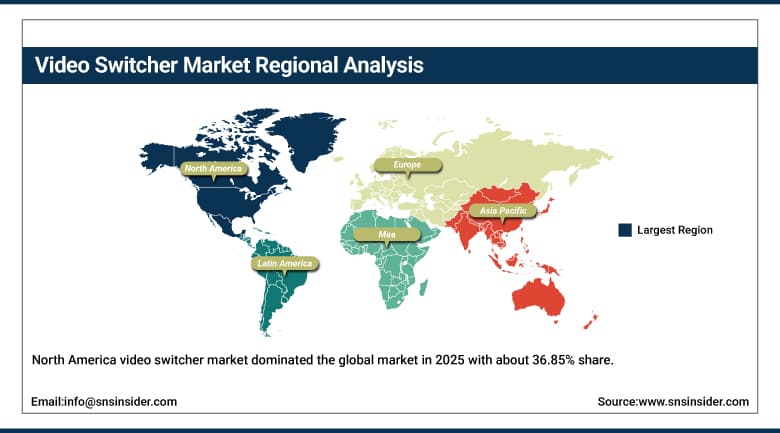
North America video switcher market dominated the global market in 2025 with about 36.85% share, owing to strong demand from broadcasting and live production. The region benefits from advanced production infrastructure and high adoption of digital workflows. Increasing use of IP based switching systems is improving production efficiency. Expansion of esports, sports broadcasting, and OTT content is driving demand. Strong focus on high quality multi camera production is further supporting market growth.
As highlighted by the FCC and CRTC broadcast infrastructure reports, there are more than 1,700 television stations in North America, where more than 90% have moved on to digital broadcasting systems capable of facilitating multi-channel production. According to the 2025 occupational and industry statistics of the Bureau of Labor Statistics, more than 70% of all broadcast and media production operations make use of digital production control systems such as video switchers in their operations. As per the NAB engineering surveys, more than 60% of the live productions are now making use of IP or hybrid video switching systems.
Get Customized Report as Per Your Business Requirement - Enquiry Now
Europe Video Switcher Market Insights.
Europe video switcher market is characterized by stable growth in 2025 owing to strong broadcasting standards and regulatory modernization. Key countries include Germany, France, United Kingdom, and Italy. Rising demand for high definition and ultra-high-definition content is driving adoption of advanced switchers. Increasing focus on remote production and cloud-based workflows is boosting efficiency. Expansion of sports broadcasting and film production industries is further supporting market growth.
According to the DESI report by the European Commission, more than 90% of EU households have access to high-capacity broadband, which helps in using cloud computing technology and remote production systems. According to the standards set by the European Broadcasting Union, more than 80% of live TV production studios in Europe are using multi-source video routing and switching systems.
Asia Pacific Video Switcher Market Insights.
Asia Pacific is the fastest growing region in the video switcher market, registering a CAGR of about 9.26% during 2026–2035. Rapid expansion of OTT platforms and live streaming services is driving strong demand across China, India, Japan, South Korea, and Southeast Asia. Increasing investments in sports broadcasting and entertainment production are boosting adoption. Rising digital infrastructure and mobile content consumption are further accelerating market growth.
According to the International Telecommunication Union Measuring Digital Development 2025 indicators, Asia Pacific accounts for over 2.9 billion internet users, representing approximately 66% regional penetration, supporting rapid growth in live video production infrastructure. As per UNESCO Institute for Statistics media and communication reports, over 75% of public broadcasters in East and Southeast Asia have transitioned to hybrid IP-based production systems.
Middle East & Africa and Latin America Video Switcher Market Insights.
The Middle East & Africa along with Latin America regions are witnessing steady growth due to expanding media infrastructure and rising entertainment demand. Key contributing countries include Brazil, Mexico, UAE, Saudi Arabia, and South Africa. Increasing investment in sports broadcasting and live event production is driving adoption of video switchers. Growth in digital media platforms and corporate events is further supporting market expansion. Rising urbanization and technology adoption are boosting regional demand.
According to ITU Facts and Figures 2024, as well as from UNESCO Institute of Statistics, internet penetration in Latin America is at 78%, while Africa has only achieved around 38%, due to an unequal development of digital broadcasting networks.
Market Dynamics:
Growth Drivers: Increasing adoption of advanced broadcasting infrastructure and IP based production systems across media industry globally
The fast development of broadcast infrastructure technology is fueling the growth in demand for video switchers based on IP and software solutions. Media companies are replacing their old-fashioned equipment with more efficient digital-based tools. The use of cloud-based production systems is adding scalability to production processes and is making it possible to work remotely. Growing financial commitments in sports broadcasting and high definition content creation contributes to this trend. Technological developments in multi-format switchers make the process more convenient within television studios and film production environments.
As per the International Telecommunication Union (ITU) 2025 broadcasting infrastructure indicators, more than 75% of broadcasters worldwide have shifted towards hybrid IP-based digital production systems that make use of IP signal routing and control. According to EBU technical reports, more than 60% of PSB’s across Europe are now using SMPTE ST 2110 IP standards for live production.
Restraints: Technical complexity, interoperability challenges, and rapid technological changes affecting consistent market adoption globally
The complexity associated with the operation of video switching systems in modern times is posing challenges to users. Incompatibilities between the older systems of broadcasting and the newer systems which use IP have slowed down the rate of adoption. Regular upgrading of technology leads to constant spending on learning and replacement of the systems. The lack of standardization in protocols is having an impact on the integration of systems from multiple vendors. The quick change in video formats and production systems poses obsolescence threats to the system.
Opportunities:Increasing adoption of ultra-high-definition formats such as 4K and 8K driving next generation video switcher demand
The shift towards 4K and the development of 8K broadcast standards will drive tremendous growth in the market of high-end video switchers. The need for high resolution videos is growing within the realms of sports, entertainment and movie making. Broadcasting stations are spending on their infrastructure so that they can facilitate the workflow of ultra-high-definition videos. With better displays and the consumer appetite for immersion, the adoption of such videos has been gaining momentum.
According to the ITU Radiocommunication Sector and the UNESCO broadcasting technology indicator, more than 85% of the global television broadcast network has been switched to digital standards, and UHD broadcast services have been initiated in more than 60 nations as of 2025. According to the EBU technical report, about 40% of big sports and live event broadcasts in Europe use 4K production, and some pilot 8K broadcast trials have been carried out in Japan and South Korea during their national events.
Recent Developments:
-
2026: Ross Video introduced Indigo unified production platform integrating ingest, editing, automation, asset management, and playout workflows at NAB 2026.
-
2025: Ross Video expanded Carbonite switcher ecosystem with enhanced automation tools and IP-based production control integrations for broadcasters.
-
2025: Vizrt advanced real-time graphics and live production switcher integration leveraging AI-assisted automation for sports and news workflows.
-
2024: Blackmagic Design launched URSA Cine cameras, PYXIS 6K, and DaVinci Resolve 19 with expanded AI-driven production tools.
Video Switcher Market Key Players are:
-
Ross Video
-
Blackmagic Design
-
Grass Valley
-
Sony
-
Panasonic
-
FOR-A
-
Evertz Microsystems
-
Imagine Communications
-
Avid Technology
-
Harmonic Inc.
-
Datavideo Technologies
-
Kramer Electronics
-
Roland Corporation
-
Utah Scientific
-
RGBlink
-
Ikegami Tsushinki
-
Vizrt
-
TVU Networks
-
Apantac LLC
-
Broadcast Pix
Video Switcher Market Report Scope:
| Report Attributes | Details |
|---|---|
| Market Size in 2025 | USD 5.44 Billion |
| Market Size by 2035 | USD 10.80 Billion |
| CAGR | CAGR of 7.12% From 2026 to 2035 |
| Base Year | 2025 |
| Forecast Period | 2026-2035 |
| Historical Data | 2022-2024 |
| Report Scope & Coverage | Market Size, Segments Analysis, Competitive Landscape, Regional Analysis, DROC & SWOT Analysis, Forecast Outlook |
| Key Segments | • By Type (Analog Video Switchers, Digital Video Switchers, Hybrid Video Switchers) • By Application (Broadcasting, Live Event Production, Corporate Events, Film Production) • By End Use (Media and Entertainment, Education, Healthcare, Corporate) • By Broadcasting Format (SD, HD, 4K, 8K) |
| Regional Analysis/Coverage | North America (US, Canada), Europe (Germany, UK, France, Italy, Spain, Russia, Poland, Rest of Europe), Asia Pacific (China, India, Japan, South Korea, Australia, ASEAN Countries, Rest of Asia Pacific), Middle East & Africa (UAE, Saudi Arabia, Qatar, South Africa, Rest of Middle East & Africa), Latin America (Brazil, Argentina, Mexico, Colombia, Rest of Latin America). |
| Company Profiles | Ross Video, Blackmagic Design, Grass Valley, Sony, Panasonic, FOR-A, Evertz Microsystems, Imagine Communications, Avid Technology, Harmonic Inc., Datavideo Technologies, Kramer Electronics, Roland Corporation, Utah Scientific, RGBlink, Ikegami Tsushinki, Vizrt, TVU Networks, Apapntac LLC, Broadcast Pix |
Frequently Asked Questions
The major growth factors include rising demand for live broadcasting, OTT platforms, esports, IP based systems, hybrid production workflows, and increasing adoption of UHD 4K and 8K multi camera production globally.
The Digital Video Switchers segment dominated the market in 2025 due to high adoption in broadcasting studios and live production environments, along with strong capability for multi-format handling and real-time switching.
The video switcher market is expected to grow at a CAGR of 7.12% from 2026 to 2035.
The video switcher market was valued at USD 5.44 Billion in 2025.
North America dominated the video switcher market in 2025 due to strong broadcasting infrastructure and high adoption of advanced IP based workflows.
