
Virtual Health Influencer Market Report Scope & Overview:
The Virtual Health Influencer Market was valued at USD 2.04 billion in 2025 and is expected to reach USD 14.83 billion by 2035, growing at a CAGR of 22.69% from 2026–2035.
In the Virtual Health Influencer Market, there is an evident rapid growth being witnessed due to various factors including the rising need for scalable and personalized engagement services that can be provided at all times using technology, the increasing use of AI-powered avatars in healthcare campaigns and educating patients, and the focus on prevention and mental health. The emergence of a digital-first health ecosystem coupled with the rising trend of using social media channels for sharing information has made virtual influencers more relevant than ever before.
Supporting this trend, global health bodies such as the World Health Organization (WHO) have emphasized the critical need for improved digital health literacy and scalable awareness programs to address rising chronic diseases and mental health conditions, reinforcing the role of AI-driven communication tools in bridging healthcare accessibility gaps.
In parallel, regulatory and technological advancements are supporting market expansion. Agencies such as the U.S. Food and Drug Administration (FDA) are increasingly establishing frameworks for AI-based healthcare tools, including software as a medical device (SaMD) and AI-driven patient engagement solutions, enabling safer and faster deployment of virtual health influencers across clinical and non-clinical environments.
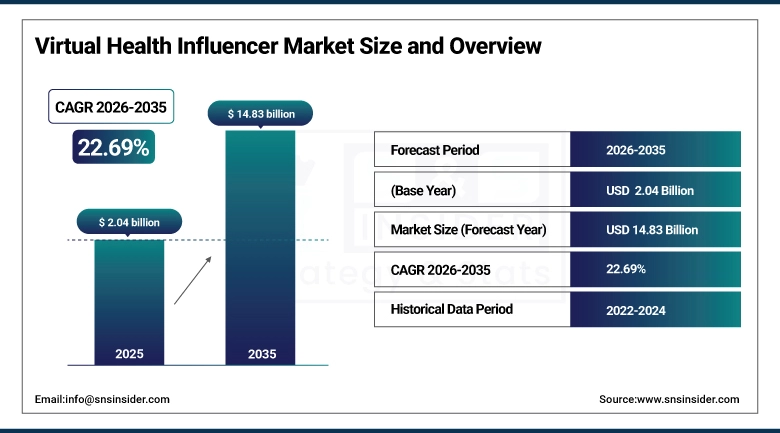
To Get more information on Virtual Health Influencer Market - Request Free Sample Report
Virtual Health Influencer Market Trends
-
Rising adoption of AI-generated virtual influencers is enabling scalable, always-available health communication and personalized patient engagement across digital platforms.
-
Increasing focus on mental health awareness and preventive healthcare campaigns is driving demand for virtual influencers in wellness education and behavior change programs.
-
Rapid advancements in generative AI, conversational AI, and real-time avatar technologies are enhancing realism, interactivity, and user trust in digital health influencers.
-
Growing integration of virtual influencers with digital therapeutics, telehealth platforms, and wearable health ecosystems is improving continuous patient engagement and monitoring.
-
Increasing investments by pharmaceutical and healthcare brands in AI-driven marketing strategies are accelerating adoption of virtual influencers for compliant and targeted outreach.
-
Rising demand for multilingual, culturally adaptive AI influencers is expanding reach across diverse global populations and emerging markets.
-
Expanding use of immersive technologies such as AR/VR and metaverse platforms is driving innovation in interactive, experience-based healthcare engagement solutions.
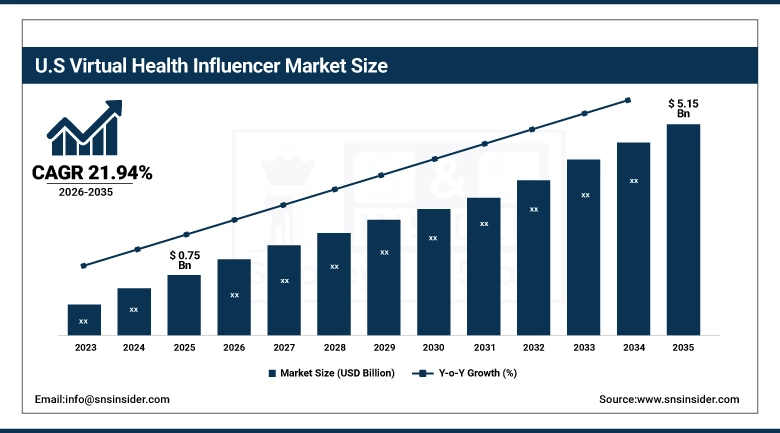
U.S. Virtual Health Influencer Market was valued at USD 0.75 billion in 2025 and is expected to reach around USD 5.15 billion by 2035, growing at a CAGR of 21.94% from 2026–2035.
U.S. Virtual Health Influencers Market is the largest market worldwide due to the existence of advanced digital health ecosystems, wide adoption of patient engagement tools based on AI, and extensive use of social media and digital channels to communicate about healthcare issues. Companies like Microsoft Corporation, NVIDIA Corporation, Google LLC, and Amazon Web Services are driving the growth of innovations related to generative AI, digital humans, and conversational AI, which can help in scaling up the usage of virtual health influencers.
Supporting this growth, organizations such as the Centers for Disease Control and Prevention highlight the growing need for digital health awareness and behavioral change programs to address rising chronic diseases and mental health challenges, reinforcing demand for AI-powered engagement solutions.
In addition, regulatory progress by the U.S. Food and Drug Administration around AI-enabled healthcare software and digital health tools is enabling faster adoption of compliant, data-driven virtual influencer solutions across healthcare ecosystems, strengthening the U.S. as a key innovation hub.
Virtual Health Influencer Market Segment Highlights
• By Influencer Type, Human-Backed Digital Avatars dominated the Virtual Health Influencer Market with 45.55% share in 2025; Fully Virtual AI Influencers is the fastest-growing segment.
• By Application, Health Awareness & Education dominated the Virtual Health Influencer Market with 30.45% share in 2025; Mental Health & Wellness Promotion is the fastest-growing segment.
• By End User, Pharmaceutical & Biotechnology Companies dominated the Virtual Health Influencer Market with 34.85% share in 2025; Health & Wellness Brands is the fastest-growing segment.
• By Technology, Generative AI & Large Language Models (LLMs) dominated the Virtual Health Influencer Market with 36.24% share in 2025; Natural Language Processing (NLP) is the fastest-growing segment.
• By Platform, Social Media Platforms dominated the Virtual Health Influencer Market with 52.51% share in 2025; Healthcare Apps / Digital Therapeutics Platforms is the fastest-growing segment.
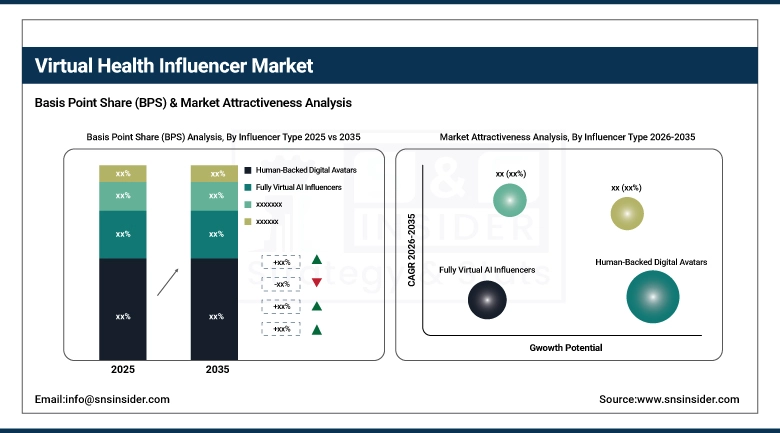
By Influencer Type, Human-Backed Digital Avatars segment dominates the Virtual Health Influencer Market, Fully Virtual AI Influencers segment expected to grow fastest
In 2025, the Human-Backed Digital Avatars segment maintained its dominant position in the Virtual Health Influencer Market, accounting for 45.55% of total revenue. This leadership stems from higher levels of trust, credibility in the clinical context, and higher acceptability from the patients and healthcare industry participants, as this type of avatar is a combination of human experience and digital reach. The extensive adoption of this avatar in campaigns and education programs in the healthcare sector and in pharmaceutical brand communication has strengthened this position further.
From 2026 to 2035, the Fully Virtual AI Influencers segment is projected to record the highest CAGR.The rapid evolution of generative AI, cost-efficiency advantages, and the ability to deliver hyper-personalized, multilingual, and real-time health engagement are accelerating adoption
By Application, Health Awareness & Education segment dominates the Virtual Health Influencer Market, Mental Health & Wellness Promotion segment expected to grow fastest
The Health Awareness & Education segment held the largest share of 30.45% in 2025, Due to the growing demand for effective communication regarding public health matters, raising disease awareness, and promoting preventive healthcare knowledge through digital mediums. Virtual health influencers are commonly employed to provide factual, interesting, and understandable medical information.
The Mental Health & Wellness Promotion segment is expected to register the highest CAGR during the 2026–2035 forecast period. Rising global mental health concerns, increasing demand for anonymous and stigma-free support systems, and the growing role of AI-driven conversational agents in emotional well-being are fueling growth.
By End User, Pharmaceutical & Biotechnology Companies segment dominates the Virtual Health Influencer Market, Health & Wellness Brands segment expected to grow fastest
The Pharmaceutical & Biotechnology Companies segment maintained the highest end-user share of 34.85% in 2025. These strengths will be reinforced by heavy investment in AI-based marketing strategies, rising demand for digital communication that complies with regulations, and the requirement to improve patient engagement initiatives.Virtual health influencers enable pharma companies to deliver consistent, regulation-aligned messaging while improving outreach efficiency and personalization.
The Health & Wellness Brands segment is projected to achieve the highest growth rate, with a CAGR during 2026–2035. The emergence of preventive healthcare trends, fitness consciousness, and lifestyle management has fueled its growth. Virtual influencers are being utilized by brands for wellness coaching, product endorsement, and customer engagement purposes.
By Technology, Generative AI & Large Language Models (LLMs) segment dominates the Virtual Health Influencer Market, Natural Language Processing (NLP) segment expected to grow fastest
The Generative AI & Large Language Models (LLMs) segment held the largest share of 36.24% in 2025, Driven by its essentiality for developing intelligent, scalable, and highly personalized virtual health influencer content. Generative AI has become the foundation of intelligent communication within the industry due to its ability to facilitate real-time conversations, multilingual conversations, and health messages. The extensive use of generative AI within digital health platforms and social media networks has cemented its importance in the industry.
The Natural Language Processing (NLP) segment is expected to record the highest CAGR of during the 2026–2035 forecast period.
By Platform, Social Media Platforms segment dominates the Virtual Health Influencer Market, Healthcare Apps / Digital Therapeutics Platforms segment expected to grow fastest
The Social Media Platforms segment held the largest share of 52.51% in 2025, The rise of virtual health influencers is driven by the sheer size of the global user base, the high levels of user engagement, and the easy dissemination of content through social media channels like Instagram, YouTube, and TikTok. Through these channels, virtual health influencers can launch campaigns that offer awareness and educate consumers on wellness issues, while promoting healthcare brands.
The Healthcare Apps / Digital Therapeutics Platforms segment is expected to record the highest CAGR during the 2026–2035 forecast period.
Virtual Health Influencer Market Regional Analysis
|
Region |
Major Country |
Share within Region (%) |
|---|---|---|
|
North America |
United States |
40.43% |
|
Europe |
Germany |
25.14% |
|
Asia Pacific |
China |
22.75% |
|
Middle East & Africa |
UAE |
6.04% |
|
Latin America |
Brazil |
5.64% |
North America Virtual Health Influencer Market Insights
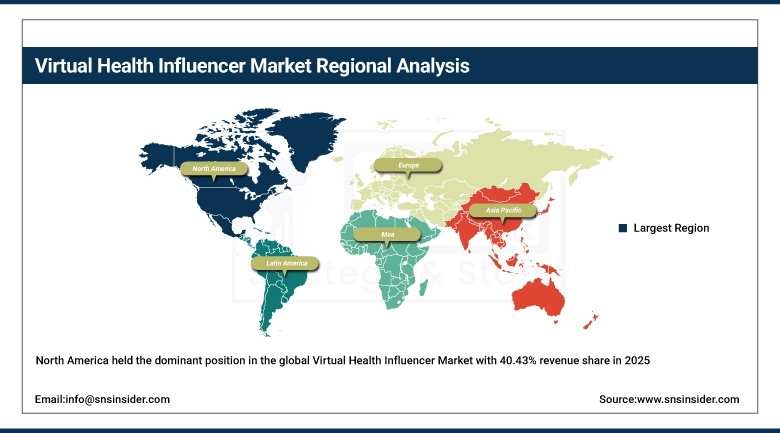
North America held the dominant position in the global Virtual Health Influencer Market with 40.43% revenue share in 2025, due to its highly evolved digital health ecosystem, extensive uptake of AI-enabled patient engagement solutions, and involvement of leading technology and healthcare innovators. The region is characterized by extensive usage of social media and mobile apps for communication within the medical industry, coupled with increased investments made by pharmaceutical and wellness companies in influencer campaigns powered by artificial intelligence. The U.S. tops regional performance in terms of intra-regional share due to extensive implementation of generative AI technologies, digital therapeutics, and virtual human innovations.
Supporting this dominance, the Centers for Disease Control and Prevention emphasizes the growing need for scalable digital health communication to address chronic diseases and mental health challenges, reinforcing demand for AI-driven engagement solutions.
Additionally, regulatory advancements by the U.S. Food and Drug Administration around AI-based healthcare software and digital engagement tools are enabling faster deployment of compliant virtual influencer solutions across clinical and non-clinical ecosystems.
Get Customized Report as per Your Business Requirement - Enquiry Now
Asia Pacific Virtual Health Influencer Market Insights
The Asia Pacific region is anticipated to register the highest CAGR of 23.94% during 2026–2035, is driven by fast-paced digital transformation, growing internet access, and growing use of mobile-first health services. Major markets in this region include China, India, Japan, South Korea, and Australia, with China contributing roughly 46% to regional revenue due to its robust investment in AI technology innovation and adoption of digital health solutions on a massive scale. The growth in the region is also driven by a growing need for localized and multilingual health communication.
Supporting this expansion, China’s National Health Commission has prioritized digital health innovation and AI integration to enhance public health outreach and awareness programs.
Governments and private players are accelerating AI-driven health engagement models, with increasing integration of generative AI, telehealth, and mobile health platforms—positioning virtual health influencers as a key tool for scalable, multilingual patient communication across densely populated markets
Europe Virtual Health Influencer Market Insights
The Europe market captured of the world revenue share in 2025, backed by robust regulatory measures, high focus on implementation of ethics in AI, and rising adoption of digital healthcare solutions. The prominent countries, including Germany, UK, France, and Nordic countries, are contributing towards rapid adoption because of well-developed healthcare setups and growing investment in digital therapeutic and patient engagement platforms. Collaboration between healthcare organizations and AI companies for the use of virtual influencer-based compliant solution is gaining momentum in this market.
The European Union is actively funding AI adoption in healthcare through initiatives like EU4Health programs (2024–2025), aimed at accelerating deployment of AI-based health technologies across member states
Europe is emerging as a leader in ethical and regulated AI health communication, with strong emphasis on data privacy, transparency, and clinically validated digital engagement—creating a favorable environment for trusted virtual health influencer ecosystems
Latin America, Middle East & Africa (LAMEA) Virtual Health Influencer Market Insights
The Latin American region and Middle East & Africa region continue to experience healthy growth rates within the Virtual Health Influencer Market owing to developments in technology infrastructure, higher smartphone penetration rates, and increased awareness about preventive healthcare. Some of the leading countries within these regions that are expected to become key adopters include Brazil, Mexico, Saudi Arabia, the United Arab Emirates, and South Africa. Increased utilization of artificial intelligence-based communication tools is expected to aid further penetration of healthcare into underserved regions.
MEA countries are rapidly adopting AI-powered digital health outreach under national transformation agendas (e.g., smart hospitals, telehealth expansion), enabling virtual health influencers to play a key role in improving healthcare accessibility, awareness, and patient engagement in underserved populations
In the Middle East, Saudi Arabia’s Ministry of Health under Vision 2030 is actively investing in AI, digital transformation, and smart healthcare solutions, including virtual engagement platforms to enhance patient interaction and awareness across the region.
Virtual Health Influencer Market Growth Drivers:
-
Rising demand for scalable, personalized, and always-available digital health engagement is driving rapid adoption of AI-powered virtual health influencers across global healthcare ecosystems
The key structure that will drive the market is the transition to digital communication in the health industry, which entails health communication that is convenient, real-time, and personalized outside the clinic setting. Considering the increasing prevalence of chronic conditions, psychological problems, and the need for preventive care, there is more emphasis on consistent patient engagement than occasional contact. Through the use of artificial intelligence and chatbot technology, virtual health influencers can facilitate effective health communication consistently in multiple languages and through behavioral triggers without human intervention constraints.
Supporting this growth, the World Health Organization has emphasized that digital health solutions are critical to improving global health coverage and patient education, particularly as non-communicable diseases account for 74% of all deaths worldwide, underscoring the need for scalable awareness and engagement tools.
Additionally, regulatory and innovation momentum is strengthening market expansion. The U.S. Food and Drug Administration continues to advance frameworks for AI-based healthcare software and digital engagement tools, enabling broader adoption of compliant, data-driven virtual influencer systems across both clinical and non-clinical environments, while major technology providers are rapidly enhancing generative AI capabilities for healthcare-specific communication use cases.
Virtual Health Influencer Market Restraints:
-
Concerns around data privacy, regulatory compliance, and medical misinformation are creating significant barriers to adoption of AI-powered virtual health influencers, particularly in highly regulated healthcare environments
The primary constraint that affects the market for virtual health influencers is the increasing difficulty in securing data, meeting regulatory requirements, and attaining clinical precision in AI-powered health communication. Virtual health influencers may need to use extensive amounts of patient data, behavioral analysis, and instant interaction with patients to generate personalized content, thus necessitating an understanding of data privacy issues, proper consent management, and potential misuse of health data. Healthcare data governance regulations and AI compliance requirements, which vary from one region to another, are continuously under development, leading to uncertainties for healthcare organizations and enterprises implementing such solutions.
Virtual Health Influencer Market Opportunities:
-
Expanding integration of virtual health influencers with digital therapeutics, wearable ecosystems, and real-time health data platforms is creating new growth pathways for personalized, outcome-driven healthcare engagement
Opportunities for future growth within the Virtual Health Influencer Market revolve around the transformation of this technology into an intelligent companion for patients' health. It would be possible by combining the use of virtual influencers with wearables, remote patient monitoring, and digital therapeutics software. Such integration will allow for constant real-time engagement depending on the specific health situation, behavior, and lifestyle of the user. This way, patients can receive highly relevant and timely interventions in the form of medication reminders, customized wellness coaching, among others.
Recent Developments:
-
2026: Microsoft Corporation expanded its healthcare-focused generative AI capabilities through deeper integration of AI copilots and digital human interfaces across clinical documentation and patient engagement platforms, enabling healthcare organizations to deploy more interactive and personalized virtual health influencer experiences at scale across hospitals and telehealth ecosystems.
-
2026: NVIDIA Corporation advanced its digital human and healthcare AI ecosystem by enhancing real-time conversational AI and simulation capabilities, supporting the development of highly realistic virtual health influencers for medical training, patient education, and immersive healthcare communication across global markets.
-
2025: Google LLC strengthened its AI-driven health communication initiatives by integrating advanced generative AI models into consumer health platforms, enabling more accurate, context-aware, and scalable virtual health engagement tools for wellness guidance and symptom awareness across digital channels.
-
2025: Amazon Web Services expanded its healthcare AI and machine learning services portfolio, enabling developers and healthcare providers to build and deploy compliant, data-secure virtual health influencer solutions integrated with telehealth, analytics, and patient engagement applications.
Virtual Health Influencer Market Key Players
Some of the Virtual Health Influencer Market Companies
-
Synthesia Ltd.
-
Soul Machines Ltd.
-
UneeQ Ltd.
-
Hour One AI Ltd.
-
HeyGen
-
D-ID Ltd.
-
DeepBrain AI Inc.
-
Replika AI
-
Sensely Inc.
-
Babylon Health
-
Wysa Ltd.
-
Ada Health GmbH
-
Gyant Inc.
-
Innovaccer
-
Verofax
-
Genies
-
NVIDIA Corporation
-
Microsoft Corporation
-
Google LLC
-
Amazon Web Services
Virtual Health Influencer Market Report Scope:
| Report Attributes | Details |
|---|---|
| Market Size in 2025 | USD 2.04 Billion |
| Market Size by 2035 | USD 14.83 Billion |
| CAGR | CAGR of 22.69% From 2026 to 2035 |
| Base Year | 2025 |
| Forecast Period | 2026-2035 |
| Historical Data | 2022-2024 |
| Report Scope & Coverage | Market Size, Segments Analysis, Competitive Landscape, Regional Analysis, DROC & SWOT Analysis, Forecast Outlook |
| Key Segments | •By Influencer Type (Fully Virtual AI Influencers, Human-Backed Digital Avatars, Hybrid Influencers (AI + Human Collaboration), Others) • By Application (Health Awareness & Education, Mental Health & Wellness Promotion, Chronic Disease Management, Fitness & Lifestyle Coaching, Pharmaceutical & Healthcare Marketing) • By End User (Pharmaceutical & Biotechnology Companies, Healthcare Providers (Hospitals & Clinics), Health & Wellness Brands, Insurance Companies) • By Technology (Generative AI & Large Language Models (LLMs), Natural Language Processing (NLP), Computer Vision & Animation Engines, AR/VR Technologies) • By Platform (Social Media Platforms, Healthcare Apps / Digital Therapeutics Platforms, Metaverse & Virtual Environments) |
| Regional Analysis/Coverage | North America (US, Canada), Europe (Germany, UK, France, Italy, Spain, Russia, Poland, Rest of Europe), Asia Pacific (China, India, Japan, South Korea, Australia, ASEAN Countries, Rest of Asia Pacific), Middle East & Africa (UAE, Saudi Arabia, Qatar, South Africa, Rest of Middle East & Africa), Latin America (Brazil, Argentina, Mexico, Colombia, Rest of Latin America). |
| Company Profiles | Synthesia Ltd., Soul Machines Ltd., UneeQ Ltd., Hour One AI Ltd., HeyGen, D-ID Ltd., DeepBrain AI Inc., Replika AI, Sensely Inc., Babylon Health, Wysa Ltd., Ada Health GmbH, Gyant Inc., Innovaccer, Verofax, Genies, NVIDIA Corporation, Microsoft Corporation, Google LLC, Amazon Web Services |
Frequently Asked Questions
North America dominated the Virtual Reality In Healthcare Market in 2025.
The Human-Backed Digital Avatars segment dominated the Virtual Reality In Healthcare Market in 2025.
Rising consumer preference for preventive healthcare, immunity enhancement, and personalized nutrition is the primary growth driver of the Vitamin Deficiency Treatment Market.
The Virtual Reality In Healthcare Market was valued at USD 2.04 billion in 2025.
The Virtual Reality In Healthcare Market is expected to grow at a CAGR of 22.69% from 2026 to 2035.
