
Water Soluble Films Market Report Scope & Overview:
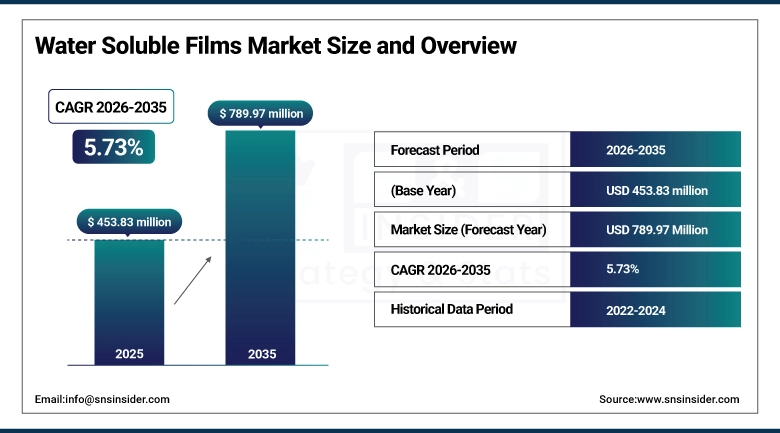
The Water Soluble Films Market size was valued at USD 453.83 Million in 2025 and is projected to reach USD 789.97 Million by 2035, growing at a CAGR of 5.73% during 2026-2035.
The Water Soluble Films Market is seeing growth because of the rise in the need for environmentally friendly and biodegradable films, growing usage of unit dose detergents, environmental concerns, and rising applications in the agricultural industry and healthcare industry. Growth in the market is also driven by technological advances and increased customer preference towards sustainable solutions.
To Get more information on Water Soluble Films Market - Request Free Sample Report
Key Water Soluble Films Market Trends
-
Rising adoption of biodegradable PVA films driven by strict environmental regulations and sustainability initiatives globally.
-
Increasing demand for unit-dose detergent packaging boosting consumption of water soluble films in households worldwide.
-
Expanding agricultural applications for safe pesticide packaging enhancing efficiency and reducing direct chemical exposure risks.
-
Technological advancements improving film strength, solubility control, and compatibility across diverse industrial and medical applications.
-
Growing use in pharmaceutical and healthcare sectors for infection control, hygiene, and precise drug delivery systems.
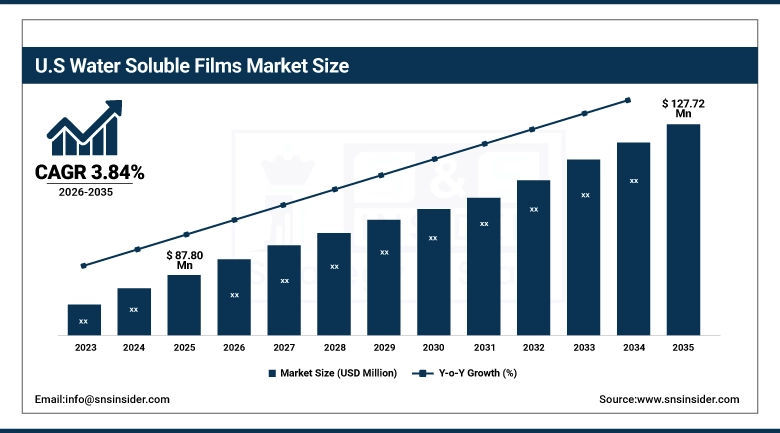
The U.S. Water Soluble Films Market size was valued at USD 87.80 Million in 2025 and is projected to reach USD 127.72 Million by 2035, growing at a CAGR of 3.84% during 2026-2035. The U.S. Water Soluble Films Market is being driven by factors such as increasing demand for sustainable packaging, extensive usage of detergent pods, strict environmental regulations, and applications in the health care, agricultural, and industrial sectors.
Water Soluble Films Market Growth Drivers:
-
Sustainability Push and Convenience Packaging Accelerate Global Adoption of Water Soluble Films Across Industries Rapidly
The key factors driving the growth of water-soluble films include increased global focus on sustainability and environmentally friendly packaging solutions. Regulatory bodies are implementing stringent regulations on disposable plastic packaging, thereby pressuring companies to opt for alternative packaging using biodegradable products such as water-soluble films based on PVA. The fast-growing trend towards unit-dose packaging of detergents within households has fueled their adoption owing to their safety, accuracy, and easy-to-use characteristics. Other applications of these films within the agricultural sector for pest control increase efficiency and minimize direct contact with chemicals. Growth in the healthcare industry, where hygiene is vital, also promotes their adoption.
Water Soluble Films Market Restraints:
-
High Production Costs and Performance Limitations Restrict Wider Adoption Across Cost-Sensitive and Developing Markets Globally
Even though the market holds great growth prospects, there are several restrictions that could act as roadblocks to its progression. Firstly, expensive manufacturing as opposed to traditional plastic films acts as a significant limitation, mainly in economically disadvantaged areas. Secondly, the dependency on raw materials, especially polyvinyl alcohol, results in unpredictable prices and uncertainties in sourcing. Furthermore, there are performance issues associated with water-soluble films, including vulnerability to moisture, an inability to last long, and the need for specific storage conditions. Certain sectors find durability an issue when using such films due to variable environmental conditions. Thirdly, a lack of awareness and inadequate facilities for handling biodegradable products is another challenge.
Water Soluble Films Market Opportunities:
-
Emerging Applications and Technological Innovations Unlock New Growth Avenues in Sustainable Packaging and Specialty Industries
The market has numerous opportunities through innovation and increasing number of application sectors. Increased spending on research and development allows producing advanced and durable biodegradable films with enhanced solubility management and multifunctional capabilities. New applications in food packaging sector, through using dissolvable films which help decrease waste levels, represent unexplored opportunities. The growing popularity of online shopping and the necessity of using sustainable packaging products provide another channel of income generation. Moreover, growing use in the healthcare industry as an alternative to infection control and medical packaging represents an opportunity for entering high-end sectors.
Water Soluble Films Market Segment Analysis
-
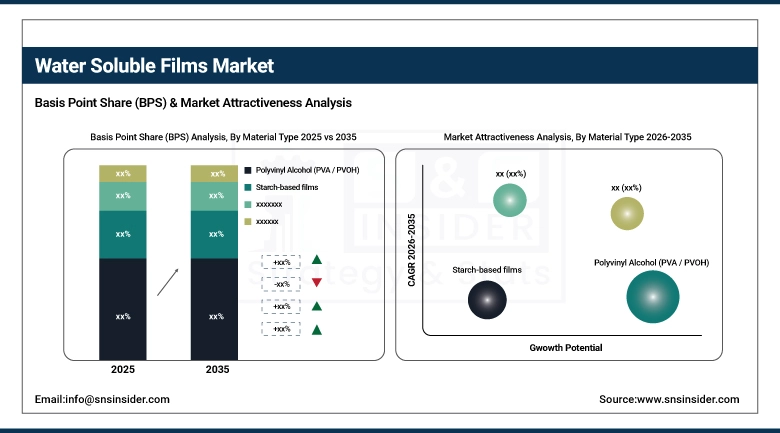
By Material Type, Polyvinyl Alcohol (PVA / PVOH) dominated with 58.46% in 2025, and Starch-based Films are expected to grow at the fastest CAGR of 7.23% from 2026 to 2035.
-
By Solubility Type, Cold Water-Soluble Films dominated with 62.74% in 2025, and Cold Water-Soluble Films are also expected to grow at the fastest CAGR of 6.30% from 2026 to 2035.
-
By Application, Detergents & Cleaning Products dominated with 41.28% in 2025, and Pharmaceuticals & Healthcare is expected to grow at the fastest CAGR of 7.22% from 2026 to 2035.
-
By End-Use Industry, Household & Consumer Goods dominated with 44.63% in 2025, and Agriculture is expected to grow at the fastest CAGR of 7.19% from 2026 to 2035.
By Material Type, PVA / PVOH Leads Water Soluble Films Market While Starch-based Films Set for Fastest Growth 2026 to 2035
In the material type segment, PVA/PVOH leads owing to its excellent solubility, film strength, and biodegradability, making it well suited for packaging and industrial applications. The ability of PVA/PVOH films to withstand detergent attack and chemical exposure allows for their wide usage. On the other hand, starch films have been gaining popularity since more industries are leaning towards environmentally friendly materials such as those that are renewable and bio-based. Although starch films provide environmental benefits, they are still being developed in terms of resilience to moisture. Cellulose films also help achieve environmental objectives due to their origin from natural sources.
By Solubility Type, Cold Water-Soluble Films Lead and Maintain Fastest Growth in Water Soluble Films Market 2026 to 2035
The Solubility Type Segment is comprised primarily of cold water-soluble films, owing to the convenience offered by such films and their compatibility with regular consumer goods like laundry and dishwashing capsules. Cold water-soluble films can dissolve efficiently at a lower temperature range. This not only makes their usage convenient but helps conserve energy as well. The advantage of dispensing doses accurately without coming into physical contact with the solution is a further benefit of such films. There are still industrial applications for hot water-soluble films. Developments in formulation science make it possible to customize dissolution time as needed for many industries, from health care to agriculture to chemicals.
By Application, Detergents & Cleaning Products Lead Water Soluble Films Market While Pharmaceuticals & Healthcare Show Fastest Growth 2026 to 2035
Detergent and cleaners have become dominant factors in terms of applications owing to the increased use of water-soluble films in unit-dose packaging for these industries due to their convenience, safety, and reduced waste generation. There has been growing consumer awareness for mess-free and convenient products, which has led to this trend in application areas. Water-soluble films have found applications in agricultural purposes to ensure safer handling of chemicals in farms and fields. Pharmaceuticals and healthcare industries are experiencing an increasing demand for using such films in infection control and medical packaging. Other applications include textiles, industry, and sustainable food packaging.
By End-Use Industry, Household & Consumer Goods Leads and Agriculture Shows Fastest Growth in Water Soluble Films Market 2026 to 2035
Household and consumer products dominate the end-use industries segment, owing to the high consumption rate of detergent pods and cleaning liquids. Key considerations such as convenience, safety, and sustainability underpin the growth in this particular segment. Increasingly, the agriculture industry is making use of water-soluble films in order to increase production while ensuring minimal environmental pollution from agrochemicals. Health care is another growing market for water-soluble films, thanks to their use in ensuring contamination-free product packaging. Other end-use industries include industrial chemicals and textiles, among others.
Water Soluble Films Market Regional Analysis
North America Water Soluble Films Market Insights
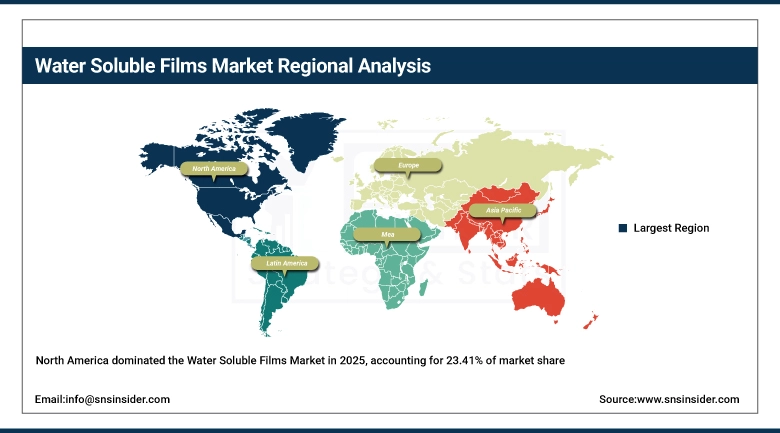
North America held a 23.41% share of the global Water Soluble Films Market in 2025 at USD 106.24 Million, growing at the slowest regional CAGR of 4.16% through 2035. The region represents the world's most mature single-region market for water soluble film in household detergent pod applications, with unit dose laundry and dishwasher detergent formats having achieved high household penetration in the United States and Canada over years of consistent marketing investment by Procter & Gamble, Henkel, and Reckitt. The region's moderate growth rate reflects this maturity in its largest application, offset by faster-growing pharmaceutical film and agricultural pouch demand that add higher-value incremental volume. MonoSol's U.S. manufacturing operations at its Portage, Indiana film production facility form the backbone of North American water soluble film supply infrastructure, serving the detergent pod filling lines of major consumer goods companies operating in the region.
Get Customized Report as per Your Business Requirement - Enquiry Now
U.S. Water Soluble Films Market Insights
The United States dominated North America's water soluble films market at 82.64%, USD 87.80 Million in 2025. The U.S. is the world's single largest national consumer of water soluble films by value, anchored by the world's highest-volume household detergent pod market and a well-developed agrochemical water soluble pouch application that benefits from large-scale professional agriculture that has adopted precise chemical dosing practices.
Europe Water Soluble Films Market Insights
Europe held 22.78% at USD 103.38 Million in 2025, growing at a CAGR of 4.85% through 2035. Europe is the second-largest regional market for water soluble films and the region where the detergent pod format first achieved widespread consumer adoption, with the UK, Germany, France, and the Benelux countries representing the highest national per capita pod detergent usage rates globally. European regulatory frameworks including the EU's Single-Use Plastics Directive and the evolving Extended Producer Responsibility requirements for packaging are creating both regulatory pressure and market opportunity for water soluble film producers whose products eliminate post-consumer plastic waste at the point of product use. Aicello Corporation's European operations and Ecopol S.p.A.'s Italian manufacturing base provide regional film production capacity that supplements imports from Japanese and U.S. producers in serving European detergent brand owner and agrochemical packaging customers.
Germany Water Soluble Films Market Insights
Germany was the leading national market for water soluble films in Europe in 2025, driven by the country's large household detergent and cleaning product consumption, Henkel AG's Dusseldorf headquarters that makes it a major buyer of water soluble film for its Persil Power-Caps and other pod detergent formats produced for European and global markets, and a well-developed agricultural chemicals industry that uses water soluble pouch packaging for professional crop protection product applications across German and Central European farming operations.
Asia Pacific Water Soluble Films Market Insights
Asia Pacific is the largest and fastest-growing region at a CAGR of 6.85% through 2035, valued at USD 193.47 Million in 2025 and projected to reach USD 374.13 Million by 2035. Japan is the most technically advanced national market within the region, hosting Kuraray Co., Ltd. and Nippon Gohsei, two of the world's leading PVA resin and water soluble film producers whose research and development investment in film performance and bio-based alternative materials defines global product development direction for the category. China is the largest national market within Asia Pacific by consumption volume and the fastest-growing, driven by the domestic detergent pod market's rapid growth, the expanding agrochemical water soluble packaging adoption among professional farming operations, and the presence of a growing number of domestic Chinese film producers that are developing PVA and starch-based film production capabilities to serve the domestic market and compete for export business.
China Water Soluble Films Market Insights
In the Asia Pacific Water Soluble Films Market, China held the top position due to the country’s strong manufacturing capabilities and its large-scale production of detergents along with increased awareness of sustainable packaging.
Latin America (LATAM) and Middle East & Africa (MEA) Water Soluble Films Market Insights
Latin America was valued at USD 31.86 Million in 2025 and is growing at a CAGR of 5.72% through 2035, with Brazil, Mexico, and Argentina representing the largest national markets within the region across household detergent pod and agrochemical packaging applications. Brazil's large agricultural economy, which is among the world's largest consumers of crop protection chemicals in absolute volume terms, provides a significant growth platform for water soluble pouch packaging as domestic agrochemical distributors and professional farming operations adopt pre-measured dose packaging formats that are standard in North American and European markets but are at an earlier adoption stage in Brazil. Middle East and Africa was valued at USD 18.88 Million in 2025 and is growing at a CAGR of 6.56% through 2035, with Gulf state household cleaning product market development, South African agricultural chemical application growth, and expanding industrial chemical use of pre-measured water soluble pouches in manufacturing and water treatment operations across the region providing the primary demand drivers.
Competitive Landscape for Water Soluble Films Market:
Kuraray Co., Ltd., headquartered in Tokyo, Japan, is the global market leader in water soluble film through its MonoSol subsidiary in the United States and its own PVA film production operations in Japan, collectively producing the largest volume of PVA-based water soluble film globally and supplying the majority of the world's major detergent pod brand owners with film that meets the precise dissolution, mechanical, and sealing performance specifications required for high-speed pod filling operations.
-
In 2024, Kuraray Co., Ltd. expanded production capacity at its MonoSol facilities to address growing demand from North American and European detergent pod customers, with additional capacity specifically allocated to cold water-soluble film grades that had experienced the tightest supply conditions given the accelerating consumer and regulatory preference for cold water wash cycle compatibility in unit dose laundry product formulations.
Mitsubishi Chemical Group Corporation, headquartered in Tokyo, Japan, produces water soluble films under its MOWIFLEX brand through its performance polymers division, serving detergent packaging, agrochemical pouching, and industrial chemical dispensing applications across Asia Pacific, Europe, and North America. Mitsubishi Chemical's PVA and polyvinyl butyral polymer expertise enables it to produce water soluble film grades with controlled dissolution kinetics across a range of water temperatures that span from cold water laundry applications to hot water institutional cleaning applications, and its global distribution network gives it commercial reach across both developed and emerging market customers that smaller specialist film producers cannot match.
- In 2024, Mitsubishi Chemical Group expanded its water soluble film product range to include a new line of starch-blend films with improved mechanical performance for agrochemical pouch applications, targeting the growing segment of crop protection product manufacturers who are under customer and regulatory pressure to transition to bio-derived packaging materials while maintaining the pouch integrity and dissolution performance reliability that professional agricultural users require for accurate field chemical dosing.
Water Soluble Films Market Key Players:
-
Kuraray Co., Ltd.
-
Mitsubishi Chemical Group Corporation
-
Sekisui Chemical Co., Ltd.
-
Ecopol S.p.A.
-
Cortec Corporation
-
AMC (UK) Ltd.
-
Mondi Group
-
Nippon Gohsei
-
MonoSol LLC
-
Soluble Technology Ltd.
-
Aquafilm LLC
-
Solupak Ltd.
-
Changzhou Zhenhua Film Co., Ltd.
-
Jiangmen Proudly Water-Soluble Plastic Co., Ltd.
-
INFHIDRO
-
Noble Industries
-
Soltec Development SAS
-
Fujian Zhongsu Biodegradable Films Co., Ltd.
| Report Attributes | Details |
|---|---|
| Market Size in 2025 | USD 453.83 Million |
| Market Size by 2035 | USD 789.97 Million |
| CAGR | CAGR of 6.35% From 2026 to 2035 |
| Base Year | 2025 |
| Forecast Period | 2026-2035 |
| Historical Data | 2022-2024 |
| Report Scope & Coverage | Market Size, Segments Analysis, Competitive Landscape, Regional Analysis, DROC & SWOT Analysis, Forecast Outlook |
| Key Segments | • By Material Type (Polyvinyl Alcohol (PVA / PVOH), Starch-based Films, Cellulose-based Films, and Others (Polymer Blends, Biodegradable Polymers)) • By Solubility Type (Cold Water-Soluble Films and Hot Water-Soluble Films) • By Application (Detergents & Cleaning Products (Laundry & Dishwasher Pods), Agrochemical Packaging (Pesticides, Fertilizers), Water Treatment Chemicals, Pharmaceuticals & Healthcare, Textile & Embroidery Backing, and Food Packaging (Niche Use) • By End-Use Industry (Household & Consumer Goods, Agriculture, Pharmaceutical & Healthcare, Industrial Chemicals, Textile Industry, and Food & Beverage Industry) |
| Regional Analysis/Coverage | North America (US, Canada), Europe (Germany, UK, France, Italy, Spain, Russia, Poland, Rest of Europe), Asia Pacific (China, India, Japan, South Korea, Australia, ASEAN Countries, Rest of Asia Pacific), Middle East & Africa (UAE, Saudi Arabia, Qatar, South Africa, Rest of Middle East & Africa), Latin America (Brazil, Argentina, Mexico, Colombia, Rest of Latin America). |
| Company Profiles | Kuraray Co., Ltd., Mitsubishi Chemical Group Corporation, Aicello Corporation, Sekisui Chemical Co., Ltd., Ecopol S.p.A., Cortec Corporation, Arrow GreenTech Ltd., AMC (UK) Ltd., Mondi Group, Nippon Gohsei, MonoSol LLC, Soluble Technology Ltd., Aquafilm LLC, Solupak Ltd., Changzhou Zhenhua Film Co., Ltd., Jiangmen Proudly Water-Soluble Plastic Co., Ltd., INFHIDRO, Noble Industries, Soltec Development SAS, Fujian Zhongsu Biodegradable Films Co., Ltd. |

Frequently Asked Questions
Asia Pacific led the Water Soluble Films Market in 2025 with a 42.63% share.
Polyvinyl Alcohol (PVA / PVOH) dominated the Water Soluble Films Market with a 58.46% share in 2025.
Key drivers include the global growth of unit dose laundry and dishwasher detergent pod formats, rising agrochemical industry adoption of water soluble pre-measured pouches for pesticide and fertilizer handling safety, expanding pharmaceutical dissolvable film drug delivery applications, and increasing plastic packaging sustainability pressure that positions water soluble film as a zero-residue packaging alternative.
The Water Soluble Films Market size was USD 453.83 Million in 2025 and is projected to reach USD 789.97 Million by 2035.
The Water Soluble Films Market is expected to grow at a CAGR of 5.73% from 2026-2035.
