
Viscose Staple Fiber Market Report Scope & Overview:
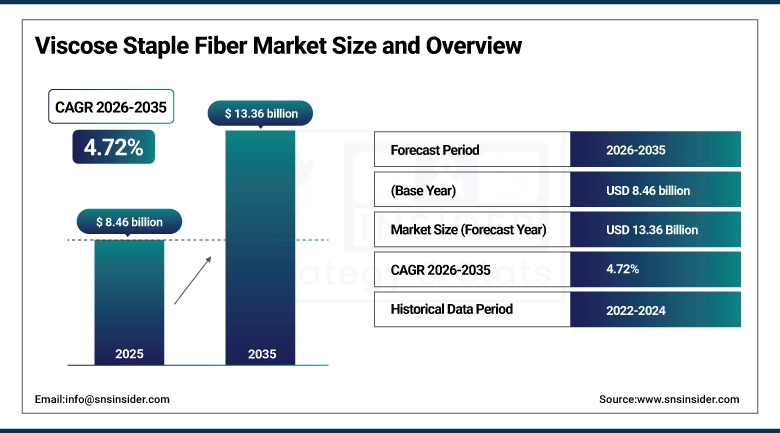
The Viscose Staple Fiber Market size was valued at USD 8.46 Billion in 2025 and is projected to reach USD 13.36 Billion by 2035, growing at a CAGR of 4.72% during 2026-2035.
The Viscose Staple Fiber Market is expanding because of the rising demand for sustainable and biodegradable fabrics, increase in the consumption of apparel products, use of non-woven hygiene products, and the tendency of opting for environmentally friendly products over synthetic fibers, backed by fast industrialization and textile production in Asia-Pacific
Viscose Staple Fiber Market Size and Forecast:
-
Market Size in 2025: USD 8.46 Billion
-
Market Size by 2035: USD 13.36 Billion
-
CAGR of 4.72% From 2026 to 2035
-
Base Year: 2025
-
Forecast Period: 2026-2035
-
Historical Data: 2022-2024
To Get more information on Viscose Staple Fiber Market - Request Free Sample Report
Key Viscose Staple Fiber Market Trends
-
Rising demand for sustainable, biodegradable fibers drives viscose adoption across global textile and apparel industries.
-
Increasing use in nonwoven hygiene products such as wipes, diapers, and medical disposables boosts growth.
-
Technological advancements improve fiber strength, softness, and durability, expanding applications in premium textile segments.
-
Strong expansion of textile manufacturing in Asia Pacific supports large-scale viscose staple fiber production growth.
-
Shift from polyester and synthetic fibers toward eco-friendly alternatives accelerates viscose staple fiber market demand globally.
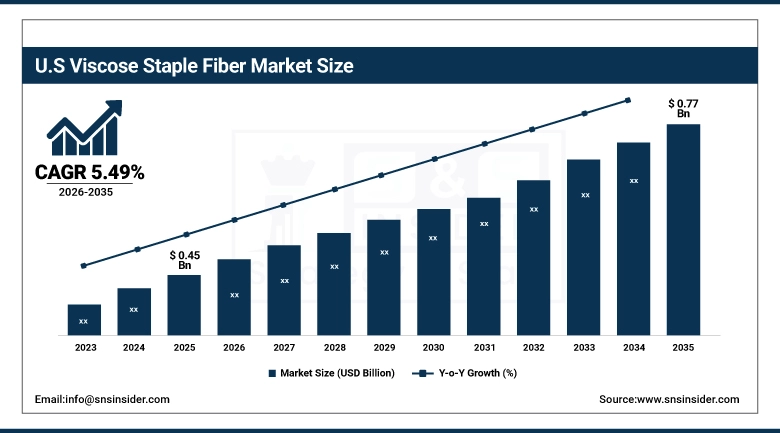
The U.S. Viscose Staple Fiber Market size was valued at USD 0.45 Billion in 2025 and is projected to reach USD 0.77 Billion by 2035, growing at a CAGR of 5.49% during 2026-2035. The U.S. Viscose Staple Fiber Market is growing due to increasing demand for sustainable textiles, rising eco-conscious consumer preferences, expanding nonwoven hygiene applications, and a shift away from synthetic fibers.
Viscose Staple Fiber Market Growth Drivers:
-
Rising Sustainability Demand and Expanding Textile Applications Accelerate Global Viscose Staple Fiber Market Growth Momentum
Market Growth of Viscose Staple Fiber Market is Majorly Influenced by Growing Preference for Sustainable Fibers throughout the Global Textile Industry. With people opting for sustainable substitutes for synthetic fibers, more use of viscose fiber in clothing and household textiles becomes evident. The rapid pace of urbanization, growing disposable income, and increase in fashion consumption also help boost the market. Furthermore, increasing application of viscose staple fiber in hygiene products, like wipes and diapers, also plays a crucial role in growing the market. Advanced manufacturing capacities in Asia Pacific and improving technologies for better performance of fiber are other important reasons.
Viscose Staple Fiber Market Restraints:
-
Environmental Concerns and Volatile Raw Material Supply Pose Significant Challenges to Market Expansion Globally
Though having great prospects of growth, there are some restraints that hinder the progress of the Viscose Staple Fiber Market. The first factor is the environmental restrictions due to harmful production procedures, as well as deforestation when obtaining raw material. Environmental restrictions in such countries as those in Europe and North America require compliance on the part of the manufacturing companies. Another important factor is the volatility of the price of the raw materials used for production, especially wood pulp. Another market constraint is the competition provided by lyocell and recycled polyester.
Viscose Staple Fiber Market Opportunities:
-
Innovation in Sustainable Production and Expansion into Nonwoven Segments Unlock New Market Opportunities Globally
The industry holds substantial promise due to innovations in sustainable production techniques and eco-friendly sourcing of raw materials. Growing focus on closed loop production processes and development of niche viscose fiber types like fire-resistant and high tenacity fibers open up new avenues for growth. High consumer interest in non-woven fabrics in the health care, hygiene, and industrial sectors represents an area full of promise. New markets in Latin America, the Middle East, and Africa represent avenues for growth owing to the growth of the textile sector in these regions.
Viscose Staple Fiber Market Segment Analysis
-
By Type, Regular / Standard Viscose Staple Fiber dominated with 62.48% in 2025, and Modified / Specialty Fiber is expected to grow at the fastest CAGR of 6.52% from 2026 to 2035.
-
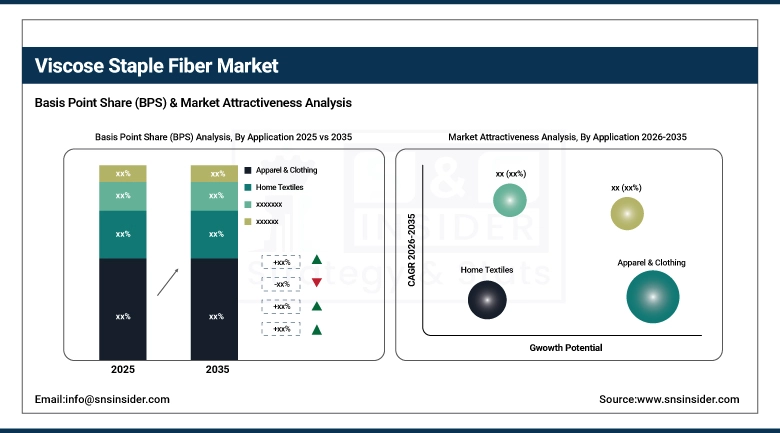
By Application, Apparel & Clothing dominated with 54.32% in 2025, and Industrial Textiles is expected to grow at the fastest CAGR of 7.41% from 2026 to 2035.
-
By End-Use Industry, Textile & Apparel Industry dominated with 68.45% in 2025, and Healthcare & Medical is expected to grow at the fastest CAGR of 7.20% from 2026 to 2035.
-
By Production Process, Continuous Process dominated with 71.36% in 2025, and Continuous Process is also expected to grow at the fastest CAGR of 5.21% from 2026 to 2035.
By Application, Apparel & Clothing Leads Viscose Staple Fiber Market While Industrial Textiles Show Fastest Growth 2026 to 2035
By applications, viscose staple fibers are mainly used in clothing and apparel due to growing demands for fashion and light weight comfort wear. By virtue of their natural texture and flexibility, they are the best choice in all types of clothing in different price categories. Besides, home textiles such as bedsheets and furnishing materials form another major category in the usage of viscose staple fibers. Industrial textile formation is an upcoming sector in the production of viscose staple fibers due to growing demands in the automobile sector, filtration industry, and other technical textiles.
By Type, Regular / Standard Viscose Staple Fiber Leads Viscose Staple Fiber Market While Modified / Specialty Fiber Set for Fastest Growth 2026 to 2035
The global viscose staple fiber market by type has regular or standard fibers as the dominant type of fiber due to their economical nature, applicability in different sectors, and favorable features for textile products. These fibers exhibit useful characteristics such as softness, breathability, and water absorbency and thus can be effectively used to make clothing. On the other hand, modified and special fibers are becoming popular owing to increased need for functional fabrics. This is because types like flame-resistant, microfibers, and dye-colored viscose have gained more usage in technologically advanced fields. Innovation in fiber production is aiding the growth of specialty viscose fibers as well.
By End-Use Industry, Textile & Apparel Leads and Healthcare & Medical Shows Fastest Growth in Viscose Staple Fiber Market 2026 to 2035
The textile and clothing industry continue to be the major end-use segment of viscose staple fibers owing to massive worldwide requirements of clothes and textile products. This particular nature of the fiber makes it highly appropriate for this industry. Moreover, the healthcare industry is also becoming significant with regard to the growing use of viscose fibers in nonwoven textiles in the health industry. The automobile industry also plays its role as it uses these fibers in interior as well as insulation applications. Besides, the personal hygiene and care sector is also becoming an important source of demand for viscose fibers.
By Production Process, Continuous Process Leads and Maintains Fastest Growth in Viscose Staple Fiber Market 2026 to 2035
Production-wise, continuous processing is commonly preferred because it is more efficient, scalable, and able to handle large-scale production. Continuous processing ensures consistent fiber quality and optimization of cost, thus appropriate in handling huge worldwide demands. Batch processing, on the other hand, is often chosen when there are limited quantities of products to produce or specific fibers that need special treatment. Although batch processing cannot be considered the most efficient choice for large-scale production, it allows for some level of customization. Technology continues to advance, making processes more sustainable and efficient for companies to achieve desired results.
Viscose Staple Fiber Market Regional Analysis
Asia Pacific Viscose Staple Fiber Market Insights
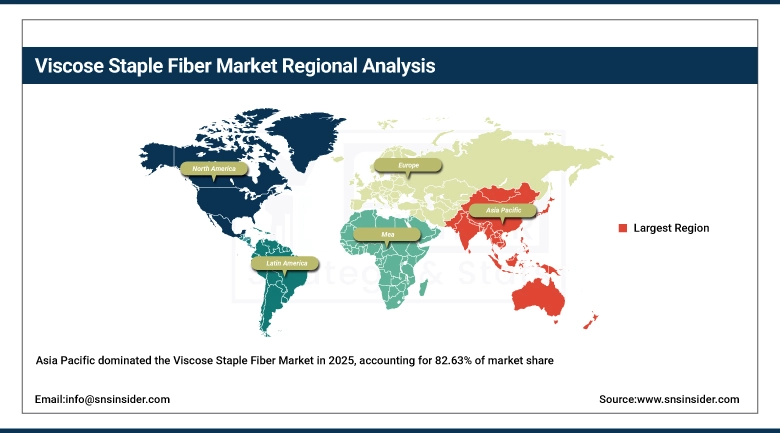
Asia Pacific is by far the dominant region at 82.63% share of global market value in 2025 at USD 6.99 Billion, though it is growing at the slowest regional CAGR of 3.72% through 2035 as the maturity of the Chinese domestic viscose market and structural pressure from synthetic fiber competition in certain apparel segments constrain the region's growth rate below the global market average. China alone accounts for the majority of Asia Pacific's viscose staple fiber production and consumption, with major producers including Sateri Holdings, Tangshan Sanyou, Xinjiang Zhongtai, Yibin Grace Group, and Jilin Chemical Fiber collectively operating the world's largest concentration of viscose fiber production capacity. India is the region's second-largest national market and one of the faster-growing, driven by the domestic textile industry's strong demand for viscose fiber in apparel and home textile fabric production and the country's growing personal care and hygiene nonwoven sector.
Get Customized Report as per Your Business Requirement - Enquiry Now
China Viscose Staple Fiber Market Insights
China has held the highest share in the Asia Pacific viscose staple fiber market owing to its massive production capacities and efficient textile manufacturing facilities. India is another country that has secured considerable market shares due to expanding textile industries.
North America Viscose Staple Fiber Market Insights
North America held a 6.82% share of the global Viscose Staple Fiber Market in 2025 at USD 0.58 Billion, growing at a CAGR of 5.82% through 2035. The region's market is driven primarily by demand from the nonwoven fabrics industry for viscose fiber in hygiene, medical, and wipes applications, as the domestic apparel textile manufacturing base that would otherwise consume viscose in yarn and fabric production has largely relocated to lower-cost Asian manufacturing countries over the past three decades. The nonwoven segment's consumption of viscose staple fiber in North America is generated by facilities producing wet wipes, medical dressings, and personal hygiene products for the large North American consumer market, with supply primarily sourced through direct import from Asian viscose producers that can deliver consistent fiber quality at competitive cost relative to any alternative regional supply.
U.S. Viscose Staple Fiber Market Insights
The United States dominated North America's viscose staple fiber market at 78.64%, USD 0.45 Billion in 2025. The U.S. is the primary driver of North American demand, with the domestic nonwoven manufacturing industry's consumption of viscose fiber for hygiene and medical applications representing the most consistent demand channel in the region. U.S. viscose fiber demand is also generated through the domestic supply chains of apparel and home textile brands that source viscose-content finished goods from Asian manufacturing, with the fiber itself consumed overseas but the end product demand originating from the U.S. retail market
Europe Viscose Staple Fiber Market Insights
Europe held 7.14% at USD 0.60 Billion in 2025, growing at a CAGR of 7.09% through 2035. Europe is a technically sophisticated market for viscose staple fiber where demand is concentrated in high-specification nonwoven applications for medical, hygiene, and industrial wipes, specialty apparel applications in premium fashion and intimate apparel, and automotive interior textile components. Lenzing AG's Austrian operations and Kelheim Fibres GmbH's German production facility make Europe the global center of specialty and high-performance viscose and lyocell fiber development, setting technical and sustainability standards that Asian commodity producers are progressively required to meet as European fashion and retail brands impose supply chain requirements. The EU's chemical regulation framework and worker safety standards for carbon disulfide exposure create operating cost burdens for European viscose producers relative to Asian competitors but also create barriers to entry that help established European specialty fiber producers maintain premium market positioning.
Germany Viscose Staple Fiber Market Insights
Germany was the leading national market for viscose staple fiber in Europe in 2025, driven by the country's large automotive interior textile manufacturing sector that specifies viscose-content fabrics in vehicle cabin applications, the presence of Kelheim Fibres GmbH's specialty viscose fiber production facility in Bavaria that supplies high-value technical fiber grades to European nonwoven and specialty textile customers, and a sophisticated fashion and home textile manufacturing and sourcing industry that generates consistent demand for premium viscose fiber grades in apparel and bedding products targeting quality-conscious European consumers.
Latin America (LATAM) and Middle East & Africa (MEA) Viscose Staple Fiber Market Insights
Latin America was valued at USD 0.18 Billion in 2025 and is growing at a CAGR of 10.59% through 2035, the second-fastest regional growth rate, reaching USD 0.50 Billion by 2035 as Brazil, Colombia, and Mexico develop growing textile and nonwoven manufacturing sectors that generate direct regional viscose fiber demand. Brazil's hygiene product manufacturing expansion and Colombia's growing fashion apparel industry are the primary demand drivers within the region. Middle East and Africa was valued at USD 0.11 Billion in 2025 and is growing at the fastest regional CAGR of 17.57% through 2035, reaching USD 0.62 Billion by 2035, driven by textile industry investment in Ethiopia, Egypt, and Turkey and the rapid development of domestic garment and home textile manufacturing in Sub-Saharan Africa that is creating new direct demand for viscose staple fiber supply in a region that was previously almost entirely dependent on finished textile imports.
Competitive Landscape for Viscose Staple Fiber Market:
Sateri Holdings Limited, headquartered in Shanghai, China, is one of the world's largest viscose staple fiber producers by production capacity, operating multiple large-scale viscose fiber production facilities across China with an aggregate capacity that makes it a dominant supplier to domestic Chinese textile and nonwoven manufacturers and a significant exporter to markets in Asia, Europe, and the Americas. Sateri's investment in EcoCosy branded sustainable viscose fiber, produced with FSC-certified wood pulp and reduced chemical intensity processes, reflects its strategic response to the sustainability requirements that international fashion brand customers are imposing on their viscose supply chains as part of voluntary and regulatory sustainability commitments.
-
In 2024, Sateri Holdings expanded its viscose fiber production capacity at its Jiangxi facilities with new continuous process spinning lines specifically configured for high-tenacity nonwoven-grade fiber production, addressing growing order volumes from Chinese and international hygiene product manufacturers whose nonwoven fabric requirements for viscose fiber had been growing faster than Sateri's existing production lines could supply within standard lead time commitments.
Grasim Industries Limited, headquartered in Mumbai, India and a flagship company of the Aditya Birla Group, is India's largest and Asia's second-largest viscose staple fiber producer, operating production facilities in Nagda, Kharach, Vilayat, and Harihar across India with a combined output that serves both the domestic Indian textile market and export customers across Asia and Europe. Grasim's Birla Cellulose brand encompasses its full range of VSF products including Liva-branded fibers that are supplied to Indian and international fashion brands under a sustainability-focused brand architecture that documents the fiber's wood sourcing, production process, and certified content claims.
- In 2024, Grasim Industries commissioned a new specialty viscose fiber production line at its Vilayat, Gujarat facility focused on microfiber and colored solution-dyed viscose grades for premium apparel and active wear applications, with the investment targeting the growing segment of Indian and international fashion brands seeking specialty viscose fiber supply from a traceable, certified domestic Indian source as an alternative to Chinese-origin specialty fiber supply.
Viscose Staple Fiber Market Key Players:
-
Lenzing AG
-
Grasim Industries Limited
-
Tangshan Sanyou Chemical Fiber Co., Ltd.
-
Xinjiang Zhongtai Chemical Co., Ltd.
-
Kelheim Fibres GmbH
-
Yibin Grace Group Company
-
Nanjing Chemical Fiber Co., Ltd.
-
Jilin Chemical Fiber Group Co., Ltd.
-
Zhejiang Fulida Group Holding Co., Ltd.
-
Shandong Helon Textile Sci. & Tech. Co., Ltd.
-
Asia Pacific Rayon Limited
-
Century Rayon
-
Xinxiang Bailu Chemical Fiber Group Co., Ltd.
-
Shandong Gaomi Silver Hawk New Materials Co., Ltd.
-
Anhui Somet Fiber Co., Ltd.
-
Aoyang Technology Co., Ltd.
-
Shandong Bohi Industry Co., Ltd.
-
Manasi Shunquan Industry Co., Ltd.
| Report Attributes | Details |
|---|---|
| Market Size in 2025 | USD 8.46 Billion |
| Market Size by 2035 | USD 13.36 Billion |
| CAGR | CAGR of 4.72% From 2026 to 2035 |
| Base Year | 2025 |
| Forecast Period | 2026-2035 |
| Historical Data | 2022-2024 |
| Report Scope & Coverage | Market Size, Segments Analysis, Competitive Landscape, Regional Analysis, DROC & SWOT Analysis, Forecast Outlook |
| Key Segments | • By Type (Regular / Standard Viscose Staple Fiber, High Wet Modulus (HWM) Fiber, High Strength Fiber, and Modified / Specialty Fiber (Flame Retardant, Microfiber, Colored)) • By Application (Apparel & Clothing, Home Textiles (Bedding, Curtains, Towels), Non-Woven Products (Hygiene, Wipes, Medical), and Industrial Textiles (Automotive, Filters)), • By End-Use Industry (Textile & Apparel Industry, Healthcare & Medical, Automotive, and Personal Care & Hygiene) • By Production Process (Continuous Process and Batch Process) |
| Regional Analysis/Coverage | North America (US, Canada), Europe (Germany, UK, France, Italy, Spain, Russia, Poland, Rest of Europe), Asia Pacific (China, India, Japan, South Korea, Australia, ASEAN Countries, Rest of Asia Pacific), Middle East & Africa (UAE, Saudi Arabia, Qatar, South Africa, Rest of Middle East & Africa), Latin America (Brazil, Argentina, Mexico, Colombia, Rest of Latin America). |
| Company Profiles | Lenzing AG, Grasim Industries Limited, Sateri Holdings Limited, Tangshan Sanyou Chemical Fiber Co., Ltd., Xinjiang Zhongtai Chemical Co., Ltd., Kelheim Fibres GmbH, Yibin Grace Group Company, Nanjing Chemical Fiber Co., Ltd., Jilin Chemical Fiber Group Co., Ltd., Zhejiang Fulida Group Holding Co., Ltd., Shandong Helon Textile Sci. & Tech. Co., Ltd., Asia Pacific Rayon Limited, Century Rayon, Acelon Chemicals & Fiber Corporation, Xinxiang Bailu Chemical Fiber Group Co., Ltd., Shandong Gaomi Silver Hawk New Materials Co., Ltd., Anhui Somet Fiber Co., Ltd., Aoyang Technology Co., Ltd., Shandong Bohi Industry Co., Ltd., Manasi Shunquan Industry Co., Ltd. |
Frequently Asked Questions
Asia Pacific led the Viscose Staple Fiber Market in 2025.
Regular / Standard Viscose Staple Fiber dominated the Viscose Staple Fiber Market in 2025.
Key drivers include sustained demand from the global apparel and home textiles industry for cellulosic fiber alternatives to cotton, growing hygiene and medical nonwoven product consumption driving viscose fiber demand in personal care and healthcare applications, and the automotive sector's increasing specification of viscose-containing interior textile components.
The Viscose Staple Fiber Market size was USD 8.46 Billion in 2025 and is projected to reach USD 13.36 Billion by 2035.
The Viscose Staple Fiber Market is expected to grow at a CAGR of 4.72% from 2026-2035.
