
Weight Loss Supplements Market Report Scope & Overview:
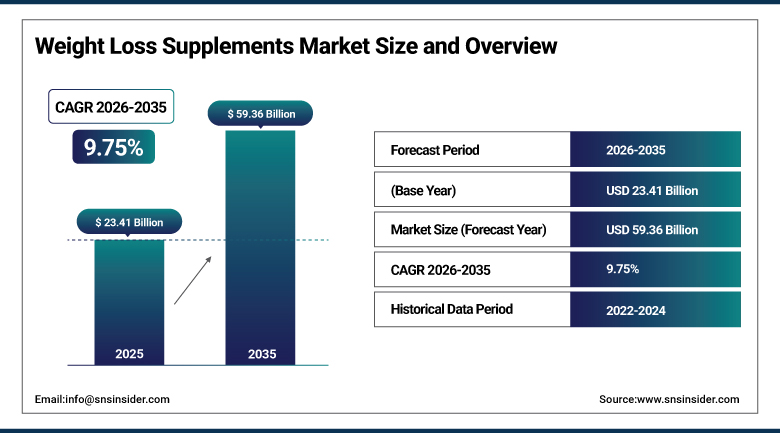
The Weight Loss Supplements Market was valued at USD 23.41 Billion in 2025 and is expected to reach USD 59.36 Billion by 2035, growing at a CAGR of 9.75% from 2026 to 2035.
The market for Weight Loss Supplements is experiencing rapid growth due to increasing cases of obesity across the world, growing preference for natural formulations and aggressive online marketing efforts. The weight loss supplements include vitamins and minerals, amino acids, herbs and plant extracts and other formulations in the form of powder, liquids, tablets and capsules, which promote weight loss through means of suppressing appetite, fat burning, and metabolism boosters. Moreover, factors driving growth in the weight loss supplements market include obesity and metabolic disorders placing an increasing burden on healthcare systems and individual budgets; scientific progress and changes in regulations making supplements more integral to personal health care routines; and development of companion products for Glucagon-like peptide-1 treatment.
Based on the data collected by the National Institutes of Health, about 15 percent of Americans use weight loss dietary supplements throughout their lifetime, and a higher percentage was found in the female population than males, which indicates the strong role that these products have taken in the health and wellness market of the United States.
To Get more information Weight Loss Supplements Market - Request Free Sample Report
Weight Loss Supplements Market Trends
-
Rising emergence of companion products for Glucagon-like peptide-1 therapies is reshaping the competitive landscape, as supplement brands develop formulations supporting GLP-1 users' nutritional needs.
-
Growing consumer preference for natural, plant-based formulations is driving reformulation across the industry as brands respond to demand for herbal and botanically derived weight management ingredients.
-
Increasing robust digital marketing push by supplement brands is expanding consumer awareness and accessibility, particularly across social media and influencer-driven advertising channels.
-
Expanding fitness culture and adoption of active lifestyles are significantly transforming demand for weight loss supplements, particularly among younger, wellness-conscious consumer segments.
-
Strategic partnerships among supplement manufacturers, fitness brands, and healthcare providers are supporting development of increasingly personalized, targeted weight management product portfolios.
U.S. Weight Loss Supplements Market Outlook
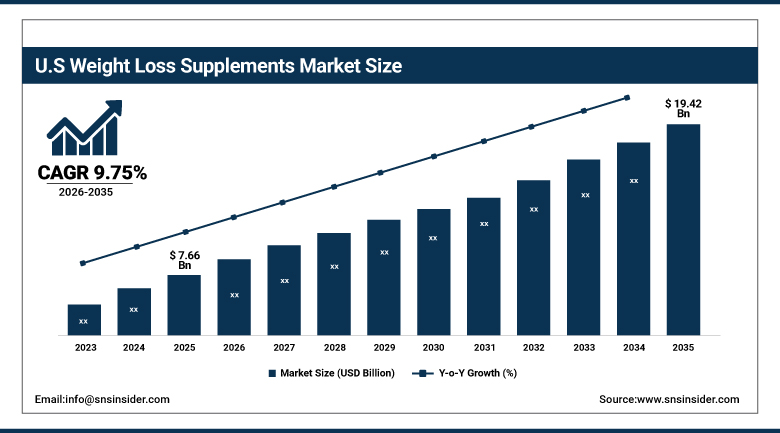
The U.S. Weight Loss Supplements Market was valued at USD 7.66 Billion in 2025 and is projected to reach USD 19.42 Billion by 2035, growing at a CAGR of 9.75% during 2026–2035.
The leading companies in the country have continued to introduce products for weight loss as the obesity rate continues to increase and people become more knowledgeable about their health and wellness needs. The adoption of the fitness trend and the marketing strategies from the supplement companies together with the growth of the retail and pharmacy sectors have continued to create a sustained demand for weight loss supplements in the country.
The U.S. weight loss supplements market size is expected to reach USD 17.23 billion by 2032, owing to the increased rate of obesity and fitness trends driving the consumer demand.
Weight Loss Supplements Market Segment Analysis
-
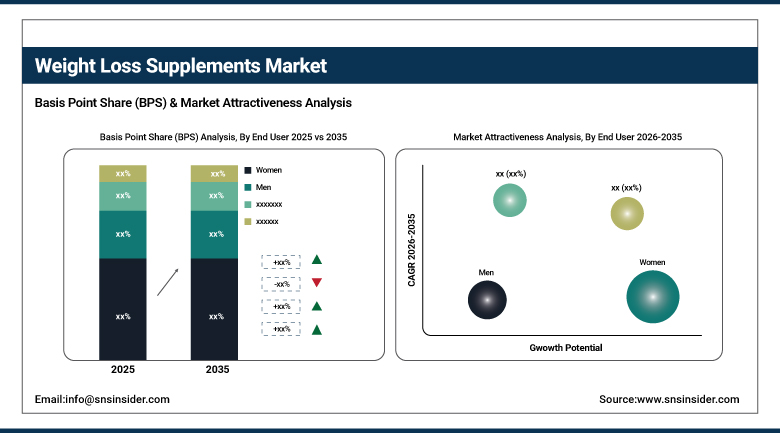
By End User, Women dominated the Weight Loss Supplements Market with a 52.99% share in 2025, while Men is the fastest-growing end user segment with a CAGR of 11.63% from 2026–2035.
-
By Form, Powders dominated the Weight Loss Supplements Market with a 32.71% share in 2025, while Liquids is the fastest-growing form segment with a CAGR of 8.63% from 2026–2035.
-
By Distribution Channel, Online Retail dominated the Weight Loss Supplements Market with a 35.83% share in 2025, while Online Retail is also the fastest-growing distribution channel segment with a CAGR of 12.73% from 2026–2035.
-
By Ingredient Type, Vitamins & Minerals dominated the Weight Loss Supplements Market with a 54.67% share in 2025, while Herbal/Plant-Based is the fastest-growing ingredient type segment with a CAGR of 10.60% from 2026–2035.
By End User, Women dominated the Weight Loss Supplements Market, while Men is the fastest-growing segment.
Based on the end user, the women segment comprised 52.99% of the share of weight loss supplements market in 2024. Women continue being the major end user segment due to their higher involvement in dietary supplements and weight management products. It is because of the established trend and marketing that has always considered women as key buyers of the weight loss supplements segments.
The share of the men segment is projected to grow at a 11.63% CAGR from 2025 to 2030. The increased awareness regarding health through fitness culture and active lifestyles is playing a pivotal role in changing the demand dynamics of male consumers in the weight management supplements segment.
By Form, Powders dominated the Weight Loss Supplements Market, while Liquids is the fastest-growing segment.
In terms of form, powders accounted for 32.71% of the weight loss supplements market size in 2024. Powders continue to be the leading form category due to their wide usage in shake or smoothie weight loss formulas, allowing for convenience in dosage and easy use as meal replacements and supplements in general weight management products.
The liquids form category is set to grow at an 8.63% CAGR up to 2030. Rising demand for ready-to-use liquid weight loss products is boosting the growth of the form category, as more convenient liquid forms of supplements are being created by manufacturers.
By Distribution Channel, Online Retail dominated the Weight Loss Supplements Market, while Online Retail is the fastest-growing segment.
According to the distribution channel, the online retail stores generated 35.83% of the revenue in 2024 and are expected to register a growth of 12.73% CAGR up to 2030. It is clear that online retail leads the market share as well as growth rate due to the convenience of shopping from home and faster delivery time as people now look for weight loss supplements online.
The fast-paced growth of the online retail segment will be boosted by the marketing efforts of the supplement companies and discovery of the product through social media. The growing preference of the customers in buying the health and wellness products through the internet and subscription delivery model will add up to the growth of this segment.
By Ingredient Type, Vitamins & Minerals dominated the Weight Loss Supplements Market, while Herbal/Plant-Based is the fastest-growing segment.
Based on ingredients, the vitamins and minerals segment dominated the market with the largest share of 54.67% in 2024. Vitamins and minerals remain the dominant ingredient category owing to their broad consumer familiarity and established role supporting overall metabolic health, making them the foundational ingredient category incorporated across the majority of weight loss supplement formulations worldwide.
The Herbal/Plant-Based segment is expected to register the fastest CAGR of 10.60% during the forecast period 2026-2035. Growing consumer preference for natural formulations, driven by demand for ingredients such as Garcinia Cambogia and green tea extract, is driving rising segment growth as manufacturers increasingly develop plant-derived weight management products addressing clean-label consumer preferences.
Regional Analysis
|
Region |
Major Country |
Share within Region, 2025 (%) |
|---|---|---|
|
North America |
United States |
85.00% |
|
Europe |
Germany |
27.60% |
|
Asia Pacific |
China |
44.60% |
|
Middle East & Africa |
UAE |
25.60% |
|
Latin America |
Brazil |
37.70% |
North America Weight Loss Supplements Market Insights
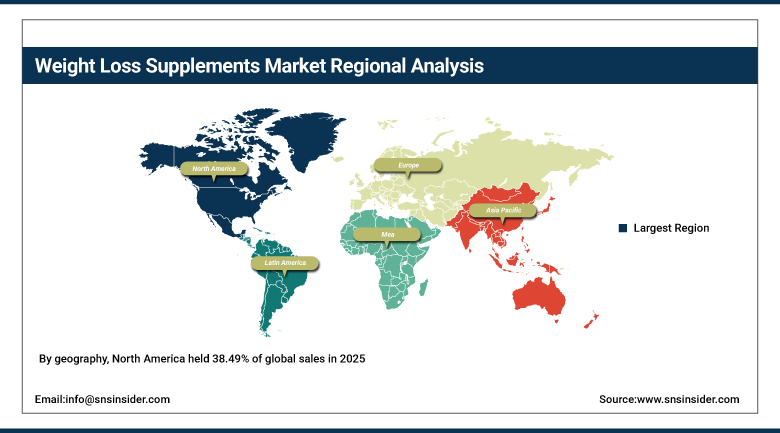
By geography, North America held 38.49% of global sales in 2024, driven by high obesity prevalence, strong consumer awareness of health and wellness benefits, and well-established retail and pharmacy distribution infrastructure supporting sustained demand across the region.
The US was the leading country within the North America Weight Loss Supplements Market in 2025, with the domestic market projected to reach USD 17.23 billion by 2032 due to rising obesity rates and fitness trends. Canada is contributing to regional growth through its own expanding natural health product retail sector and growing consumer interest in weight management supplementation.
Get Customized Report as per Your Business Requirement - Enquiry Now
Europe Weight Loss Supplements Market Insights
The Europe Weight Loss Supplements Market was a major contributor in 2025. This is attributed to the region's strong natural health product tradition, growing consumer demand for clinically validated weight management formulations, and expanding regulatory frameworks supporting supplement innovation across member states.
Germany is one of the major markets in Europe owing to its strong dietary supplement manufacturing base and growing consumer demand for natural, plant-based weight management ingredients. Other countries such as the United Kingdom and France are also contributing to market growth through expanding fitness culture adoption and rising natural health product retail penetration.
Asia Pacific Weight Loss Supplements Market Insights
Asia-Pacific is forecast to record the fastest 10.85% CAGR between 2025 and 2030. The market growth is driven by rising disposable incomes, growing health consciousness, and expanding dietary supplement manufacturing capacity across the region's major and emerging economies.
China is one of the main growth drivers in the Asia Pacific Weight Loss Supplements Market, owing to its massive consumer base and rapidly expanding domestic dietary supplement manufacturing capacity. Japan, South Korea, and India are also contributing to regional growth through expanding health-conscious consumer bases and rising demand for weight management supplementation.
Middle East & Africa and Latin America Weight Loss Supplements Market Insights
Middle East & Africa and Latin American regions are gradually expanding weight loss supplement adoption as dietary supplement retail infrastructure develops and consumer awareness of obesity-related health benefits grows across both regions.
Brazil is set to be a prominent Latin American market fueled by growing dietary supplement consumption and rising consumer interest in weight management products. The Middle East & Africa region has UAE and Saudi Arabia investing in modern retail infrastructure that is gradually expanding access to premium weight loss supplement categories across their growing health and wellness sectors.
Market Dynamics
Growth Drivers: Rising obesity prevalence and digital marketing driving market growth
A worldwide rise in obesity levels, increasing preference for natural products, and increased digital marketing efforts constitute some of the major forces impacting the Weight Loss Supplements Market. Obesity and related disorders are continually posing great pressures on healthcare facilities as well as consumer budgets, leading to the increasing demand for solutions that can help people manage their weight in diverse market segments around the globe.
Innovations in the field of nutrition, changes in regulations, and the growing understanding of the importance of holistic health have led to a rise in the importance of supplements, which now form an integral part of individual health plans. Obesity, growing consciousness about health and fitness, active marketing strategies employed by companies, and growing retail and pharmacy availability will continue to boost demand in the forecast period, due to the increased disposable income of urban consumers.
Restraints: Health risk concerns and regulatory challenges limiting market expansion
One of the major obstacles to the growth of the market includes the possible side effects and the risks involved with the use of weight loss supplements, which have been constantly posing safety threats and limiting their growth even with high demand for such solutions.
Furthermore, problems related to regulations as well as insufficient control of product quality in various international markets are constantly creating difficulties in developing effective products. Another challenge faced by the manufacturers of weight loss supplements includes the entry of pharmaceutical GLP-1 products as an extremely effective weight management solution.
Opportunities: Expansion of GLP-1 companion products and personalized formulations creating new growth avenues
The introduction of companion products for Glucagon-like peptide-1 treatments is influencing the competitive dynamics, leading to a great chance for supplements manufacturers able to create product formulas which can help people using GLP-1 treatments meet their nutritional requirements, such as maintaining muscle mass and providing micronutrients during fast weight loss.
In addition, there is significant potential in the further development of personalized formulations based on AI technology in accordance with the health characteristics of individual consumers. Growth of digital marketing and e-commerce sales in emerging economies of Asia Pacific and Latin America will lead to great demand increase in future years.
Recent Developments:
-
2025: Herbalife Nutrition launched an updated GLP-1 companion nutrition support product line, offering consumers formulations addressing muscle preservation and micronutrient needs during pharmaceutical-assisted weight loss.
-
2025: Amway expanded its plant-based weight management supplement portfolio, targeting growing consumer demand for natural, herbal-derived weight loss formulations across its global distribution network.
-
2026: GNC Holdings launched an updated appetite suppressant formulation featuring natural ingredients, offering consumers a clean-label alternative to conventional synthetic weight management supplements.
-
2026: USANA Health Sciences expanded its personalized weight loss supplement platform, incorporating AI-driven formulation technology to deliver tailored nutritional recommendations for individual consumer health profiles.
Weight Loss Supplements Market key players are:
-
Herbalife Nutrition Ltd.
-
Amway Corporation
-
Nestlé S.A.
-
Glanbia plc
-
GNC Holdings, LLC
-
Abbott Laboratories
-
Reckitt Benckiser Group plc
-
Nature's Bounty Co.
-
Isagenix International, LLC
-
USANA Health Sciences, Inc.
-
MusclePharm Corporation
-
Atkins Nutritionals, Inc.
-
Garden of Life, LLC
-
BioCare Copenhagen
-
Huel Ltd.
-
WW International, Inc. (Weight Watchers)
-
Bayer AG
-
Church & Dwight Co., Inc.
-
NOW Health Group, Inc.
-
Isagenix Worldwide, LLC
Weight Loss Supplements Market Report Scope:
| Report Attributes | Details |
|---|---|
| Market Size in 2025 | USD 23.41 Billion |
| Market Size by 2035 | USD 59.36 Billion |
| CAGR | CAGR of 9.75% From 2026 to 2035 |
| Base Year | 2025 |
| Forecast Period | 2026-2035 |
| Historical Data | 2022-2024 |
| Report Scope & Coverage | Market Size, Segments Analysis, Competitive Landscape, Regional Analysis, DROC & SWOT Analysis, Forecast Outlook |
| Key Segments | • By End User (Women, Men) • By Form (Powders, Liquids, Tablets/Capsules) • By Distribution Channel (Online Retail, Supermarkets/Hypermarkets, Health & Wellness Stores) • By Ingredient Type (Vitamins & Minerals, Herbal/Plant-Based, Amino Acids) |
| Regional Analysis/Coverage | North America (US, Canada), Europe (Germany, UK, France, Italy, Spain, Russia, Poland, Rest of Europe), Asia Pacific (China, India, Japan, South Korea, Australia, ASEAN Countries, Rest of Asia Pacific), Middle East & Africa (UAE, Saudi Arabia, Qatar, South Africa, Rest of Middle East & Africa), Latin America (Brazil, Argentina, Mexico, Colombia, Rest of Latin America). |
| Company Profiles | Herbalife Nutrition Ltd., Amway Corporation, Nestlé S.A., Glanbia plc, GNC Holdings, LLC, Abbott Laboratories, Reckitt Benckiser Group plc, Nature's Bounty Co., Isagenix International, LLC, USANA Health Sciences, Inc., MusclePharm Corporation, Atkins Nutritionals, Inc., Garden of Life, LLC, BioCare Copenhagen, Huel Ltd., WW International, Inc. (Weight Watchers), Bayer AG, Church & Dwight Co., Inc., NOW Health Group, Inc., Isagenix Worldwide, LLC |
Frequently Asked Questions
The Weight Loss Supplements Market is expected to grow at a CAGR of 9.75% from 2026 to 2035.
The Weight Loss Supplements Market was valued at USD 23.41 Billion in 2025.
The market is driven by a global uptick in obesity rates, a rising inclination toward natural formulations, and a robust digital marketing push.
The Women segment dominated the Weight Loss Supplements Market, accounting for approximately 52.99% market share.
The North America region dominated the Weight Loss Supplements Market in 2025 with 38.49% of global sales.
