
Youth Mental Health Crisis Intervention Platform Market Report Scope & Overview:
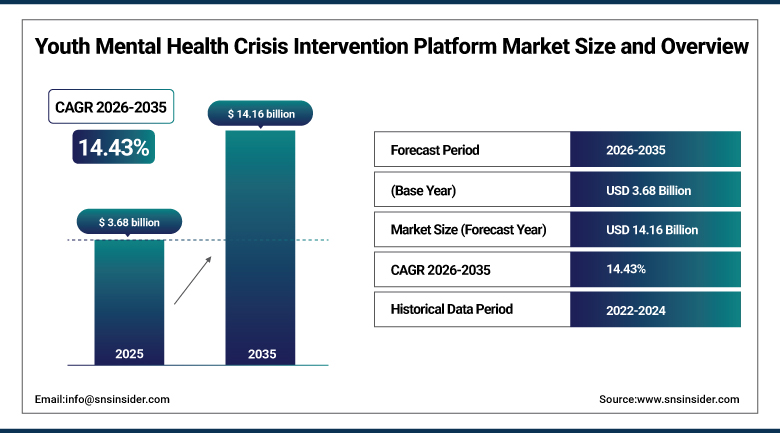
The Youth Mental Health Crisis Intervention Platform Market was valued at USD 3.68 Billion in 2025 and is projected to reach USD 14.16 Billion by 2035, expanding at a CAGR of 14.43% during the forecast period 2026–2035.
Youth mental health crisis intervention platform market around the world is witnessing significant expansion owing to rising incidences of anxiety, depression, suicidal tendencies, and behavioral disorders in children, adolescents, and young adults. Increasing adoption of AI-based crisis intervention platform, digital counseling service, remote behavioral monitoring, and real-time crisis communication platforms by various healthcare providers, education sector players, government, and non-government organizations to offer instant psychological intervention is driving market growth. Increasing investments in digital mental health infrastructure, growing smartphone penetration, expanding tele-mental health service delivery, and growing awareness regarding early mental health intervention are some of the factors boosting the market growth.
Various providers of digital mental health platforms have ramped up deployment of AI-based youth crisis intervention platforms, which have behavioral risk assessment in real time, text-based counseling, telepsychiatry services, and cloud-connected care coordination systems. Expansion in youth-centered digital mental health ecosystems by governments and healthcare and educational institutions is another factor.
To Get more information Youth Mental Health Crisis Intervention Platform Market - Request Free Sample Report
Youth Mental Health Crisis Intervention Platform Market Trends:
-
Increasing adoption of AI-powered crisis screening and behavioral risk assessment platforms.
-
Rising deployment of digital crisis chat and text counseling services for adolescents.
-
Growing commercialization of cloud-based youth mental health intervention ecosystems.
-
Expansion of virtual counseling and telepsychiatry services across educational institutions.
-
Increasing integration of predictive analytics for early identification of mental health crises.
U.S. Youth Mental Health Crisis Intervention Platform Market Size Outlook:
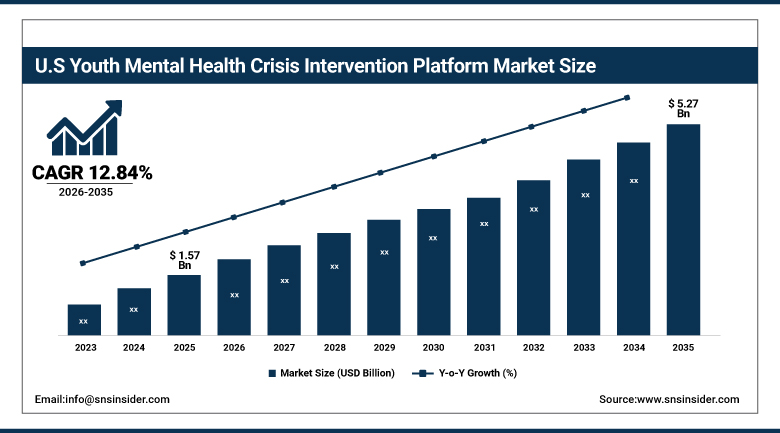
The U.S. Youth Mental Health Crisis Intervention Platform Market was valued at USD 1.57 billion in 2025 and is expected to reach approximately USD 5.27 billion by 2035, expanding at a CAGR of 12.84% during 2026–2035.
The US continues dominating the international market for the youth mental health crisis intervention platform market thanks to advanced behavioral healthcare delivery system, increased adoption of tele-mental health solutions, and rising government efforts to promote youth mental health services. Educational establishments, healthcare providers, public health authorities, and nonprofits have been increasingly using AI-integrated crisis intervention platforms, virtual counseling tools, behavioral monitoring, and cloud-based coordination care solutions for better detection of youth's mental health risks and faster provision of professional help. Digital therapeutics investments, nationwide expansion of 988 Suicide & Crisis Lifeline ecosystem, increased insurance coverage for virtual behavioral healthcare solutions, and effective cooperation between educational establishments and healthcare organizations support market growth.
Healthcare organizations and educational institutions in the U.S. have been deploying AI-assisted crisis triage solutions combined with real-time behavioral analytics, virtual counseling, and referral management systems to facilitate youth mental health crisis intervention and achieve positive behavioral outcomes.
Youth Mental Health Crisis Intervention Platform Market Segment Analysis:
-
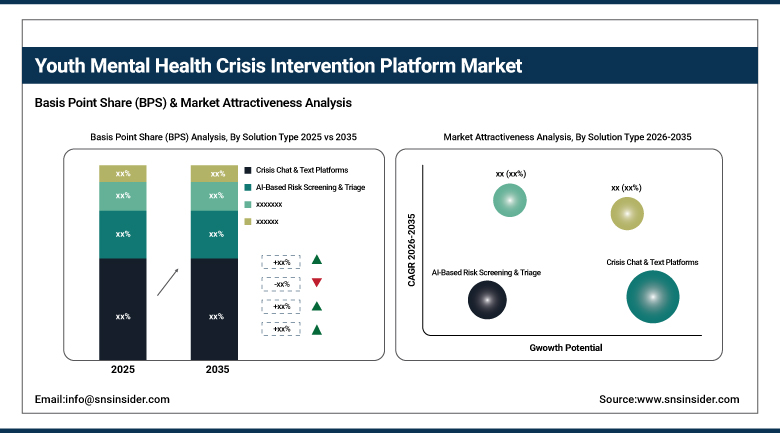
By Solution Type, crisis chat & text platforms dominated the market with 31.00% share in 2025, while virtual therapy & counseling platforms are projected to witness the fastest growth with a CAGR of 15.83% during the forecast period.
-
By Crisis Type, anxiety & depression crisis dominated the market with 35.00% share in 2025, while family, school & social crisis is projected to witness the fastest growth with a CAGR of 15.27% during the forecast period.
-
By End User, schools & universities dominated the market with 27.00% share in 2025, and are projected to witness the fastest growth with a CAGR of 15.64% during the forecast period.
By Solution Type, crisis chat & text platforms dominated, while virtual therapy & counseling platforms fastest-growing segment.
Crisis chat & text platforms dominated the global youth mental health support market with the highest revenue share of 31.00% in 2025 due to the rising preference among the young individuals for confidential, mobile-first, and immediate availability of mental health assistance services. The platforms offer 24X7 crisis chat services, anonymity of counseling, AI-driven conversation routing, multilingual services, and quick referral of high-risk cases to trained professionals. There are numerous adolescent mental health agencies that are expanding their AI-enabled crisis chat and text platforms including predictive behavioral analytics, multilingual services, and immediate escalation to clinicians for faster intervention.
The virtual therapy & counseling platforms segment is expected to exhibit a CAGR of 15.83% during 2026–2035 due to the increased tele-mental health infrastructure, growing adoption of virtual behavioral health services, and rising mental health professional shortages across the globe. Healthcare facilities are offering secure video consultations, AI-assisted therapy recommendation services, digital cognitive behavioral therapy services, and cloud-based patients’ management system for better treatment continuity. Virtual behavioral healthcare providers are continuously expanding their virtual counseling platforms including AI-driven clinical decision support, integration of scheduling systems, and telepsychiatry services.
By Crisis Type, anxiety & depression crisis dominated, while family, school & social crisis fastest-growing segment.
Anxiety & depression crisis segment accounted for the highest market share of 35.00% in 2025 owing to the rising prevalence of anxiety disorders, depression, emotions, and behavioral issues linked to stress in children, teens, and young adults. The growing levels of academic pressure, exposure to excessive amount of digital media, loneliness, bullying and other challenges faced by youth after the pandemic have created the need for early interventions and digital assessment platforms. Public health organizations have been continuously increasing their efforts to screen youth behavioral health and identify anxiety and depression using digital assessment platforms in the context of school mental health programs.
The family, school & social crisis segment is expected to witness the highest CAGR of 15.27% during the forecast period attributed to the increased understanding of environmental, educational and family influences on teen mental health. Digital intervention platforms increasingly focus on including the elements related to family engagement, school counseling, peer support and community referrals for crisis management. Educational organizations have been increasingly implementing digital behavioral health initiatives incorporating AI-driven wellness screening, counselor referral and family engagement platforms.
By End User, schools & universities dominated and are fastest-growing segment.
The Schools & Universities segment had the largest revenue market share of 27.00% in 2025 and is expected to witness the highest CAGR of 15.64%. Educational institutions are the first place where any kind of behavioral health issues can be identified early on and hence have easy access to counseling services, crisis management, and referrals. The Schools & Universities segment comprises institutions that implement behavioral screening software powered by AI, virtual counseling services, digital well-being apps, and cloud-based crisis management tools, which help to make sure that students have better well-being while simultaneously helping teachers, counselors, and healthcare professionals.
Mental health projects funded by government bodies and increasing awareness about early psychological intervention are driving growth in the Schools & Universities segment. Multiple education sectors implemented school-based digital mental health solutions comprising of AI-powered behavioral screening solutions, crisis management platforms, virtual counseling services, and proper referral process for youth mental healthcare.
Regional Analysis:
|
Region |
Major Country |
Share within Region, 2025 (%) |
|---|---|---|
|
North America |
United States |
93.00% |
|
Europe |
Germany |
27.00% |
|
Asia Pacific |
China |
18.00% |
|
Middle East & Africa |
UAE |
5.00% |
|
Latin America |
Brazil |
4.00% |
North America Youth Mental Health Crisis Intervention Platform Market Insights
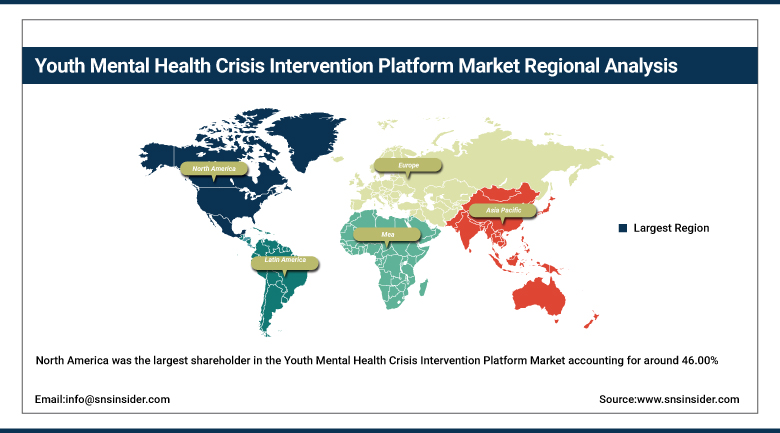
North America was the largest shareholder in the Global Youth Mental Health Crisis Intervention Platform Market accounting for around 46.00% of the overall market revenue in 2025. The region's market growth is bolstered by its advanced behavioral health infrastructure, wide use of telehealth, positive reimbursement environment, and various government initiatives in favor of youth mental health care. Many healthcare organizations, schools, public health departments, and nonprofits are utilizing artificial intelligence powered crisis intervention platforms, digital counseling solutions, behavioral analysis, and care coordination systems on the cloud to enhance early detection of psychological crises.
The further development of digital therapeutic solutions, behavioral health ecosystem, and national mental health awareness campaigns is anticipated to contribute to the ongoing growth of the market in the region. Cooperation between healthcare providers, schools, and technology companies increases commercialization possibilities in North America, which includes the U.S. and Canada. The U.S. healthcare organizations are constantly extending their use of AI-driven behavioral health platforms with virtual counseling and crisis chat services alongside with mental health analytics.
Get Customized Report as per Your Business Requirement - Enquiry Now
Europe Youth Mental Health Crisis Intervention Platform Market Insights
The European market investments in digital behavioral healthcare, development of telepsychiatry services, and the growing trend of government policies towards improving the mental well-being of adolescents. Countries such as Germany, the UK, France, Italy, Spain, and the Netherlands are focusing on enhancing school-based psychological counseling programs while developing more AI-based mental health solutions and virtual counseling solutions.
The integration of cloud-based interventions for mental crises, assessment of behavioral risks, and digital referral networks has become common practice in the region's healthcare systems. Awareness about youth suicide prevention, early behavioral intervention, and cross-disciplinary efforts between education and healthcare continue to fuel growth in the European market. There were several mental health campaigns for youths to provide them with digital counseling services, AI-based behavioral screenings, and integrated crisis intervention in schools.
Asia Pacific Youth Mental Health Crisis Intervention Platform Market Insights
The highest growth rate of CAGR at 19.17% is expected in Asia Pacific owing to growing mental health awareness, evolving digital health care technology, high penetration rates of smartphones, and increased funding from governments in behavioral health infrastructure development. Several countries such as China, Japan, India, Australia, Singapore, and South Korea have started using cloud-based mental health platforms, artificial intelligence-based behavioral analysis solutions, and virtual counseling services for adolescent and younger people.
Increasing engagement from digital health startups, development of school-based mental health programs, and greater availability of telepsychiatry services are contributing significantly towards creating business opportunities in this region. Increased health care expenditure and heightened awareness about early intervention in mental health conditions will help drive regional market growth. Various digital health organizations in Asia Pacific rolled out AI-based platforms for youth behavioral health management.
Middle East & Africa and Latin America Youth Mental Health Crisis Intervention Platform Market Insights
Middle East & Africa owing to growing investments by governments in digitalization of the healthcare sector, development of telemedicine technology, and increased awareness about teenage mental health in the UAE, Saudi Arabia, South Africa, and nearby regions. Healthcare institutions have started using AI-enabled behavioral assessment devices, online counseling services, and crisis communication technologies to provide better access to specialty care in order to reduce the treatment gaps for underprivileged youth population.
Latin America due to increased utilization of digital healthcare services, rising public spending on behavioral health care, and growing use of school-based psychological services in Brazil, Mexico, Argentina, and Chile. Healthcare institutions, non-profit organizations, and educational establishments are widely adopting cloud-based mental healthcare platforms, virtual counseling services, and AI-driven crisis management tools to improve the accessibility of behavioral healthcare services. Rising healthcare modernization and increasing awareness regarding mental healthcare intervention keep boosting the regional market growth. Governments and healthcare institutions across the Middle East, Africa, and Latin America expanded digital mental health initiatives incorporating telepsychiatry, AI-based crisis assessment, and virtual counseling services for teenagers.
Market Dynamics:
Growth Drivers: Rising need for artificial intelligence-driven digital crisis interventions in youth.
There has been an unprecedented increase in the occurrence of adolescent cases such as anxiety disorder, depression, suicidal thoughts, cyber bullying, drug use, and emotional suffering. There have been several reasons behind the growing demand for digital crisis interventions around the world. Several stakeholders in the healthcare sector including hospitals, schools, government agencies and non-government organizations are now quickly embracing digital crisis interventions.
Digital platforms such as real-time crisis chats, behavioral analysis, telepsychiatry integration, and risk stratifications are helping professionals in identifying potential high-risk patients more quickly and easily and giving them access to professional mental health care. With the increasing investments in behavioral health infrastructure in schools, growth of digital therapies, and increasing government interventions in youth mental health care, the market for digital crisis interventions is becoming stronger. In the United States, the Substance Abuse and Mental Health Services Administration (SAMHSA) kept developing behavioral crisis response programs.
Restraints: Data privacy issues, regulatory framework, and shortage of behavioral health specialists.
In spite of market growth, the potential for commercialization is limited due to data privacy issues in the healthcare industry, complex regulation, interoperability issues, and shortage of licensed mental health practitioners globally. Digital crisis intervention services handle very sensitive psychological, behavioral, and pediatric health-related data and, thus, should adhere to privacy laws within the healthcare sector and utilize a secure cloud platform.
Moreover, the implementation of AI-driven behavioral monitoring technologies in electronic health records systems poses difficulties for many healthcare facilities and educational organizations. Furthermore, the lack of reimbursement models in digital behavioral healthcare and disparate regulatory pathways in different countries prevent wide adoption of such technologies, especially in the underdeveloped health sectors with poorly developed infrastructure in the digital mental health industry. Regulatory bodies have continued to strengthen the framework in relation to artificial intelligence, cyber security, and digital health software applications.
Opportunities: Growth of digital mental health care ecosystems and behavioral analytics in schools.
There are significant opportunities available with respect to growth of AI-assisted school ecosystems for digital mental health care and behavioral analytics. Educational institutions are increasingly working alongside healthcare organizations, government entities, and technology firms to create comprehensive digital mental health systems that provide constant monitoring of behavior, psychological screening, counseling, and coordinated referrals. AI can be used to detect behavior patterns proactively, giving clinicians and counselors and opportunity to take preemptive measures before psychological conditions turn into full-blown crises.
With continued investments into digital learning technologies, increased accessibility of smartphones, greater use of telemedicine, and more use of personalized digital medicine, it is likely there will be many long-term opportunities for technology vendors providing solutions for youth behavioral health around the world. Multiple educational systems have already introduced AI-assisted platforms for students’ wellbeing incorporating predictive behavioral analytics, digital counseling, automated crisis management, and coordinated referral systems.
Recent Developments:
-
2026: Headspace Health expanded its AI-powered behavioral healthcare platform by introducing enhanced youth mental wellness programs, virtual counseling capabilities, and personalized crisis support tools for adolescents and educational institutions.
-
2026: Talkspace, Inc. strengthened its digital mental healthcare services through expanded partnerships with healthcare organizations and educational institutions to improve virtual therapy access and youth behavioral health support.
-
2025: Brightline expanded pediatric digital behavioral health services by enhancing virtual therapy programs, caregiver support resources, and coordinated behavioral healthcare delivery for children and adolescents.
-
2025: Bend Health introduced AI-supported pediatric behavioral health programs integrating family engagement, virtual therapy, remote monitoring, and personalized mental wellness pathways for children and teenagers.
Youth Mental Health Crisis Intervention Platform Market Key Players are:
-
Headspace Health
-
Talkspace, Inc.
-
Brightline
-
Bend Health
-
Teladoc Health, Inc.
-
Amwell
-
NeuroFlow, Inc.
-
Lyra Health, Inc.
-
Spring Health
-
Calm Health
-
BetterHelp
-
Woebot Health
-
Koko
-
Cognoa, Inc.
-
Kooth Digital Health
-
BeMe Health
-
Child Mind Institute
-
Vita Health
-
Cerebral Inc.
-
DarioHealth Corp.
Youth Mental Health Crisis Intervention Platform Market Report Scope:
| Report Attributes | Details |
|---|---|
| Market Size in 2025 | USD 3.68 Billion |
| Market Size by 2035 | USD 14.16 Billion |
| CAGR | CAGR of 14.43% From 2026 to 2035 |
| Base Year | 2025 |
| Forecast Period | 2026-2035 |
| Historical Data | 2022-2024 |
| Report Scope & Coverage | Market Size, Segments Analysis, Competitive Landscape, Regional Analysis, DROC & SWOT Analysis, Forecast Outlook |
| Key Segments | • By Solution Type (Crisis Chat & Text Platforms, Virtual Therapy & Counseling Platforms, AI-Based Risk Screening & Triage, Peer Support & Community Platforms, Others) • By Crisis Type (Anxiety & Depression Crisis, Self-Harm & Suicide Risk, Substance Use & Behavioral Crisis, Family, School & Social Crisis, Others) • By End User (Schools & Universities, Healthcare Providers, Government & Public Health Agencies, Parents & Families, Nonprofits & Community Organizations, Others) |
| Regional Analysis/Coverage | North America (US, Canada), Europe (Germany, UK, France, Italy, Spain, Russia, Poland, Rest of Europe), Asia Pacific (China, India, Japan, South Korea, Australia, ASEAN Countries, Rest of Asia Pacific), Middle East & Africa (UAE, Saudi Arabia, Qatar, South Africa, Rest of Middle East & Africa), Latin America (Brazil, Argentina, Mexico, Colombia, Rest of Latin America). |
| Company Profiles | Headspace Health, Talkspace, Inc., Brightline, Bend Health, Teladoc Health, Inc., Amwell, NeuroFlow, Inc., Lyra Health, Inc., Spring Health, Calm Health, BetterHelp, Woebot Health, Koko, Cognoa, Inc., Kooth Digital Health, BeMe Health, Child Mind Institute, Vita Health, Cerebral Inc., DarioHealth Corp. |

Frequently Asked Questions
Crisis Chat & Text Platforms dominated the market, accounting for 31.00% of total revenue in 2025.
The market is expected to expand at a CAGR of 14.43% during the forecast period.
North America dominated the global market in 2025, accounting for 46.00% of total revenue.
The market is projected to reach USD 14.16 Billion by 2035.
The Youth Mental Health Crisis Intervention Platform Market was valued at USD 3.68 Billion in 2025.
