
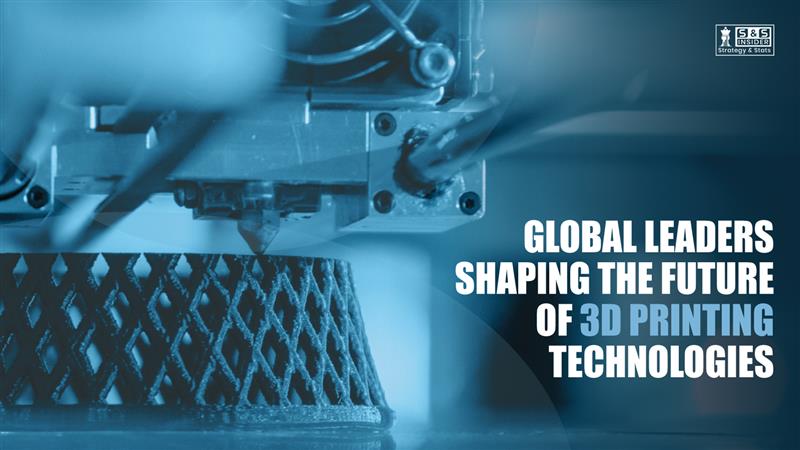
The global 3D printing (additive manufacturing) industry continues to evolve rapidly, transitioning from prototyping-focused use cases to full-scale industrial production across healthcare, aerospace, automotive, electronics, and consumer goods. As discussed in our previous blogs on advanced manufacturing and digital fabrication trends, the growth of additive manufacturing is being fueled by improvements in material science, software integration, automation, and scalable production systems.
Leading 3D printing providers are no longer differentiated solely by printer hardware. Instead, competitive advantage increasingly lies in end-to-end ecosystems, combining machines, materials, software, and industry-specific solutions. Below is an overview of key global 3D printing providers that are shaping the future of additive manufacturing through innovation, performance, and application diversity.
-
Stratasys Ltd.
Stratasys remains one of the most established names in polymer-based 3D printing, with strong adoption across industrial manufacturing, healthcare, and education. The company has consistently focused on precision, material diversity, and real-world part simulation.
Its F370 CR platform supports continuous manufacturing environments, offering reliability and repeatability for production-grade applications. Meanwhile, the J750 Digital Anatomy system represents a major leap in medical 3D printing, enabling highly realistic anatomical models with accurate tissue behavior. This capability has strengthened Stratasys’ position in surgical planning, medical training, and device testing.
-
3D Systems Corporation
3D Systems is recognized for its broad additive manufacturing portfolio spanning polymers, metals, and healthcare-focused solutions. The company has played a key role in advancing stereolithography and high-speed production platforms.
The ProX 800 is widely used for large, high-detail parts requiring excellent surface quality, particularly in aerospace and automotive prototyping. The Figure 4 Standalone platform supports fast, scalable production and is increasingly used for jigs, fixtures, and functional components. 3D Systems’ ability to bridge prototyping and production aligns with the industry-wide shift toward additive manufacturing at scale.
-
Materialise NV
Unlike many hardware-focused providers, Materialise has built its leadership on software-driven additive manufacturing workflows. As highlighted in earlier blogs, software interoperability and data optimization are critical to improving efficiency and reducing production errors.
The Mimics Innovation Suite is widely adopted in healthcare for converting medical imaging data into precise 3D models, supporting patient-specific solutions. Magics, on the other hand, is a core tool in industrial AM environments, enabling build preparation, error correction, and workflow optimization. Materialise’s software-first approach positions it as a strategic enabler across the additive manufacturing value chain.
-
GE Additive
GE Additive has brought industrial-scale credibility to metal additive manufacturing, particularly for aerospace, energy, and defense applications. The company’s solutions are designed for high-performance environments where quality and repeatability are critical.
The Concept Laser M2 Series 5 supports serial production of complex metal components, while GE’s Binder Jet Line addresses the growing need for cost-effective, high-volume 3D printing metal part production. GE Additive’s strength lies in combining machine innovation with deep material science and industrial process expertise.
-
HP Inc.
HP has emerged as a disruptive force in additive manufacturing by focusing on speed, scalability, and production economics. As discussed in previous manufacturing technology blogs, throughput and cost efficiency are becoming decisive factors for adoption.
The Jet Fusion 5200 Series has become a benchmark for polymer production printing, offering consistent part quality and mechanical strength. HP’s Metal Jet S100 targets high-volume metal production, especially in automotive and industrial sectors. HP’s approach reflects the broader trend toward additive manufacturing as a true alternative to traditional mass production.
-
SLM Solutions Group AG
SLM Solutions specializes in metal powder bed fusion systems designed for precision and high throughput. Its technology is widely adopted in aerospace, medical implants, and high-performance engineering.
The SLM® 280 2.0 provides flexibility for multi-material production, while the NXG XII 600, with its multi-laser architecture, is engineered for industrial-scale manufacturing. SLM Solutions’ focus on productivity and build consistency aligns with growing demand for metal AM in critical applications.
-
EOS GmbH
EOS is one of the pioneers of industrial additive manufacturing and continues to be a trusted provider for both polymer and metal systems. The company emphasizes process stability, material qualification, and production scalability.
The EOS M 300-4 enables high-speed metal part production with multiple lasers, while the EOS P 500 supports large-batch polymer manufacturing. EOS systems are widely used where reliability, repeatability, and certification readiness are essential.
-
Voxeljet AG
Voxeljet is known for its expertise in large-format binder jetting, particularly for tooling, sand molds, and architectural components. Its solutions address applications where size and speed are critical.
The VX1000 and VJET X systems enable efficient production of complex, large-scale parts, supporting automotive casting, industrial tooling, and foundry operations. Voxeljet’s technology expands additive manufacturing beyond small- and mid-sized components.
-
Renishaw plc
Renishaw has built a strong reputation in precision engineering and metal additive manufacturing. Its systems are designed for controlled, high-accuracy environments.
The RenAM 500Q enhances throughput through quad-laser architecture, while the AM250 remains a reliable platform for specialized metal applications. Renishaw’s integration of metrology and process control strengthens quality assurance in additive manufacturing workflows.
-
Desktop Metal
Desktop Metal has accelerated the adoption of metal additive manufacturing by focusing on speed, accessibility, and production-scale solutions.
The Production System™ P-50 leverages binder jetting for mass production of metal parts, while the Fiber™ system enables high-strength composite components through continuous fiber reinforcement. Desktop Metal’s portfolio reflects the growing convergence of additive manufacturing and traditional manufacturing economics.
Conclusion:
As highlighted across our previous blogs, the global 3D printing landscape is increasingly defined by industrial scalability, digital integration, and application-specific solutions rather than standalone hardware innovation. Leading providers are investing heavily in automation, 3D printing materials development, and software ecosystems to support long-term adoption.
With industries seeking lightweight structures, complex geometries, faster production cycles, and localized manufacturing, 3D printing providers will continue to play a pivotal role in reshaping global manufacturing value chains.


