
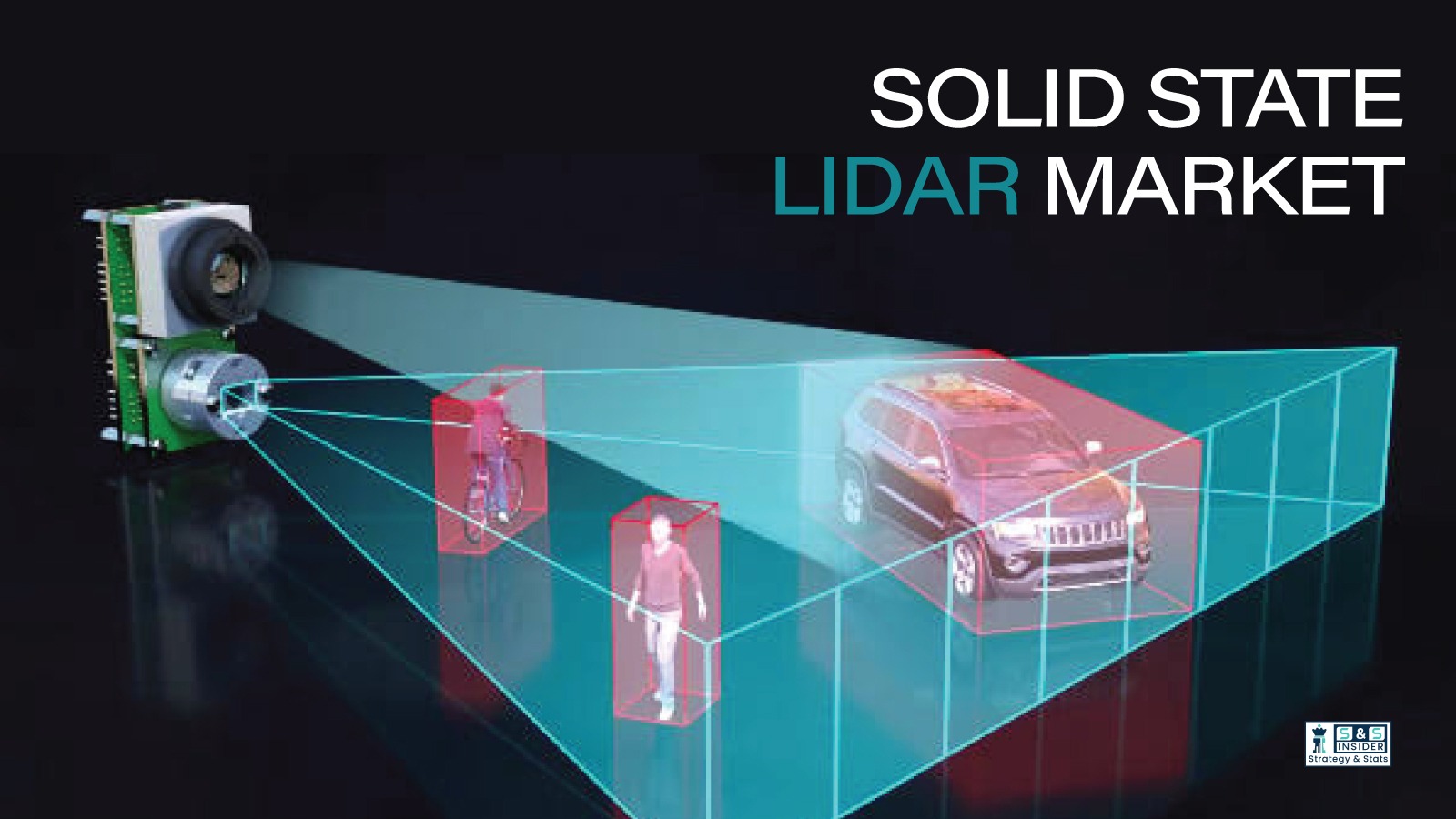
There have been many rapid advancements made in solid-state LiDAR technology that will enable next-generation sensing systems with compactness, high performance, and cost-effectiveness in 3D environment mapping for applications, such as autonomous vehicles, robots, industrial automation, and smart infrastructures. Unlike conventional LiDAR systems, solid-state LiDAR devices get rid of any moving components, making them reliable, less complex, and easy to integrate into advanced driver assistance systems (ADAS), autonomous mobility, drones, and intelligent transportation systems. Continuous advancements in silicon photonic, MEMS, flash LiDAR, and 4D sensing will improve sensing accuracy, distance, scalability, and perception capability.
According to Global Solid State LiDAR Market Analysis Report, the market size of Solid State LiDAR market was valued at USD 2.18 Billion in 2025 and is expected to grow to USD 13.69 Billion by 2035 with a Compound Annual Growth Rate CAGR of 20.17% in the period between 2026 and 2035. Some of the factors that will fuel market growth include increased use of autonomous vehicles, the rise in the adoption of ADAS technologies, increasing robotic applications, and investments in smart mobility infrastructures.
Key Players:
The leading firms present in the Solid-State LiDAR Market include Hesai Group, RoboSense, Luminar Technologies, Innoviz Technologies, Ouster Inc., Cepton Technologies, Aeva Technologies, Quanergy Systems, LeddarTech, SICK AG, Valeo, AEye Inc., Huawei Technologies, Seyond, Neuvition Inc., Scantinel Photonics, Opsys Technologies, Baraja, LuminWave, and Innovusion.
Strategic Developments & Industry Innovations:
In January 2026, Seyond introduced its Hummingbird solid-state LiDAR series, highlighting fully digital scanning architecture, compact system design, and automotive-grade mass-production readiness for robotics and autonomous mobility applications.
In April 2026, Voyant Photonics accelerated commercialization of silicon photonics-based chip-scale 4D FMCW LiDAR solutions designed for scalable deployment across robotics, industrial automation, and autonomous systems.
In February 2026, MicroVision launched an affordable solid-state LiDAR platform targeting sub-USD 200 pricing for mainstream ADAS integration, significantly improving accessibility for next-generation intelligent transportation systems.
The Following Are the Leading Companies in the Global Solid-State LiDAR Industry:
1. Hesai Group: Scaling High-Performance LiDAR Manufacturing for Autonomous Mobility
 Hesai Technology is an emerging player in the development of superior solid-state LiDAR systems that can be utilized in autonomous driving, robotics, smart mobility, and automation. The product line of the firm includes LiDAR solutions, 4D sensors, chip-scale perception modules, as well as ADAS solutions to help in making long-range and precision environmental mapping. These technologies can be employed to achieve autonomous driving, robotaxis, logistics automation, and intelligent transport systems. Notably, the firm has shipped over 1.6 million units of LiDARs in 2025 and scaled up its manufacturing capacity for wide market penetration.
2. Luminar Technologies: Advancing Long-Range LiDAR for Autonomous Driving Systems
 Luminar Technologies has expertise in manufacturing state-of-the-art long-range LiDAR and perception technologies that can be applied in autonomous vehicles and future generation ADAS technology. This firm's product offerings include high resolution LiDAR sensors, artificial intelligence-based perception technologies, automotive safety system solutions, and highway autonomy technologies which target premium automakers. Luminar Technologies has also collaborated with some leading global automakers in order to improve safety, navigation and obstacle detection capabilities of their vehicles. The recent developments at Luminar Technologies include their restructuring plan where they have offered full support to current LiDAR installations.
3. RoboSense: Driving Smart Mobility Through Intelligent LiDAR Solutions
 RoboSense is among the key players in the provision of MEMS Solid-state LiDAR technology to the market, catering to sectors such as autonomous vehicles, robotics, industrial automation, and smart infrastructure. RoboSense product line includes automotive LiDAR sensors, high-definition 3D sensing systems, intelligent perception software, and robotic navigation systems that are tailored for highly accurate environment mapping. Scalability of digital LiDAR systems and AI-integrated sensing systems are the two critical areas of concentration for RoboSense. In recent times, RoboSense has forecasted its first quarter earnings due to an increase in deployment of robotic LiDAR systems.
Future Outlook of the Solid-State LiDAR Market:
Growth of Solid-State LiDAR Market will be witnessed due to increased use of autonomous cars, robotics, industry automation, and smart transportation. Innovation in silicon photonics, MEMS technologies, flash LiDAR, AI perception, and sensor-on-a-chip is enhancing precision, scalability, and cost-effectiveness of LiDAR systems. Companies such as Hesai Group, Luminar Technologies, and RoboSense are contributing to innovations in high-resolution 3D sensing, automotive LiDAR technology, scalable production, and AI perception solutions.
As more companies will invest in autonomous mobility, robotic AI technologies, industry digitization, and smart cities, the solid-state LiDAR technologies are anticipated to provide essential components of smarter and safer intelligent systems of the future.



