India's vision for semiconductors is now taking shape beyond semiconductor fabrication toward the creation of a sustainable manufacturing ecosystem. A semiconductor fabrication plant requires a robust support system in terms of material, chemicals, gases, machines, and other advanced engineering solutions. The recent association between Tata Electronics and Sumitomo Chemical reflects India's increasing efforts in this direction.
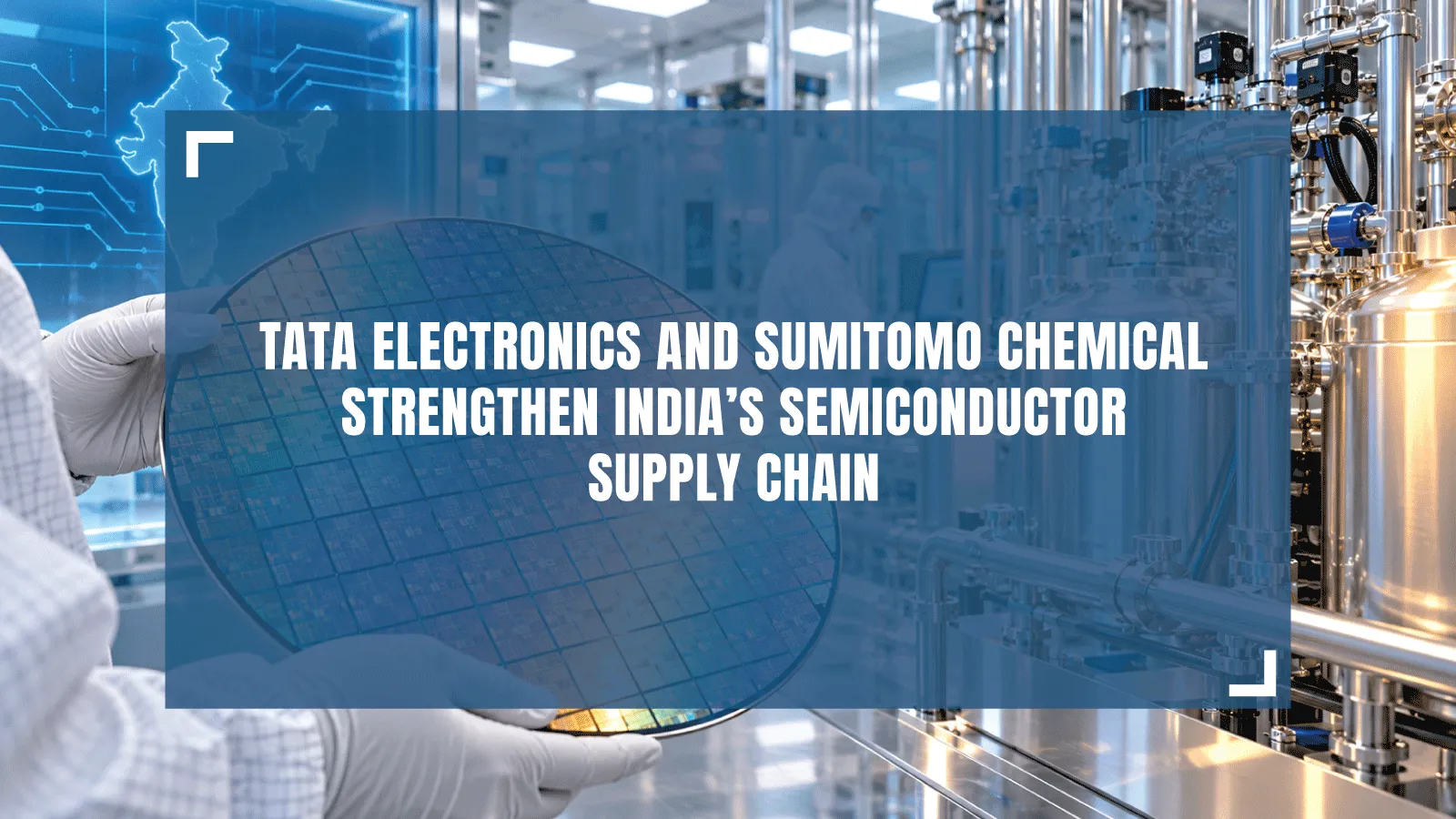
On September 18, 2026, Tata Electronics and Sumitomo Chemical entered into a Memorandum of Understanding on exploring possible collaborations in semiconductor materials for its future fabrication plant in Dholera, Gujarat. They will be looking at possibilities in the manufacturing of semiconductor materials and ultra-pure chemicals in India.
It is an important move by India in its quest to develop semiconductor capabilities domestically with international cooperation in the chip supply chain.
Semiconductor Manufacturing Requires More Than Advanced Fabrication Equipment
Establishing an ecosystem for the manufacture of semiconductors goes beyond building a fabrication facility and procuring production machinery. There are several specialized materials used in the manufacture of chips, which have to be very pure and functional in order to produce the chips successfully. The materials include photoresists, functional chemicals, and process chemicals, all of which are very crucial in semiconductor fabrication processes.
Thus, the issue of availability of dependable materials is strategic to semiconductor fabricators. The MoU signed between Tata Electronics and Sumitomo Chemical takes care of this vital part of the supply chain. As per the agreement, the companies will examine the supply of semiconductor materials to the upcoming Dholera fab of Tata Electronics, including photoresists, functional chemicals, and process chemicals, such as hydrogen peroxide, isopropyl alcohol, ammonia water, and sulfuric acid.
Local Semiconductor Materials Could Reduce Supply Chain Vulnerabilities
The semiconductor industry globally has shown how disturbances in one particular aspect of the supply chain have had a ripple effect on manufacturing in other parts of the world and other industries as well. For countries looking to develop indigenous semiconductor manufacturing equipment capacity, then, it becomes important for them to focus on developing a resilient supply chain.
The alliance between Tata Electronics and Sumitomo Chemical will be beneficial in this regard as it will consider the feasibility of having the capability to produce semiconductors and high-purity chemicals in India. As per the statements made by Sumitomo Chemical, the partnership will look into various ways of creating a stable supply chain of semiconductor materials, which includes the setting up of a semiconductor chemicals plant in India.
Dholera Fab Is Becoming a Foundation for India’s Chip Manufacturing Ambitions
The collaboration is closely connected to Tata Electronics' semiconductor fabrication project in Dholera, Gujarat.
Tata Electronics is working on its first ever commercial 12 inch or 300-millimeter semiconductor wafer fabrication unit in the Dholera region. The company has planned an investment of about 11 billion dollars in the project that will be used to manufacture chips for various purposes like automotive technology, mobile and artificial intelligence.
Large scale fab facilities require an efficient supplier chain of companies. It is essential for the collaboration with Sumitomo Chemical not just for particular materials but also for the creation of industrial infrastructure around the fab. Such developments will assist in making India progress towards integration in the semiconductor manufacturing industry.
Japan’s Semiconductor Expertise Can Complement India’s Manufacturing Expansion
The partnership also reflects the growing role of Japan in India's semiconductor development.
Japanese technology firms have had a strong track record for many years within multiple components of the semiconductor supply chain including materials, chemicals, equipment, precision technologies, and process technologies. The burgeoning semiconductor industry in India provides an avenue to leverage this existing technological prowess along with the developing manufacturing capability of the country. Sumitomo Chemicals has a great track record in providing semiconductor materials across the globe.
The partnership of India with the existing international suppliers will help the country leverage its capabilities much faster than would otherwise be possible without any partnership. On the other hand, the semiconductor development in India provides Japanese companies with access to a market which is building up capabilities in fabrication, assembly, testing, packaging, and material aspects.
High-Purity Chemicals Are Critical to Semiconductor Quality
The significance of purity of chemicals is often ignored when there is much talk about semiconductors centered around processors and manufacturing equipment. However, semiconductor manufacturing is associated with highly specialized processes where the purity of materials is very important. Chemicals are employed in various stages of fabrication, cleaning, processing and manufacturing in general.
Thus, the need for purity is vital for process control and quality of manufacturing. The partnership between Tata Electronics and Sumitomo Chemical Company is thus quite important as it satisfies this crucial need. The supply of high-quality chemicals will help to meet the needs of semiconductor manufacturing and may open up possibilities for local manufacturing.
This could also encourage the development of additional suppliers and specialized chemical capabilities within India.
India’s Semiconductor Ecosystem Is Expanding Across Multiple Supply Chain Layers
Sumitomo Chemicals' deal is part of Tata Electronics’ larger strategy of building the ecosystem needed to foster semiconductor manufacturing.
During SEMICON India 2026, Tata Electronics unveiled several deals covering materials, infrastructure, packaging, logistics, and engineering, which include deals around high purity gases, gas distribution, semiconductor packaging, and logistics.
Such a trend is significant since a competitive semiconductor industry cannot be solely reliant on one fabrication plant. An interlinked ecosystem of firms, which would be able to provide all necessary inputs and services across the entire semiconductor industry value chain, is needed.
This trend may eventually lead to more opportunities for local players while bringing even more foreign suppliers into the Indian market.
Supply Chain Diversification Is Becoming a Global Semiconductor Priority
The global semiconductor chain structure is being revamped to include factors, such as resilience and diversification across geography. Efforts are being made by companies and government alike to decrease the over-reliance on manufacturing abilities located in a few places. This has meant that there is greater emphasis on regional semiconductor ecosystems which can support production activities in multiple levels.
Through domestic manufacturing efforts coupled with international technological and logistics linkages, India is trying to become an important part of the global semiconductor industry. This is illustrated by the Tata Electronics-Sumitomo Chemical alliance, which shows how the strategy goes beyond mere chip manufacturing. Materials are as crucial to developing a sustainable manufacturing ecosystem as the technology that lies at the heart of the manufacturing process.
The Semiconductor Opportunity is Expanding from Chips to the Entire Ecosystem
This agreement between Tata Electronics and Sumitomo Chemical brings into light an underlying fact about semiconductors: successful chip manufacture is possible only with the presence of a large range of technology and supplier networks.
As Tata Electronics advances towards setting up their Dholera fab and establishes ties within the semiconductor supply chain, the dreams of India are becoming increasingly inclined toward developing an entire network of manufacture and not just individual chip manufacturing centers.
The collaboration between Tata Electronics and Sumitomo Chemical is one such instance. The collaboration could help India in developing a more robust and diverse semiconductor ecosystem through greater access to semiconductor raw materials.